
Registered RBT is an informal search phrase for a person who holds the Registered Behavior Technician credential. The official credential name is Registered Behavior Technician, or RBT. An RBT is a paraprofessional in behavior analysis who assists with behavior-analytic services under the direction and close supervision of an RBT Supervisor and/or RBT Requirements Coordinator.
Table of Contents
- What registered RBT means
- The RBT role is supervised
- How a person becomes an RBT
- Registered RBT and the examination
- A registered RBT workplace scenario
- Ethical identity and public descriptions
- Documentation and maintenance after certification
- Common misunderstandings about a registered RBT
- Registered RBT study checklist
- Frequently Asked Questions
- References
Quick answer: Treat registered rbt as a current-source RBT study topic. Identify the actor and decision owner, follow the written procedure, record observable facts, and keep the supervision boundary visible.
Study boundary: This independent guide is educational content. It is not a BACB policy, certification decision, legal opinion, answer key, or guarantee of examination success. Examples are original and are not official, recalled, leaked, or BACB-endorsed questions.
Current exam context: The current BACB RBT Test Content Outline describes 43 tasks across six domains; the examination includes 75 scored questions and 10 unscored pilot questions in a 90-minute testing period. Verify the current handbook and outline before relying on a time-sensitive detail.
What registered RBT means
The word registered can make the credential sound like a general professional registration or state license. In the BACB context, the relevant credential is RBT certification. A candidate should verify the exact title, issuing organization, jurisdiction, and current requirements before describing the credential to an employer or family.
The credential answers one question: whether the person met the applicable BACB certification requirements. It does not answer every workplace question. An employer may have additional training or documentation rules, and state or local laws may impose separate requirements. Keep certification status, employer status, and licensure status distinct.
The RBT role is supervised
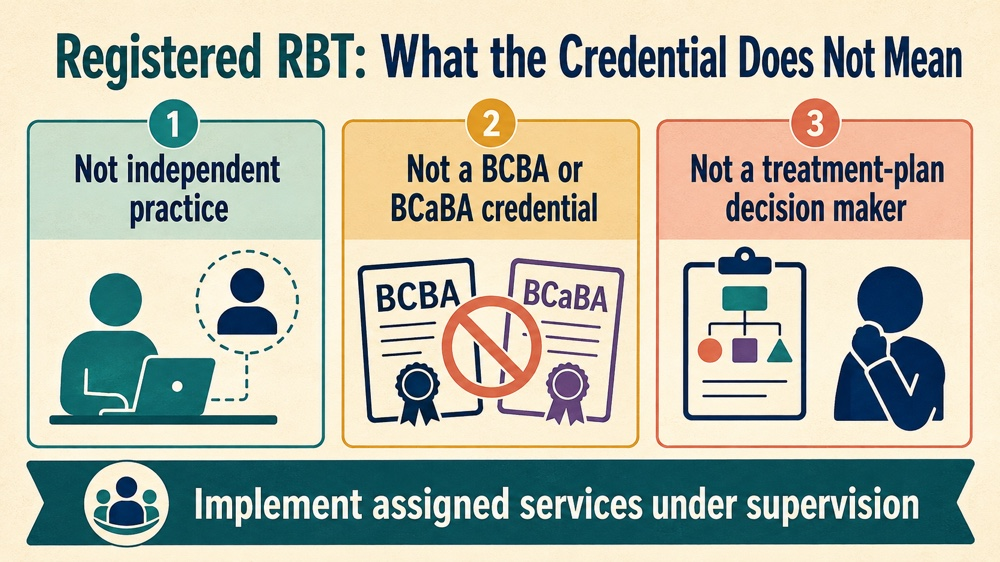
An RBT implements assigned behavior-analytic services within demonstrated competence. The RBT may collect data, teach skills, implement behavior-reduction procedures, document sessions, and communicate with the supervising team. The RBT does not independently diagnose, design a treatment plan, conduct an assessment as the decision owner, or change clinical goals because a situation is inconvenient.
Supervision is active professional support, not only a signature. It provides observation, feedback, training, and a route for questions. A registered RBT should know who is responsible for direction, how to report a safety concern, where records are kept, and what to do when the written plan is unclear or exceeds current skill.
How a person becomes an RBT
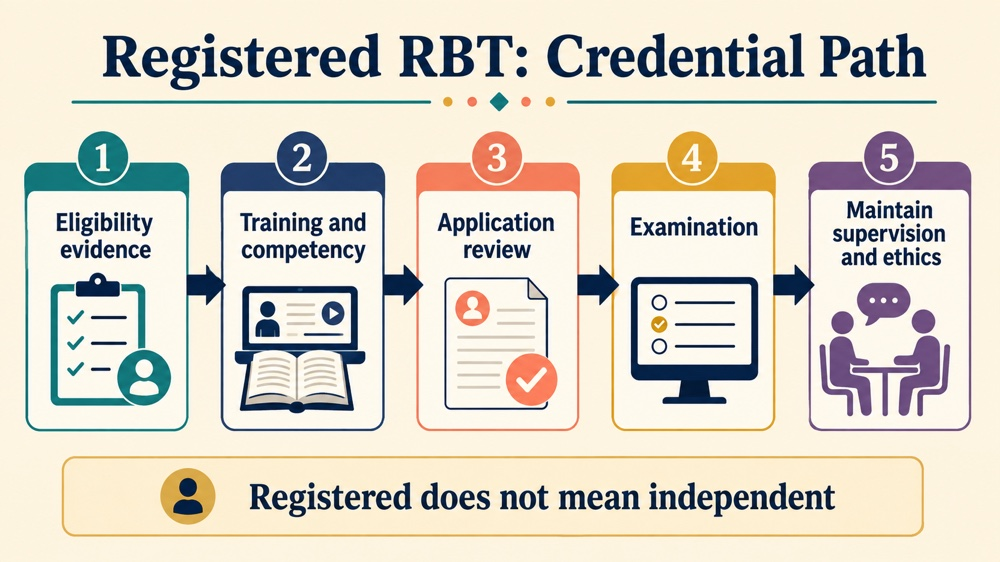
The certification pathway includes eligibility evidence, required training, an initial competency assessment, an application, examination authorization, and the examination, followed by ongoing maintenance requirements. The current handbook controls the exact requirements and transition provisions. A course advertisement or an old checklist cannot replace the official source.
- Review the current RBT Handbook and confirm the applicable pathway.
- Complete the required education, checks, training, and competency steps.
- Prepare accurate records and submit the application through the portal.
- Respond to action items and schedule the examination only when authorized.
- After certification, maintain supervision, ethical conduct, documentation, and current requirements.
Registered RBT and the examination
The current RBT examination is organized around six domains: Data Collection and Graphing, Behavior Assessment, Behavior Acquisition, Behavior Reduction, Documentation and Reporting, and Ethics. Use these domains to study the actions of an entry-level technician. For example, a data question asks what to record; an ethics question may ask whether the RBT should protect privacy or seek supervision.
The current outline describes 43 tasks, and the examination includes 75 scored questions plus 10 unscored pilot questions in a 90-minute testing period. Practice with original scenarios and explanations. Do not treat a commercial study product, a remembered question, or a social post as official exam material.
A registered RBT workplace scenario
A family asks a registered RBT to change the goal because the learner appears tired. The RBT can listen respectfully, document the concern, and communicate it to the supervising team. The RBT should not rewrite the goal, remove a programmed demand, or promise a new treatment plan without direction. The response protects the family relationship while preserving clinical responsibility.
If the RBT notices a repeated barrier, bring examples rather than a judgment. State the instruction, response, materials, prompt, consequence, and relevant context. A supervisor can then evaluate whether the procedure, schedule, or environment needs a change. The RBT’s observation is valuable precisely because it is accurate and role-appropriate.
Ethical identity and public descriptions
A registered RBT should describe the credential accurately in profiles, emails, conversations, and marketing. Do not imply that the RBT is a BCBA, an independent analyst, or a BACB-endorsed representative of a training site. Do not promise a learner’s outcome or disclose client details to make a professional story sound impressive.
Credential accuracy also includes knowing when status changes. A pending application is not an active certification, and an expired or lapsed credential should not be presented as current. When in doubt, check the official registry or applicable portal instructions and ask the responsible organization how the status should be described.
Documentation and maintenance after certification
Passing the examination does not end professional responsibility. Maintain required supervision, complete documentation, protect account and client information, and monitor current BACB notices. Keep evidence of required activities according to the applicable retention rules. If a record is incomplete, report the gap and correct it through the approved process rather than inventing a signature or date.
Maintenance questions often look ordinary: a supervision record is missing, a legal name changes, a public profile is outdated, or a session note contains an error. The ethical response is to identify the accurate current status, notify the appropriate person, correct the record honestly, and keep evidence of the follow-up.
Common misunderstandings about a registered RBT
- Thinking ‘registered’ means the RBT can practice independently.
- Confusing an RBT certification with a BCBA, BCaBA, state license, or training certificate.
- Assuming one supervisor, employer, or course provider speaks for the BACB.
- Treating supervision as optional after passing the examination.
- Using the credential to make promises about clinical outcomes.
- Changing a plan or assessment because a family request sounds reasonable.
- Relying on an undated summary when the official handbook has changed.
Registered RBT study checklist
- Can I state the official credential name and its paraprofessional scope?
- Can I explain the difference between certification, employment, supervision, and licensure?
- Can I outline the current application and examination pathway without promising an outcome?
- Can I connect the six domains to observable technician actions?
- Can I identify when a question belongs to the supervisor or certification board?
- Can I describe a credential accurately and protect confidential information?
- Can I repair a documentation problem honestly and promptly?
The word registered should never be used as a shortcut for authority. A strong answer shows what the RBT can do, what evidence supports the action, and when the responsible supervising team must decide.
Make one final two-column note. In the first column, write actions an RBT may perform when trained and assigned: implement the plan, collect the specified data, document the session, and communicate concerns. In the second, write decisions that require the responsible professional: select goals, interpret assessment results, change a treatment procedure, determine a new mastery criterion, or make a certification decision. Add the source or supervisor who controls each decision. This note is useful because many questions contain a helpful-sounding option that quietly crosses the boundary.
Then rehearse a maintenance scenario rather than stopping at the examination. Ask what happens if the credential description is inaccurate, a supervision record is incomplete, or a portal notice is missed. The answer should begin with checking the current requirement, notifying the appropriate person, correcting the record honestly, and keeping evidence of the follow-up. A registered RBT protects the credential by making the status accurate, not by using a stronger title. Keep this review separate from clinical notes and never include client-identifying information in a public study file.
Practice the concept
Review registered rbt with original RBT scenarios, current-source reminders, and clear role boundaries.
Try the RBT practice resource →
Frequently Asked Questions
What is a registered RBT?
It is an informal phrase usually referring to a person who holds the BACB’s Registered Behavior Technician certification. Candidates should use the official credential name in formal records.
Can an RBT work independently?
No. An RBT assists with behavior-analytic services under required direction and close supervision and within demonstrated competence.
Is a training certificate the same as RBT certification?
No. Training is one part of the pathway. Certification depends on meeting all applicable requirements and completing the examination process.
Are these official BACB materials?
No. This is independent study content, not a BACB certification program or BACB-endorsed provider.
References
- Behavior Analyst Certification Board: Registered Behavior Technician Handbook, updated June 2026.
- Behavior Analyst Certification Board: RBT Test Content Outline (3rd ed.).
- Behavior Analyst Certification Board: RBT resources.
- Behavior Analyst Certification Board: ethics resources.
- Behavior Analyst Certification Board: RBT Ethics Code (2.0).