
The search phrase RBT certification test questions needs a careful boundary: independent practice questions are not official BACB questions, recalled items, leaked content, or a certification decision. The most useful practice asks what an entry-level RBT should observe, implement, record, and report under a stated plan. This guide explains how to use original scenarios without confusing practice with the examination or certification process.
Table of Contents
- Separate practice from certification
- What a strong original question includes
- Practice data collection and graphing
- Practice acquisition and reduction
- Practice documentation and ethics
- Review the answer, not just the score
- Current exam context
- Mistakes to avoid with test-question searches
- RBT certification test questions checklist
- Frequently Asked Questions
- References
Then reinforce the concepts with free RBT mock exams and review the explanations.
Continue your RBT study with RBT exam study materials and original practice resources.
Quick answer: Treat rbt certification test questions as a current-source RBT study topic. Define the concept, connect it to an observable action, use original examples, and keep the supervision boundary visible.
Study boundary: This independent guide is educational content. It is not a BACB policy, certification decision, legal opinion, answer key, or guarantee of examination success. Examples are original and are not official, recalled, leaked, or BACB-endorsed questions.
Current exam context: The current BACB RBT Test Content Outline describes 43 tasks across six domains; the examination includes 75 scored questions and 10 unscored pilot questions in a 90-minute testing period. Verify the current handbook and outline before relying on a time-sensitive detail.
Separate practice from certification
A practice question is a learning prompt. The examination is the current BACB testing process, and certification depends on the applicable pathway and decisions. A percentage on a third-party quiz cannot prove eligibility, examination authorization, or certification. Put those three labels at the top of your notes so a score does not acquire administrative meaning by accident.
Use the current BACB Handbook and RBT Test Content Outline for official requirements and examination context. Use independent questions to rehearse reasoning, not to search for protected content or a shortcut.
What a strong original question includes
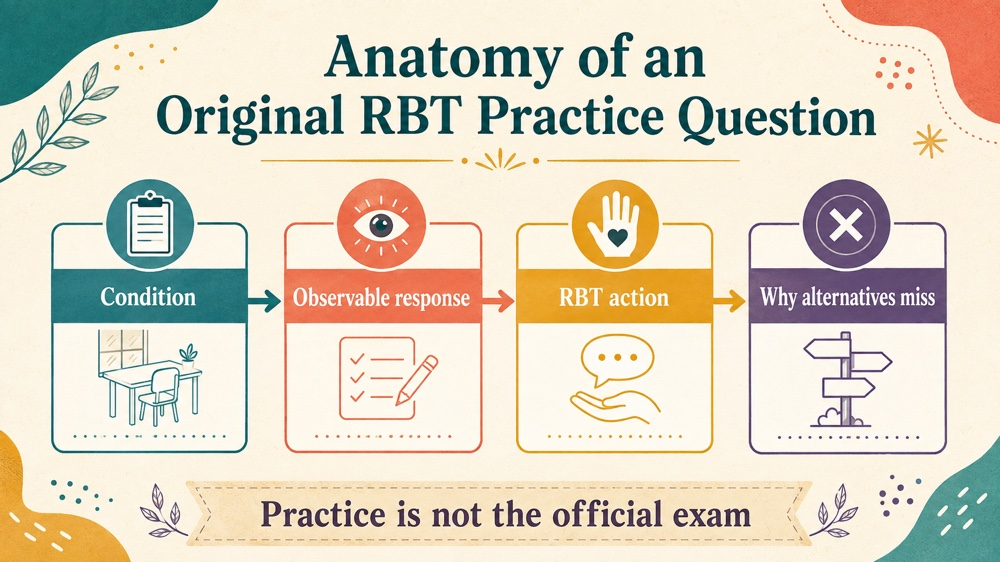
A useful item gives enough context to identify the actor, the observable behavior, the measurement or teaching rule, and the available consequence or reporting path. The explanation should identify the best RBT action and why a tempting alternative exceeds the role. Avoid vague prompts that reward guessing a keyword.
- Read the condition and identify who is acting.
- Underline the observable response or data rule.
- Choose the action specified by training and the written plan.
- Check privacy, safety, and documentation implications.
- Explain why an unsupported change or interpretation is not the answer.
Practice data collection and graphing
An original item may provide an operational definition and ask which measure fits. Another may ask what to do when a timer, material, or definition is unclear. The careful answer follows the programmed recording system, documents the barrier, and seeks direction. It does not reconstruct data later or choose the measure that produces the most favorable graph.
After the answer, draw a miniature timeline or count example. If you confused rate and frequency, write what changes when time becomes part of the measure. This turns an incorrect response into a concrete study action.
Practice acquisition and reduction
An acquisition scenario may describe a prompt hierarchy, a programmed delay, and a reinforcement criterion. The RBT implements those steps and records prompt level and response outcome. A reduction scenario may describe differential reinforcement, an antecedent strategy, or a safety procedure. The RBT follows the plan and reports concerns instead of inventing a new consequence.
Do not make the answer more clinical than the prompt allows. A technician should not diagnose a function from one event, redesign a treatment, or promise a family that a procedure will work. Focus on implementation, data, communication, and competence.
Practice documentation and ethics
A question can ask which note is objective, which information should remain private, or when a concern should be reported. Strong answers use observable facts, protect identifying information, follow supervision channels, and acknowledge competence limits. A polished note is not automatically accurate if it claims an interpretation that was not observed.
Include role and privacy checks in every practice block. If a caregiver requests a plan change, the RBT can listen, document the concern, and contact the supervising team through the approved route. The RBT should not agree to a clinical change merely because the request sounds reasonable.
Review the answer, not just the score
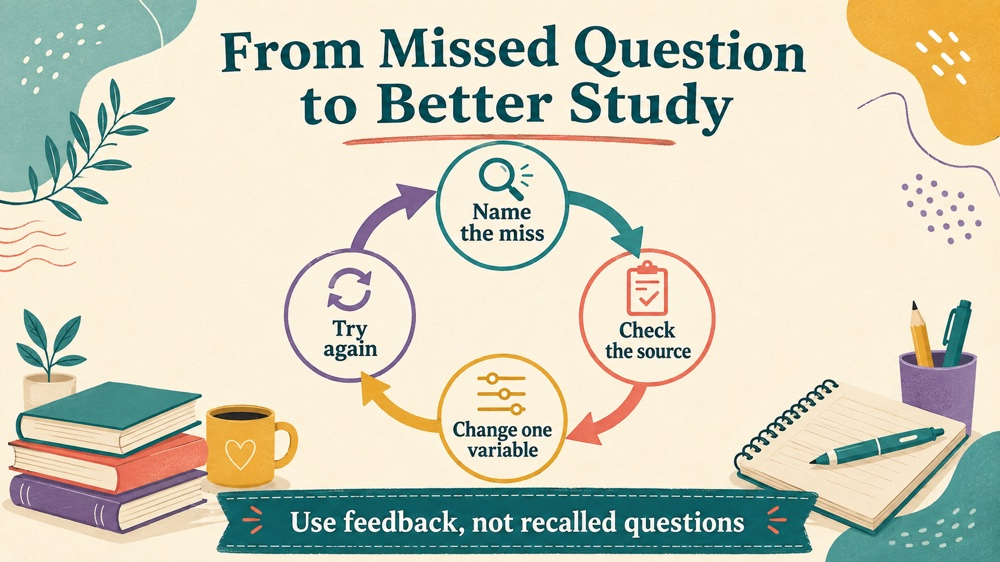
Use a four-step loop: answer, explain, tag the miss, and write a new scenario. Tags can include vocabulary, measurement, discrimination, calculation, reading the condition, or role boundary. The new scenario should alter one variable while preserving the concept. This is more reliable than repeating a familiar question until the wording feels easy.
If an explanation depends on a current administrative rule, link it to the official source and check the version date. If it is an original teaching example, label it as such. Clear provenance is part of good study practice.
Current exam context
The current RBT Test Content Outline describes 43 tasks across six domains. The examination includes 75 scored questions and 10 unscored pilot questions in a 90-minute period. These figures help plan practice coverage but do not make any independent item official or predictive. Verify current BACB materials before relying on time-sensitive details.
Balance practice across data collection and graphing, behavior assessment, acquisition, reduction, documentation and reporting, and ethics. A question set that tests only definitions can leave a learner unprepared for a scenario requiring a safe handoff or objective record.
Mistakes to avoid with test-question searches
- Calling third-party questions official or BACB-endorsed.
- Using recalled, leaked, or protected questions.
- Treating a practice score as an eligibility or certification result.
- Choosing an answer that independently changes the program.
- Ignoring privacy, safety, data integrity, or supervision.
- Studying only the easiest domain or repeating the same wording.
- Using a quiz as a replacement for the current Handbook or TCO.
RBT certification test questions checklist
- Can I state what practice can and cannot prove?
- Does each item identify an actor, condition, observable action, and rule?
- Can I explain the data and role-boundary reason for my answer?
- Do I practice all six current domains?
- Do I review explanations and write new scenarios after misses?
- Can I distinguish submission, authorization, examination, and certification?
- Are all examples original and clearly not official or recalled?
Use RBT certification test questions as a prompt for reasoning, not as a claim about the board’s protected examination. Original practice, current sources, and clear explanations make the study process more trustworthy.
Practice the concept
Review rbt certification test questions with original RBT scenarios, current-source reminders, and clear role boundaries.
Review the RBT study resource →
Frequently Asked Questions
Are these official RBT certification test questions?
No. Independent practice questions are original study material and are not official, recalled, leaked, or BACB-endorsed questions.
Can a practice score prove certification readiness?
It can identify topics to review, but it cannot replace the applicable pathway, competency process, examination, or certification decision.
What makes a question useful?
It gives a clear condition, observable action, data or consequence rule, and explanation of the RBT role boundary.
What should I do after missing a question?
Tag the reason for the miss, review the source or concept, and write a new scenario that changes one variable.
References
- Behavior Analyst Certification Board: Registered Behavior Technician Handbook, updated June 2026.
- Behavior Analyst Certification Board: RBT Test Content Outline (3rd ed.).
- Behavior Analyst Certification Board: RBT resources.
- Behavior Analyst Certification Board: ethics resources.
- Behavior Analyst Certification Board: RBT Ethics Code (2.0).