

The phrase behavior technician exam is often used for RBT exam preparation, but candidates should anchor their study in the current BACB Handbook and RBT Test Content Outline. This guide explains the exam context, the six domains, the kind of entry-level decisions to practice, and the difference between independent study questions and official certification processes. Examples are original and are not official, recalled, leaked, or BACB-endorsed questions.
Table of Contents
- Identify the current RBT exam source
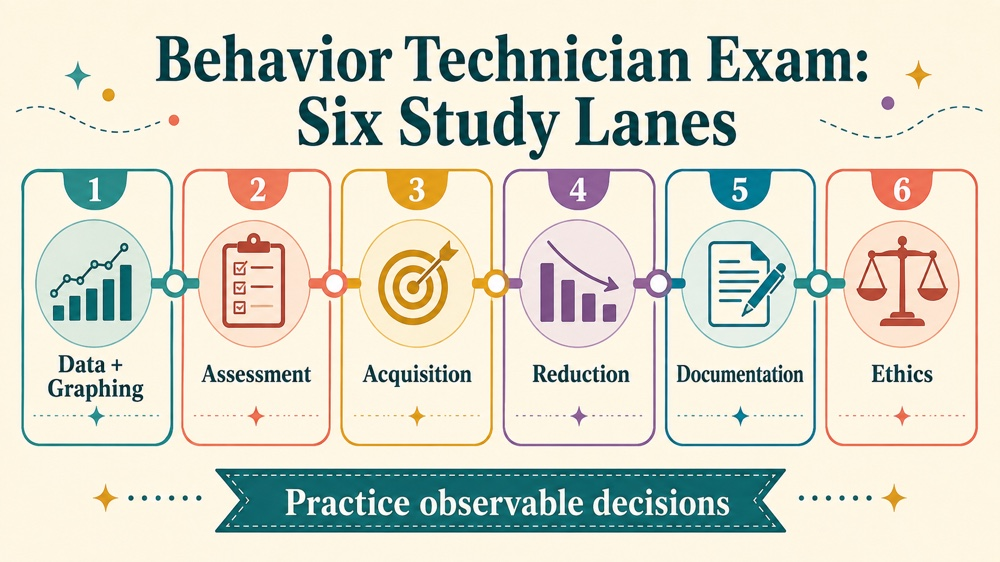
- Understand the six examination domains
- Practice measurement and graphing decisions
- Practice assessment participation
- Practice acquisition and reduction
- Practice documentation and ethics
- Know the current exam context
- Avoid misleading question sources
- Behavior technician exam checklist
- Frequently Asked Questions
- References
Continue your RBT study with RBT exam study materials and original practice resources.
Quick answer: Treat behavior technician exam as a current-source RBT study topic. Define the concept, connect it to an observable action, use original examples, and keep the supervision boundary visible.
Study boundary: This independent guide is educational content. It is not a BACB policy, certification decision, legal opinion, answer key, or guarantee of examination success. It does not promise a passing score or certification outcome. Examples are original and are not official, recalled, leaked, or BACB-endorsed questions.
Current exam context: The current BACB RBT Test Content Outline describes 43 tasks across six domains; the examination includes 75 scored questions and 10 unscored pilot questions in a 90-minute testing period. Verify the current handbook and outline before relying on a time-sensitive detail.
Identify the current RBT exam source
Start with the current RBT Test Content Outline (3rd ed.) for examination coverage and the current Handbook for pathway and administrative requirements. Record the source dates before using a course page, quiz, or social post. An old explanation can still sound confident while missing a current transition or instruction.
Use one page for source notes and another for study mistakes. That separation makes it easier to distinguish a content gap from an application or scheduling question.
Understand the six examination domains
The current outline describes 43 tasks across Data Collection and Graphing, Behavior Assessment, Behavior Acquisition, Behavior Reduction, Documentation and Reporting, and Ethics. Study each domain through a condition and action, not a list of words. Ask what the RBT should observe, implement, record, and communicate.
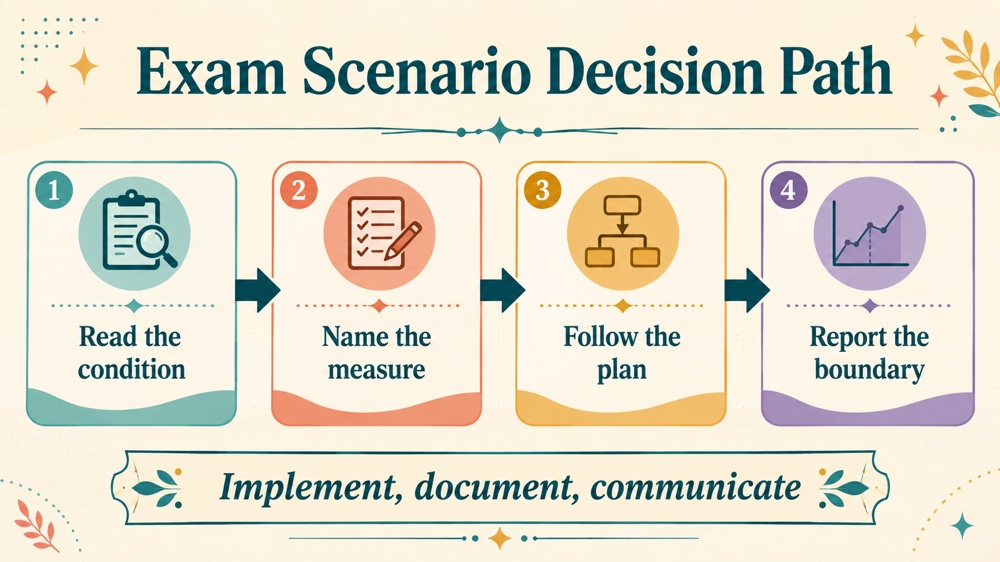
- Read the condition carefully.
- Identify the observable response or data rule.
- Choose the action assigned to the RBT.
- Check the programmed consequence or reporting path.
- Explain why an unsupported alternative is wrong.
Practice measurement and graphing decisions
A behavior technician exam practice item may ask whether frequency, rate, duration, latency, interval recording, permanent product, or percentage fits a defined behavior. The answer depends on the operational definition and program rules. The RBT should record accurately, preserve data integrity, and report unclear instructions rather than invent a replacement measure.
Draw a timeline or count after each answer. If you confused duration and latency, write what event starts and stops each measure. Visualizing the rule is more useful than memorizing a synonym.
Practice assessment participation
Assessment items should test participation, not independent diagnosis. An RBT may implement assigned preference-assessment or observation procedures, record responses, and communicate observations. Interpretation, treatment design, and changes to the procedure remain within the applicable supervision and competence structure.
If a scenario asks for a change that is not in the plan, the study answer should include a safe pause, documentation, and a handoff. A quick clinical guess is not evidence of competence.
Practice acquisition and reduction
Acquisition questions may involve reinforcement, prompting, fading, shaping, chaining, discrimination, generalization, or maintenance. Reduction questions may involve antecedent strategies, differential reinforcement, extinction, safety, and reporting. In both cases, choose the action that follows the written plan and preserves accurate records.
Do not diagnose a function from one event, promise an outcome, or create a new consequence. The entry-level technician’s strength is consistent implementation and communication within role.
Practice documentation and ethics
A strong behavior technician exam study block includes objective notes, confidentiality, competence, supervision, and reporting. Choose the response that records observable facts, protects identifying information, and uses the approved route for concerns. If the question asks for an interpretation that was not observed, do not add it to the note as fact.
Put a privacy check beside every example that contains a client, caregiver, or school detail. Fictional examples can still teach the correct habit: disclose only what is needed through the proper channel.
Know the current exam context
The current examination includes 75 scored questions and 10 unscored pilot questions in a 90-minute testing period. Use these figures for planning and verify the official source before relying on time-sensitive details. A third-party practice score is not an authorization, examination result, or certification decision.
Plan mixed-domain sessions and review explanations after each miss. The aim is a reproducible decision process, not a prediction of protected question wording.
Avoid misleading question sources
- Calling a third-party quiz official or BACB-endorsed.
- Using recalled, leaked, or protected questions.
- Treating a score as proof of eligibility or certification.
- Choosing a clinical change because it sounds sophisticated.
- Ignoring safety, privacy, data integrity, or reporting.
- Studying one familiar domain and skipping the others.
- Using an old outline without a version date.
Behavior technician exam checklist
- Can I name the current source for exam coverage?
- Can I apply the six domains to new conditions?
- Can I explain the start and stop rules for common measures?
- Can I implement a plan without redesigning it?
- Can I document objective facts and protect privacy?
- Can I explain the difference between practice, examination, authorization, and certification?
- Are all practice examples original and clearly labeled?
Use this behavior technician exam checklist to organize study, not to claim an official result. The current BACB sources control changing details, and independent practice should remain clearly separate from protected examination content.
Practice the concept
Review behavior technician exam with original RBT scenarios, current-source reminders, and clear role boundaries.
Review the RBT study resource →
Frequently Asked Questions
What is the behavior technician exam?
For RBT preparation, use the current BACB Handbook and RBT Test Content Outline to understand the applicable examination and pathway. The exact current requirements should be checked at the source.
What domains should I study?
Study the six current domains: data collection and graphing, behavior assessment, behavior acquisition, behavior reduction, documentation and reporting, and ethics.
Are free practice questions official?
No. Independent practice questions are original study tools and are not official, recalled, leaked, or BACB-endorsed.
Can a practice score prove certification?
No. A score can guide review but cannot replace the applicable pathway, authorization, examination, or certification decision.
References
- Behavior Analyst Certification Board: Registered Behavior Technician Handbook, updated June 2026.
- Behavior Analyst Certification Board: RBT Test Content Outline (3rd ed.).
- Behavior Analyst Certification Board: RBT resources.
- Behavior Analyst Certification Board: ethics resources.
- Behavior Analyst Certification Board: RBT Ethics Code (2.0).