
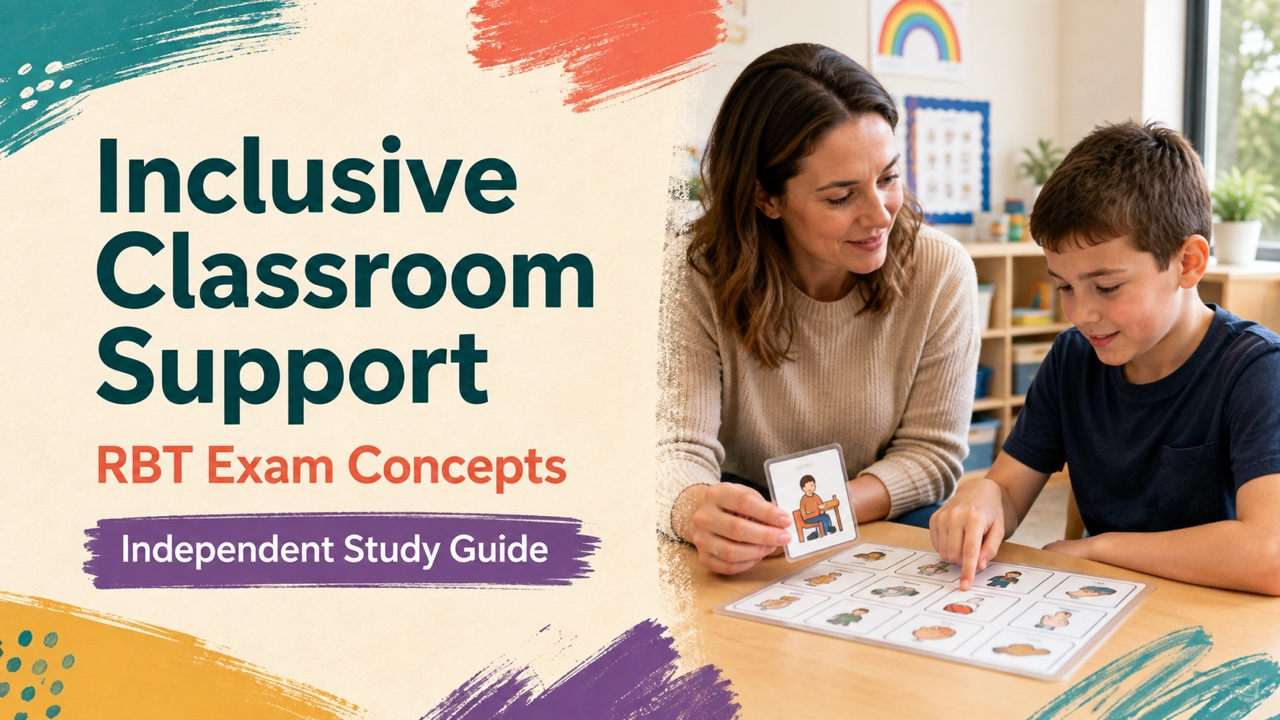
A behavior technician contributes to an inclusive classroom environment by supporting meaningful participation, following the educational and behavior plan, using respectful communication, and collaborating within the assigned role. Inclusion is not achieved by separating a learner unnecessarily, lowering expectations, or making a classroom revolve around one adult’s convenience. It also does not mean an RBT independently redesigns instruction or decides which accommodations a student should receive. The technician observes, implements assigned supports, collects accurate data, protects privacy, and communicates barriers to the supervisor and classroom team through the approved route. This independent guide turns the long search phrase a behavior technician contributes to an inclusive classroom environment by into observable actions. Use it to study generalization, prompting, reinforcement, data, dignity, and teamwork. Local school policies, individualized plans, and supervision control the details in a real classroom.
Table of Contents
- A behavior technician contributes to an inclusive classroom environment by supporting participation
- Follow the classroom and behavior plan
- Use prompts and reinforcement without isolation
- Collect data that supports team decisions
- Support communication and choice
- Respect peers, culture, and privacy
- Coordinate with supervision and classroom staff
- Avoid inclusion mistakes
- A behavior technician contributes to an inclusive classroom environment by checklist
- Frequently Asked Questions
- References
Continue your RBT study with RBT exam study materials and original practice resources.
Quick answer: Treat a behavior technician contributes to an inclusive classroom environment by as a current-source RBT study topic. Define the issue, connect it to observable action, use original examples, and keep the supervision boundary visible.
Study boundary: This independent guide is educational content. It is not a BACB policy, certification decision, legal opinion, answer key, or guarantee of examination success. Examples are original and are not official, recalled, leaked, or BACB-endorsed questions.
Current exam context: The current BACB RBT Test Content Outline describes 43 tasks across six domains; the examination includes 75 scored questions and 10 unscored pilot questions in a 90-minute testing period. Verify the current handbook and outline before relying on a time-sensitive detail.
A behavior technician contributes to an inclusive classroom environment by supporting participation
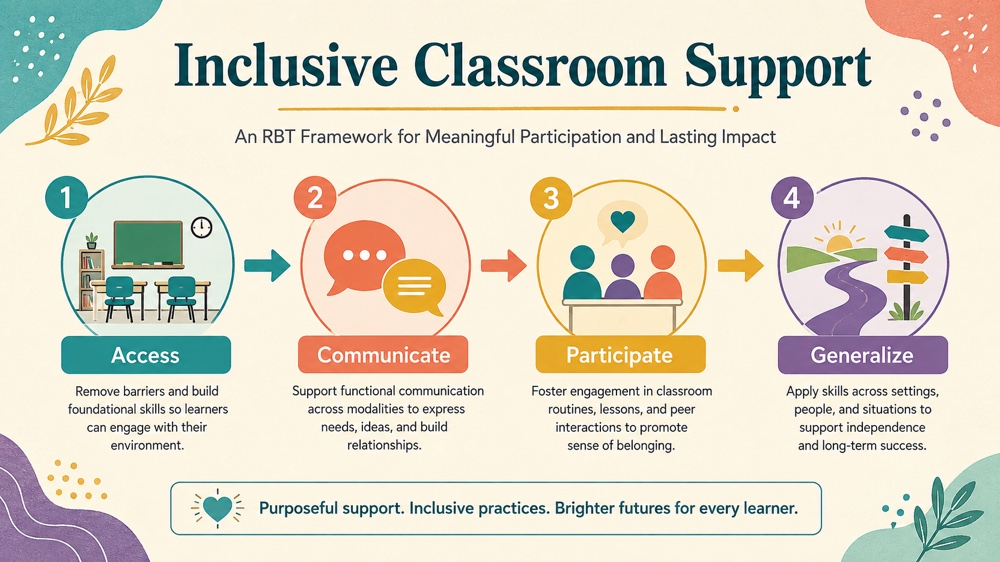
Begin with the learner’s access to ordinary classroom routines, materials, peers, instruction, and communication. Use the assigned support with the least intrusive approach specified by the plan. Track what happened and report barriers instead of creating a separate routine simply because it is easier for the adult.
Follow the classroom and behavior plan
Read the relevant instructions, identify the target response and data rule, and coordinate timing with the teacher or supervisor. The classroom’s educational goals and the behavior plan should be respected. If directions conflict or a support is unclear, ask the responsible people before improvising.
Use prompts and reinforcement without isolation
Prompt participation as written, reinforce the programmed response, and fade support when the plan calls for it. Avoid hovering, speaking for the learner, or making a separate reward system that draws unnecessary attention. The goal is meaningful access and independence, not adult dependence.
Collect data that supports team decisions
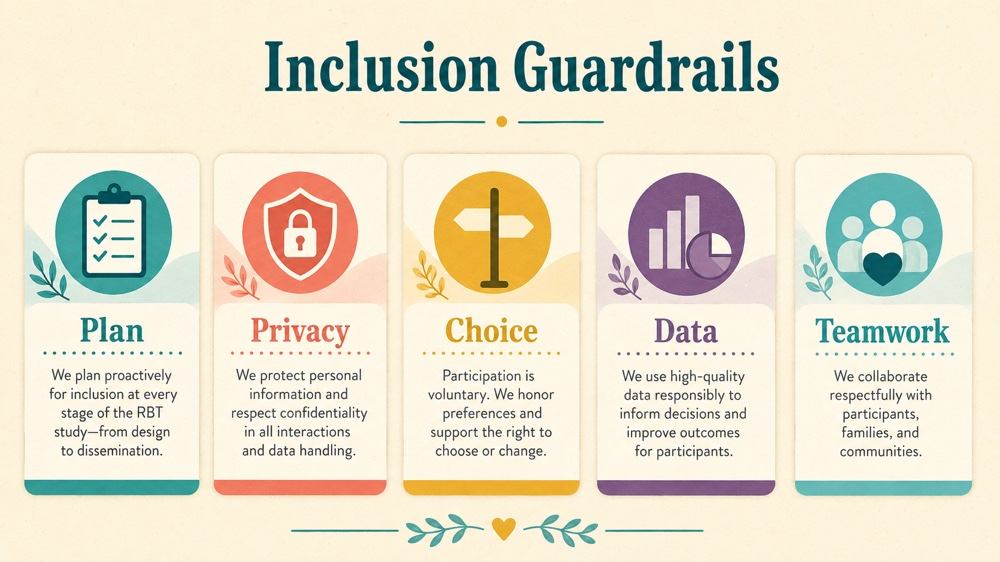
Record the assigned measure, opportunities, prompt level, latency, or participation data according to the written system. Keep notes objective and protect education records. Share the pattern through the approved channel so the team can review what is working and what needs clarification.
Support communication and choice
Honor approved communication forms, wait time, choice-making, and help-seeking. Do not interpret a learner’s communication as defiance or assume that quiet means agreement. If a communication response is not defined, ask the supervisor or classroom team rather than inventing a new target.
Respect peers, culture, and privacy
Use language that describes observable behavior without ridicule or public labels. Limit discussion to people who need the information, follow school procedures, and consider cultural and contextual differences. Inclusion requires both access to the group and protection from unnecessary exposure.
Coordinate with supervision and classroom staff
A leading technician communicates briefly, follows the agreed route, accepts feedback, and reports changes in schedule, health, materials, or safety. The RBT can contribute observations and implementation support, while program design, educational decisions, and clinical interpretation remain with the responsible professionals.
Avoid inclusion mistakes
- Separating a learner for adult convenience.
- Speaking for the learner when communication support is available.
- Using unapproved rewards or changing criteria.
- Sharing private information with peers or uninvolved staff.
- Treating a classroom behavior as a diagnosis or motive.
- Ignoring teacher instructions or the written plan.
- Calling original examples official examination questions.
A behavior technician contributes to an inclusive classroom environment by checklist
- Does the support increase access to ordinary routines?
- Am I following the written educational and behavior plan?
- Is prompting respectful and faded as assigned?
- Are data and notes objective and secure?
- Are communication and choice honored?
- Do I know who receives the observation or concern?
- Have I protected peers’ and learners’ privacy?
Use a behavior technician contributes to an inclusive classroom environment by as an observable practice prompt. RBT Training is independent educational content and is not affiliated with or endorsed by BACB.
Practice the concept
Review a behavior technician contributes to an inclusive classroom environment by with original RBT scenarios, current-source reminders, and clear role boundaries.
Review the RBT study resource →
Frequently Asked Questions
A behavior technician contributes to an inclusive classroom environment by doing what?
By supporting participation in ordinary routines, following assigned plans, using respectful prompts and reinforcement, collecting data, protecting privacy, and communicating within supervision.
Should an RBT create a separate classroom program?
No. The technician implements assigned supports and reports barriers; educational and clinical program decisions belong to the responsible professionals.
What does inclusion look like in daily practice?
It can include access to peers, instruction, materials, communication, choices, and routines with only the support specified as necessary.
Are these official BACB questions?
No. They are original educational scenarios and are not official, recalled, leaked, or BACB-endorsed.
References
- Behavior Analyst Certification Board: Registered Behavior Technician Handbook, updated June 2026.
- Behavior Analyst Certification Board: RBT Test Content Outline (3rd ed.).
- Behavior Analyst Certification Board: RBT resources.
- Behavior Analyst Certification Board: ethics resources.
- Behavior Analyst Certification Board: RBT Ethics Code (2.0).