
A registered behavior technician study guide PDF can be convenient: you can save it, print it, annotate it, and return to one concept without opening several tabs. Convenience is not the same as currency or authority, though. A useful guide should identify its edition, connect concepts to the current RBT Test Content Outline, explain what an RBT does next, and give you room to correct your reasoning.
Table of Contents
- What a registered behavior technician study guide PDF should do
- Check the source before printing
- Separate official facts from study notes
- Map the guide to six RBT domains
- Design a printable concept page
- Turn PDF reading into application
- Use original examples and corrections
- Choose the right study session
- Avoid these study-guide PDF mistakes
- Frequently Asked Questions
- References
This article shows how to choose and use a study-guide PDF for independent RBT exam preparation. The current BACB Handbook and the RBT Test Content Outline, 3rd edition, control credentialing, application, and examination information. A study guide can organize learning; it cannot approve an application, complete an initial competency assessment, reproduce a secure examination, or issue certification.
RBT Training is not affiliated with, operated by, or endorsed by the Behavior Analyst Certification Board (BACB). The examples below are newly written for study. They are not official, recalled, leaked, or BACB-endorsed questions, and no study guide or practice score can guarantee a passing result or certification.
What a registered behavior technician study guide PDF should do
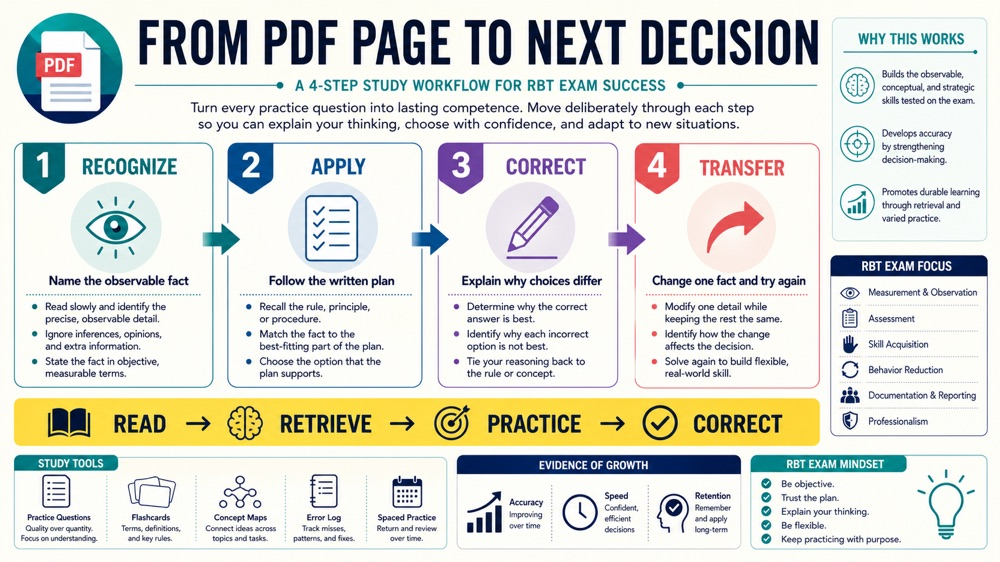
Before downloading a file, define the job you need it to perform. A strong registered behavior technician study guide PDF should help you move through four stages:
- Recognize: identify the observable behavior, measurement, procedure, or ethical issue.
- Apply: connect the scenario to the written plan and the RBT role.
- Explain: state why the best action fits and why the alternatives do not.
- Transfer: solve a new example after one fact, setting, or response changes.
A file that only lists definitions may be useful for first exposure, but it is not a complete decision-training tool. A file that uses official-looking colors or a credential logo does not become an official BACB resource. Check the document title, author, edition, update date, source links, and independent-content boundary before you print it.
| Guide feature | What it supports | What to check |
|---|---|---|
| Edition and update date | Freshness review | Does it name the current TCO or Handbook? |
| Six-domain map | Balanced coverage | Are domain names and task counts source-linked? |
| Decision examples | Scenario transfer | Are examples newly written and role-safe? |
| Correction fields | Next-step study | Does it explain distractors, not only the answer? |
| Reference page | Verification | Do the links open to primary documents? |
For example, a guide that explains frequency but never asks you to distinguish frequency from duration leaves the most important decision unfinished. Add a small “What would change the answer?” box to every concept page.
Check the source before printing
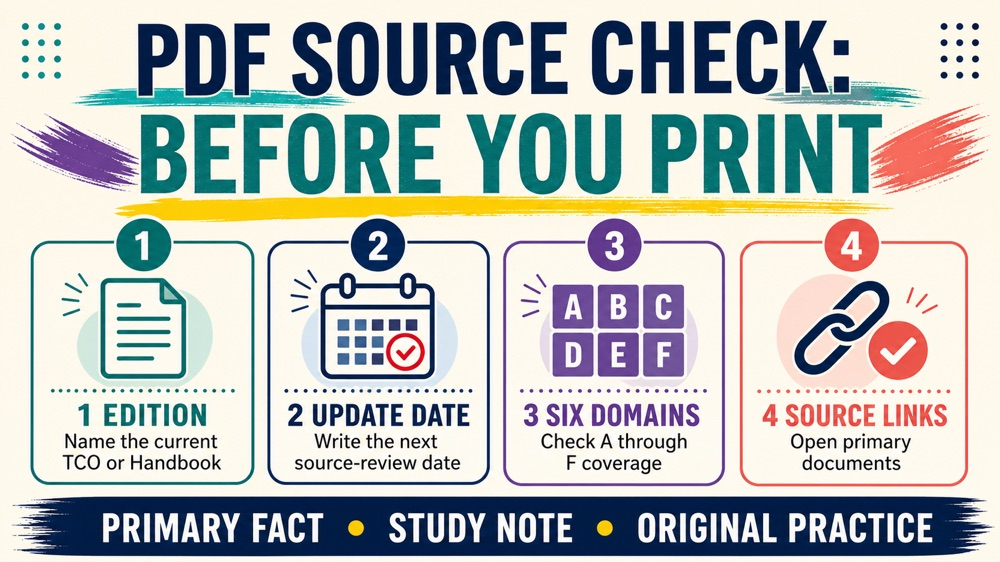
Run a source check before you annotate a registered behavior technician study guide PDF:
- Find the edition, publication date, and last update date.
- Open the linked BACB TCO and compare the six-domain map.
- Open the current Handbook and compare examination or pathway facts.
- Look for “real,” “official questions,” “recalled,” “leaked,” or “endorsed” claims.
- Mark each page as primary-source fact, independent explanation, or original practice.
- Write the date of your next source review on the cover page.
An older file can still contain useful ABA concepts, but its requirements, blueprint language, or examples may need review. Search snippets and download-page labels are not enough evidence. If the PDF is based on an older task-list edition, label it as an older reference and compare it with the current official outline before using it for exam preparation.
Separate official facts from study notes
Use three visual labels in the margin:
- PRIMARY SOURCE: a current statement checked against a BACB document, with the document title and date.
- STUDY NOTE: an independent explanation that makes a concept easier to remember.
- ORIGINAL PRACTICE: a newly written scenario, answer explanation, or correction rule.
For orientation, the current BACB Handbook describes an examination with 75 scored questions and 10 unscored pilot questions, four answer choices, and a 90-minute time limit. The current TCO organizes 43 tasks across six domains. These facts belong in a primary-source box. Your guide may create a 20-question quiz, a 50-question scenario set, or an 85-question practice block, but those numbers describe the independent resource, not a secure BACB examination form.
This separation protects you from accidentally treating a study explanation as a new requirement. It also makes updates faster: if the Handbook changes, you can replace the primary-source box without rewriting every concept note.
Map the guide to six RBT domains
A good study guide should let you see where each page fits within the current six-domain map:
| Domain | Tasks / share | Concept page to build |
|---|---|---|
| A. Data Collection and Graphing | 13 / 17% | Observable definition, measurement match, graph or data-sheet reading. |
| B. Behavior Assessment | 8 / 11% | Assigned assessment procedure, direct observation, preference or skill assessment. |
| C. Behavior Acquisition | 19 / 25% | Teaching steps, prompting, reinforcement, maintenance, and generalization. |
| D. Behavior Reduction | 14 / 19% | Plan fidelity, safety direction, observable recording, and reporting. |
| E. Documentation and Reporting | 10 / 13% | Objective notes, communication route, privacy, and data accuracy. |
| F. Ethics | 11 / 15% | Competence, supervision, dignity, confidentiality, and boundaries. |
The percentages help you allocate attention; they do not give you a separate personal score for each domain. The outline contains 43 tasks, not 43 one-to-one questions. Use every row as a coverage check, then choose examples that make the task observable and actionable.
Design a printable concept page
A printable page should be easy to scan in grayscale and still useful on screen. Use one concept or task per page:
- Plain-language rule: define the concept without hiding the decision.
- Observable anchor: write what you would see, hear, count, or time.
- Plan anchor: state which written procedure controls.
- Role-safe action: implement, record, report, or ask.
- Contrast box: list the nearest competing concept and how to distinguish it.
- Original example: include a short scenario with one clear change point.
- Source box: record the document, edition, link, and check date.
Leave space for a correction, not only a highlight. A learner should be able to write “I chose duration because I noticed how long the response lasted” or “I should ask before changing the prompt hierarchy.” Those sentences show usable understanding.
Turn PDF reading into application
Use a short retrieval loop for each section:
- Read one concept page and close the file.
- Say the rule from memory in one or two sentences.
- Write the observable fact that would matter in a scenario.
- Solve a newly written example without looking at the answer.
- Change one fact and solve the example again.
- Record the error pattern and the next page to review.
For example, if the page explains latency, create one scenario where the interval begins at the instruction and ends at the response. Then create a second scenario where the question asks how long the response continues after it begins. The words are close, but the measurement decision is different. That contrast is more useful than copying a definition twice.
Keep the service boundary visible. A study page may help you recognize a prompt-fading concept, but the current written plan controls how you implement prompting with a client. If the plan is unclear or a situation is outside your training, follow the established supervision route instead of improvising.
Use original examples and corrections
The examples below are newly written for independent study. They are not official, recalled, leaked, or BACB-endorsed questions:
- Measurement: a response begins after an instruction and stops after 14 seconds. Identify the onset and offset before choosing the measure that captures elapsed time.
- Assessment: an assigned preference procedure lists the materials and order, but one material is unavailable. Follow the written procedure and ask the supervisor how to proceed; do not silently substitute a different assessment.
- Acquisition: the plan specifies a prompt hierarchy and a reinforcement condition. The learner responds independently, so record the response and do not add an unnecessary prompt.
- Reduction: a new safety event is not addressed in the current plan. Follow existing safety direction, record observable facts, and contact the responsible professional.
- Documentation: a note says the learner was “unmotivated.” Replace the interpretation with what occurred, when it occurred, what was presented, and what response followed.
- Ethics: a friend asks you to share a recognizable client story. Protect confidentiality and use an approved professional channel with de-identified material only.
For every miss, write the distractor error: wrong measurement, unsupported inference, plan change, scope problem, or privacy risk. Then write a new transfer item. The correction is the part that turns a PDF into a study system.
Choose the right study session
| Session | Best use | Evidence to save |
|---|---|---|
| 20-minute concept review | Retrieve one rule and one contrast. | One plain-language explanation and one changed example. |
| 45-minute mixed practice | Apply concepts across several domains. | Correction log sorted by decision type. |
| 90-minute practice block | Rehearse pacing and endurance. | Time notes, low-confidence answers, and next review list. |
| Supervision review | Resolve scope, plan, or safety uncertainty. | Non-identifying question and the source or instruction clarified. |
Do not judge a guide only by page count. A 23-page file with clear sources and correction spaces may be more useful than a 200-page download that mixes old editions, definitions, and unsupported “real question” claims. Choose the smallest resource that lets you retrieve, apply, correct, and transfer.
Avoid these study-guide PDF mistakes
- Confusing a full name with official status: “Registered Behavior Technician” in a title does not establish BACB authorship.
- Skipping the edition check: compare a PDF based on an older task list with the current TCO.
- Printing before checking sources: verify the Handbook, TCO, and ethics materials first.
- Studying only definitions: add observable facts, plans, contrasts, and next actions.
- Using recalled or leaked material: use newly written independent examples instead.
- Sharing identifying information: keep correction examples fictional and non-identifying.
- Treating a practice score as a guarantee: use scores to select the next study action.
Bottom line: a registered behavior technician study guide PDF is most useful when it is current, source-linked, clearly independent, and built for decisions. Check its edition, map it to all six TCO domains and 43 tasks, use the official format facts as a separate source box, and turn every practice miss into a correction and transfer step.
Ready to compare study materials?
Review the RBT exam-prep pack and choose materials that support source checks, six-domain coverage, original practice, and correction logs.
Compare RBT Exam Prep Materials →
Frequently Asked Questions
Is every registered behavior technician study guide PDF current?
No. Check the edition, update date, source links, and relationship to the current BACB Handbook and TCO before relying on it.
Can a study-guide PDF replace the official Handbook?
No. Use primary BACB documents for credentialing and examination facts; use a study guide as an independent learning aid.
What should I write on a printable concept page?
Include the plain-language rule, observable anchor, written-plan anchor, role-safe action, contrast, original example, source, and correction space.
Can a PDF guarantee a passing result?
No. A guide or practice score cannot guarantee assessment completion, a passing result, or certification.
References
- Behavior Analyst Certification Board. RBT Test Content Outline, 3rd edition.
- Behavior Analyst Certification Board. RBT Handbook, updated June 2026.
- Behavior Analyst Certification Board. RBT Ethics Code.