

Behavioral technician training should do more than introduce terminology. It should help a learner understand the current plan, observe behavior objectively, follow authorized procedures, record data, communicate facts, and ask for supervision when a situation is unclear.
Table of Contents
- What behavioral technician training is for
- The four training foundations
- Start with ethics and role boundaries
- Learn to observe and measure
- Practice implementation with feedback
- Build a clean communication habit
- Prepare for the first session
- Use supervision well
- Avoid common training mistakes
- FAQ
- Key takeaways
- Sources and scope
RBT KNOWLEDGE GUIDE · TRAINING FOUNDATIONS
Behavioral Technician Training: What to Learn Before Your First Session
A practical overview of the knowledge, practice habits, communication, and supervision boundaries that help a new technician start with a clear plan.
Behavioral technician training should do more than introduce terminology. It should help a learner understand the current plan, observe behavior objectively, follow authorized procedures, record data, communicate facts, and ask for supervision when a situation is unclear. Those habits support safe and consistent service delivery, but they do not replace the requirements for a credential, a competency assessment, or ongoing supervision.
This article is educational and general. A learner must follow the current training program, employer policies, supervisor instructions, and applicable professional requirements. Do not use a general article to invent a client procedure or change an authorized plan.
What behavioral technician training is for
A technician works inside a team. The job may involve implementing teaching procedures, supporting behavior-change plans, collecting defined data, preparing materials, and communicating session information. Training gives the learner a framework for those tasks and a chance to practice before independent implementation is expected.
For an RBT applicant, the BACB’s current 2026 pathway includes a defined 40-hour training requirement, an initial competency assessment, application steps, and an examination. The training requirement is only one part of that pathway. A course completion record does not by itself make someone an RBT or guarantee a job.
The four training foundations
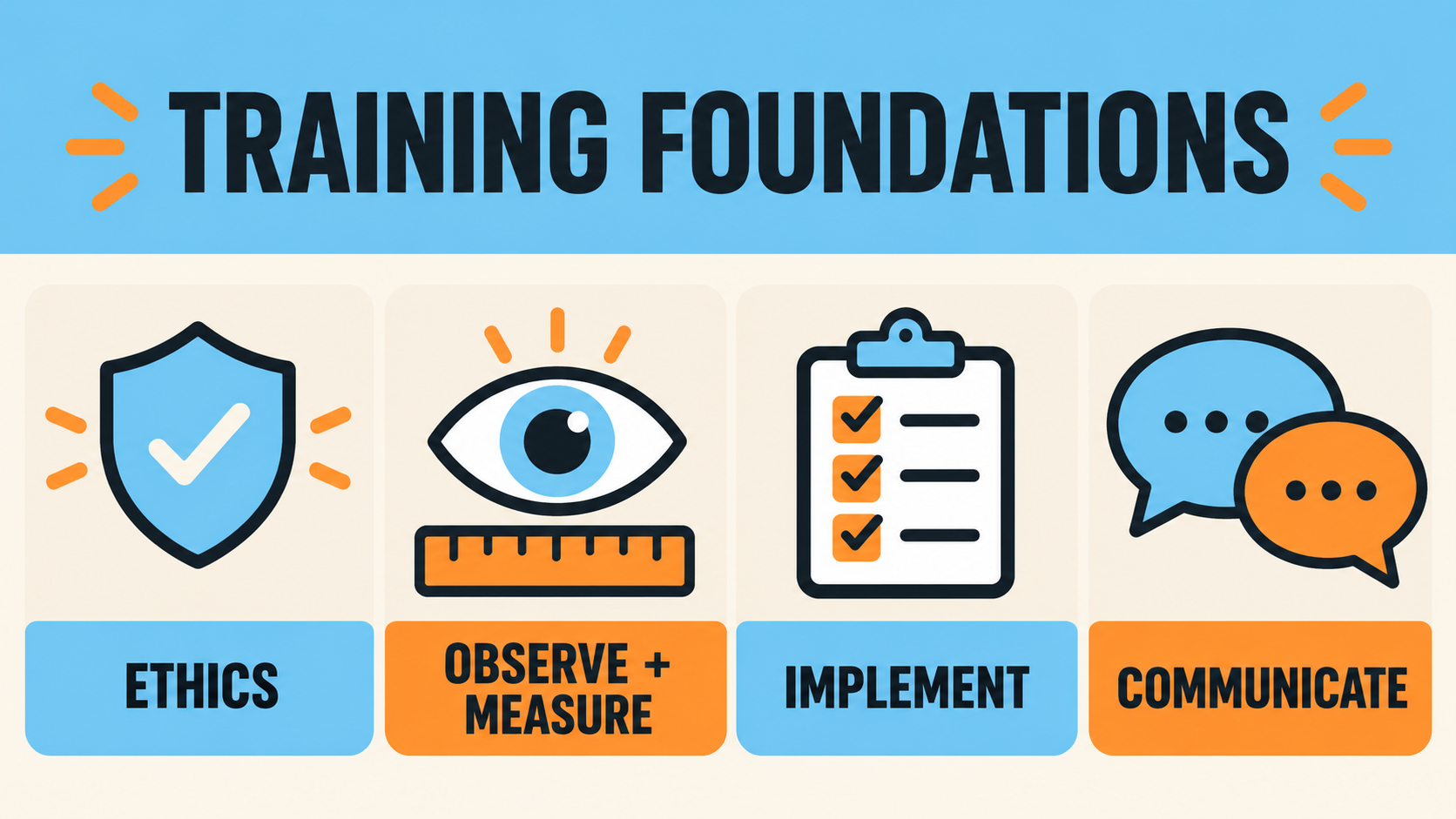
Strong preparation usually connects four areas:
- Ethics: protect dignity, privacy, boundaries, and the learner’s rights.
- Observe and measure: describe what happens and record it using the defined system.
- Implement: follow the written procedure with fidelity and use materials as instructed.
- Communicate: report relevant facts, questions, risks, and data through the approved pathway.
These foundations are connected. If a learner cannot identify what counts as a target response, implementation and data collection will drift. If the learner is unsure who to ask, a small ambiguity may become an undocumented change in service.
Start with ethics and role boundaries
Ethics is not a final quiz topic. It shapes everyday decisions about privacy, consent, respectful language, dual relationships, gifts, social media, and communication. Training should make the approved route for questions visible, especially for safety concerns, suspected abuse, confidentiality issues, and requests that fall outside the technician’s role.
A technician is not expected to independently diagnose, design an assessment, rewrite a treatment plan, or make a clinical decision simply because a session is difficult. A responsible training program teaches the learner how to pause, protect safety, document objective facts, and contact the appropriate supervisor or emergency pathway.
Learn to observe and measure
Observation training turns labels into recordable events. A learner should practice identifying the operational definition, onset and offset rules, examples, nonexamples, and measurement method before collecting data. “The learner was upset” does not tell the team what to count. The plan may define speech, movement, contact, duration, latency, or another observable feature.
Match the data method to the question. Frequency or rate may fit discrete responses. Duration may fit behavior that continues over time. Latency may measure the delay between an instruction and a response. Percentage or trial-based recording may fit opportunities defined in the program. The technician should use the method on the current data sheet and ask the supervisor when the definition and form do not match.
Practice implementation with feedback
Reading a procedure is not the same as performing it. Effective training can include modeling, examples and nonexamples, rehearsal, role-play, quizzes, interactive activities, and feedback. The learner should practice the sequence at a manageable pace and receive correction before working in a real session.
When practicing, focus on observable performance:
- Do you prepare the correct materials?
- Do you deliver the instruction as written?
- Do you provide the specified prompt or consequence?
- Do you record the correct response and measurement?
- Do you recognize when to stop and ask for help?
Feedback should be specific enough to improve the next rehearsal. A general “good job” does not show which step was accurate or which step needs practice.
Build a clean communication habit
Good handoffs are concise, objective, and routed through approved channels. A useful message can include the time and context, what was observed, what the current plan says, what action was taken within that plan, relevant data, and the question that needs an answer.
Avoid turning an observation into a diagnosis or motive. “At 10:15, the learner pushed the materials from the table after the instruction; three opportunities were recorded on the data sheet” is more useful than “the learner wanted to escape work.” The supervisor can evaluate patterns and next steps using the defined data.
Prepare for the first session
Before the first session, review the current plan and ask what is unclear. Confirm the learner’s preferred communication methods, session schedule, materials, reinforcement or teaching procedures as authorized, safety steps, data form, and contact pathway. Do not rely on memory from a generic training video when the client-specific plan says something different.
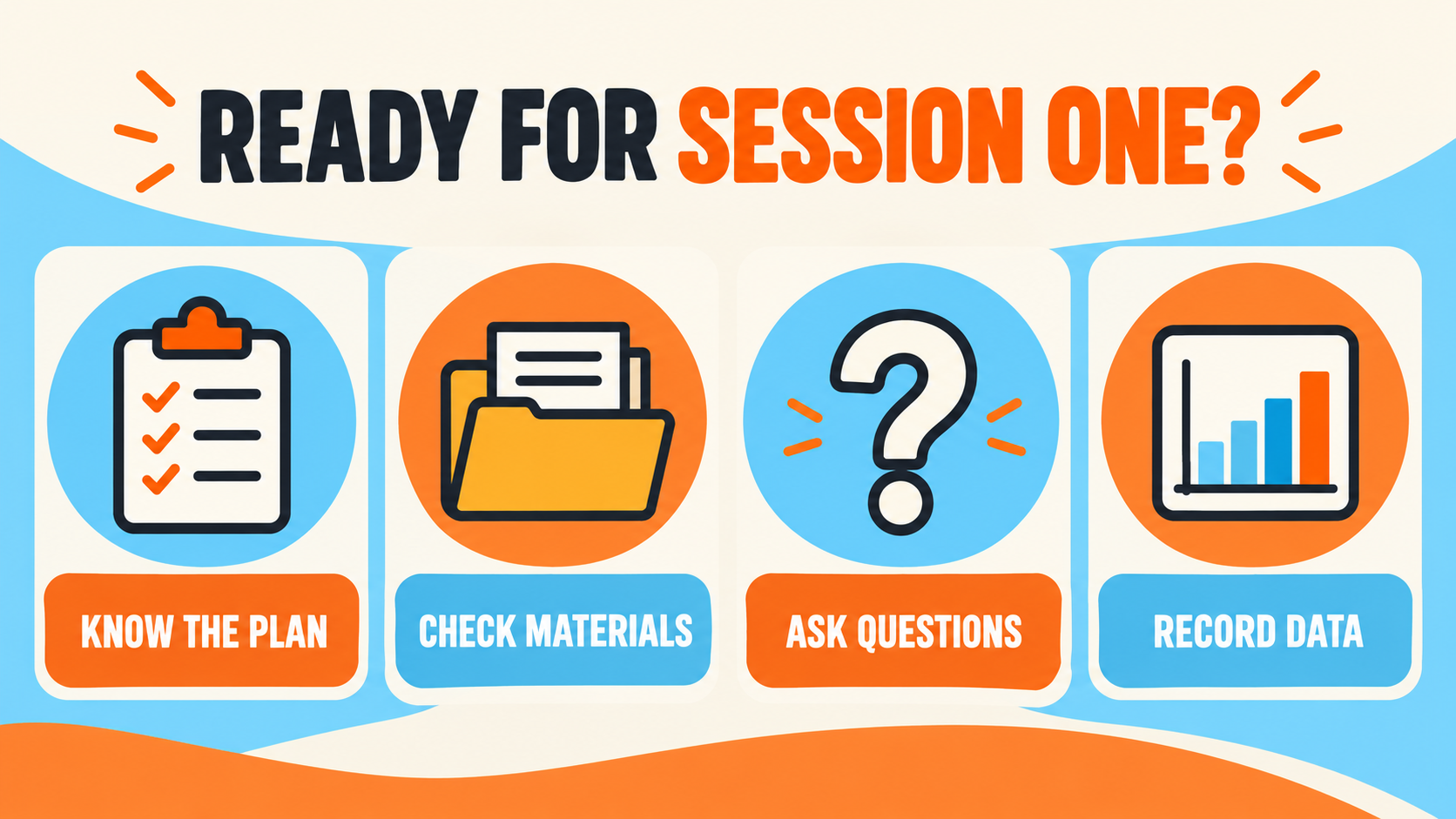
Use a short readiness check:
- Know which plan and definitions are current.
- Check that materials and data sheets are available.
- Ask the supervisor about safety, transitions, and likely questions.
- Confirm how and where to record data.
- Know what to do if the plan does not cover an event.
Use supervision well
Supervision is a working relationship, not just a scheduled meeting. Bring specific questions, examples of uncertainty, data that need review, and any situation in which the written procedure was difficult to apply. Write down the supervisor’s clarification according to the organization’s process.
Ask promptly when there is an immediate safety concern, an ethical concern, a possible change in the learner’s needs, an unclear measurement rule, a missing material, or a request outside your training. Waiting because you are afraid to ask can reduce data quality and create avoidable risk. A technician can be confident and still seek direction.
Avoid common training mistakes
Confusing completion with competence
Finishing lessons shows completion of a learning activity. It does not prove that every skill can be performed accurately in every context. Competency assessment, supervision, feedback, and performance review serve different purposes.
Memorizing labels instead of procedures
Knowing a term such as reinforcement or prompting is not enough. Practice how the authorized program defines the response, what the technician should do, and how the data are recorded.
Using a generic plan for a specific learner
General training examples are useful for learning concepts. The learner-specific plan controls implementation in the actual session. Ask when the two appear inconsistent.
Recording interpretations as data
Keep observations separate from hypotheses. Describe what happened, record according to the measurement rule, and route questions about function or pattern to the supervising clinician.
FAQ
What should behavioral technician training include?
It should address ethics, service-delivery role boundaries, observing and measuring behavior, implementing procedures, communication, and practice with feedback. The exact curriculum depends on the program and the current requirements that apply.
Does training make someone an RBT?
No. Training is one part of the RBT pathway. Applicants must verify current eligibility and complete the required assessment, application, and examination steps.
What should I do if the plan is unclear during a session?
Follow the approved safety and escalation process, avoid inventing a new procedure, document objective facts, and contact the appropriate supervisor. Immediate safety concerns use the organization’s urgent or emergency pathway.
How can I tell whether I am ready to start?
You should be able to identify the current plan, prepare materials, follow the stated procedure, record the defined data, communicate objectively, and recognize when you need supervision. A competency assessor or supervisor should evaluate readiness for the specific role.
Key takeaways
Behavioral technician training is strongest when it connects ethics, objective observation, faithful implementation, and clean communication. Use practice and feedback to prepare for real sessions, keep client-specific decisions inside the authorized plan, and treat supervision as part of competent work. Training can prepare you for the next step, but it does not independently grant certification or replace the current official requirements.
Ready to practice the RBT concepts you just reviewed?
Try an independent, original RBT practice resource with exam-style questions, scoring, and answer explanations.
References
- Behavior Analyst Certification Board. RBT Test Content Outline, 3rd edition.
- Behavior Analyst Certification Board. RBT Handbook.
- Behavior Analyst Certification Board. RBT Ethics Code.