
Behavior technician autism spectrum personality traits job requirements are easiest to understand when a vague personality label becomes an observable work behavior. Job postings may ask for patience, compassion, teamwork, flexibility, data skills, training, and comfort with the physical demands of working with children on the autism spectrum. Those are employer-specific expectations, not a single national BACB checklist. This guide separates common requirements from RBT certification requirements and gives applicants a practical way to evaluate fit without stereotyping autistic children or promising a particular hiring outcome.
Table of Contents
- Behavior technician autism spectrum personality traits job requirements: what the phrase is really asking
- Behavior technician autism spectrum personality traits job requirements: common education and training
- Behavior technician autism spectrum personality traits job requirements: technical skills employers may look for
- Behavior technician autism spectrum personality traits job requirements: personality behaviors that matter at work
- Schedule, physical, and safety expectations
- Supervision, teamwork, and learner dignity
- How to evaluate your fit before applying
- Frequently asked questions
- Official sources and scope
RBT career and job-fit guide
Behavior Technician Autism Spectrum Personality Traits Job Requirements
Review common skills, training, teamwork, safety, and role-fit expectations before applying.
The phrase behavior technician autism spectrum personality traits job requirements combines several questions: What does the job involve? What training is expected? What personal qualities help? Can I meet the physical and schedule demands? And how is the role different from an RBT credential?
Job postings vary. Some employers hire entry-level behavior technicians and provide training; others prefer an active RBT certification or previous experience with children, autism, or developmental disabilities. This guide separates common employer expectations from BACB requirements and translates “personality traits” into observable work behaviors rather than a personality test.
Behavior technician autism spectrum personality traits job requirements: what the phrase is really asking
A behavior technician may work in a home, clinic, school, community, or center-based setting. The title is not one universal credential. An RBT is a BACB credentialed behavior technician who provides services under the direction and close supervision required by the role; another behavior technician position may use a different training or employer pathway.
Read the live job posting in four layers:
- Minimum qualifications: what is required to apply, such as age, diploma, background check, certification, or experience.
- Work duties: what you will do, such as implement assigned programs, collect data, prepare materials, communicate with families, or document sessions.
- Working conditions: schedule, travel, standing, sitting, kneeling, lifting, noise, and possible safety situations.
- Training and support: who supervises you, how onboarding works, and what competency or certification steps the employer expects.
Do not assume that a preferred qualification is a universal BACB rule, and do not assume that a broad employer phrase authorizes independent clinical decisions. The specific posting, employment agreement, current BACB source, and applicable law control.
Behavior technician autism spectrum personality traits job requirements: common education and training
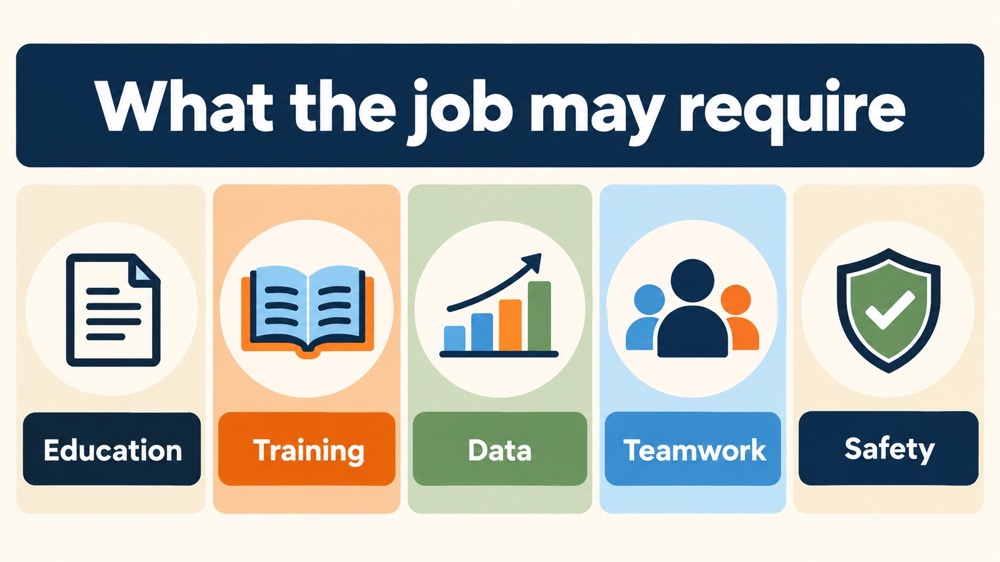
Many entry-level postings list a high school diploma or equivalent, while some prefer college coursework, experience with children, education, psychology, special education, or related work. Other employers may prioritize reliability and willingness to complete paid training. The education line is therefore employer-specific.
For an RBT pathway, candidates should review the current BACB requirements and Handbook rather than relying on an old job description. Training, competency assessment, examination, application, and supervision are connected but separate steps. Completing one course does not automatically make a person an active RBT.
Training may include:
- behavior-analytic concepts and observable definitions;
- data collection and documentation;
- teaching, prompting, reinforcement, and generalization procedures;
- behavior-reduction and safety procedures within an approved plan;
- privacy, ethics, cultural responsiveness, and professional communication; and
- employer-specific systems, crisis response, first aid, or background requirements.
Behavior technician autism spectrum personality traits job requirements: technical skills employers may look for
Technical requirements are easier to evaluate than personality labels because they can be demonstrated in training, role-play, observation, or a work sample.
Data and objective observation
A technician may need to follow a measurement definition, record opportunities accurately, update a graph or data system, and describe what occurred without guessing about motives. If a definition is unclear, the safe response is to ask the supervisor rather than invent a new rule.
Implementing assigned procedures
Technicians often implement a written program under supervision. That can include preparing materials, following prompts and reinforcement procedures, practicing communication or daily-living skills, and reporting barriers. The technician should not independently diagnose, redesign treatment, or change criteria simply because a session is difficult.
Documentation and communication
Employers may expect objective session notes, accurate attendance or billing information, timely messages, and clear handoffs. A useful note describes the observable event, the authorized procedure, the response, and the relevant context. It does not label a child as “bad,” “lazy,” or “manipulative.”
Safety awareness
Safety skill includes knowing the approved plan, noticing hazards, calling for help, protecting dignity, and documenting concerns. It does not mean handling every crisis alone. Ask what training, supervision, and emergency procedures the employer provides before accepting a role.
Behavior technician autism spectrum personality traits job requirements: personality behaviors that matter at work
“Personality traits” should not become a stereotype about autistic children or a demand for one kind of worker. The most useful traits are observable behaviors:
- Patience: allows processing time and repeated practice without rushing or shaming.
- Calmness: maintains a steady voice and follows the plan when a learner is distressed or the routine changes.
- Curiosity: asks what happened before and after an event rather than assuming intent.
- Flexibility: adapts to a schedule change while still following the authorized goal and safety direction.
- Reliability: arrives prepared, completes records, and communicates early when a commitment may be missed.
- Humility: accepts feedback, says when something is unclear, and seeks supervision before guessing.
- Respect: treats communication differences, preferences, refusal, and dignity as important information, not obstacles.
- Team orientation: collaborates with supervisors and caregivers without promising an unauthorized change.
You do not need to be extroverted, endlessly cheerful, or naturally comfortable in every situation. A quiet, organized, reflective person may be an excellent technician. The question is whether your work behaviors can support accurate implementation, safety, communication, and respect.
Schedule, physical, and safety expectations
Behavior technician jobs can have demands that are easy to underestimate from the title. Read the posting for:
- early mornings, evenings, weekends, school-day hours, or changing client schedules;
- travel between homes, clinics, schools, or community settings;
- standing, walking, sitting on the floor, kneeling, bending, reaching, or moving quickly;
- possible lifting, carrying, blocking, or safety response requirements described by the employer;
- noise, repetitive activity, close physical proximity, or unpredictable changes; and
- documentation time outside direct service hours.
Do not use a generic article to decide whether you can safely perform a specific job. Ask the employer for the essential functions, training, equipment, supervision, and accommodation process. If you need an accommodation, use the appropriate confidential employment route rather than disclosing unnecessary personal information to a client.
Supervision, teamwork, and learner dignity
BACB describes RBT practice as occurring under the direction and close supervision of an RBT Supervisor and/or RBT Requirements Coordinator. Ask an employer who provides supervision, how feedback is delivered, how observations happen, and what to do when a written program or instruction is unclear.
Teamwork is not simply agreeing with the supervisor. It includes reporting a change, asking a precise question, documenting an error, sharing caregiver information through approved channels, and escalating a safety or ethics concern. A strong technician can say, “I observed this, I implemented this step, and I need direction about the next step.”
Learner dignity should be visible in the job’s training and culture. Ask how the organization handles communication access, breaks, refusal, assent, privacy, cultural responsiveness, and outcome measurement. A job that talks only about compliance and speed but cannot explain dignity and safety deserves careful questions.
How to evaluate your fit before applying
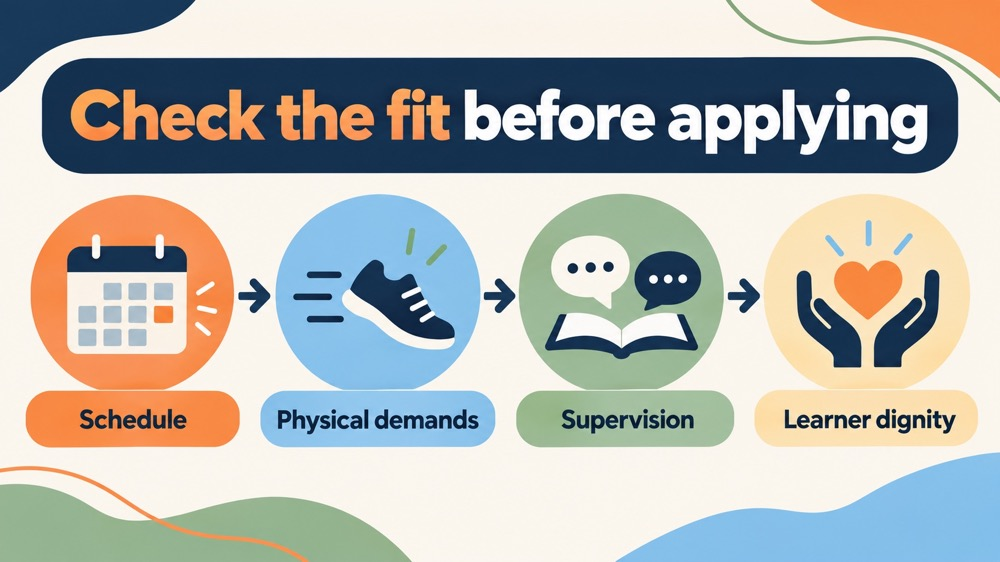
Use the live posting as a checklist, then answer these questions honestly:
- Can I meet the minimum qualifications? Separate required items from preferred items and confirm unclear certification language.
- Can I learn the technical work? Identify your experience with data, children, teaching, documentation, communication, or structured routines.
- Can I work within supervision? Consider whether you can receive feedback, follow an assigned plan, and ask for help when the situation changes.
- Can I meet the working conditions safely? Ask about schedule, travel, movement, physical demands, and accommodations before accepting an offer.
- Does the organization fit my values? Ask how it protects privacy, dignity, communication access, and learner preferences.
Prepare examples for an interview: a time you received corrective feedback, recorded something objectively, stayed calm during a change, protected someone’s privacy, or admitted that you needed instruction. Employers are usually looking for evidence of learning and responsibility, not a perfect personality.
Frequently asked questions
Do I need to be an RBT before applying for a behavior technician job?
Not always. Some employers hire entry-level technicians and provide training, while others require or prefer active RBT certification. Read the specific posting and verify current BACB requirements separately.
What personality is best for working with autistic children?
There is no single required personality. Look for patience, calmness, respect, flexibility, reliability, curiosity, and willingness to learn. These are behaviors that can be demonstrated and developed, not stereotypes about autistic children.
Are physical requirements the same at every clinic?
No. Movement, lifting, travel, schedule, and safety demands vary by setting and employer. Ask for the actual essential functions and the organization’s accommodation process.
Can a behavior technician change the plan during a difficult session?
An RBT should implement assigned procedures and contact the supervisor about clinical changes. A job title or personal confidence does not create independent treatment-design authority.
What should I ask during an interview?
Ask who supervises the role, how training and competency are evaluated, how data and feedback are handled, what the schedule and physical demands are, and how the organization protects learner dignity, privacy, and communication.
Official sources and scope
This guide was checked against BACB’s RBT resource page, supervision and training resources, the RBT Ethics Code, the RBT Test Content Outline, and representative current employer postings. Employer requirements change, so use the live posting and current BACB sources for an actual application.
Ready to practice the RBT concepts you just reviewed?
Try an independent, original RBT practice resource with exam-style questions, scoring, and answer explanations.
References
- Behavior Analyst Certification Board. RBT Test Content Outline, 3rd edition.
- Behavior Analyst Certification Board. RBT Handbook.
- Behavior Analyst Certification Board. RBT Ethics Code.