
The rbt application attestation signer is not simply the person who happens to supervise an applicant. The current BACB form identifies a qualified attesting certificant, the required relationship with the organization that employs the applicant, and the records that support the signature. This guide answers the search question rbt application attestation who can sign while keeping signer eligibility separate from timing and document checklists covered in other articles.
Table of Contents
- RBT application attestation who can sign: the short answer
- The credential requirement
- The organization relationship requirement
- Can a supervisor or HR person sign?
- What the attestor must be able to verify
- Signer checklist
- Frequently asked questions
- Official references and final reminder
RBT application attestation, signer eligibility, and verification
RBT Application Attestation: Who Can Sign?
Use the current BACB form to distinguish a qualified attesting certificant from a supervisor, HR employee, or convenient signer.
The rbt application attestation signer is not simply the person who happens to supervise an applicant. The current BACB form identifies a qualified attesting certificant, the required relationship with the organization that employs the applicant, and the records that support the signature. This article answers the question rbt application attestation who can sign while keeping signer eligibility separate from the date windows and general document checklist covered in other application resources.
Always compare the advice below with the current BACB RBT Certification Application Attestation form. The BACB application-processing page currently lists the form as version 3/2025. A saved PDF, training provider checklist, or old screenshot should not replace the current form and portal instructions.
RBT application attestation who can sign: the short answer
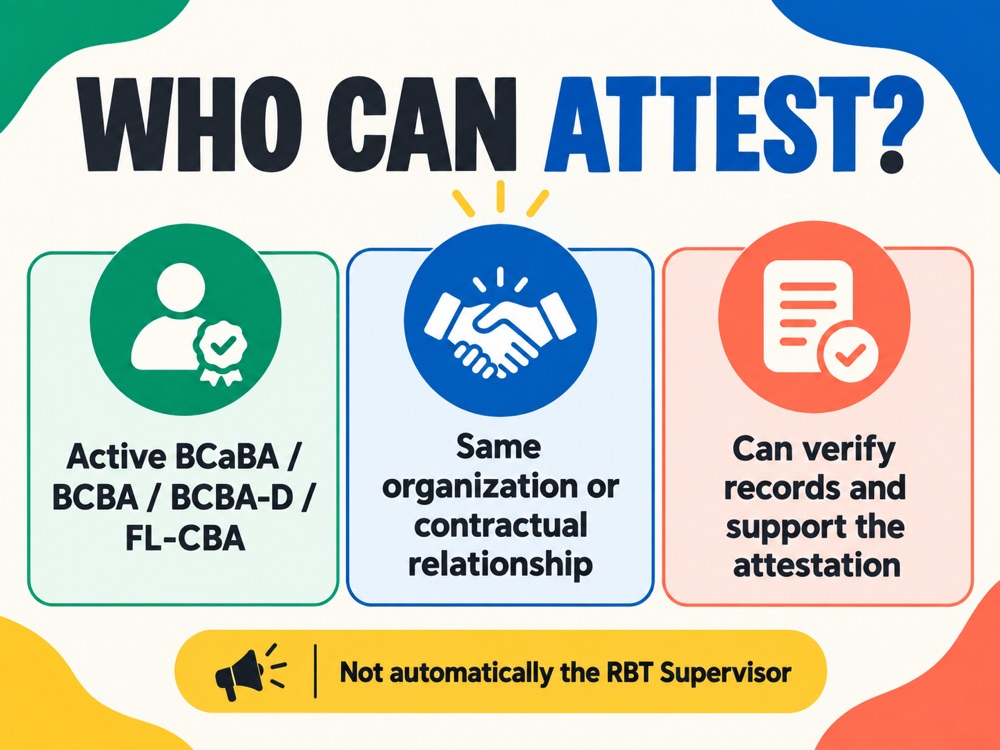
The signer must generally satisfy two gates at the same time:
- Active credential: The current form identifies an active BCaBA, BCBA, BCBA-D, or FL-CBA as the attesting certificant.
- Organization relationship: The certificant must be employed by the same organization as the applicant or have a contractual relationship with the organization that employs the applicant.
The signer also needs enough access to verify the application information and enough knowledge of the organization’s screening policies and process to support the attestation. A person may hold the right credential but still be the wrong signer if there is no qualifying relationship with the employing organization. Conversely, a trusted HR employee may know every record but cannot automatically serve as the attesting certificant without the required active credential.
The credential requirement
Before discussing job titles, check the attestor’s credential. The current attestation form asks for the attestor’s legal name, certification type, and BACB certification number or BACB ID. That information lets the application connect the signature to an identifiable certificant rather than to an unnamed manager.
The form’s current categories include:
- BCaBA
- BCBA
- BCBA-D
- FL-CBA
“Active” matters. Do not assume that a former credential, an expired credential, a pending application, or a different professional license satisfies the attestor field. Verify the credential status and number through the appropriate BACB information before the form is signed. If the current form changes its credential categories or wording, use that updated form as the controlling document.
The organization relationship requirement
The second gate is the relationship to the organization that employs the applicant. The attestor must either be employed by the same organization or have a contractual relationship with that organization. This is narrower than “has met the applicant” or “works in the same field.” The relationship gives the attestor a legitimate path to the organization’s records, policies, and screening process.
The form asks for the organization name and whether the attestor is employed or contracted. Complete those fields consistently with the applicant’s employer information. For a contracted certificant, keep the contract or other relationship evidence available. The BACB may request the contract in an audit, so the relationship should be real, current, and documentable rather than an informal favor.
| Question | What to confirm |
|---|---|
| Who employs the applicant? | Use the organization that actually employs the applicant for the relevant RBT application. |
| How is the attestor connected? | Record same-organization employment or a contractual relationship with that employer. |
| What evidence exists? | Keep employment or contract documentation and the organization’s verification records. |
| Do names match? | Check that the organization name is consistent across the form, application, and supporting records. |
Can a supervisor or HR person sign?
Not automatically. The attestor does not have to be the RBT Supervisor or RBT Requirements Coordinator. Those roles may be held by a qualified signer, but the job title itself does not create signing authority. The person still needs the active credential and the required organization relationship.
HR involvement is also a role distinction. HR staff may run or store criminal background and abuse registry checks. The current guidance allows an attestor to confirm information through the organization, including information handled by HR, when the attestor is familiar with the organization’s policies, procedures, and process. That does not mean an HR employee without an eligible active certificant credential can sign the attestation as the attesting certificant.
A supervisor who is not in one of the accepted credential categories should not sign merely because they observe the applicant’s work. A BCBA from another organization should not sign merely because they know the applicant. In both situations, the missing credential or organization relationship is the problem.
What the attestor must be able to verify
The signature is a confirmation, not a decorative approval stamp. The attestor should be able to review the relevant documents directly or confirm the information with the organization employing the applicant. The form connects the attestation to the applicant’s age, high-school-level education or equivalent, criminal background check, and abuse registry check.
Good verification practice includes:
- Confirming the applicant’s identity and the legal name used on the application.
- Checking the education or equivalent information through the organization’s accepted process.
- Reviewing or confirming the criminal background check and abuse registry check rather than relying on an unverified statement.
- Understanding what the organization’s HR or compliance team did, when it did it, and where the supporting records are stored.
- Keeping the attestation and supporting documentation available if BACB requests an audit response.
The attestor should pause when a record is incomplete, a date is unclear, the organization relationship has changed, or the form asks for information the attestor cannot support. A signature should reflect a reasonable verification process. It is not a guarantee that the BACB will approve the application, and it does not transfer responsibility for inaccurate information away from the signer or applicant.
Signer checklist
Before the applicant uploads the form, use this short signer check:
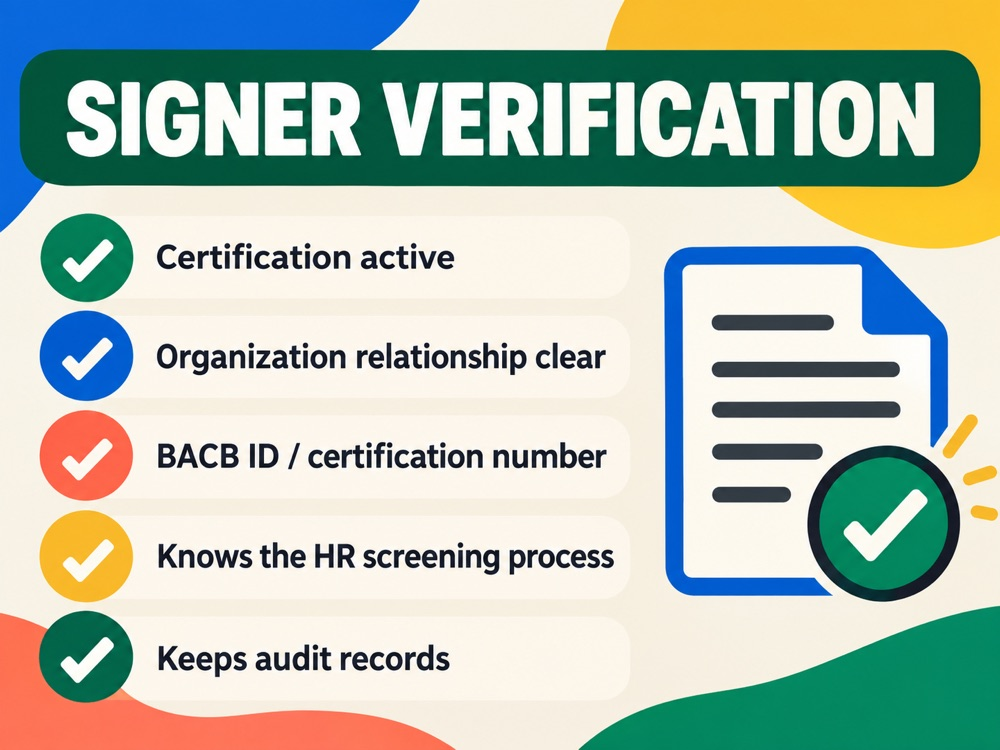
- Credential active: Confirm the attestor’s current accepted credential and BACB certification number or BACB ID.
- Organization relationship clear: Confirm same-organization employment or a documented contract with the applicant’s employing organization.
- Form fields complete: Check legal name, certification type, organization name, relationship type, signature, and date.
- Verification path understood: Know whether the information was reviewed directly or confirmed through the organization.
- HR process understood: Be familiar enough with the organization’s screening policies and procedures to explain the records if audited.
- Records retained: Store the completed form and supporting evidence securely according to the current BACB instructions and organization policy.
Frequently asked questions
Can any BCBA sign an RBT application attestation?
No. The current form’s organization relationship requirement matters. An active BCBA who is employed by the same organization or contracted with the applicant’s employing organization may qualify, but an unrelated BCBA should not sign simply because the credential is active.
Does the signer have to be the RBT Supervisor?
No. The attestor does not have to hold the RBT Supervisor or RBT Requirements Coordinator role. Those roles may overlap with the attestor role, but the current credential and organization relationship requirements still apply.
Can an HR employee sign the form?
Only if that person also meets the current form’s attesting-certificant requirements. HR may provide or verify screening records, but HR responsibility alone does not replace the required active credential.
What if the attestor is contracted rather than employed?
A contractual relationship with the organization that employs the applicant may satisfy the relationship route when it is genuine and documentable. Keep the contract available in case BACB requests it during an audit, and confirm that the current form still uses the same wording.
Does a completed signature guarantee certification?
No. It supports the application. The BACB still controls application review, action items, exam authorization, and certification decisions under the current requirements and portal instructions.
Official references and final reminder
For the controlling details, review the current RBT Certification Application Attestation form, the BACB application-processing updates, the RBT application tips, and the RBT Handbook. The current BACB form and portal instructions control if a credential category, relationship rule, field, or process changes.
This article is an educational summary of public BACB guidance, not individualized certification, legal, employment, immigration, or financial advice. If the signer’s credential, employment relationship, contract, or verification records are unclear, resolve that uncertainty with the organization and the current BACB instructions before submitting the application.
Ready to practice the RBT concepts you just reviewed?
Try an independent, original RBT practice resource with exam-style questions, scoring, and answer explanations.
References
- Behavior Analyst Certification Board. RBT Test Content Outline, 3rd edition.
- Behavior Analyst Certification Board. RBT Handbook.
- Behavior Analyst Certification Board. RBT Ethics Code.