
A registered behavior technician practice test can mean a ten-question quiz, a mixed-domain checkpoint, or a full timed simulation. Those tools are not interchangeable. A quick quiz can reveal whether one concept is familiar; a practice test can show whether you can switch between domains; a full mock can rehearse pacing. Choosing the wrong format can make your score hard to interpret.
Table of Contents
- What a registered behavior technician practice test should do
- Match the format to the study job
- Check current RBT scope
- Audit the question and explanation
- Use a practice test as a baseline
- Build a domain retest
- Keep practice independent and ethical
- Common practice-test mistakes
- Frequently Asked Questions
- References
This guide compares the jobs of each format, gives you a checklist for evaluating an independent practice test, and shows how to turn results into a targeted retest. It keeps the current RBT blueprint and professional boundaries visible without implying that any independent item is official BACB content.
RBT Training is an independent educational resource. It is not affiliated with, operated by, or endorsed by the Behavior Analyst Certification Board (BACB). The examples and practice prompts below are newly written for independent study; they are not official, recalled, leaked, or BACB-endorsed questions. No practice test or score guarantees a passing result.
What a registered behavior technician practice test should do
A useful practice test gives you evidence about applied understanding. It should make the task and scenario clear, include plausible options, explain the controlling clue, and point to a domain or next action. It should not depend on secret “real questions,” vague authority claims, or a score that is presented as a guarantee.
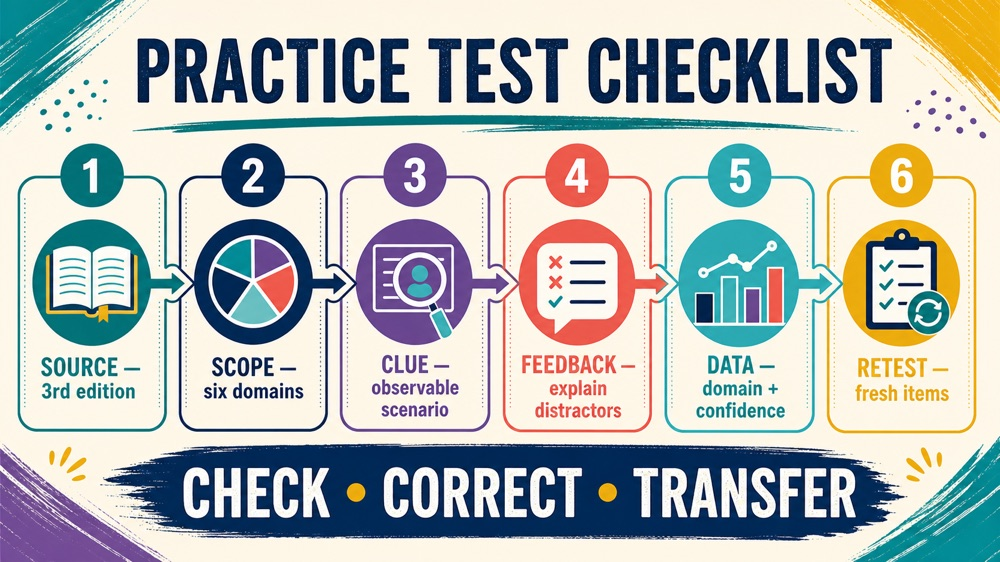
| Feature | What to inspect | Why it matters |
|---|---|---|
| Current source | RBT Test Content Outline, 3rd edition, update date, and source link. | Prevents a test from quietly using an older task structure. |
| Scenario quality | Observable facts and one or more decisive conditions. | Tests application instead of term recognition. |
| Distractors | Wrong options differ for a reason, not only by wording. | Reveals whether you can discriminate nearby concepts. |
| Feedback | Correct rule, why the selected option fits, and why alternatives fail. | Turns a mistake into a teachable correction. |
| Review data | Domain, confidence, time, and next practice step. | Lets you choose the right format for the next session. |
Question count is only one attribute. A short set with well-written explanations can be more useful than a large bank that repeats stems or hides the rationale.
Match the format to the study job
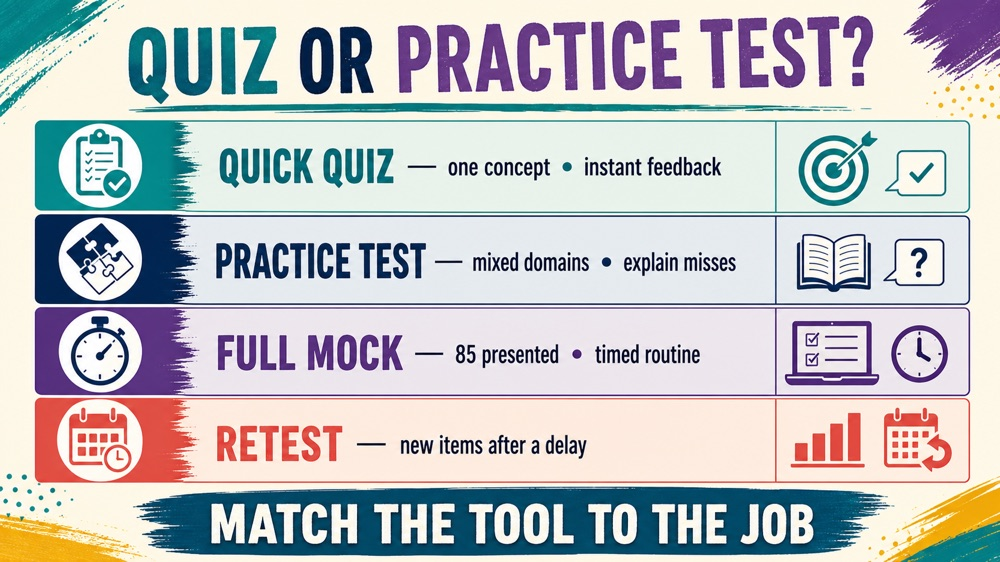
Use the smallest tool that answers the question you have today. Do you need to learn one distinction, check mixed-domain transfer, or rehearse the full routine?
| Format | Best use | What it cannot tell you alone |
|---|---|---|
| Quick quiz | Check one concept immediately after learning it. | Whether you can switch domains or manage a full session. |
| Practice test | Mix topics, apply rules, and identify a weak area. | Whether your timing will hold across a full exam. |
| Full mock | Rehearse a long, timed question session and review stamina. | Which concept caused a miss unless the result includes explanations and domain data. |
| Focused retest | Check whether a repaired rule transfers to new scenarios. | Overall readiness if the set is too narrow. |
Start with a quick quiz when the concept is new. Use a mixed practice test after you have studied several domains. Use a full mock after you can explain the common contrasts without looking. Then return to a focused retest rather than repeating the same form until the answers feel familiar.
Check current RBT scope
The academic anchor is the RBT Test Content Outline, 3rd edition. It describes 43 tasks across six domains. The exam context used in this workflow includes 75 scored questions and 10 unscored pilot questions. Use those facts to check whether a practice resource identifies current scope, but do not treat an independent test as an official exam form.
- A — Data Collection and Graphing: measurement procedures, data recording, and graph interpretation.
- B — Behavior Assessment: supporting assessment and communicating observations objectively.
- C — Behavior Acquisition: implementing teaching, prompts, reinforcement, chaining, shaping, and generalization as written.
- D — Behavior Reduction: implementing reduction procedures safely and following the plan.
- E — Documentation and Reporting: objective records, relevant communication, and confidentiality.
- F — Ethics: dignity, boundaries, supervision, competence, and professional conduct.
Broad ABA questions may be interesting but still be a poor RBT practice choice if they test material outside the current outline or ask the technician to make an independent clinical decision. Scope is part of question quality.
Audit the question and explanation
Before accepting a practice test as a study tool, inspect a few items manually:
- Read the stem: can you identify what was observable and what was only interpretation?
- Find the clue: does a timing, unit, plan, or consequence condition control the answer?
- Check the options: are the distractors plausible but specifically wrong?
- Read the rationale: does it teach a portable rule rather than restate the answer?
- Test transfer: can you write a new scenario in which one detail changes?
For example, an item about data may ask for rate rather than frequency because the count is divided by time. An item about preference may show a choice but not enough evidence to call the item a reinforcer. A documentation item may use a subjective label that should be replaced with observable language. The explanation should name the distinction each time.
Use a practice test as a baseline
Take the first mixed test for information, not validation. Before you answer, mark your confidence. After you submit, record:
| Field | Example note |
|---|---|
| Domain | Data Collection and Graphing |
| Confidence | Low, medium, high before feedback |
| Decision clue | “per hour” made rate the better match |
| Error type | Concept, application, scope, reading, or timing |
| Next action | Write two new rate-versus-frequency scenarios |
Correct answers deserve review when confidence was low. A guess may inflate a percentage without showing stable understanding. Wrong answers with high confidence deserve special attention because they can reveal a rule inversion or a scope assumption.
Build a domain retest
Use the baseline to choose a focused retest. If the weak area is skill acquisition, make the next set distinguish prompting, prompt fading, reinforcement, chaining, shaping, and generalization. If it is behavior reduction, check the plan, function-related clues, differential reinforcement, extinction, safety, and supervision boundaries. If it is ethics or documentation, practice objective communication and client dignity decisions.
- Choose one domain and no more than two close concept pairs.
- Review the source definition and write a plain-language rule.
- Create or select fresh scenarios with changed settings or behaviors.
- Explain the correct choice and one distractor aloud.
- Retest after a delay, then compare transfer and confidence.
Do not retake the exact same questions immediately and call the higher score mastery. Repetition can measure memory of the answer order rather than the concept.
Keep practice independent and ethical
Use independent practice with clear labels. The RBT examination is secure content; a trustworthy resource does not advertise recalled or leaked questions. It also does not turn a practice test into a clinical authorization.
- Use original examples: do not copy client data, screenshots, or exam content into public study files.
- Keep the source visible: link to the official TCO and current requirements resources.
- Protect role boundaries: select options that implement the written plan or seek supervision when appropriate.
- Separate practice from certification: a test score does not establish practical competence or official eligibility.
If a question asks you to invent an intervention, diagnose, or disclose client information, treat the item as a scope warning and return to the handbook, ethics source, and supervisor route.
Common practice-test mistakes
- Choosing by question count only: inspect explanations and task mapping.
- Using a full mock too early: learn the concept before making timing the main variable.
- Repeating the same form: use fresh items to test transfer.
- Ignoring confidence: guessed correct answers are still review items.
- Skipping distractors: understand why the nearest wrong option fails.
- Mixing old and current scope: check edition, domain names, and update date.
- Calling practice official: independent content must stay clearly labeled.
Bottom line: a registered behavior technician practice test is useful when its format matches your study job, its questions reflect current RBT scope, its explanations teach distinctions, and its results lead to a fresh retest. Use a quiz to learn, a practice test to diagnose, and a full mock to rehearse the routine.
Ready to choose your next practice format?
Start with independent RBT questions, record the domain and clue, and retest with new scenarios.
Try Free RBT Practice Questions →
Frequently Asked Questions
What is the difference between a quiz and a registered behavior technician practice test?
A quiz usually checks one concept quickly. A practice test mixes topics and provides a broader diagnostic, while a full mock adds long-session and pacing practice.
How do I know whether a practice test is current?
Check for the RBT Test Content Outline, 3rd edition, a six-domain map, an update date, and a link to the source.
Should I use a timed practice test?
Use untimed practice to learn explanations first, then timed sets to rehearse pacing. Record the mode so you interpret the score correctly.
What should I do after a low practice-test score?
Classify each miss by domain, confidence, clue, and error type. Study the specific distinction, then retest with new questions after a delay.
Are independent practice-test questions official RBT exam questions?
No. Independent questions are study aids. They should not be presented as official, recalled, leaked, or BACB-endorsed exam content.
References
- Behavior Analyst Certification Board. RBT Test Content Outline, 3rd edition.
- Behavior Analyst Certification Board. RBT Handbook, updated June 2026.
- Behavior Analyst Certification Board. RBT Ethics Code.
- Free RBT practice-test resource. Reviewed for competitor research; not an endorsement.
- RBT Hub practice-test resource. Reviewed for competitor research; not an endorsement.
- RBT practice-test resource. Reviewed for competitor research; not an endorsement.