

Behavior technician hiring works best when the employer defines the actual role before reviewing resumes. A fair process explains duties, scope, training expectations, supervision, privacy, safety, scheduling, and onboarding support; then it evaluates candidates with consistent, job-related questions rather than vague personality tests or promises.
Table of Contents
- Behavior technician hiring: the short answer
- Define the actual role
- Verify credentials and training
- Plan supervision and support
- Use fair, job-related interview questions
- Build a safe onboarding plan
- Recognize hiring red flags
- Frequently asked questions
Role definition, credentials, supervision, interview questions, privacy, safety, and onboarding
Behavior Technician Hiring: A Fair, Role-Aware Checklist
Define the job clearly, evaluate job-related skills consistently, and plan supervision before the first day.
Behavior technician hiring works best when the employer defines the actual role before reviewing resumes. A fair process explains duties, scope, training expectations, supervision, privacy, safety, scheduling, and onboarding support; then it evaluates candidates with consistent, job-related questions rather than vague personality tests or promises.
A behavior technician may be an RBT, a trainee, or another employee title depending on the organization and current requirements. Do not use the titles interchangeably without checking the job’s credential and supervision expectations. A certificate, course completion, or interview impression does not replace the organization’s current process for verification and onboarding.
Behavior technician hiring: the short answer
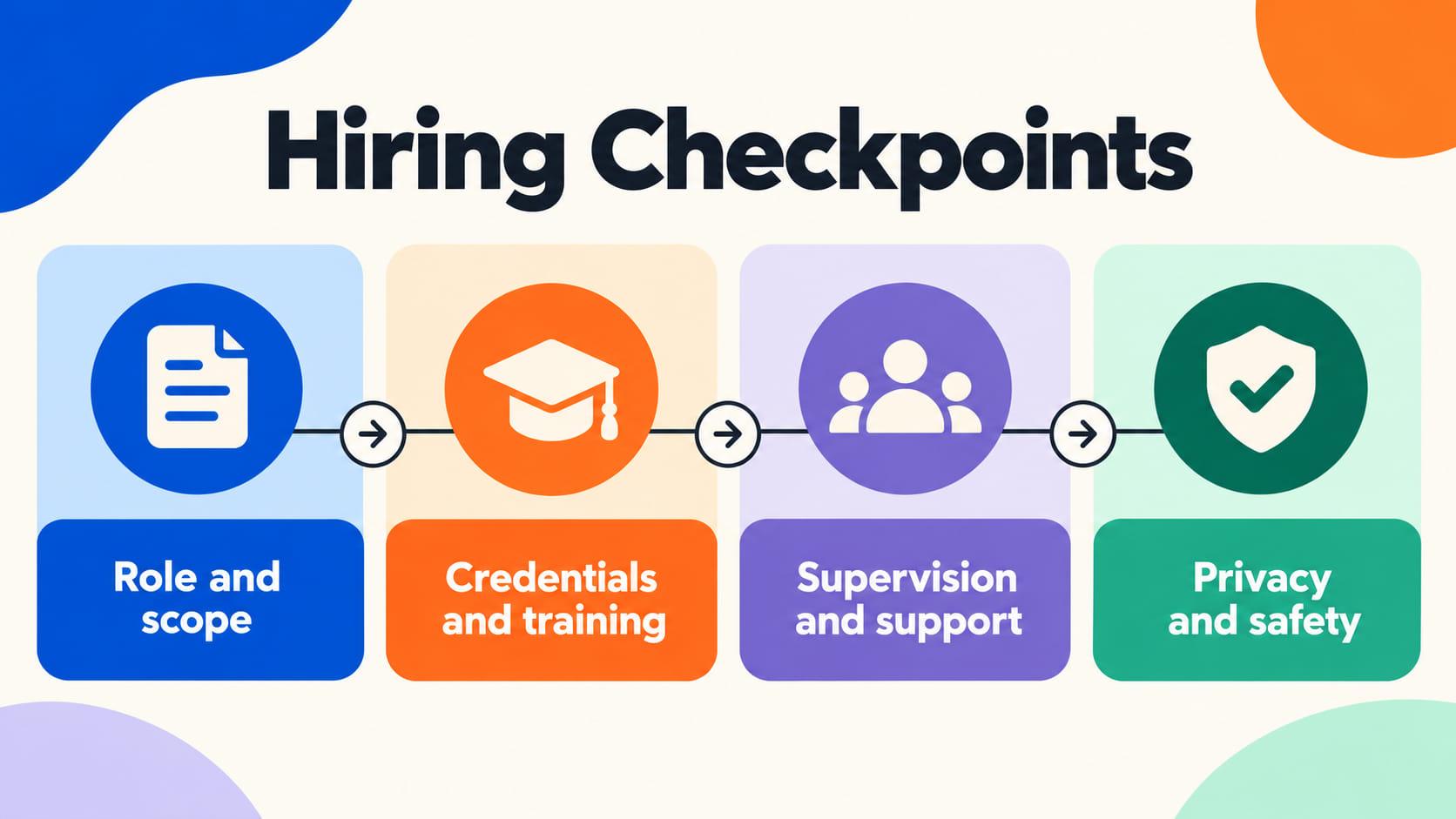
Before posting the job, write down:
- What services and settings will the employee support?
- Which tasks are implementation tasks, and which decisions belong to a supervisor or other qualified professional?
- What training, credential, competency, background, and documentation steps apply?
- Who provides supervision, feedback, scheduling support, and escalation?
- How will privacy, safety, accessibility, travel, pay, and scheduling expectations be explained?
Define the actual role
Start with duties the employee will perform, not an impressive title. A clear description may include implementing assigned skill-acquisition or behavior-reduction procedures, recording defined data, preparing materials, communicating observations, participating in supervision, and following safety and privacy procedures.
Also state what the role does not include. A behavior technician should not be advertised as independently diagnosing, designing a treatment plan, changing a reinforcement procedure without direction, or making clinical decisions that belong to a qualified supervisor. A vague job description can place a new employee and clients at risk because expectations are not aligned before hiring.
Describe the setting honestly. Tell candidates whether work is home-based, center-based, school-based, community-based, or mixed; whether travel is required; whether sessions involve lifting or other physical demands; and how cancellations or schedule changes are handled. Ask HR or qualified counsel to review employment and accessibility language rather than improvising legal requirements.
Verify credentials and training
Use current official materials when listing RBT or other credential requirements. The BACB RBT page and Handbook should be the starting point for applicable eligibility, training, competency, examination, supervision, and maintenance information. Requirements and processes can change, so do not copy an old job post and assume it is current.
Ask candidates for the documentation the employer’s process requires, then verify it consistently. A fair process does not demand more proof from one candidate because an interviewer has a personal preference. If the employee is in training, say which steps the organization will support and which the candidate must complete.
Do not treat a high quiz score or a polished certificate as proof of performance in every service context. Hiring should include a plan for observation, competency assessment when applicable, supervised practice, and feedback. The employer should also explain who pays for required training or screening and when those expectations apply.
Plan supervision and support
Supervision should exist before the employee starts. Identify the supervisor, how direction is delivered, how questions are answered during sessions, how feedback is documented, and what happens when the written plan is unclear. A new technician should know that asking for help is part of competent practice, not a reason to hide uncertainty.
Plan for realistic support. A technician may need modeling, role-play, data practice, observation, correction, and time to learn the organization’s documentation system. Avoid assigning a full schedule immediately without checking training, supervision access, transportation, and the employee’s ability to follow the relevant procedures.
Privacy belongs in the plan. Candidates should not be asked to use real client records, videos, or names for a portfolio or interview demonstration. Use fictional scenarios or properly authorized materials, and explain how the organization controls access to service records.
Use fair, job-related interview questions
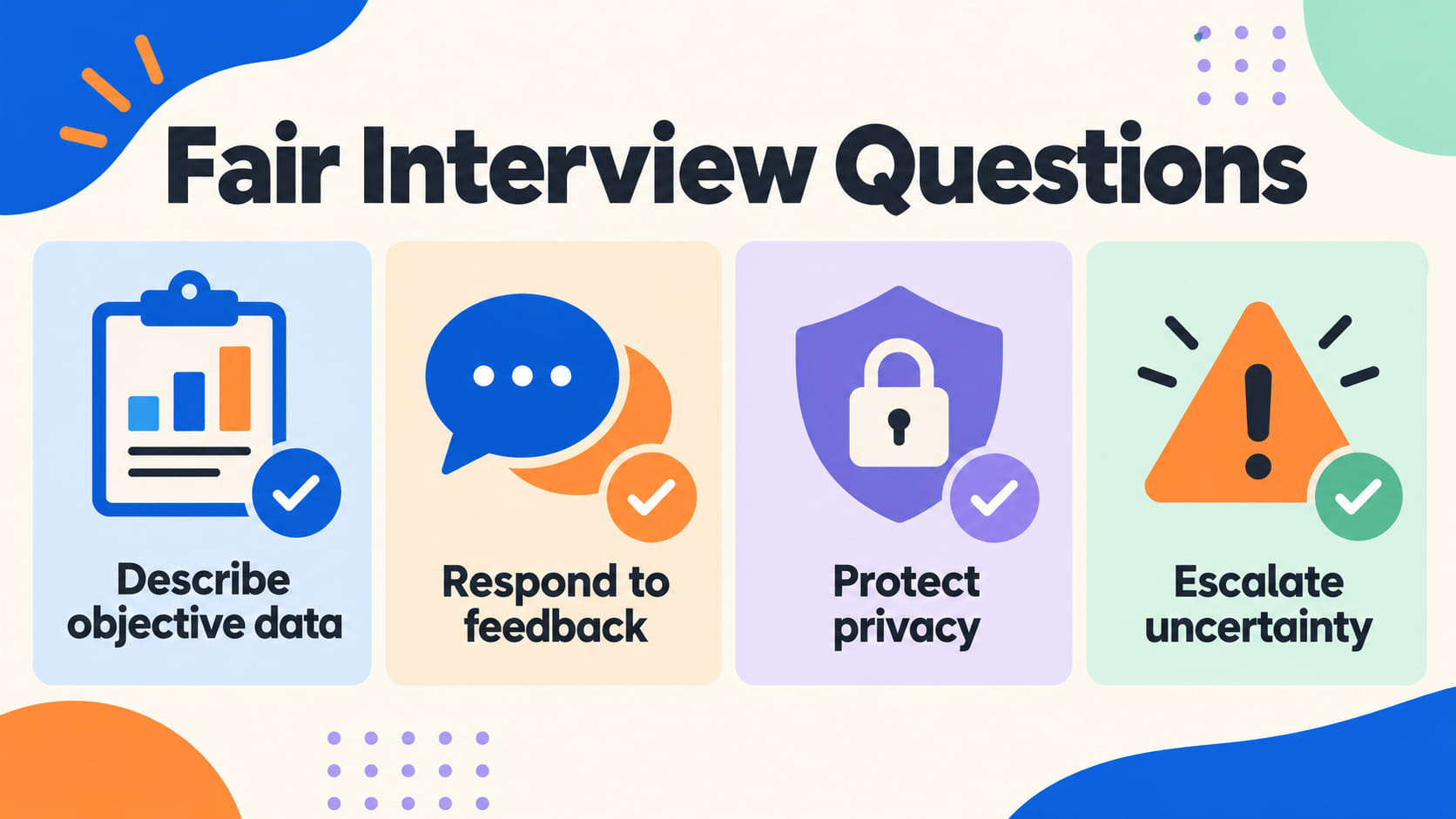
Ask every candidate a consistent core set of questions and score answers against defined criteria. Good questions examine observable work behaviors rather than asking the candidate to perform a personality. Examples include:
- “Tell us how you would describe an observed behavior without adding a judgment.”
- “What would you do if the written plan is unclear during a session?”
- “How do you respond when a supervisor gives corrective feedback?”
- “How would you protect privacy when discussing a session with a team member?”
- “What would you record after a measurement procedure does not go as expected?”
Evaluate the reasoning: objective description, willingness to seek direction, privacy awareness, accurate documentation, and respect for scope. Do not reward confident answers that propose independent treatment changes. A candidate can be thoughtful and teachable even when they do not yet know every technical term.
Build a safe onboarding plan
Onboarding should connect the job description to actual supervised practice. Cover the service model, role boundaries, documentation, incident reporting, confidentiality, data systems, communication channels, emergency procedures, and how to contact a supervisor during sessions.
Use observation and feedback before expecting independent fluency. Document what was taught, what was observed, what feedback was given, and what remains to be checked. If a required competency assessment applies, do not mark it complete merely because orientation ended.
Give the employee a way to raise concerns. The employee should know how to report a safety issue, privacy concern, missing material, possible boundary problem, or mismatch between the plan and the request being made. A culture that rewards hiding mistakes undermines both client protection and data quality.
Recognize hiring red flags
- Scope inflation: the job asks a technician to design treatment, diagnose, or work without required direction.
- Credential shortcuts: the employer treats an old certificate or a verbal claim as sufficient without a consistent verification process.
- No supervision plan: the posting describes client duties but not who provides direction or feedback.
- Privacy shortcuts: applicants are asked to bring real client notes, videos, or names to interviews.
- Personality screening: hiring depends on vague labels instead of job-related behaviors and documented criteria.
- Guaranteed outcomes: the employer promises certification, hours, advancement, or a caseload that depends on conditions it cannot control.
Frequently asked questions
What should behavior technician hiring include?
Define duties and boundaries, verify applicable training or credentials, explain supervision, use consistent job-related questions, protect privacy, and provide supervised onboarding with feedback.
Does an RBT credential prove a person is ready for every job?
No. It is relevant evidence within the current credential process, but each employer must evaluate setting-specific skills, support needs, documentation, safety, and supervision fit.
Can an employer hire a technician who is still training?
That depends on the employer’s process and the current requirements that apply. State clearly which duties are permitted, what supervision is provided, and which steps must be completed before the employee performs each task.
What should an interviewer avoid?
Avoid questions that invite private client information, require an applicant to guess outside scope, rely on vague personality judgments, or promise outcomes the employer cannot guarantee. Use qualified HR or legal support for employment-law questions.
Role reminder: This is educational information, not HR, employment-law, clinical, or legal advice. Verify current BACB requirements and consult qualified HR or legal support for employment decisions and accommodations.
Official starting points: the BACB RBT page, RBT Handbook, supervision and training resources, and RBT Ethics Code.
Ready to practice the RBT concepts you just reviewed?
Try an independent, original RBT practice resource with exam-style questions, scoring, and answer explanations.
References
- Behavior Analyst Certification Board. RBT Test Content Outline, 3rd edition.
- Behavior Analyst Certification Board. RBT Handbook.
- Behavior Analyst Certification Board. RBT Ethics Code.