
ABA technician requirements are not one universal checklist. They can include the duties of the role, the employer’s hiring expectations, the current RBT credential pathway, supervision, training, and site-specific policies. Read the job posting, verify current official sources, ask what the employer requires, and avoid assuming that a course certificate or job title answers every question.
Table of Contents
- ABA technician requirements: the short answer
- Layer 1: the technician role
- Layer 2: employer requirements
- Layer 3: current credential steps
- Supervision and records
- Questions to ask before applying
- Requirements mistakes to avoid
- Frequently asked questions
ABA technician roles, job requirements, RBT pathways, supervision, and application questions
ABA Technician Requirements: Separate the Role, Employer, and Credential
A practical way to read job postings, verify official requirements, and ask better questions before applying.
ABA technician requirements are not one universal checklist. They can include the duties of the role, the employer’s hiring expectations, the current RBT credential pathway, supervision, training, and site-specific policies. Read the job posting, verify current official sources, ask what the employer requires, and avoid assuming that a course certificate or job title answers every question.
Two organizations can use the same title while expecting different schedules, documentation, transportation, background checks, training, or experience. Separate what is official from what is a workplace preference before spending time or money.
ABA technician requirements: the short answer
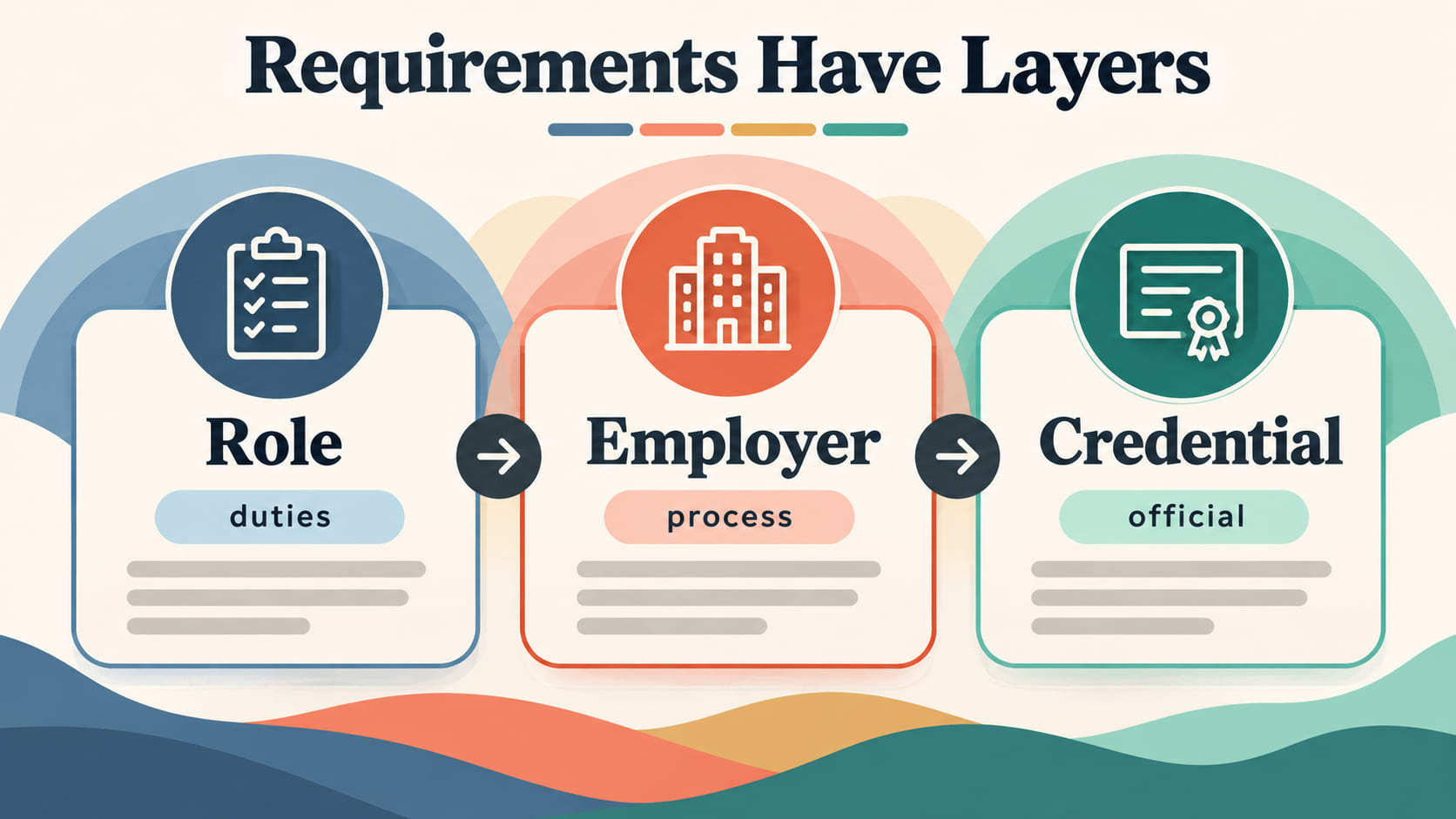
Read the requirements in three layers:
- Role: What work will the technician perform, and what decisions stay with the supervisor?
- Employer: What does this organization require for hiring, onboarding, scheduling, documentation, and safety?
- Credential: Which current official credential or pathway, if any, applies to this job?
This structure prevents a common mistake: treating an employer’s preference as a universal credential rule or treating an official credential as proof that an employer must hire someone.
Layer 1: the technician role
A behavior technician may implement assigned behavior-analytic services, follow written procedures, collect defined data, support skill acquisition or behavior reduction, document sessions, communicate observations, and protect privacy. The exact duties depend on the service setting and supervision.
Role requirements should explain what the technician does and what the technician does not do. An RBT works under supervision and should not independently diagnose, design treatment, change a plan because it seems convenient, or supervise another person simply because of experience.
When a posting uses broad phrases such as “manage cases” or “develop programs,” ask what those words mean in the actual role. The title alone cannot establish decision authority or scope.
Layer 2: employer requirements
Employers may set additional hiring and onboarding expectations. These can include availability, transportation, location, background screening, references, training modules, health or safety procedures, documentation systems, communication expectations, and the ability to work in a particular setting.
These requirements are not automatically BACB requirements. Ask which items are legally required, which are organization policy, which are client or payer requirements, and which are preferences for the position. If the answer is unclear, request the written policy or job description.
Also ask about compensation and time commitments in practical terms: paid versus unpaid training, travel, cancellations, documentation time, supervision time, and what happens when a case ends. The posting may not answer every question, but a transparent employer should explain the arrangement.
Layer 3: current credential steps
If a job requires or prefers RBT certification, use the current BACB RBT page, handbook, and other official materials to verify the pathway. Training, competency evaluation, application, examination, supervision, and maintenance may be separate steps. Do not rely on an old checklist or course advertisement for current details.
A training certificate does not automatically equal the credential. A job offer does not automatically create a credential. A credential does not guarantee a job. Keep those statements separate when comparing programs and employers.
If the position uses a different technician title, ask whether the employer requires RBT certification, supports it, or uses an internal training and supervision process. The answer can vary by organization and jurisdiction, so avoid turning one posting into a universal rule.
Supervision and records
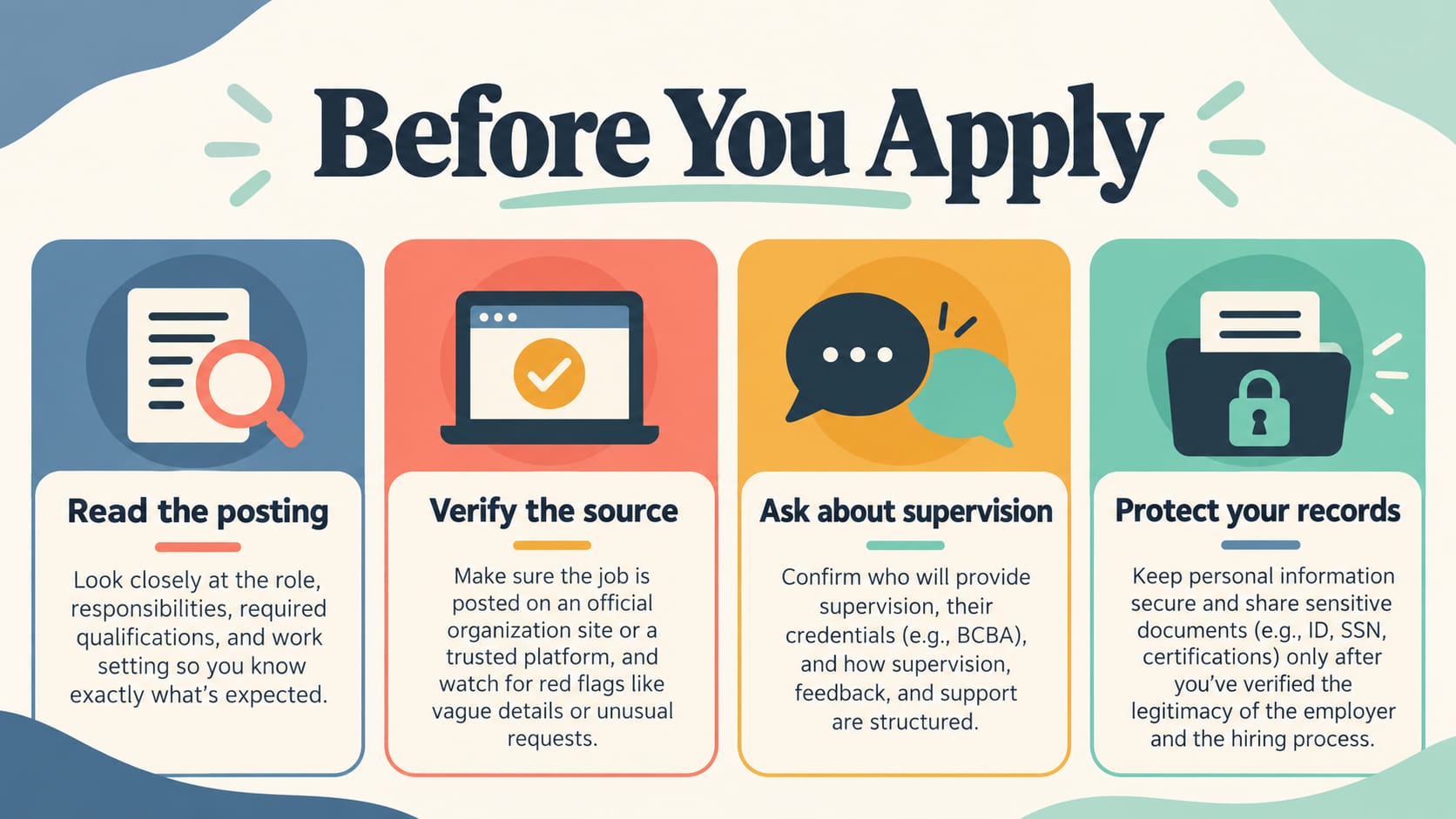
Ask who the responsible supervisor is, how observation and feedback occur, how questions are escalated, and where supervision and session records are kept. A credential or job title does not explain whether the arrangement provides workable access to direction.
Before starting, understand which work you may perform, which decisions need approval, how data are recorded, and what happens when the supervisor is unavailable. Do not sign for work you did not perform, copy private records into a personal file, or continue an unclear procedure without asking for direction.
Questions to ask before applying
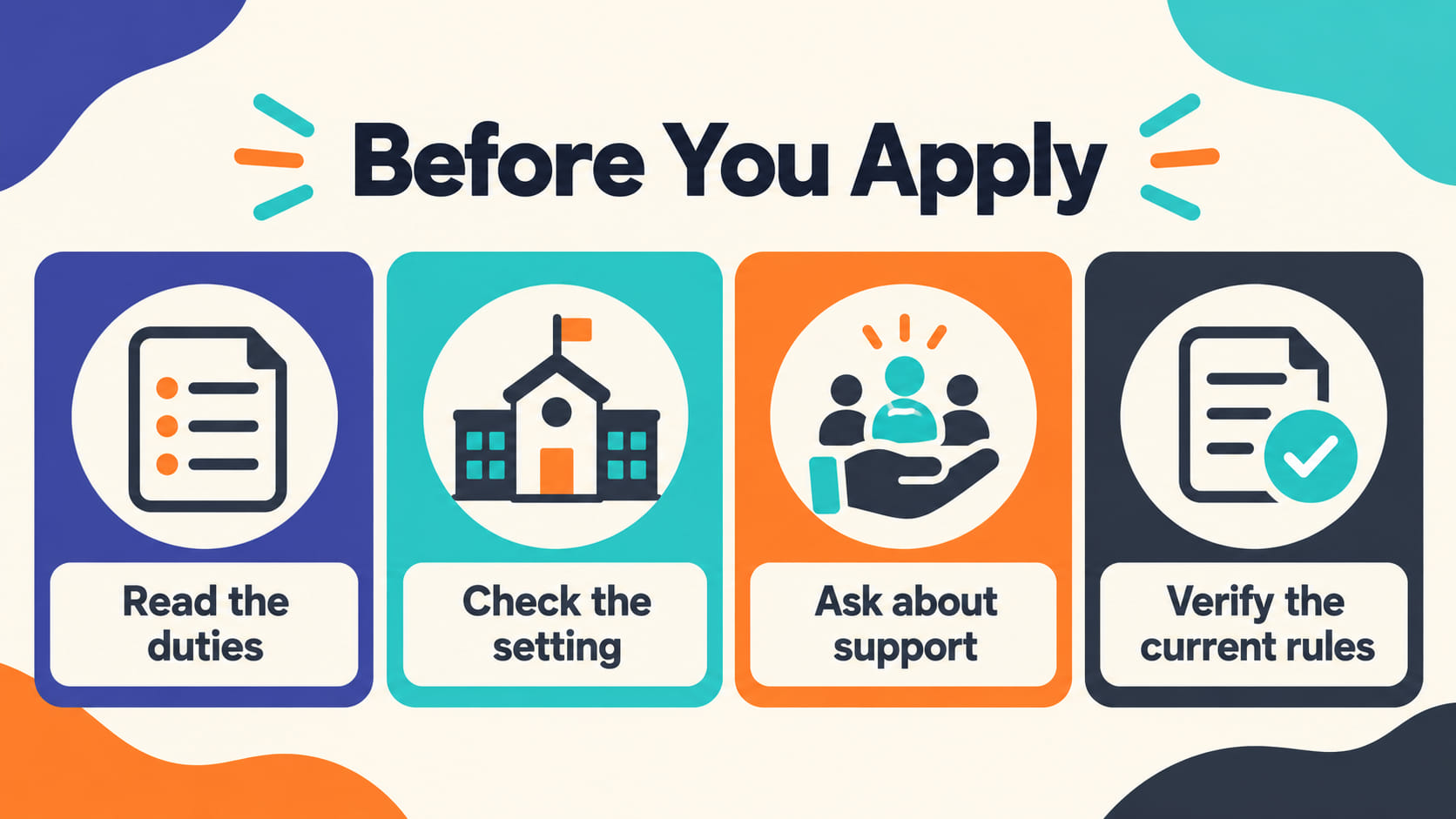
- Which duties are assigned to the technician, and which decisions belong to the supervisor?
- Is an RBT credential required, preferred, supported, or not part of this role?
- Which training and competency steps are paid, supervised, and recorded?
- Who provides supervision, how can I reach them, and what is the backup route?
- What are the expectations for data, notes, privacy, travel, cancellations, and schedule changes?
- Which requirements are current official rules and which are employer policy?
- What does the employer not promise: certification, hours, client assignment, pay, or a particular outcome?
When two postings look similar, compare the support structure as carefully as the headline requirements. One employer may provide paid training, consistent observation, and a clear supervisor; another may expect a credential and prior experience before the first day. Neither arrangement should be assumed from the job title alone.
Keep your own checklist of the source and date for each answer. Requirements can change, and a saved screenshot or conversation is easier to evaluate when you know whether it described an official credential, an employer policy, or a temporary hiring preference. This simple habit prevents avoidable confusion later when applying for work in this field with confidence.
Requirements mistakes to avoid
- Assuming every technician job is the same: read the actual posting and service setting.
- Confusing a preference with a rule: ask who sets the requirement and where it is written.
- Trusting old credential information: verify current official pages and handbook versions.
- Ignoring supervision: the person who hires you may not be the person who provides technical direction.
- Buying a guarantee: no checklist, course, or employer can promise every result.
- Overstating your experience: describe actual skills, training, and supervised duties accurately.
Frequently asked questions
Are ABA technician requirements the same as RBT requirements?
Not necessarily. A technician job may have employer requirements, while RBT certification has current official requirements. Compare the layers and verify each source.
Does every ABA technician need a degree?
Do not assume a universal answer. Check the actual employer posting and current official credential materials that apply to the role you are considering.
Can I apply before completing the credential?
Some employers may hire candidates at different stages, while others may require a credential before work begins. Ask the employer which stage is required and what supervision or onboarding is available.
What is the most important requirement?
Clarity about the actual duties, current credential pathway, supervision, safety, privacy, and records is more useful than relying on a single impressive-sounding requirement.
Role reminder: This is educational career information, not credentialing, employment, legal, or clinical advice. Verify current BACB materials and the employer’s written requirements for your situation.
Official starting points: the BACB RBT page, RBT Handbook, RBT Test Content Outline, and supervision and training resources.
Ready to practice the RBT concepts you just reviewed?
Try an independent, original RBT practice resource with exam-style questions, scoring, and answer explanations.
References
- Behavior Analyst Certification Board. RBT Test Content Outline, 3rd edition.
- Behavior Analyst Certification Board. RBT Handbook.
- Behavior Analyst Certification Board. RBT Ethics Code.