
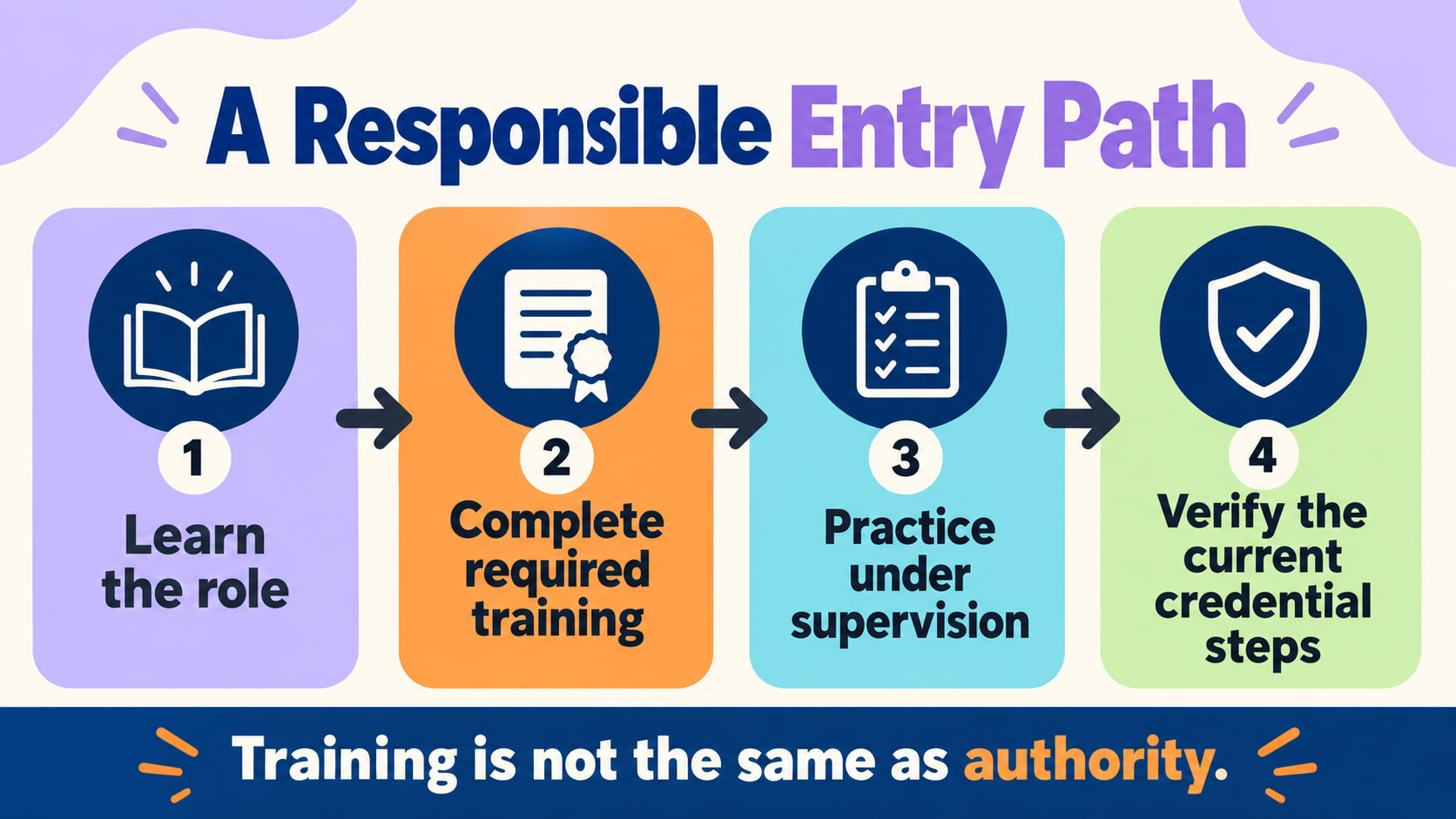
If you search for “attain ABA behavior technician,” you may be asking how to enter behavior-analytic work or how to pursue the Registered Behavior Technician pathway. The wording is not a credential name, so the safest answer is to separate employer hiring steps from current official RBT requirements. Learn the role, complete the requirements that actually apply, practice under supervision, and confirm your scope before accepting responsibilities.
Table of Contents
- Attain ABA behavior technician: the short answer
- The two paths people often mean
- How to verify current requirements
- Why supervised practice matters
- Scope after training
- Questions to ask before enrolling or applying
- Frequently asked questions
Attain ABA behavior technician training, RBT pathway, supervised practice, scope, and employer questions
Attain ABA Behavior Technician: Training, Steps, and Scope
Translate an awkward search phrase into a responsible path for entering ABA work without confusing training, employment, and credentialing.
If you search for “attain ABA behavior technician,” you may be asking how to enter behavior-analytic work or how to pursue the Registered Behavior Technician pathway. The wording is not a credential name, so the safest answer is to separate employer hiring steps from current official RBT requirements. Learn the role, complete the requirements that actually apply, practice under supervision, and confirm your scope before accepting responsibilities.
This distinction matters because a training provider can teach useful material, an employer can hire someone into a support position, and a credentialing body can set requirements. Those are connected parts of a career path, but they are not the same decision or the same source of authority.
Attain ABA behavior technician: the short answer
A responsible path usually has four questions:
- What role are you seeking? Is the target an employer-defined behavior technician position, the RBT credential, or both?
- Which requirements are current? Use the official source for eligibility, training, examination, supervision, application, and maintenance details.
- How will competence be demonstrated? Look for instruction, practice, feedback, and a clear check of the assigned skills.
- What remains outside scope? Training does not automatically authorize independent diagnosis, treatment design, plan changes, or supervision.
The two paths people often mean
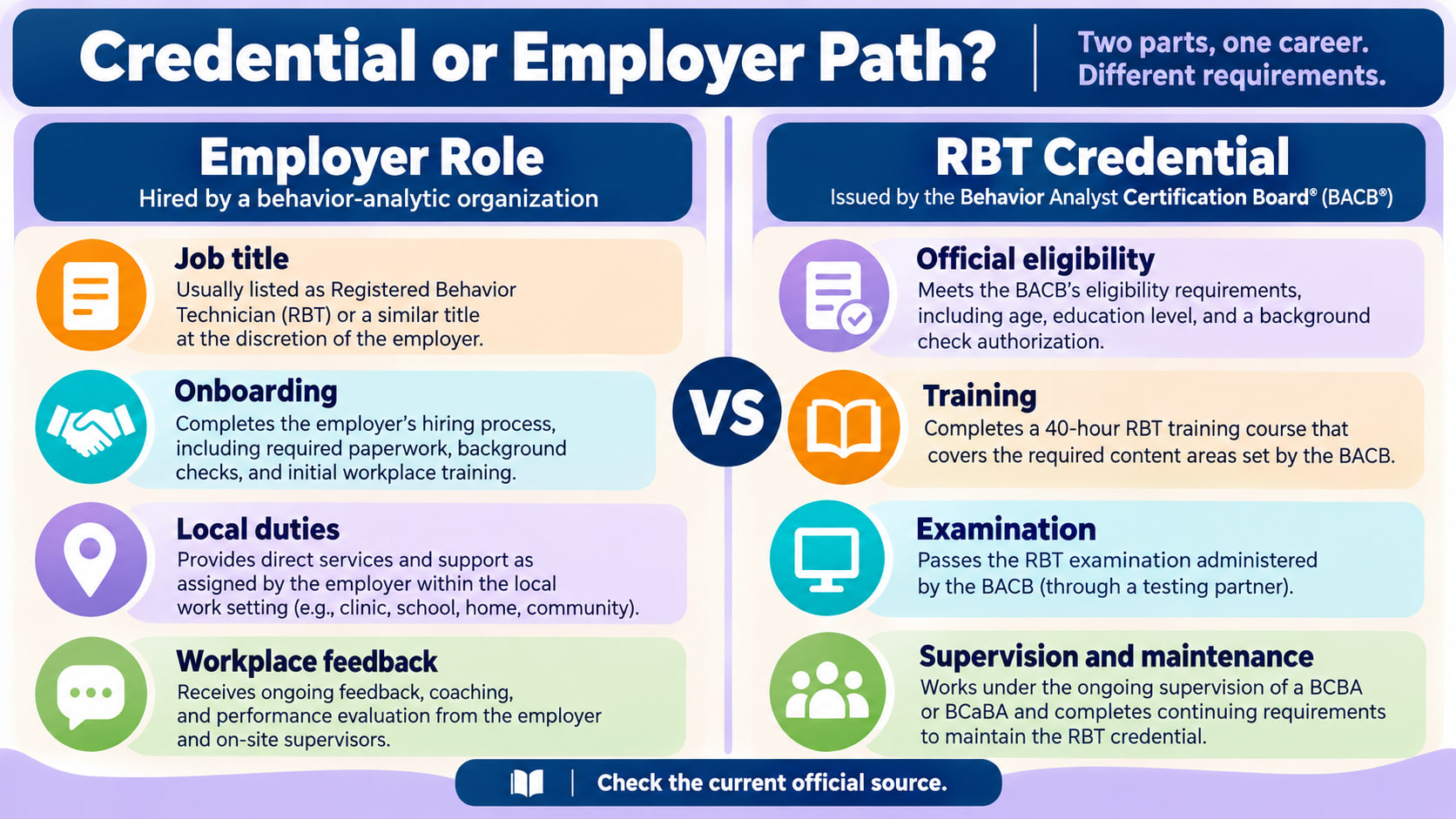
The employment path begins with a job description. An organization may hire a behavior technician, assistant, trainee, or similar support role and then provide onboarding, workplace training, documentation instruction, and local supervision. The employer decides which duties fit that position, subject to applicable rules and policies.
The credential path follows the requirements of the credentialing body. For someone considering the RBT route, current BACB materials are the starting point for official eligibility, training, examination, supervision, application, and maintenance information. A job title is not proof that a person has completed those steps, and a course advertisement is not a substitute for the official source.
The two paths can overlap. An employer may support an RBT application, or a person may complete parts of the credential pathway before applying. Still, ask which steps are included, who pays for them, how supervision is provided, and what remains your responsibility.
How to verify current requirements
Start with the official RBT page, handbook, current test content outline, and supervision resources. Check the date and version of every document. Requirements, forms, fees, examination details, and supervision rules can change, so an old blog checklist or a screenshot should not be treated as current policy.
Make a simple source-backed checklist with separate columns for eligibility, required training, competency or assessment steps, examination, application, supervision, and ongoing maintenance. Mark each item as “official requirement,” “employer requirement,” or “question to confirm.” This prevents an employer preference from being mistaken for a universal credential rule.
Be cautious with promises. No course, recruiter, or job posting can guarantee certification, employment, a salary, or client progress. A credible program should explain what it provides, what it does not provide, how instructors are qualified, how practice is supervised, and where the current official requirements can be checked.
Why supervised practice matters
Reading definitions is different from implementing a plan with a real learner and team. Supervised practice helps a person learn how to prepare materials, follow assigned procedures, collect defined data, document sessions, communicate observations, protect privacy, and respond when the written plan does not fit the situation.
Good supervision includes clear instructions, opportunities to practice, observation or review, specific feedback, and a route for questions between sessions. Ask how competency is checked and what happens before a trainee performs a task independently. If the answer is only “watch someone for a while,” ask for more detail.
When an urgent safety concern or an unclear instruction appears, follow the approved escalation route. A trainee or technician should not invent a clinical solution to prove readiness. Knowing when to pause and request help is part of responsible professional performance.
Scope after training
Training increases knowledge and may support competence, but it does not automatically expand authority. A behavior technician should work within the assigned plan, current training, demonstrated competence, supervision arrangement, and organization policies.
- Implement: follow the current assigned procedure and use approved materials and data definitions.
- Observe: describe what happened instead of presenting an unsupported diagnosis or motive.
- Document: record honestly, correct errors through the approved process, and protect privacy.
- Communicate: report barriers and questions through the approved channel.
- Escalate: ask before changing targets, interventions, safety steps, or other parts of a plan.
- Represent: describe credential and training status accurately; do not let a title imply independent clinical authority.
Questions to ask before enrolling or applying
Use these questions to compare a program or job with your actual goal:
- Am I seeking an employer role, the RBT credential, or both?
- Which requirements come from the current official credential source?
- Does the program include practice, competency feedback, and documented supervision?
- Who is responsible for the application, examination, fees, records, and ongoing requirements?
- What duties will I perform, and which decisions must go to the supervisor?
- How does the organization protect learner privacy and handle safety concerns?
- What happens if a current official requirement changes during my pathway?
Written answers are useful. Save the current official links, the employer’s role description, and the training provider’s terms. If two sources conflict, pause and verify with the authority responsible for that requirement rather than choosing the easier answer.
Frequently asked questions
What does “attain ABA behavior technician” mean?
It is a search phrase rather than a universal credential name. People may use it to ask how to enter ABA technician work or how to pursue the RBT pathway.
Does a training course make me an RBT?
Not by itself. Check the current official eligibility, training, examination, application, supervision, and maintenance requirements. Training completion and credential status are separate facts.
Can I work before completing a credential?
That depends on the employer, setting, applicable policies, and the duties assigned. Ask exactly what role you would hold, what training is required, and what supervision applies. Do not represent yourself as holding a credential you have not earned.
What should I do after I finish training?
Verify the current official next steps, arrange the required supervision or assessment, keep records, and ask the employer or credentialing body about anything unclear. Continue working only within the role and scope that have actually been assigned.
Role reminder: This is educational pathway information, not individualized clinical, credentialing, employment, legal, or treatment advice. Check current official requirements and ask the responsible supervisor or credentialing body about a specific situation.
Official starting points: the BACB RBT page, RBT Handbook, RBT Test Content Outline, and supervision and training resources.
Ready to practice the RBT concepts you just reviewed?
Try an independent, original RBT practice resource with exam-style questions, scoring, and answer explanations.
References
- Behavior Analyst Certification Board. RBT Test Content Outline, 3rd edition.
- Behavior Analyst Certification Board. RBT Handbook.
- Behavior Analyst Certification Board. RBT Ethics Code.