

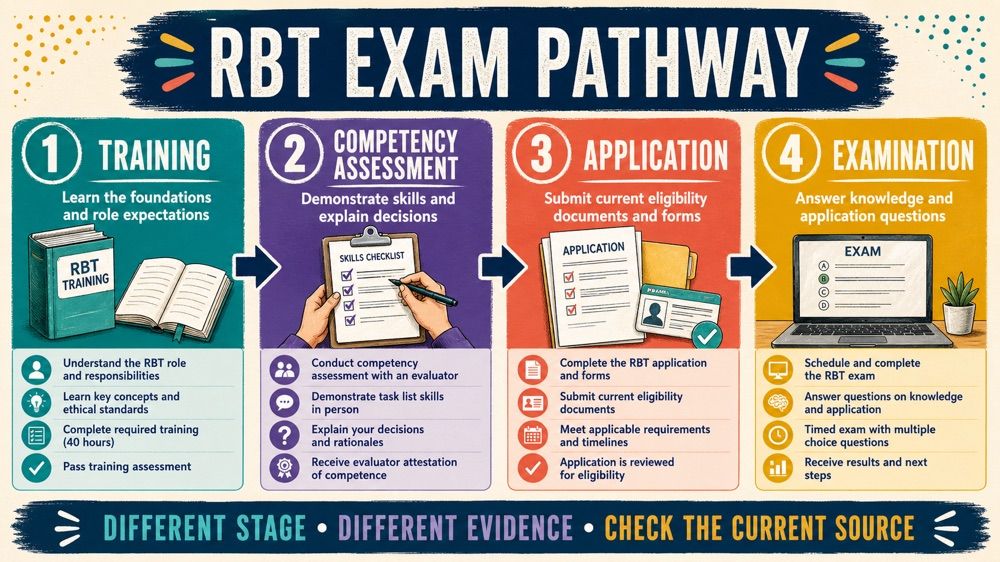
The registered behavior technician exam is easier to plan when you separate three different questions: what must you know, what must you demonstrate, and what administrative step must you complete? The certification exam tests knowledge and application. It is not the 40-hour training, not the initial competency assessment, and not a substitute for the current BACB application requirements.
Table of Contents
- What the registered behavior technician exam tests
- Separate the exam from other RBT requirements
- Check the current 3rd-edition scope
- Study the six domains by decision
- Use current sources and old labels carefully
- Practice scenarios, not answer patterns
- Build a registered behavior technician exam study loop
- Audit your readiness with evidence
- Common RBT exam mistakes
- Frequently Asked Questions
- References
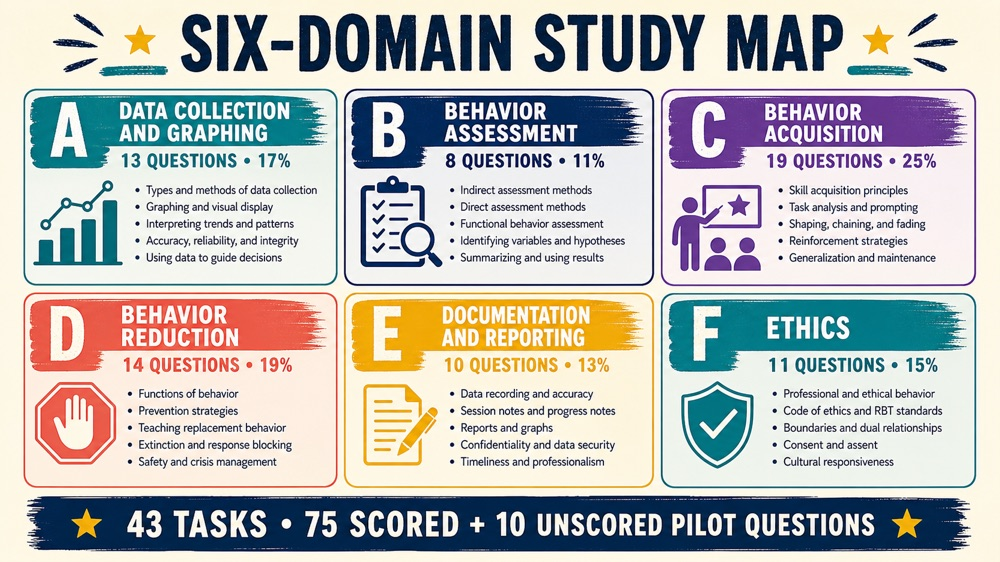
This guide uses the current RBT Test Content Outline, 3rd edition, to organize the exam into six domains and 43 tasks. It explains the 75 scored and 10 unscored pilot-question context, gives a domain-by-domain study map, and shows how to use source checks, scenarios, and corrections without trusting a practice score as a promise.
RBT Training is an independent educational resource. It is not affiliated with, operated by, or endorsed by the Behavior Analyst Certification Board (BACB). The examples and practice prompts below are newly written for independent study; they are not official, recalled, leaked, or BACB-endorsed questions. No study guide, practice test, or schedule guarantees a passing result.
What the registered behavior technician exam tests
The current registered behavior technician exam is built from the RBT Test Content Outline, 3rd edition. The TCO describes the knowledge, skills, and abilities identified as important for entry-level behavior technicians. “Entry-level” does not mean “definition-only.” A strong study question asks you to match an observable clue to a measurement, procedure, documentation choice, or supervision-safe action.
| Question demand | What to do | Common error |
|---|---|---|
| Define a concept | State the term in observable, usable language. | Repeating a vague synonym without an example. |
| Choose a measurement | Match the requested unit, timing, or scoring rule. | Choosing frequency whenever the stem gives a count. |
| Apply a procedure | Follow the written teaching, reduction, or assessment direction. | Inventing a new intervention because it sounds efficient. |
| Read a professional scenario | Protect privacy, dignity, accuracy, and supervision boundaries. | Choosing the most helpful-sounding option without checking role. |
| Communicate a problem | Describe observable facts and use the correct reporting route. | Hiding an irregularity or replacing facts with a judgment. |
Use these demands as a quality test for study material. A page with attractive definitions may still be weak if it never asks what changes when the time unit, prompt condition, written plan, or professional relationship changes.
Separate the exam from other RBT requirements
Search results often place every RBT resource under one “exam” label. Keep the stages separate:
| Stage | Evidence involved | What to study |
|---|---|---|
| 40-hour training | Completion of required training content and documentation. | Foundations, procedures, ethics, and role expectations from the current requirements. |
| Initial competency assessment | Demonstrated skills and interview or role-play evidence under the current packet. | Performance, communication, accurate implementation, and feedback. |
| Certification application | Eligibility documents, forms, and current BACB process requirements. | Use the current Handbook and BACB instructions rather than a study blog. |
| Certification examination | Multiple-choice knowledge and application performance under exam conditions. | Current TCO scope, concepts, scenarios, distinctions, and review routine. |
A practice exam can help with the fourth stage, but it does not complete the competency assessment or application. An independent PDF is not the official packet. If a page promises that one mock exam replaces training or proves practical competence, it has crossed an important boundary.
Check the current 3rd-edition scope
The official TCO page states that the current outline contains 43 tasks organized into six domains. The current exam context includes 75 scored questions and 10 unscored pilot questions. An independent practice resource may use 20, 75, 85, or another number of questions, but it should not relabel its own item count as official content.
| Current domain | Scored share | Source check |
|---|---|---|
| A. Data Collection and Graphing | 13 / 17% | Measurement, data integrity, and graphs are more than a vocabulary list. |
| B. Behavior Assessment | 8 / 11% | Distinguish assigned assessment support from independent clinical interpretation. |
| C. Behavior Acquisition | 19 / 25% | Connect teaching, reinforcement, prompting, chaining, maintenance, and generalization. |
| D. Behavior Reduction | 14 / 19% | Follow written plans, antecedent strategies, differential reinforcement, safety, and reporting. |
| E. Documentation and Reporting | 10 / 13% | Practice objective notes, data accuracy, communication, privacy, and chain of command. |
| F. Ethics | 11 / 15% | Study dignity, competence, supervision, boundaries, confidentiality, and integrity. |
The percentages are a planning map for the scored content, not a promise about the order or exact wording of individual items. Use the map to avoid spending all your time on a favorite concept while leaving documentation or ethics decisions untested.
Study the six domains by decision
Turn each domain into a question you can answer in a new scenario:
- Domain A: What was directly observed, and which measurement system matches the target and time condition?
- Domain B: Which assigned assessment procedure is being implemented, and what interpretation is outside the RBT’s role?
- Domain C: What teaching step, prompt, reinforcement arrangement, or generalization opportunity does the written plan specify?
- Domain D: What behavior-reduction or safety procedure is authorized, and what should be documented or reported?
- Domain E: Can another observer verify the note, data, communication, and variable affecting progress?
- Domain F: Which option protects dignity, privacy, competence, supervision, integrity, and professional boundaries?
For example, a single scenario can touch several domains: a learner does not respond to an instruction, the RBT uses a prompt, the data sheet has an unusual entry, and the caregiver asks what happened. The best answer may require a prompt rule from Domain C, objective documentation from Domain E, and a respectful communication boundary from Domain F. The TCO is organized into domains, but real decisions can connect them.
Use current sources and old labels carefully
The 3rd-edition outline changed several public labels. Older materials may say Measurement, Assessment, Skill Acquisition, Documentation, and Professional Conduct or Scope of Practice. The current labels are Data Collection and Graphing, Behavior Assessment, Behavior Acquisition, Documentation and Reporting, and Ethics. A crosswalk can help you find familiar concepts, but it should not replace the current source.
| Older label you may see | Current 3rd-edition label | What to verify |
|---|---|---|
| Measurement | Data Collection and Graphing | Latency and interresponse time are part of the current measurement scope. |
| Assessment | Behavior Assessment | Preference, skill, and functional-assessment components have explicit current tasks. |
| Skill Acquisition | Behavior Acquisition | Prompting, naturalistic teaching, chaining, maintenance, and generalization have current task language. |
| Professional Conduct and Scope | Ethics | Use the current RBT Ethics Code and current TCO rather than an old summary. |
When a resource uses an old label, ask whether the concept is still present, renamed, expanded, or redistributed. Do not delete a useful definition automatically, but do not assume that old weights, task numbers, or administrative details remain current.
Practice scenarios, not answer patterns
Study material should help you identify the controlling condition in a short case. Use a four-part note for every item:
- Observable clue: what happened, was measured, or was written in the plan?
- Concept or procedure: which current task does the clue activate?
- Nearest distractor: which option sounds plausible but fails the condition?
- Role-safe action: implement, record, communicate, or seek direction?
Try an original measurement example: a response occurred 12 times during a 30-minute observation. If the question asks for frequency, report the count. If it asks for rate, connect the count to time. If it asks for duration, you need start and stop information. The same behavior can produce different answers because the requested measure changes.
Try an original ethics example: a family member asks the RBT to provide a private service to a sibling. The best answer is not determined by whether the family seems friendly. Identify the possible multiple relationship or conflict, protect the professional boundary, and seek guidance through the approved route.
These examples are newly written for independent study. They are not official, recalled, leaked, or BACB-endorsed questions. The point is to transfer the decision rule to a new setting, not to memorize a familiar stem.
Build a registered behavior technician exam study loop
A reliable study loop is more informative than taking the same mock repeatedly:
- Map: choose one current TCO domain and task group.
- Learn: define the concept, write a contrast, and study one original example.
- Practice: answer fresh questions with confidence marks before feedback.
- Correct: identify the clue, rule, distractor mismatch, and role-safe next action.
- Transfer: solve a new scenario with the setting, timing, behavior, or relationship changed.
- Mix: return to a mixed-domain set so you can switch decisions without losing the clue.
Record the source, date, format, item count, confidence, domain, and error type. A correct answer selected as a guess belongs in the correction log. A wrong answer with high confidence deserves special attention because it may reveal an inverted rule rather than a simple knowledge gap.
Use full-length practice after you can explain the common distinctions untimed. If timing is the first problem, identify whether the cause is rereading, uncertainty between two concepts, calculation, or fatigue. The intervention for each problem is different.
Audit your readiness with evidence
No independent checklist can guarantee the result of the registered behavior technician exam. Use a readiness audit with multiple evidence types:
| Evidence | Question to ask | Warning signal |
|---|---|---|
| Source coverage | Can I map study materials to the current 43 tasks and six domains? | I rely on a file with no edition or source note. |
| Concept accuracy | Can I define and contrast the major terms? | I recognize words but cannot write a fresh example. |
| Application | Can I identify the controlling clue in a changed scenario? | I only answer correctly when wording is familiar. |
| Role boundaries | Do I choose plan-based, objective, supervision-safe actions? | I keep selecting options that redesign procedures independently. |
| Timing | Can I maintain accurate decisions as a mixed set continues? | Late-session misses rise because I reread or rush. |
| Correction | Can I explain why the nearest distractor fails? | I record letters and scores but no decision rule. |
When a warning signal appears, choose a narrow next action: one measurement contrast, one prompt-fading decision, one objective-note rewrite, one confidentiality scenario, or one fresh mixed set. Specific evidence creates a more useful plan than a generic promise to study harder.
Common RBT exam mistakes
- Using the 2nd edition as the only map: compare old labels with the current TCO 3rd edition.
- Mixing eligibility with exam content: use the current Handbook for process requirements and the TCO for exam scope.
- Confusing competency assessment with the examination: one evaluates demonstrated performance; the other evaluates exam responses.
- Studying only Behavior Acquisition: use the domain distribution and test documentation, reporting, and ethics too.
- Memorizing answer letters: create fresh scenarios and explain the nearest distractor.
- Treating a practice score as official: record the provider, condition, and limitations.
- Ignoring supervision boundaries: choose actions that implement, document, communicate, or seek direction as appropriate.
- Trusting “real” or “recalled” claims: use independent content that respects examination security.
Bottom line: prepare for the registered behavior technician exam from the current RBT Test Content Outline, 3rd edition: 43 tasks, six domains, and the 75 scored plus 10 unscored pilot-question context. Separate the exam from training, competency assessment, and application steps, then build knowledge through source checks, original scenarios, corrections, and transfer.
Ready to turn the outline into practice?
Choose a current domain, solve fresh RBT questions, and record the clue and correction that determine your next review.
Try Free RBT Practice Questions →
Frequently Asked Questions
What does the registered behavior technician exam test?
It tests knowledge and application across the six domains in the current RBT Test Content Outline, 3rd edition, including data, assessment, acquisition, reduction, documentation, and ethics.
How many tasks are in the current RBT exam outline?
The current RBT Test Content Outline, 3rd edition, describes 43 tasks organized into six domains.
How many questions are on the RBT exam?
The current exam context includes 75 scored questions and 10 unscored pilot questions. Use the current BACB source for format and process details.
Is the RBT exam the same as the competency assessment?
No. The competency assessment evaluates demonstrated skills or interview evidence, while the certification exam evaluates answers to exam questions.
Can a practice score guarantee that I will pass?
No. A practice score is evidence from one resource under one set of conditions. It can guide review but cannot guarantee a passing result or certification.
References
- Behavior Analyst Certification Board. RBT Test Content Outline, 3rd edition.
- Behavior Analyst Certification Board. RBT examination resource hub.
- Behavior Analyst Certification Board. RBT Handbook.
- Behavior Analyst Certification Board. RBT Ethics Code (2.0).
- RBT six-domain study-guide resource. Reviewed for competitor research; not an endorsement.
- RBT study-guide and edition-crosswalk resource. Reviewed for competitor research; not an endorsement.