
The registered behavior technician test is one step in the RBT certification path, not the entire path. A good preparation plan separates eligibility, required training, the initial competency assessment, the application, the official examination, and ongoing certification requirements. It also separates BACB facts from third-party practice tests, PDFs, quizzes, and study claims.
Table of Contents
- What the registered behavior technician test is
- Separate eligibility from test prep
- Check the current exam outline
- Understand the six test domains
- Official test vs. practice test
- Use a clue-first question method
- Prepare for test day within the rules
- Turn practice results into a review plan
- Audit an RBT test resource before using it
- Common registered behavior technician test mistakes
- Frequently Asked Questions
- References
The current RBT Test Content Outline, 3rd edition, describes 43 tasks organized into six domains. The current examination includes 75 scored questions and 10 unscored pilot questions; the current BACB Handbook also identifies four answer choices and 90 minutes. Use the current BACB Handbook, TCO, and examination pages for requirements and process details.
RBT Training is an independent educational resource. It is not affiliated with, operated by, or endorsed by the Behavior Analyst Certification Board (BACB). The examples and practice prompts below are newly written for independent study. They are not official, current, retired, recalled, leaked, or BACB-endorsed questions. No practice score, PDF, or study schedule can guarantee a passing result.
What the registered behavior technician test is
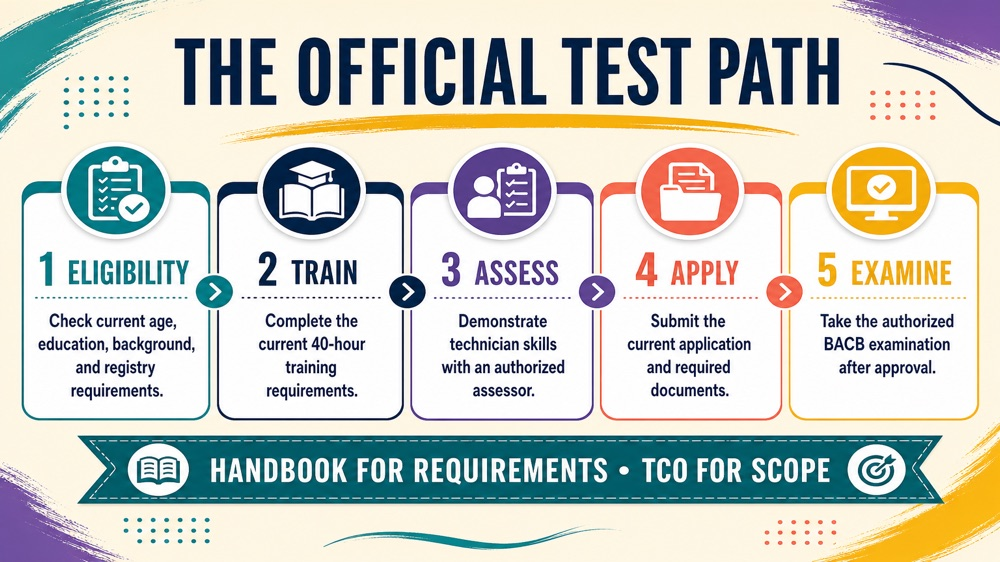
The registered behavior technician test is a BACB certification examination that assesses knowledge of the current RBT Test Content Outline at an entry-level behavior-technician standard. It is not the 40-hour training itself, not the initial competency assessment, and not a substitute for an approved certification application.
| Stage | What it demonstrates | What a study test cannot replace |
|---|---|---|
| Eligibility | Whether the applicant meets current age, education, background, registry, and other applicable requirements. | Use the current BACB Handbook and local organization or jurisdiction instructions. |
| 40-hour training | Completion of training that meets the current BACB curriculum requirements. | A quiz or PDF does not create a training certificate. |
| Initial competency assessment | Demonstrated performance of required technician skills with an authorized assessor. | A multiple-choice test does not prove hands-on competence. |
| Certification application | Submission and review of required documents and attestation. | A high practice score does not approve an application. |
| Certification examination | Knowledge and application responses under the current examination conditions. | Independent practice questions are not official test items. |
This separation prevents two common errors. A learner may be academically prepared but missing an application document, or may have completed an assessment but still need to study the written exam. Use the official path for administrative decisions and independent practice for learning and review.
Separate eligibility from test prep
The current BACB Handbook is the authority for the 2026 eligibility path. In broad terms, the Handbook describes requirements such as being at least 18, having at least a high-school-level education or equivalent, passing required background and abuse-registry checks, completing the current 40-hour training, and completing the initial competency assessment within the stated application window. Details and timing can change, so verify the current Handbook before applying.
The Handbook also explains that the 40-hour training must meet the current curriculum requirements and be completed within the stated time boundaries. The initial competency assessment is a demonstrated-skills requirement after training; it is not the same as answering multiple-choice questions. An employer, training provider, or assessor may have additional process instructions, but those do not override current BACB requirements.
Use this simple decision rule:
- If your question is “Can I apply?” read the current BACB Handbook.
- If your question is “What will the exam cover?” read the current TCO.
- If your question is “Can I perform the skill?” use supervised training and the initial competency assessment.
- If your question is “Can I apply the concept under time pressure?” use independent practice questions and a correction log.
Check the current exam outline
The current RBT Test Content Outline, 3rd edition, is the scope anchor for the registered behavior technician test. It contains 43 tasks across six domains. The current Handbook states that the examination includes 75 scored questions and 10 unscored questions, with four possible answers and one correct answer per question, and 90 minutes to complete the examination.
| Official exam fact | How to use it in study | What not to infer |
|---|---|---|
| 85 questions total | Practice pacing on a comparable provider simulation only after your untimed reasoning is accurate. | An 85-question third-party test is not the official examination. |
| 75 scored questions | Use the current domain distribution to avoid ignoring smaller areas. | A practice set with 75 items is not automatically the official scored form. |
| 10 unscored pilot questions | Understand why a candidate may see items that do not count toward the result. | You cannot identify which items are unscored while testing. |
| Four choices, one correct answer | Compare the stem with every option and reject the nearest distractor. | “Most familiar” or “most helpful-sounding” means correct. |
| 90 minutes | Use pacing as one study variable and record whether rereading, calculation, uncertainty, or fatigue caused delay. | A provider’s timer or pass threshold guarantees official performance. |
The BACB maintains multiple examination forms for security and test-development reasons. That is why preparation should focus on the public content outline and transferable decision rules, not on memorizing a circulated question set. Do not seek current or recalled test content.
Understand the six test domains
Use the current names and planning shares below. The percentages are the official outline’s rounded distribution of the 75 scored questions, not a promise about the order of an individual form:
| Domain | Questions / share | Decision to practice |
|---|---|---|
| A. Data Collection and Graphing | 13 / 17% | Match observable behavior, time, and data procedure; calculate or summarize accurately. |
| B. Behavior Assessment | 8 / 11% | Implement assigned assessment procedures and recognize the boundary between data and interpretation. |
| C. Behavior Acquisition | 19 / 25% | Follow teaching, prompting, reinforcement, chaining, shaping, maintenance, and generalization procedures. |
| D. Behavior Reduction | 14 / 19% | Follow written reduction and safety plans, record what occurred, and report appropriately. |
| E. Documentation and Reporting | 10 / 13% | Write objective notes, maintain data integrity, protect information, and communicate through the right route. |
| F. Ethics | 11 / 15% | Protect dignity, privacy, competence, supervision, professional boundaries, and integrity. |
Older notes may call some domains Measurement, Assessment, Skill Acquisition, Documentation, or Professional Conduct and Scope of Practice. Use those terms as a cross-reference only. Do not import old weights or task numbers without checking the 3rd-edition TCO.
Official test vs. practice test
Search results for the registered behavior technician test often place official BACB resources next to independent tests. A practice test can be useful, but it has a different status:
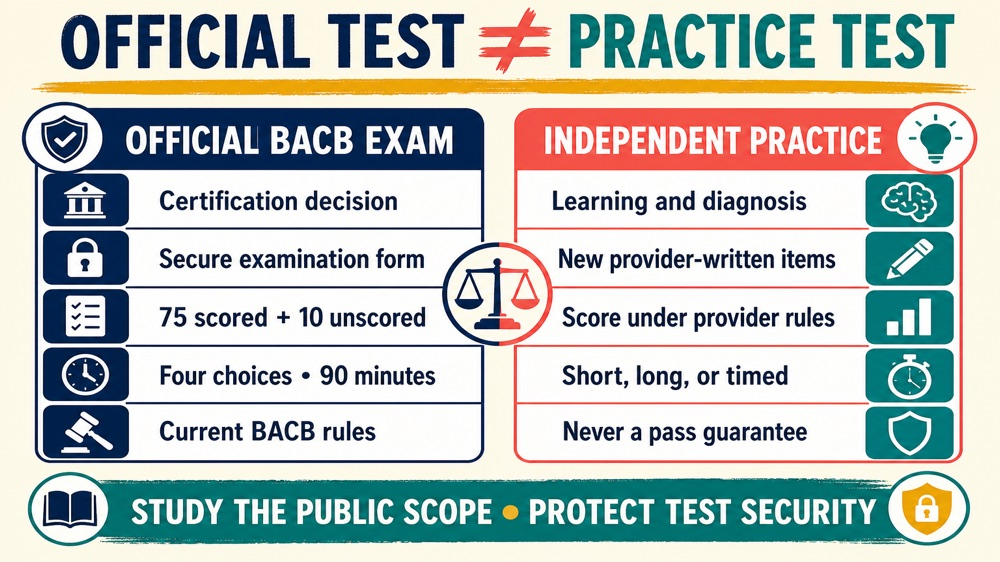
| Feature | Official BACB examination | Independent practice resource |
|---|---|---|
| Purpose | Certification decision based on the authorized examination form. | Learning, diagnosis, pacing, or confidence-building. |
| Content | Secure examination items from the current test pool. | Newly written questions, definitions, or scenarios created by the provider. |
| Scoring | Official result under BACB procedures. | Provider score under its own answer key and conditions. |
| Source authority | Current BACB rules and examination system. | Provider’s sources, editorial process, and update claims must be checked. |
| Security | Protected high-stakes content. | Should not claim to reproduce current, recalled, or leaked items. |
Prefer explanations that identify the controlling clue and why the nearest distractor fails. A page that only reports “correct” or “incorrect” gives you a score but not a repair plan. Also check whether the question set says which edition it follows, whether the answer key matches the explanation, and whether the domain labels are current.
Use a clue-first question method
For original registered behavior technician test practice prompts, use the same five-step method:
- Read the requested decision: measurement, assessment procedure, teaching step, reduction response, documentation, or ethics action.
- Mark the controlling clue: the time unit, observable event, written plan, prompt condition, privacy issue, or reporting relationship.
- Predict before scanning: say the rule in plain language before letting a tempting option steer you.
- Reject the nearest distractor: name the condition it ignores or changes.
- Check role and source: choose the plan-based, objective, supervision-safe action and record your confidence.
For example: During a 30-minute observation, a learner engages in a target response 12 times. If the question asks for frequency, the answer is the count of 12. If it asks for rate per hour, convert the count to the requested time unit. If it asks for duration, the stem must provide start and stop information. The behavior name does not decide the measure; the question’s requested unit does.
For another example: An RBT is assigned a preference-assessment procedure and records the learner’s selection. The RBT should implement and record the procedure as written, not independently diagnose behavioral function or assume that the selected item will reinforce every response. A practice explanation should make the role boundary visible.
Prepare for test day within the rules
Use the current BACB and Pearson VUE instructions for scheduling, identification, accommodations, testing-center rules, and prohibited items. A blog cannot replace those instructions. The current official path is the source for what you may bring, when to arrive, how to request an accommodation, and how an appointment is changed.
For study purposes, rehearse three test-day skills:
- Stem control: read the whole scenario and identify the word or condition that changes the answer.
- Pacing: notice whether time is lost to rereading, calculation, two-option uncertainty, or fatigue. Use a practice timer only to measure that variable.
- Decision confidence: mark uncertain items for review when the practice interface allows it, but do not change an answer without a reason tied to the stem.
Do not use “real questions,” recalled items, answer dumps, or leaked content. Besides creating an examination-security problem, memorized wording does not transfer when the setting or clue changes.
Turn practice results into a review plan
After a quiz or mock, record more than the score. Use a correction log:
| Field | Record | Why it matters |
|---|---|---|
| Provider and edition | URL or PDF, date, and stated TCO edition. | Prevents an old or unsupported resource from becoming your only map. |
| Domain and task | Current A–F domain and narrow concept. | Shows whether errors cluster in one decision family. |
| Controlling clue | Time unit, observable action, plan direction, or ethical issue. | Builds transfer instead of answer-letter memory. |
| Confidence | Sure, narrowed-down, or guessed before feedback. | Separates stable knowledge from lucky accuracy. |
| Nearest distractor | Why the tempting alternative failed. | Reveals the specific contrast to repair. |
| Next action | One source reread, contrast, rewrite, or changed-scenario retest. | Keeps the next study session concrete. |
Use a short diagnostic when you need a map, a domain quiz when one distinction needs repair, a mixed set when you need transfer, and a longer timed simulation when untimed reasoning is already accurate. A practice score is evidence under one condition, not a pass prediction.
Audit an RBT test resource before using it
Before trusting a PDF, quiz, or online test, run this checklist:
- Current edition: Does the resource name the RBT Test Content Outline, 3rd edition?
- Official boundary: Does it distinguish BACB facts from provider-created explanations and questions?
- Six-domain coverage: Are A–F domains visible, with current names and a coherent distribution?
- Answer integrity: Does the answer key match the explanation and the stem’s controlling clue?
- Originality and security: Does it avoid claiming current, real, recalled, leaked, or BACB-endorsed questions?
- Accessible review: Can you pause, read, print, annotate, and revisit errors without losing the explanation?
- Privacy: Is the site clear about accounts, stored answers, and personal information?
High question volume does not automatically mean high quality. Some pages in the search results use old domain weights or mix a provider’s 75-question product with the official scored-item count. Check the source before allowing a number to shape your plan.
Common registered behavior technician test mistakes
- Confusing the test with eligibility: use the Handbook for requirements and the TCO for exam scope.
- Calling a practice PDF official: an item count and answer key do not create BACB status.
- Using old labels as current facts: crosswalk the 2nd edition and verify weights against the 3rd edition.
- Memorizing leaked or recalled wording: use original questions and transferable decision rules.
- Ignoring the unscored context: remember that the official exam includes 75 scored questions and 10 unscored pilot questions.
- Assuming every test form is identical: focus on public content and secure-test behavior.
- Choosing the helpful-sounding answer: check the written plan, observable evidence, and role boundary.
- Treating a practice percentage as a guarantee: record the conditions and corrections instead.
Bottom line: Prepare for the registered behavior technician test by separating the official certification path from independent practice. Verify the current 3rd-edition TCO and Handbook, learn the 43-task six-domain scope, understand the 85-question context of 75 scored and 10 unscored items, practice the clue before the answer, and turn every error into a targeted retest. That is a safer and more durable strategy than chasing a “real question” claim.
Ready for a structured practice round?
Use current-domain practice questions, track your confidence, and turn each correction into the next review action.
Try Free RBT Practice Questions →
Frequently Asked Questions
What is the registered behavior technician test?
It is the BACB certification examination that assesses knowledge of the current RBT Test Content Outline at an entry-level behavior-technician standard. It is separate from training, the initial competency assessment, and the application.
How many questions are on the RBT test?
The current BACB Handbook states that the examination includes 75 scored questions and 10 unscored questions, for 85 questions total. Candidates have 90 minutes and each question has four possible answers with one correct answer.
What does the current RBT test cover?
The current RBT Test Content Outline, 3rd edition, contains 43 tasks organized into Data Collection and Graphing, Behavior Assessment, Behavior Acquisition, Behavior Reduction, Documentation and Reporting, and Ethics.
Is an RBT practice test the official examination?
No. A practice test is an independent study resource. It can help with concepts, application, pacing, and corrections, but it is not an official BACB form and should not claim to contain current, recalled, or leaked questions.
What should I study before the RBT test?
Review the current TCO, your 40-hour training materials, and competency-assessment learning, then practice all six domains with original scenarios and a correction log. Use the current Handbook for requirements and test-day instructions.
Can a practice score guarantee that I will pass?
No. A practice score reflects one provider, one item set, and one condition. It cannot guarantee a passing result, certification, or performance on the official examination.
References
- Behavior Analyst Certification Board. RBT Test Content Outline, 3rd edition.
- Behavior Analyst Certification Board. RBT Test Content Outline, 3rd-edition PDF.
- Behavior Analyst Certification Board. RBT Handbook.
- Behavior Analyst Certification Board. Examination Information.
- Behavior Analyst Certification Board. RBT examination resource hub.
- Independent RBT practice-resource page. Reviewed for competitor research; not an endorsement.
- Independent RBT practice-test page. Reviewed for competitor research; not an endorsement.