

Behavior technician training works best as a cycle of learning, practice, observation, and review—not as a shortcut to independent clinical judgment.
Table of Contents
- What behavior technician training should accomplish
- The four-part learning roadmap
- Part 1: Learn the concepts
- Part 2: Practice observable skills
- Part 3: Observe and ask focused questions
- Part 4: Review feedback and repeat
- Training, authorization, and supervision
- Documentation, privacy, and preparation
- Frequently asked questions
- References
RBT TRAINING · PRACTICAL ROADMAP
Behavior Technician Training: A Practical Learning Roadmap
Learn concepts, practice observable skills, use supervision, and turn feedback into the next safe step.
Behavior technician training works best as a cycle rather than a single orientation session. A learner studies the concepts, practices a defined skill, observes how the skill is used in the approved setting, receives feedback, and repeats the cycle until the next step is clear. Training can make learning more organized, but it does not by itself establish certification, independent authority, or permission to make clinical decisions.
This roadmap is designed for readers preparing for or working within an RBT-related training process. Always compare the plan with the current BACB handbook, task list, employer requirements, supervisor direction, and applicable privacy and safety policies. Requirements and portal instructions can change, so an old checklist or another person’s experience should not replace current official information.
What behavior technician training should accomplish
Useful training connects knowledge to observable action. Instead of stopping at “I read about prompting,” a learner should be able to describe the relevant procedure, identify what the supervisor expects to see, practice the steps in a safe learning context, notice when the situation does not match the example, and ask for clarification. The goal is not to sound confident; the goal is to make the learner’s performance easier to observe, discuss, and improve.
A strong training plan also makes limits visible. The learner should know which activities are practice, which activities are supervised service delivery, which questions belong with the supervisor, and which records require special protection. When a plan is unclear, pausing and asking is a professional action—not a failure.
The four-part learning roadmap
The four stages below can be revisited for each skill area. They are not a promise that every learner will progress at the same speed, and they are not a substitute for an approved competency or supervision process.
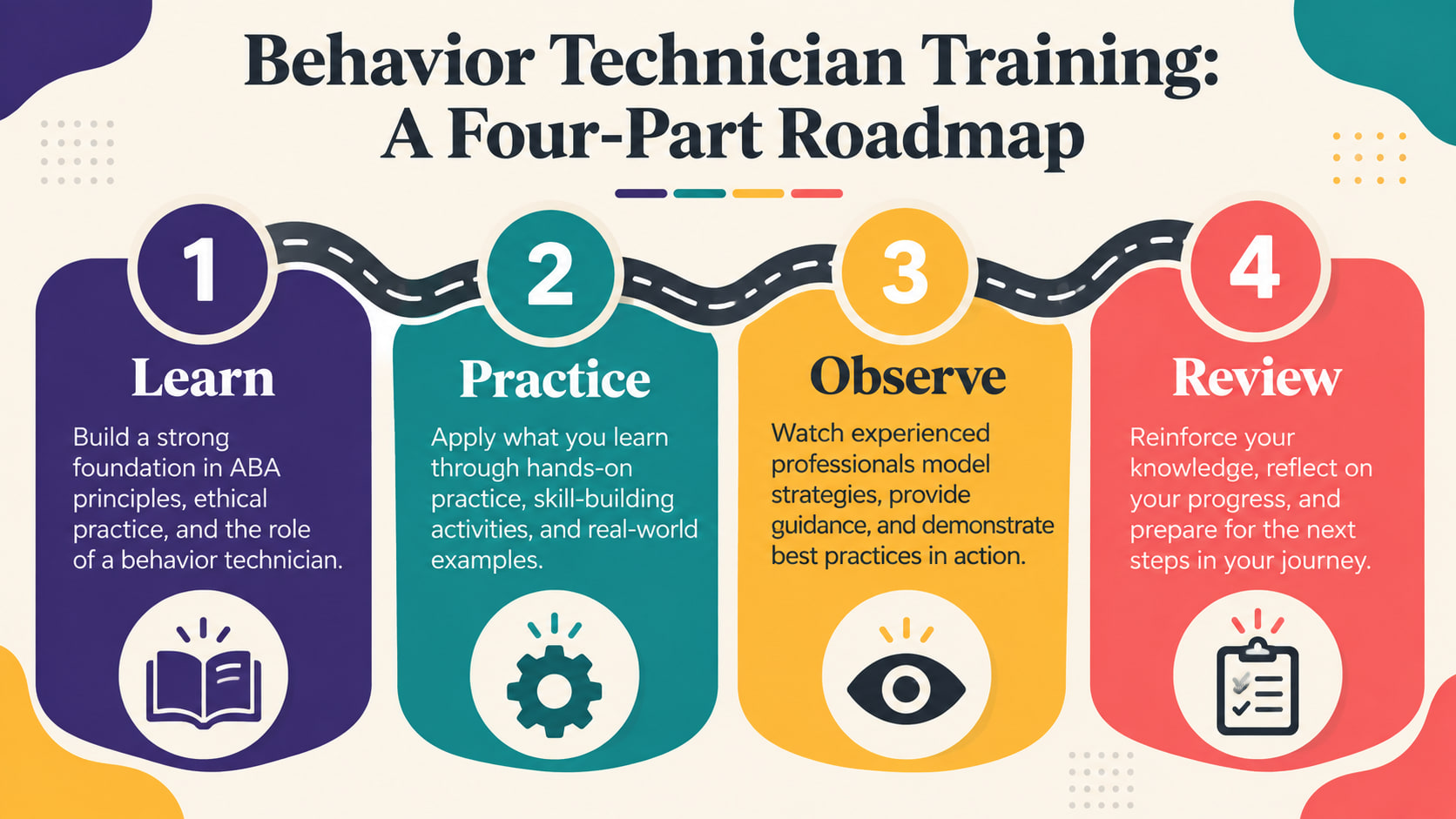
- Learn: define the terms, purpose, steps, safety considerations, and documentation expectations.
- Practice: rehearse an observable action in a suitable context without pretending that rehearsal is authorization.
- Observe: watch an approved demonstration or supervised interaction and compare the plan with what actually happens.
- Review: receive specific feedback, record the next practice target, and repeat with appropriate support.
Part 1: Learn the concepts
Start with the current source material and translate each topic into plain language. For example, a learner might write a short definition, a purpose statement, one observable example, one common mistake, and one question to ask a supervisor. This five-line note is more useful than copying a long paragraph without checking whether the idea can be applied.
Learning should include the reason behind a procedure. A prompt is not merely a cue to deliver mechanically; the learner needs to understand what the prompt is intended to support, what the approved plan says, and how the supervisor will evaluate its use. The same principle applies to reinforcement, data collection, skill acquisition, behavior reduction procedures, communication, and safety routines.
Use original examples when studying. Build a scenario around a neutral fictional learner, describe only the details needed to illustrate the concept, and avoid placing real names, dates, diagnoses, photos, or identifying information in study notes. An original example tests understanding without turning private service information into training material.
Part 2: Practice observable skills
Practice becomes stronger when the target is specific. “Improve my data skills” is too broad for one session. “Record the defined response using the approved measurement method in three practice opportunities, then explain one uncertainty” gives the learner and supervisor something to observe.
Before practicing, confirm the context, materials, safety rules, and who is responsible for feedback. A role-play, worksheet, mock data set, or supervisor-approved rehearsal may be appropriate. Do not turn an unapproved exercise into service delivery, and do not improvise a client-facing procedure because a practice example seemed simple.
After practice, compare what was planned with what was done. Note the exact step that felt difficult: identifying the start of a response, delivering a prompt at the right time, recording an opportunity, following a transition routine, or describing an observation without adding an opinion. A precise note gives the next session a useful starting point.
Part 3: Observe and ask focused questions
Observation helps connect written instructions to real timing, communication, and context. Watch for the sequence of events, the person’s response, the technician’s action, and the record that is produced. Avoid copying a technique just because it looked effective in one moment; ask how the action relates to the approved plan and what conditions would change the next step.
Prepare questions before supervision. Instead of “Was that okay?” ask, “When the instruction was repeated, what sign told you to pause?” or “Which part of the definition should I use when two behaviors occur close together?” Focused questions make it easier to discuss observable details without turning the conversation into a judgment about a learner or family.
Observation is also a chance to notice uncertainty. A learner may see that a direction, prompt, or data point does not fit the written example. The correct response is to preserve the facts, protect privacy, and ask the authorized supervisor or support channel. Guessing may feel faster, but an unverified change can affect safety, consistency, and documentation.
Part 4: Review feedback and repeat
Feedback is most useful when it identifies the behavior, the context, the effect, and the next practice action. “Be more confident” is difficult to apply. “Pause after the instruction and wait the planned interval before adding the next prompt” is concrete enough to rehearse and observe.
Keep feedback separate from self-criticism. A correction identifies a skill that needs another opportunity; it does not define the learner’s character or predict the outcome of a future evaluation. Ask the supervisor to clarify what successful performance would look like and how it will be checked. Then practice the smallest meaningful part before adding complexity.
Use a short review loop: What was the target? What did I observe? What did I do? What feedback did I receive? What will I repeat or ask next time? This loop creates continuity across sessions and reduces the temptation to study only what feels comfortable.
Training, authorization, and supervision
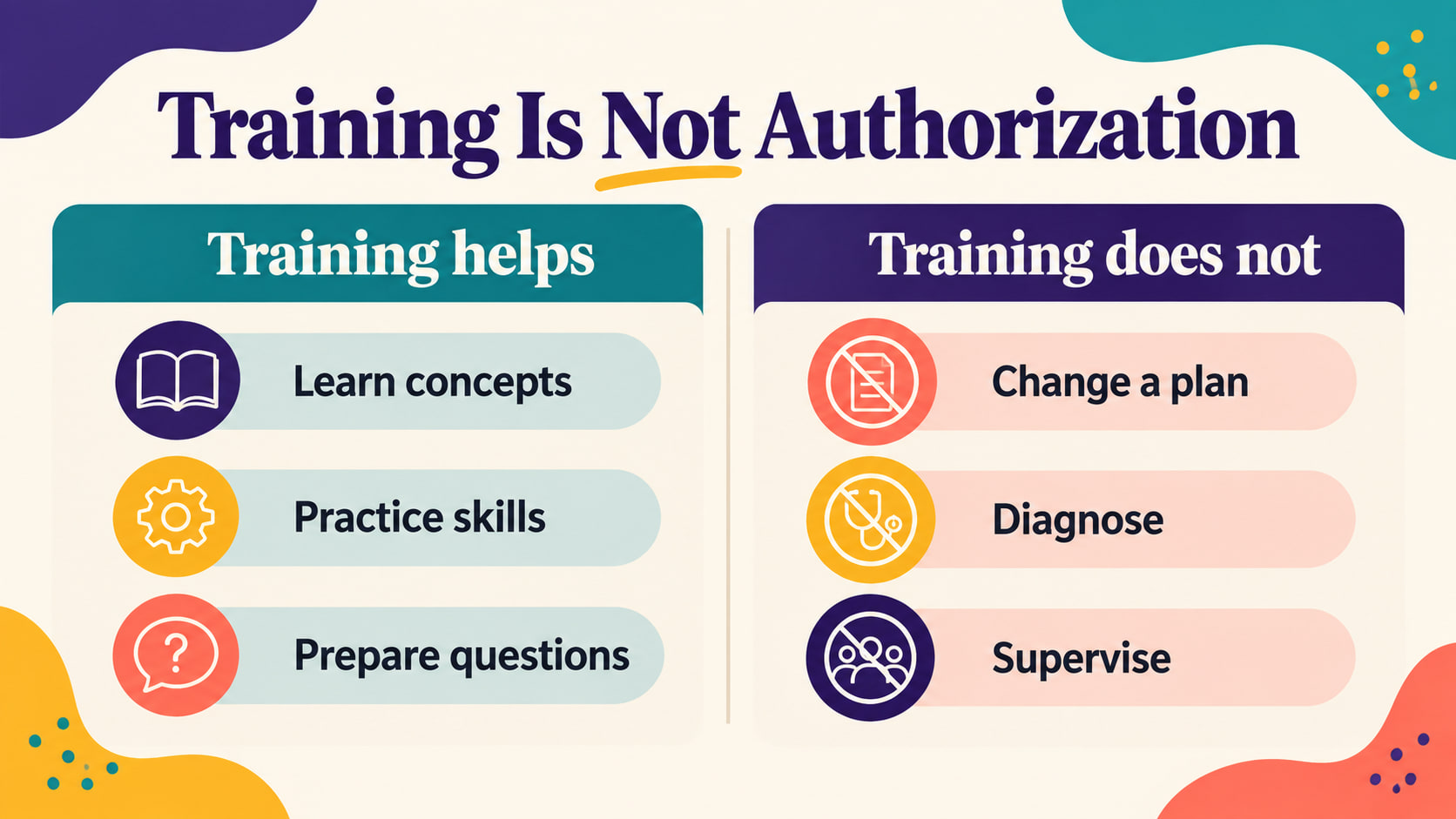
Training supports learning; it does not independently authorize a person to change a treatment plan, diagnose, supervise another technician, or represent a credential as active. A learner may understand a concept and still need direction before applying it in a particular service situation. The current official requirements and the approved supervision structure determine what is allowed.
When a client, caregiver, teacher, or coworker asks for a change, do not treat the request as permission to revise the plan. Listen respectfully, document the relevant facts through the approved process, and bring the question to the person authorized to decide. When a safety concern is immediate, follow the current emergency and escalation procedure rather than waiting for a routine study discussion.
Supervision is not only a sign-off at the end of training. It is a structured opportunity to observe performance, receive feedback, discuss ethical and practical questions, and confirm the next action. Keep the boundaries clear: a supervisor’s demonstration is a learning resource, while the plan and current organizational process remain the source of authority.
Documentation, privacy, and preparation
Good preparation reduces avoidable errors. Bring the current training objective, the relevant approved material, a short list of questions, and a way to record feedback that does not expose unnecessary client information. Write objective descriptions rather than labels or guesses. “The learner left the table after the instruction” is different from “the learner was noncompliant,” because the first statement identifies an observable event.
Protect notes, screenshots, messages, and login information. Do not place identifiable service details into a public AI tool, personal social media post, shared class folder, or an ordinary chat. Use only the storage and communication methods allowed by the employer or supervising organization. If a training example can be taught without a real person’s information, use the fictional version.
Before a session ends, confirm the next step: reread a source, rehearse a definition, observe a demonstration, collect a specified practice sample, or ask a particular supervisor question. A small, documented next action is easier to complete than a vague goal to “study more.”
Frequently asked questions
Does behavior technician training automatically make someone an RBT?
No. Training is one part of a broader process and does not itself establish eligibility, certification, approval, supervision, or current credential status. Follow the current official requirements.
Is watching a supervisor enough training?
Observation is valuable, but passive watching may not demonstrate that the learner can describe, practice, and perform a skill. Use the approved process to combine observation with questions, practice, and feedback.
What should I do when the written plan seems unclear?
Pause, preserve the observable facts, protect privacy, and ask the authorized supervisor or official support route. Do not make an independent change because an old example or online post suggested one.
How can I make study notes more useful?
For each topic, write the definition, purpose, observable example, common error, and one focused question. Keep the example fictional or de-identified according to the applicable policy.
Source note: Review the current BACB RBT Handbook, task list, ethics code, employer policy, and supervision instructions. This article is educational and does not provide individualized legal, clinical, employment, or credentialing advice.
Ready to practice the RBT concepts you just reviewed?
Try an independent, original RBT practice resource with exam-style questions, scoring, and answer explanations.
References
- Behavior Analyst Certification Board. RBT Test Content Outline, 3rd edition.
- Behavior Analyst Certification Board. RBT Handbook.
- Behavior Analyst Certification Board. RBT Ethics Code.