

A center based behavior technician works in a team setting where preparation, teaching, objective data, transitions, privacy, and supervision shape the day.
Table of Contents
- Center based behavior technician: what the setting is
- A typical workday sequence
- Prepare for the session
- Teach and support within the plan
- Record data accurately
- Handoff and team communication
- Skills to keep visible
- Frequently asked questions
- References
RBT CAREER · CENTER-BASED WORK
Center-Based Behavior Technician: What to Expect
Prepare, teach, record, hand off, and keep communication and supervision visible.
A center based behavior technician works in a team setting where preparation, teaching, objective data, transitions, privacy, and supervision shape the day. The center may include shared rooms, scheduled routines, multiple staff members, and several learners, but the exact work depends on the employer, program, learner needs, safety procedures, and current plan.
This guide describes common workflow questions without promising a universal schedule or client outcome. Follow the current employer policy, supervisor direction, privacy rules, safety procedures, and official credential requirements. A center setting does not authorize an RBT to diagnose, change a treatment plan, or make decisions outside the assigned role.
Center based behavior technician: what the setting is
A center-based program provides services in an organized location rather than in a private home or community setting. The location may have treatment rooms, shared materials, group spaces, staff areas, check-in procedures, and scheduled transitions. Some programs are highly structured; others use a mixture of natural routines and planned instruction.
Shared spaces create opportunities for teamwork and additional privacy responsibilities. A technician may hear information about another learner, see a schedule, or pass through a room during someone else’s session. Access does not equal permission to discuss, copy, photograph, or share that information.
Ask the employer how sessions are assigned, how rooms and materials are cleaned, how incidents are escalated, and who supervises the work. A clear orientation should explain both what to do and what not to do.
A typical workday sequence
The exact schedule varies, but a useful workflow often has four connected parts:
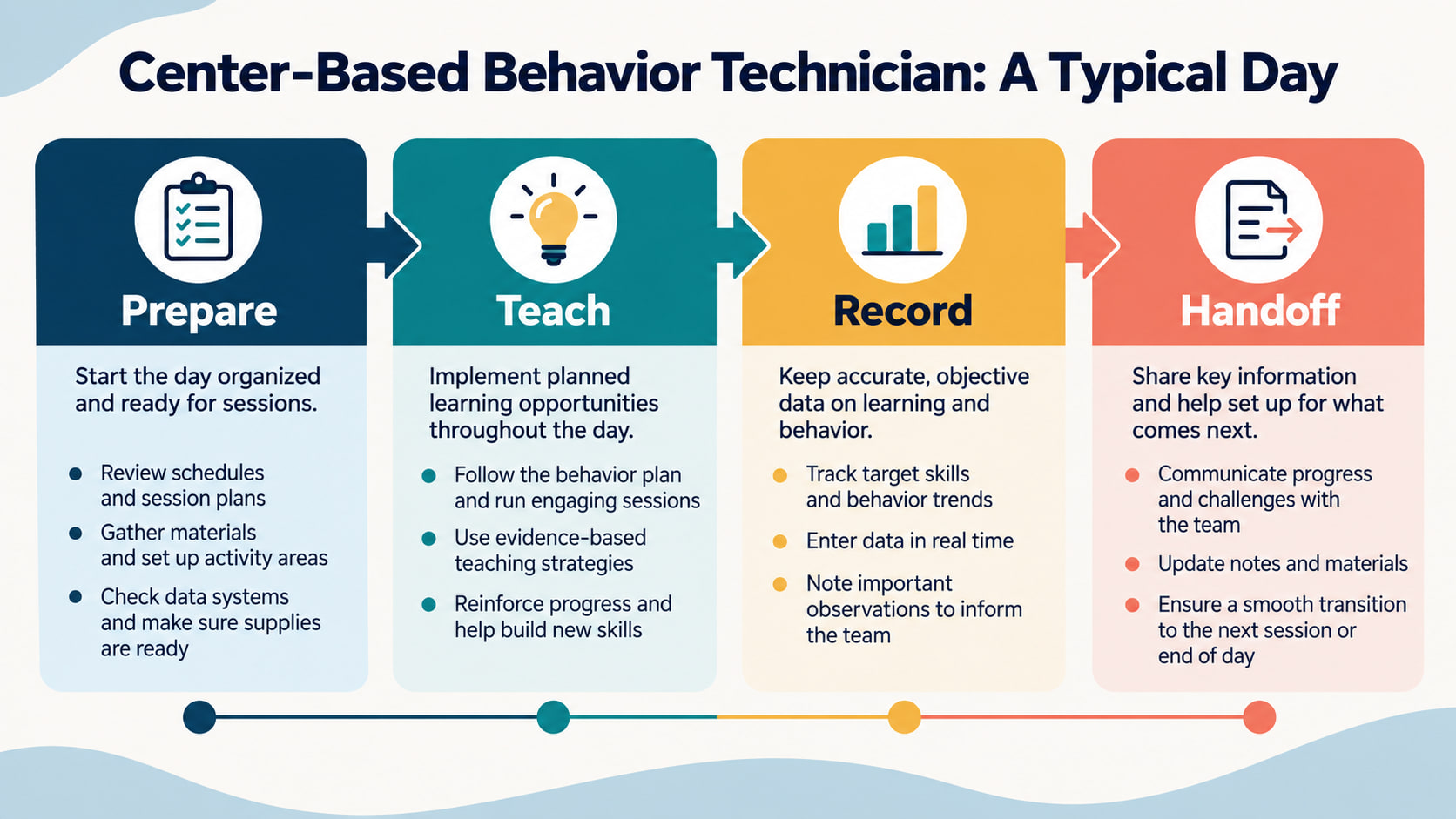
- Prepare: Review the current plan, materials, schedule, safety notes, and assigned questions.
- Teach: Implement approved procedures, support communication and participation, and protect dignity.
- Record: Collect required data and write objective notes through the approved system.
- Handoff: Communicate relevant facts, secure records, and identify questions for the supervisor or next staff member.
Busy transitions can make the four parts feel compressed. Use the organization’s priority and safety instructions rather than skipping documentation or sharing information casually. If the workflow does not leave enough time to complete required records, raise the issue through supervision.
Prepare for the session
Preparation begins with the current plan, not an old note or a coworker’s memory. Check target definitions, prompting guidance, reinforcement procedure, data fields, materials, and safety instructions. Confirm which learner and session you are assigned to and use only the information necessary for that work.
Check the environment. Materials should be ready, the workspace should be appropriate, and hazards or access issues should be reported. Do not improvise a new teaching program because a material is missing. Ask the supervisor what temporary step is approved.
Prepare questions before the session. Examples include: Which response counts as independent? What should I record during a transition? What is the escalation route if a caregiver asks for a plan change? Focused questions help supervision become practical.
Teach and support within the plan
During a session, implement the assigned procedure as written. Use planned instructions, prompts, reinforcement, communication supports, and error-correction steps. Keep language and timing consistent with the program so the team can interpret the data.
Center routines can change quickly. A room may become noisy, another activity may start, or a staff member may ask for help. Protect the learner’s safety and privacy, follow the current contingency, and tell the supervisor when a context changes the way a procedure can be implemented. Do not silently change the goal or criterion.
Support choice and dignity. A shared setting is not a reason to discuss a learner in front of peers, rush communication, or use public attention as a shortcut. Follow the plan for breaks, communication, and safety.
Record data accurately
Data should show what happened, not what a busy day felt like. Use the defined measurement method and record the relevant opportunity, response, prompt level, consequence, duration, frequency, or other field required by the program.
Write objective notes. “The learner placed two items in the bin after a model prompt” is more useful than “the learner did well.” If a target was not run, a material was unavailable, or a safety event interrupted the routine, record the facts and follow the supervisor’s documentation process.
Do not complete a record from memory when the system requires contemporaneous data. Do not copy one learner’s note into another record. Protect logins, screens, paper forms, and shared devices. Report an error or possible privacy exposure promptly.
Handoff and team communication
Handoff is a professional exchange, not a casual story. Share the minimum necessary information with the authorized recipient through the approved channel. Describe completed targets, relevant observations, safety events, missing materials, and questions that affect the next step.
Use neutral language. Separate what you observed from what you think it means. “The learner used the break card after the visual cue” is different from “the learner wanted to escape.” The supervisor can interpret the pattern with broader data.
If a request conflicts with the plan, pause and ask. A teammate’s urgency, a caregiver’s suggestion, or a crowded schedule does not independently authorize a new procedure. Keep the handoff secure and do not discuss client details in public areas.
Skills to keep visible
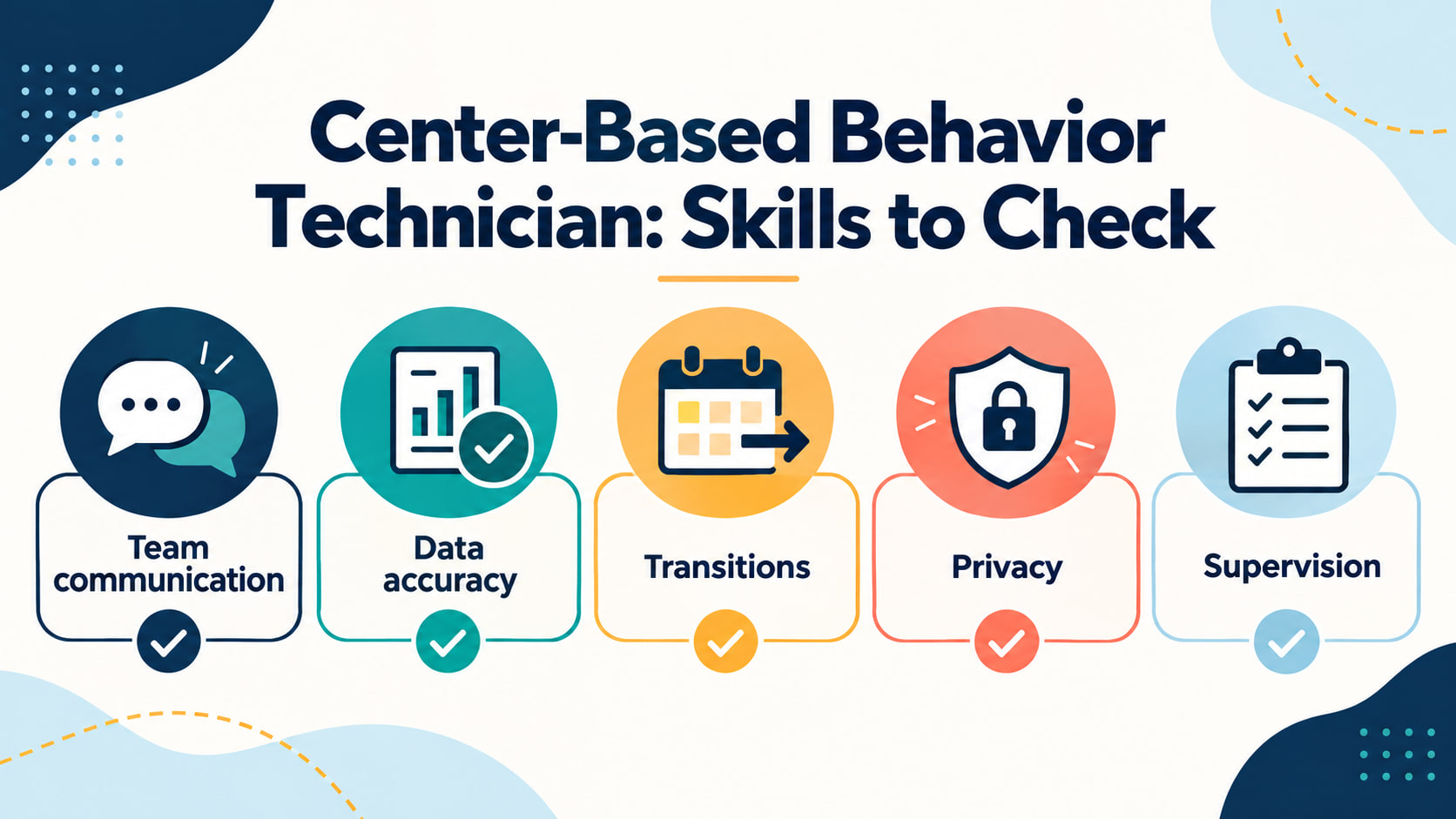
- Team communication: Ask focused questions and share objective facts through the approved route.
- Data accuracy: Use current definitions, complete required fields, and correct mistakes properly.
- Transitions: Follow visual, timing, and safety routines without inventing a new consequence.
- Privacy: Protect records, conversations, screens, and information about every learner in the center.
- Supervision: Know who can answer questions and who is authorized to change a procedure.
These skills support both service quality and the technician’s own learning. Ask for feedback on one observable target at a time, such as data accuracy during transitions or concise handoff language.
Center-based work also requires flexibility without losing consistency. A technician may move between planned teaching, natural routines, team questions, and cleanup while still protecting the learner’s privacy and completing required records. When competing tasks appear, use the supervisor’s priorities and document what could not be completed.
Frequently asked questions
Is every center-based technician schedule the same?
No. Schedule, group structure, room use, duties, and supervision vary by employer and program. Ask for the exact workflow before accepting a role.
Does a center setting make the work easier?
It can provide more immediate team access and organized materials, but shared spaces also create transition, privacy, communication, and staffing demands.
Can a technician change a plan when a room is busy?
No. Follow the approved safety and implementation procedure, record the context, and ask the supervisor about a change.
What should I do if I hear private information about another learner?
Do not repeat, photograph, or store it. Use only information necessary for your assigned role and follow the organization’s privacy process if exposure occurs.
Source note: Review the current BACB RBT Handbook, official application instructions, employer policy, ethics code, and supervisor guidance. This article is educational and does not provide individualized legal, clinical, employment, or credentialing advice.
Ready to practice the RBT concepts you just reviewed?
Try an independent, original RBT practice resource with exam-style questions, scoring, and answer explanations.
References
- Behavior Analyst Certification Board. RBT Test Content Outline, 3rd edition.
- Behavior Analyst Certification Board. RBT Handbook.
- Behavior Analyst Certification Board. RBT Ethics Code.