

Behavior technician jobs with training can differ widely, so compare who trains you, who supervises you, what is paid, and how readiness is checked.
Table of Contents
- Behavior technician jobs with training: what the phrase can mean
- Compare the training offer
- Ask what is paid
- Check supervised practice
- Understand competency review
- Separate the job from credential claims
- Questions to ask before accepting
- Frequently asked questions
- References
RBT CAREER · TRAINING OFFERS
Behavior Technician Jobs With Training: What to Check
Compare paid training, supervised practice, competency review, feedback, duties, and credential claims.
Behavior technician jobs with training can differ widely. One listing may describe a short orientation, another may include paid onboarding and supervised practice, and another may advertise a pathway toward a separate credential. Compare who trains you, who supervises you, what is paid, which duties are allowed, and how readiness is checked.
“Training provided” is not a universal promise. Read the written job description, offer, employer policy, current BACB instructions, and supervision process. This guide helps job seekers ask precise questions; it does not guarantee employment, certification, a wage, or a particular career route.
Behavior technician jobs with training: what the phrase can mean
Training may refer to orientation, privacy and safety instruction, behavior-analytic concepts, role-play, observation, competency review, ongoing supervision, or a combination. It may happen before employment, after hiring, during paid work, or through a separate provider. The phrase alone does not tell you the hours, provider, assessment, or transferability.
Ask what role the training prepares you for. A technician job, trainee position, RBT pathway, internal certification, and continuing education course are not automatically the same. Confirm whether completion changes your job title, duties, pay, supervision, or eligibility for another process.
Keep the job and credential questions separate. An employer can train you for its workflow without determining whether you meet current BACB requirements. Use the official handbook and application instructions for credential questions.
Compare the training offer
Look for four concrete parts: training content, supervised practice, competency review, and ongoing feedback.
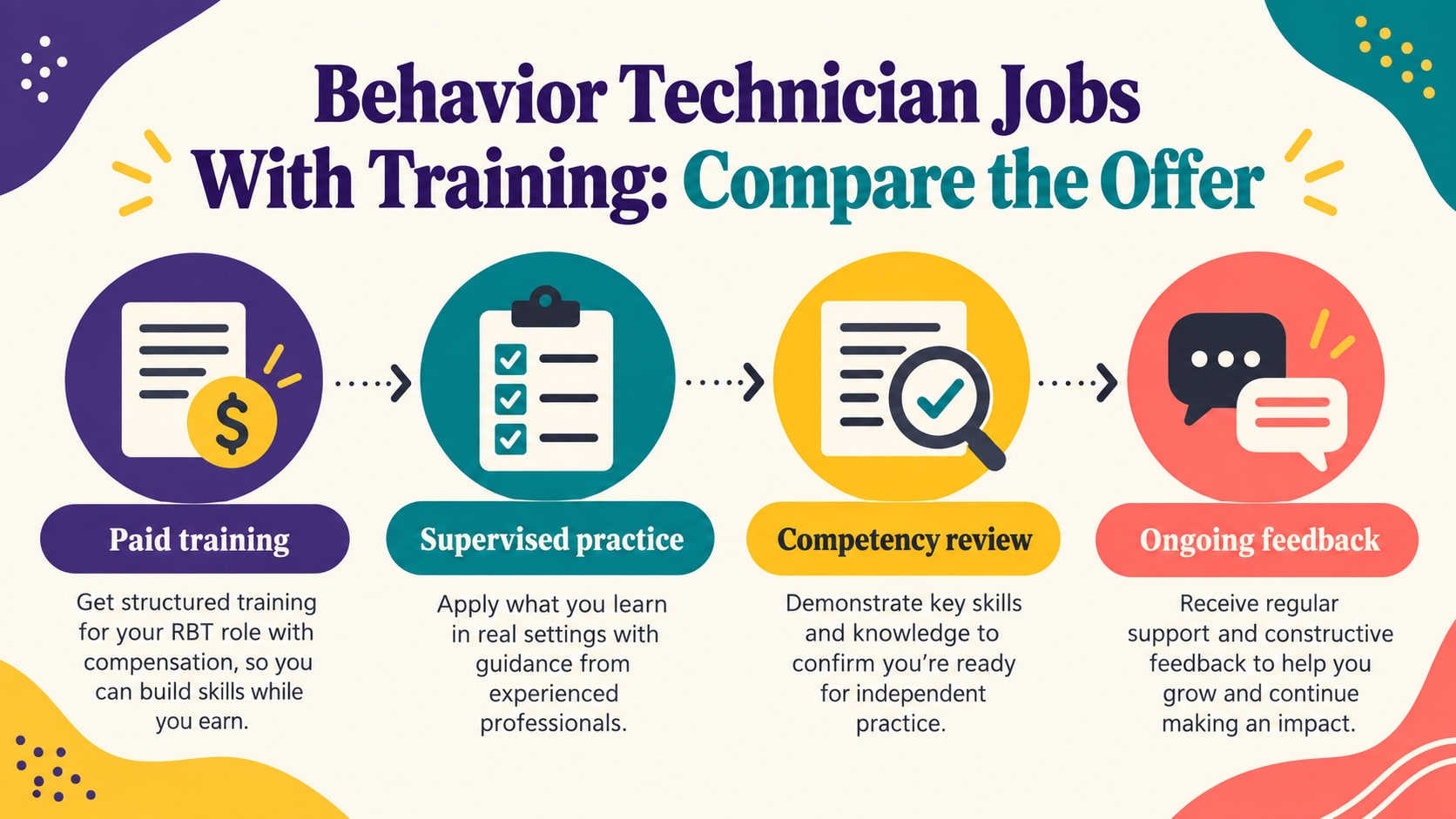
- Paid training: Confirm whether orientation, modules, role-play, shadowing, and meetings are paid and how time is recorded.
- Supervised practice: Ask who observes your work, how questions are answered, and what tasks are prohibited before readiness.
- Competency review: Ask what is evaluated, who evaluates it, and how feedback or a second attempt works.
- Ongoing feedback: Confirm how often supervision occurs and how performance concerns are documented and supported.
A strong offer explains the support process rather than promising instant independence. If the listing says “full training” but cannot describe who teaches, observes, or answers questions, request clarification before relying on it.
Ask what is paid
Training pay can be different from service pay, and unpaid time may have specific rules or employer conditions. Ask the employer to explain which activities are compensated, how travel and required meetings are handled, when pay begins, and what happens if training is not completed.
Keep the written answer. A verbal statement from a recruiter may not match the offer or local requirements. Do not pay a large fee or provide sensitive identity information to an unverified training site because a job advertisement feels urgent.
Also ask about materials, assessments, background checks, uniforms, technology, and recertification or continuing training. A job can be attractive while still having costs or obligations that should be understood in advance.
Check supervised practice
Supervised practice is more than watching someone work. It should make clear who gives direction, what you are permitted to do, how your implementation is observed, and how feedback reaches you. Ask what happens when a plan is unclear, a learner responds unexpectedly, or a safety issue occurs.
Before readiness is established, do not perform unfamiliar procedures independently because the center is busy. Follow the assigned role, ask for support, and use the escalation route. A training job should have a safe answer to “Who do I ask right now?”
Privacy is part of practice. Learn how to protect screens, notes, conversations, login credentials, and client information in the training environment. Do not use real client details in personal study notes or public tools unless the approved policy explicitly permits the method.
Understand competency review
Ask what competent performance looks like. A review may consider definitions, prompting, reinforcement, data collection, communication, ethics, safety, documentation, and role boundaries. Find out whether the review is a formal requirement, an internal check, or feedback intended for learning.
Request specific feedback. “Needs confidence” is difficult to practice; “record the prompt level in the required field after each opportunity” is observable. Ask how corrections are made and whether you may practice again with supervision.
Do not claim certification or independent competence because you completed an internal checklist. Use the official verification process and the employer’s current role language.
Separate the job from credential claims
A training offer may be a useful entry point, but it does not automatically satisfy every current official requirement. Check the official handbook, application instructions, required training, competency assessment, examination, supervision, and maintenance steps that apply to the credential you are considering.
Keep resumes and online profiles accurate. Distinguish orientation, supervised experience, course completion, internal status, and an active credential. Do not call yourself certified because a job listing uses the word “RBT,” because you created an account, or because a supervisor said you are doing well.
Role boundaries remain important after training. A technician may implement assigned procedures, collect objective data, communicate observations, and protect privacy. The technician should not diagnose, select goals, change a treatment plan, or promise outcomes.
Questions to ask before accepting
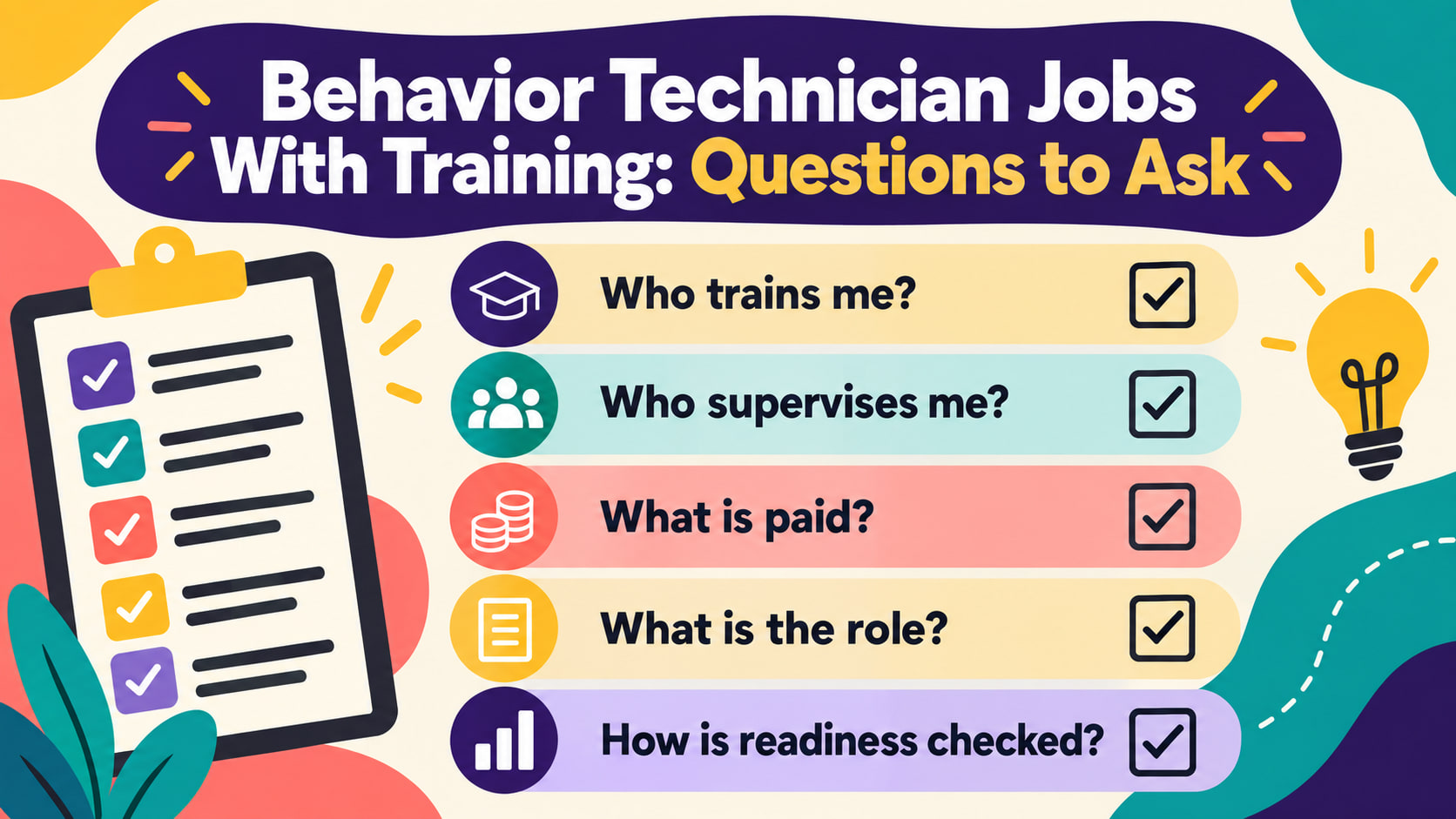
- Who trains me? Is the instructor qualified for the material, and what source controls the process?
- Who supervises me? How do I contact that person during a session?
- What is paid? Which modules, meetings, shadowing, and assessments are compensated?
- What is the role? Which duties are allowed before and after readiness review?
- How is readiness checked? What is observed, documented, corrected, and reviewed?
If the answers are vague, ask for the policy or written offer. A careful decision is better than accepting a title that hides unclear duties, unpaid obligations, or inadequate supervision.
Also compare the support after the first weeks. Ask whether feedback continues, how schedule changes are communicated, who reviews documentation, and how the employer handles a mismatch between training examples and a real session. Good onboarding should leave a clear route for questions instead of expecting a new technician to solve uncertainty alone.
Frequently asked questions
Do all behavior technician jobs with training lead to RBT certification?
No. Employment training and certification requirements are separate. Verify the current official pathway and the employer’s exact process.
Is training always paid?
No assumption is safe. Ask the employer how each required activity is paid, recorded, and scheduled, and keep the written answer.
Can I work independently after orientation?
Not automatically. Follow the role’s readiness, competency, supervision, safety, and employer requirements.
What if an employer promises certification?
Ask what the promise specifically means, compare it with current official requirements, and avoid representing a credential as current until it is officially verified.
Source note: Review the current BACB RBT Handbook, official application instructions, employer policy, ethics code, and supervision guidance. This article is educational and does not provide individualized legal, clinical, employment, or credentialing advice.
Ready to practice the RBT concepts you just reviewed?
Try an independent, original RBT practice resource with exam-style questions, scoring, and answer explanations.
References
- Behavior Analyst Certification Board. RBT Test Content Outline, 3rd edition.
- Behavior Analyst Certification Board. RBT Handbook.
- Behavior Analyst Certification Board. RBT Ethics Code.