

Behavior technician training near me can vary by provider, format, supervision, practice, and purpose, so compare the full pathway before enrolling.
Table of Contents
- Behavior technician training near me: what “near me” can mean
- Compare the full pathway
- Check the provider and format
- Confirm practice and supervision
- Ask what the course proves
- Verify before enrolling
- Questions to ask
- Frequently asked questions
- References
LOCAL SEARCH · TRAINING COMPARISON
Behavior Technician Training Near Me: How to Compare
Compare provider, format, supervision, practice, verification, privacy, and purpose.
Behavior technician training near me can vary by provider, format, supervision, practice, and purpose, so compare the full pathway before enrolling. A local address, search result, or “start today” message does not prove that a course satisfies an employer’s requirements or a current official certification process.
This guide helps readers compare local and online options without endorsing an unknown provider. Training, costs, schedules, instructors, waitlists, and requirements change. Verify the current details directly and use the BACB handbook or official instructions for credential questions.
Behavior technician training near me: what “near me” can mean
“Near me” may describe a classroom, a provider’s office, an employer’s onboarding program, a center, a live online cohort, or a directory result targeted to your location. Ask where instruction actually occurs, whether attendance is required, and whether practice is supervised or independent.
Separate a course from a job. An employer may train staff for its procedures; a school may teach concepts; a credential pathway may include separate requirements. A course certificate is not automatically an active professional credential or proof that a person can work independently.
Start with your purpose. Are you exploring the field, meeting an employer requirement, preparing for a current official process, or looking for supervised practice? The answer changes which details matter most.
Compare the full pathway
Use the same five categories for each option:
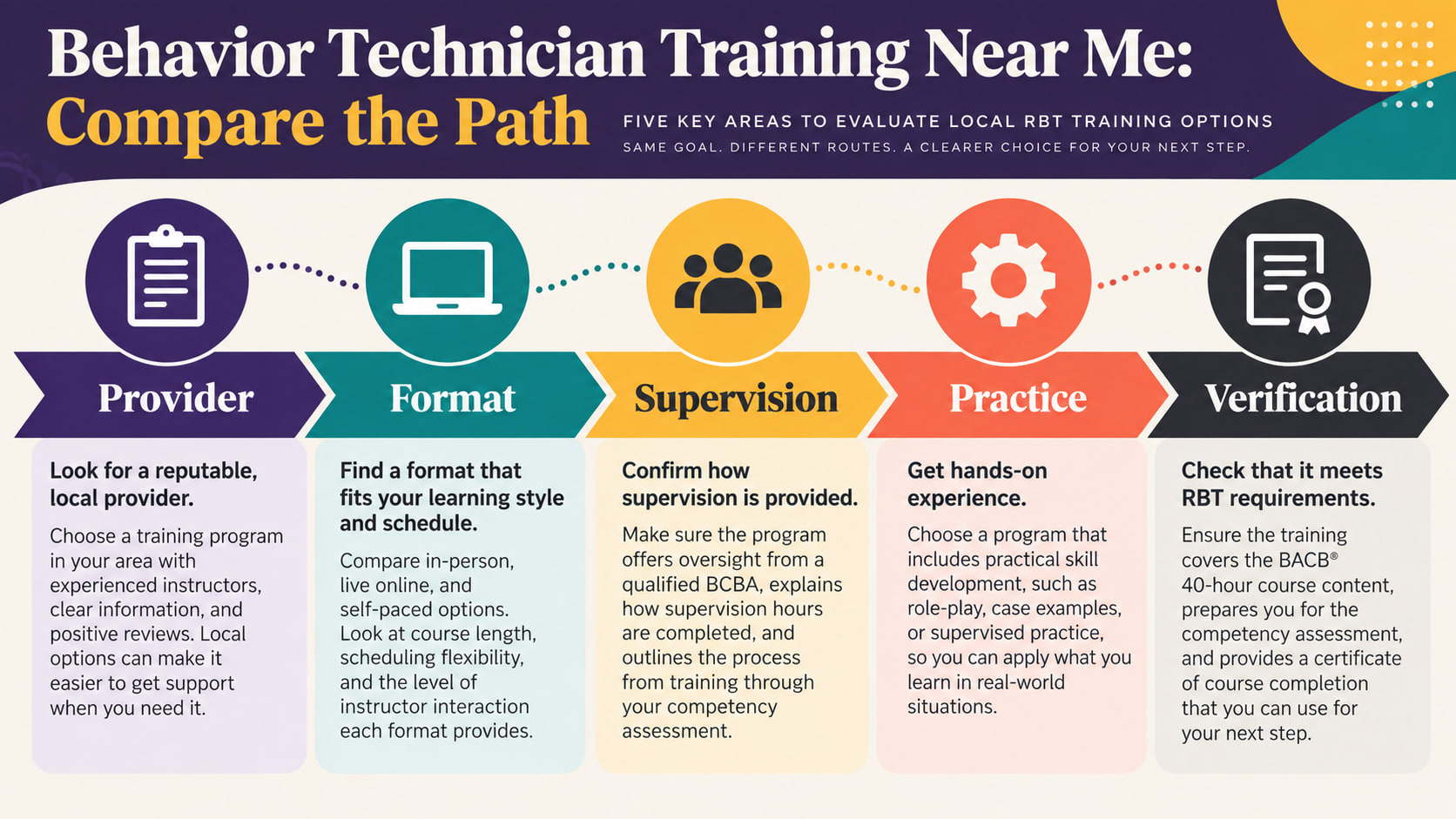
- Provider: Who teaches, owns, updates, and supports the training?
- Format: Is it in person, live online, self-paced, blended, or employer-based?
- Supervision: Who observes practice, answers questions, and handles safety?
- Practice: Are there role-plays, demonstrations, feedback, and competency checks?
- Verification: What does completion prove, and who recognizes it?
Compare written descriptions rather than marketing headlines. A course can be convenient and still not be the right fit for your purpose if it lacks practice, feedback, or a clear source for its requirements.
Check the provider and format
Read the official provider site, instructor information, contact method, refund or cancellation policy, schedule, cost, and privacy notice. Confirm the date of the material and ask how updates are handled when official requirements change.
For an online course, ask how identity, attendance, participation, questions, and assessments work. For in-person training, ask about location, accessibility, materials, travel, and whether the setting offers supervised practice. For employer training, ask whether the time is paid and what duties are allowed before completion.
Do not upload identity documents, passwords, one-time codes, or client information to an unverified form. Use the organization’s published contact route if a message creates unusual urgency.
Confirm practice and supervision
Reading or watching videos can introduce concepts, but practical readiness needs observable feedback. Ask who demonstrates a skill, who watches your practice, what is corrected, and whether you can ask questions during or after a session.
Supervision should clarify what happens when the plan is unclear, a learner responds unexpectedly, or a safety issue occurs. A course that says “you will be ready” without describing observation, feedback, and role limits deserves careful questions.
Do not practice on a real client outside the approved role or supervision process. Use role-play, fictional examples, or the authorized training setting.
Ask what the course proves
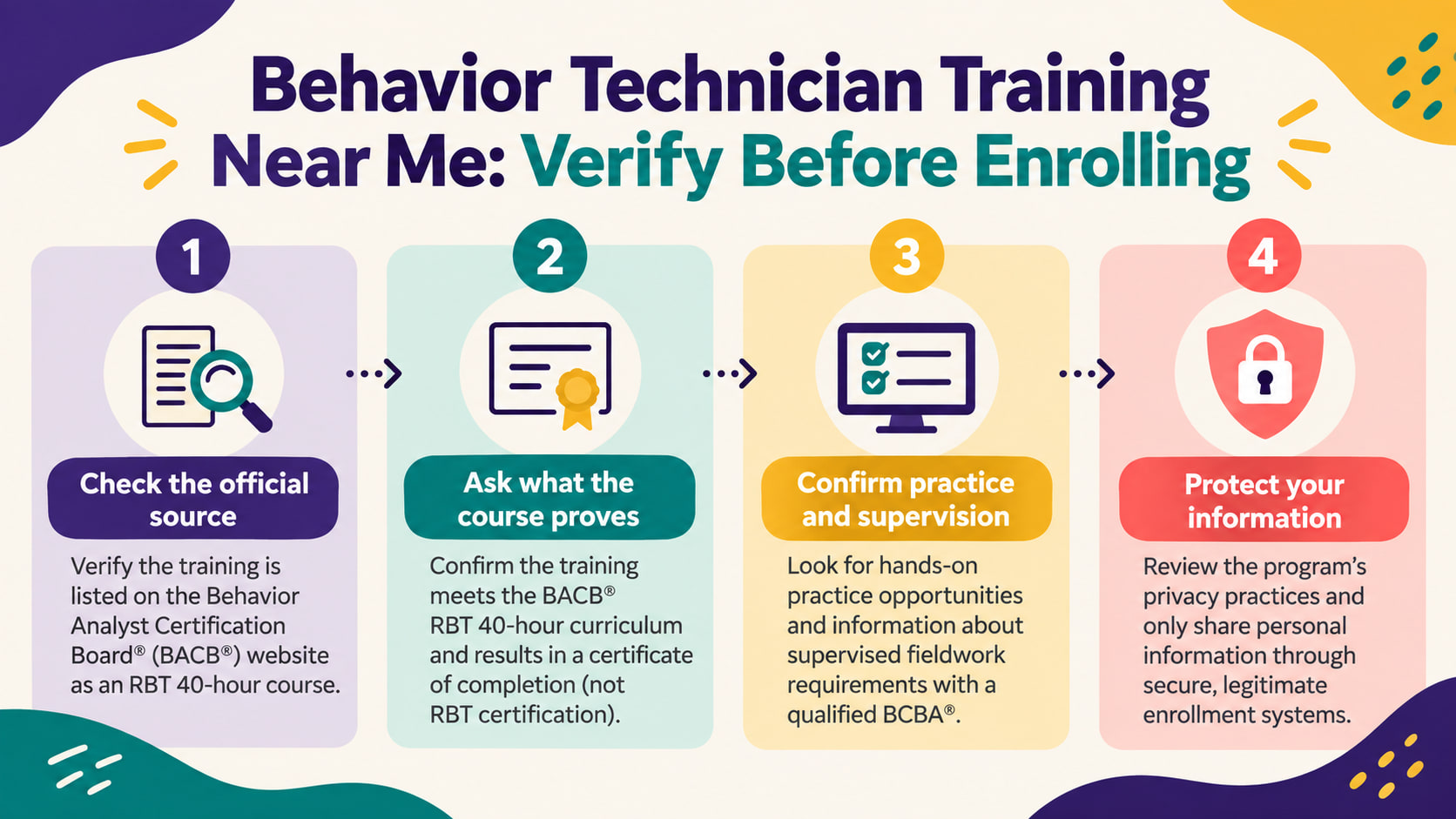
Ask whether the completion document shows attendance, course completion, competency, employer readiness, continuing education, or another limited fact. Read the exact wording. Do not assume that a badge, certificate, or provider logo transfers to every employer or official application.
If a course mentions RBT certification, compare its claim with the current BACB handbook, application instructions, training rules, competency assessment, examination, supervision, and maintenance requirements. A private provider cannot replace the official process.
Use accurate language on a resume. Distinguish course completion, supervised experience, internal training, and active credential status.
Verify before enrolling
Check the provider’s identity and current information before paying or sharing personal details. Save the course page, written answers, cost, dates, cancellation rules, and what completion means. If the provider refuses to explain its source, supervision, or refund process, pause.
Ask whether the training includes privacy, ethics, data, communication, safety, prompting, reinforcement, and role boundaries. A convenient location does not compensate for unclear duties or inadequate support.
Consider how the training fits your real schedule. Ask whether attendance is required, whether missed sessions can be made up, how long access lasts, and whether the provider offers technical or learning support. A course that is theoretically nearby may still be difficult to complete if travel, timing, language, or accessibility needs are not addressed.
Consider the next step after completion. Will an employer review the document? Is additional supervised practice required? Who can answer a question about an official application? Write down the answer instead of relying on a general phrase such as “career ready.”
Good training should make limits clearer, not blur them. You should know what you can implement, what data you should collect, what information must remain private, who supervises the work, and when to pause. If the course encourages you to diagnose, change a plan, or claim a credential immediately, treat that as a warning sign.
It is also reasonable to ask how the provider handles complaints, corrections, missed instruction, accessibility needs, and changes to the curriculum. You are comparing a learning process, not just a location. A transparent provider should be able to explain who answers questions, where current policies are found, and what happens when your goal changes before enrollment is complete.
Questions to ask
- Who provides and updates the training?
- What is included in the price and schedule?
- Is practice observed and are feedback and reassessment available?
- Who supervises work after training?
- What exactly does the completion document prove?
- Does the employer or official process recognize it?
- How are privacy and personal information protected?
Frequently asked questions
Is the nearest training provider automatically best?
No. Compare purpose, provider, practice, supervision, privacy, cost, and verification rather than distance alone.
Does a course guarantee RBT certification?
No. Certification depends on current official requirements and verification. A private course may cover useful material without replacing the process.
Can I practice with a client during a course?
Only through an approved role, plan, consent, supervision, and organizational process. Do not improvise practice on a real client.
What should I save before enrolling?
Save the current description, price, dates, provider identity, refund terms, supervision details, and exact statement of what completion proves.
Source note: Review current official RBT requirements, provider policies, privacy instructions, and supervision guidance. This article is educational and does not provide individualized legal, clinical, employment, or credentialing advice.
Ready to practice the RBT concepts you just reviewed?
Try an independent, original RBT practice resource with exam-style questions, scoring, and answer explanations.
References
- Behavior Analyst Certification Board. RBT Test Content Outline, 3rd edition.
- Behavior Analyst Certification Board. RBT Handbook.
- Behavior Analyst Certification Board. RBT Ethics Code.