

An ABA behavior technician job description should explain the setting, client population, supervision, implementation duties, data expectations, schedule, credential requirements, and escalation process.
Table of Contents
- What an ABA behavior technician job description covers
- Core duties to look for
- Data and documentation
- Teaching and teamwork
- Credential and training language
- What the role does not authorize
- Questions before accepting a job
- Frequently asked questions
- References
RBT CAREER · ROLE GUIDE
ABA Behavior Technician Job Description: Duties and Boundaries
A clear guide to implementation, data, teaching, teamwork, supervision, and the limits that should appear in an ABA behavior technician role.
An ABA behavior technician job description should explain the setting, client population, supervision, implementation duties, data expectations, schedule, credential requirements, and escalation process. Titles vary: some employers use behavior technician, registered behavior technician, behavioral technician, or another local title. Read the actual duties and credential language instead of assuming that every title describes the same role.
In general, an RBT is a paraprofessional who assists with behavior-analytic services under close, ongoing supervision. A job description can help you evaluate fit, but it cannot replace the current BACB requirements, an employer’s written policy, a client’s plan, or supervisor direction.
What an ABA behavior technician job description covers
A behavior technician may support skill acquisition, behavior-reduction procedures, communication, daily living skills, data collection, and collaboration with a supervising professional. The exact duties depend on the service setting, plan, employer, state, and credential status.
Look for language that identifies who designs or maintains the behavior plan, who observes implementation, how feedback is delivered, and how safety concerns are escalated. A clear description distinguishes direct implementation from assessment, treatment design, and clinical decision-making.
Core duties to look for
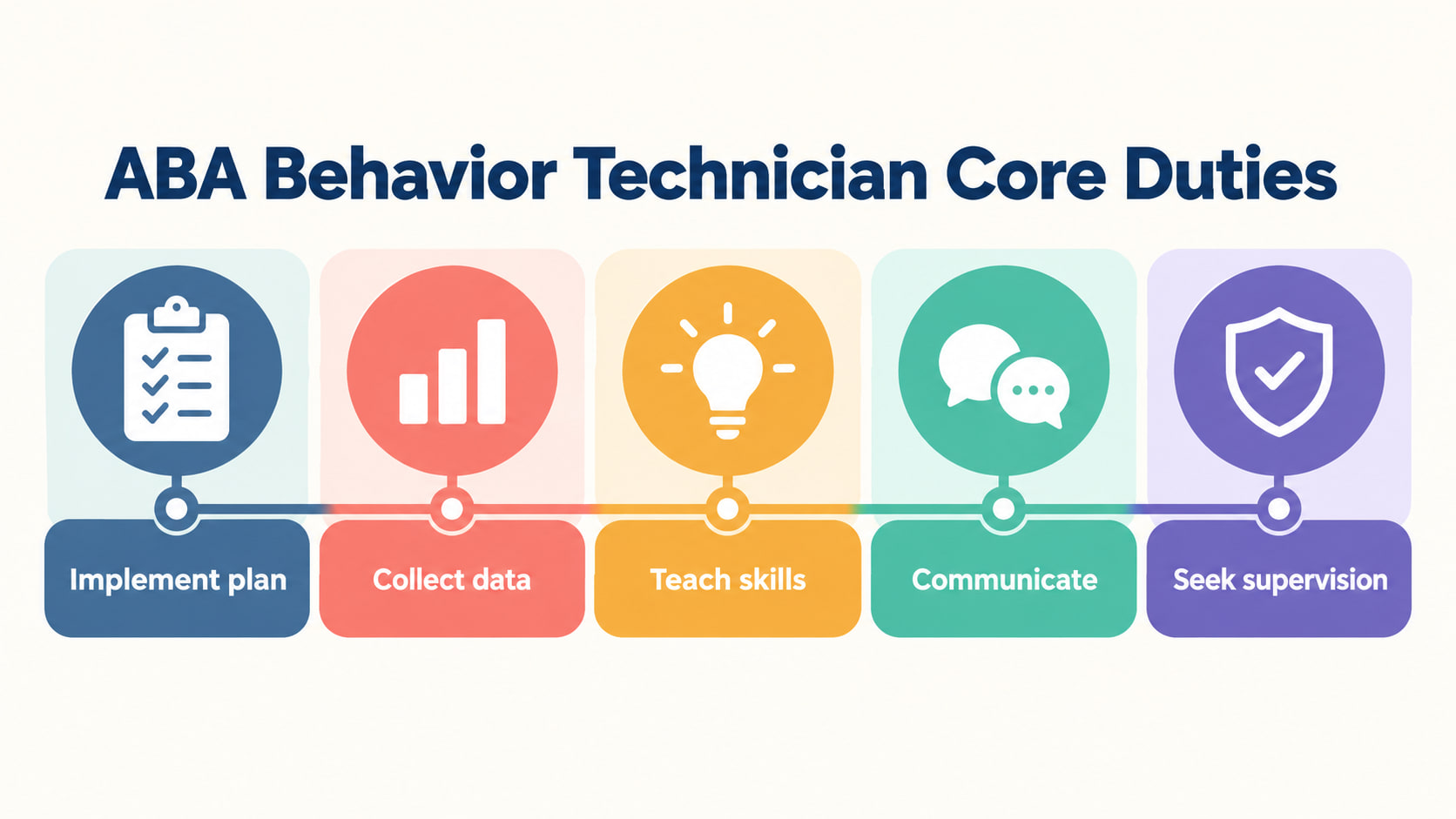
Common duty categories include:
- Implement the plan: follow authorized teaching and behavior-support procedures as trained.
- Collect data: record defined responses using the current measurement and documentation system.
- Teach skills: support communication, learning, independence, or replacement skills according to the plan.
- Protect dignity and safety: use respectful interactions, privacy practices, and approved safety procedures.
- Communicate: share objective observations and questions with the supervisor, caregivers, educators, and team members through approved channels.
- Seek supervision: ask for direction when instructions conflict, a procedure is unclear, or a situation is outside training.
These categories are useful for comparing job descriptions, but they are not a universal job template. An employer may add attendance, transportation, session preparation, cleaning of materials, or other duties. Ask which duties are paid, trained, supervised, and documented.
Look for the difference between an outcome and a duty. “Help the learner make progress” is an outcome statement; “implement the programmed teaching procedure and record the defined response” describes work that can be trained and observed. The more specific the posting, the easier it is to compare the role with your experience and ask about support.
Data and documentation
Data work is more than entering numbers into an app. A technician must understand the operational definition, measurement, start and stop rules, opportunity, prompt level, and what to do when a response is ambiguous or an opportunity is missed.
Ask which system is used, who reviews the data, how corrections are made, and when documentation is due. Do not estimate a missing event, change a measure because it is easier, or write an interpretation as if it were an observation. A strong job description tells you how training and feedback support accurate records.
Teaching and teamwork
Teaching duties may include presenting instructions, arranging materials, prompting, reinforcing responses, practicing communication, and supporting generalization. The technician should implement the programmed steps rather than inventing a new prompt, reward, target, or mastery rule.
Teamwork means reporting what occurred without blaming or diagnosing. Ask how the technician communicates with the BCBA, supervisor, caregivers, classroom staff, or other providers. Clarify what information can be shared, where it is recorded, and who responds to family questions or plan concerns.
Good teamwork also includes respectful disagreement. You can report that a material was unavailable, a response definition was unclear, or a safety step did not match the situation without deciding who was at fault. Ask how the organization handles corrections and whether feedback is documented in the same system as session notes.
Credential and training language
Read words such as required, preferred, eligible to obtain, company-sponsored, state-certified, and active credential carefully. A behavior technician title may not itself mean the person holds the BACB RBT credential. Some roles may accept a person who will complete training; others may require an active credential before independent work.
Ask what training is included, whether it is paid, who provides the competency assessment, how supervision is arranged, and which steps remain your responsibility. A degree, short course, or prior classroom role does not automatically replace the current credentialing pathway.
What the role does not authorize
An ABA behavior technician does not independently diagnose, design treatment, conduct an assessment outside authorization, change a behavior plan, select a new intervention, or interpret policy as a substitute for a supervisor. Knowing ABA vocabulary is not the same as having independent clinical authority.
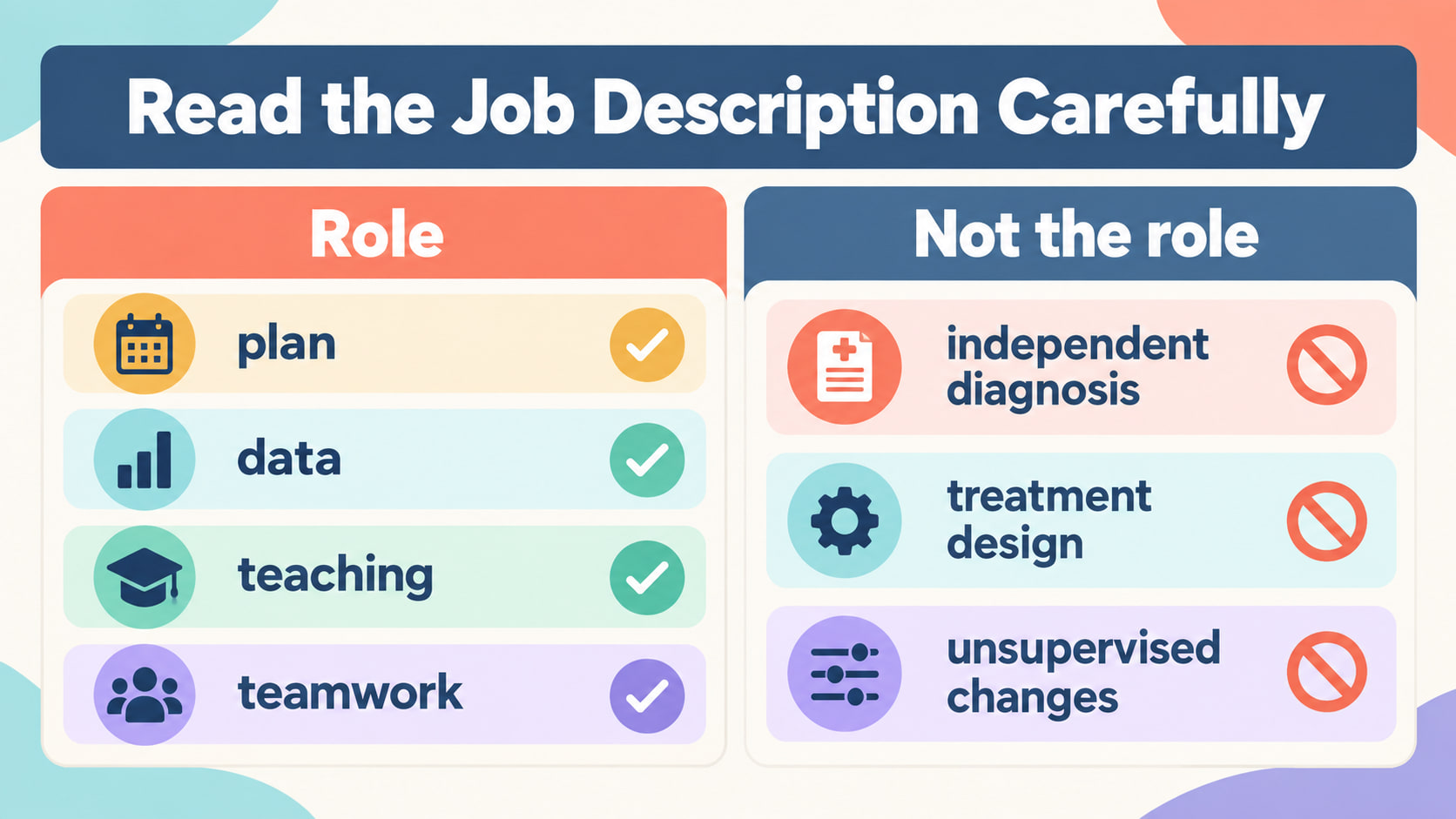
If an instruction is unclear or unsafe, follow the designated escalation route. If a caregiver asks for a change, acknowledge the question and route it to the appropriate supervisor. If a plan conflict appears, document objective facts and seek clarification before improvising.
Physical prompting, crisis procedures, restrictive practices, medication-related questions, and personal information require particular care. Follow the current authorized procedure and training. Do not rely on a generic job description to decide what is permitted in a specific case.
Ask for examples of the training provided before a difficult duty begins. A posting may use a broad phrase such as “manage challenging behavior,” but the actual process should identify the approved procedures, safety support, documentation, and supervisor availability. If the answer remains vague, treat that as an important employment question.
Questions before accepting a job
- Who is the supervising professional, and how often will direct observation and feedback occur?
- What population, setting, schedule, and travel expectations apply?
- Which data system and documentation deadlines will I use?
- What training and competency checks happen before independent sessions?
- What credential must be active, and who handles renewal or verification?
- What happens when a session is canceled, a safety concern occurs, or the plan is unclear?
- Are meetings, travel, preparation, documentation, and training paid?
Compare the written offer with the job description. Job titles, pay, hours, duties, and requirements can vary by location and contract. Save the job ID and access date because postings can change.
Frequently asked questions
Is an ABA behavior technician the same as an RBT?
Not always. Behavior technician can be a general employer title, while RBT is a specific BACB credential. Check the exact credential language and current official requirements.
What is the most important duty?
Accurate, respectful implementation of the authorized plan under supervision, including data collection and timely communication about questions or concerns.
Can a behavior technician change a treatment plan?
No. A technician should implement assigned procedures and bring observations or proposed concerns to the supervising professional.
What should a job description say about supervision?
It should identify the supervisor or supervising structure, feedback and observation process, escalation route, and expectations for documentation and ongoing support.
Source note: Review the current BACB RBT page and Handbook, employer job description, client plan, ethics materials, and supervisor direction for your situation. This article is educational and does not provide individualized legal, clinical, employment, or credentialing advice.
Ready to practice the RBT concepts you just reviewed?
Try an independent, original RBT practice resource with exam-style questions, scoring, and answer explanations.
References
- Behavior Analyst Certification Board. RBT Test Content Outline, 3rd edition.
- Behavior Analyst Certification Board. RBT Handbook.
- Behavior Analyst Certification Board. RBT Ethics Code.