

Registered behavior technician training is not one universal product. Compare what each program includes and what remains your responsibility.
Table of Contents
- What registered behavior technician training includes
- Compare the curriculum
- Check competency assessment
- Separate training from supervision
- Evaluate support and access
- Read the price and policy details
- Questions to ask before enrolling
- RBT boundaries and next steps
- Frequently asked questions
- References
RBT CAREER · TRAINING GUIDE
Registered Behavior Technician Training: How to Compare Programs
A practical checklist for comparing curriculum, competency, supervision, support, cost, and current credentialing requirements.
Registered behavior technician training is not one universal product. A program may provide an instructional curriculum, practice activities, a completion record, a competency assessment pathway, or support with an application. Those pieces are related but not interchangeable. Compare what each program actually includes, what remains your responsibility, and how the current official requirements apply.
Use the current BACB Handbook and other official materials for credentialing decisions. A course description, sales page, review, or advertisement cannot guarantee certification, examination success, employment, or a particular supervision arrangement. The purpose of this guide is to help you ask better questions before paying or enrolling.
What registered behavior technician training includes
Training usually refers to structured instruction in behavior-analytic concepts and job-related tasks. A useful program should explain its curriculum, delivery method, access period, assessment process, instructor or provider identity, and any completion documentation. It should also make clear whether the course is designed to satisfy a particular current requirement or is only general education.
Start by separating five stages: learning content, demonstrating competency, completing any application steps, meeting supervision requirements, and preparing for an examination if applicable. A program may support one stage without providing the others. If a page uses “become an RBT” as a headline, read the fine print to find out which stages are actually included.
Compare the curriculum
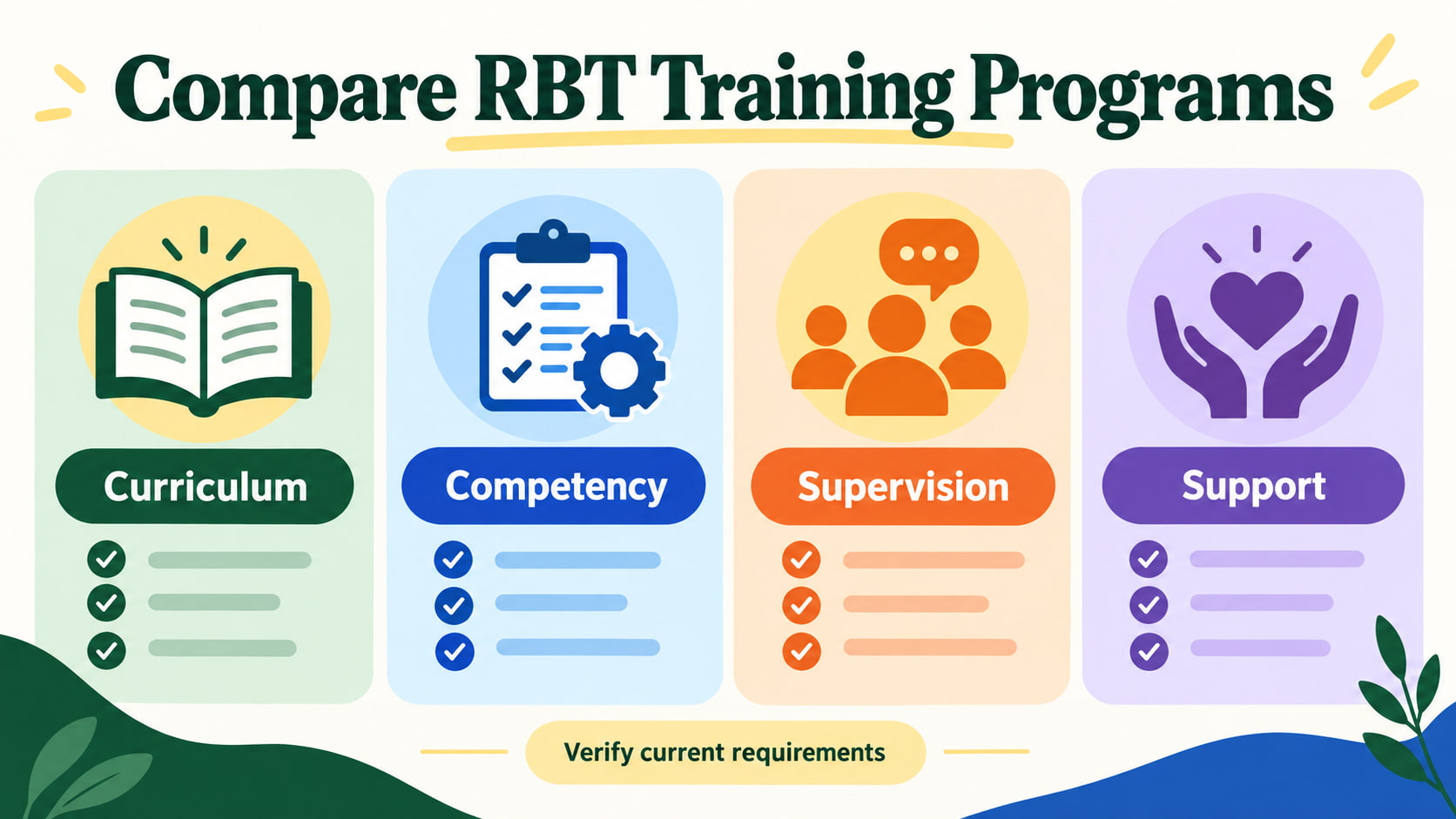
Ask whether the curriculum is current, organized, and specific enough to guide study. A strong outline identifies domains, learning objectives, examples, practice opportunities, and ways to review missed concepts. It should not rely on vague promises such as “learn everything you need” without showing what is taught.
Look for instruction that connects definitions to observable practice: measurement, skill acquisition, prompting, reinforcement, behavior reduction, documentation, ethics, professional conduct, and supervision. Examples should explain why an answer fits a scenario and should be clearly independent educational examples rather than official or recalled examination questions.
Check the update date and the version of the official outline or handbook referenced. Requirements and administrative procedures can change. A program that does not identify its source version makes it harder to know whether the lessons are still aligned with current expectations.
Check competency assessment
Instruction and competency assessment answer different questions. Instruction asks whether you studied content; a competency assessment asks whether you can demonstrate specified tasks under the applicable process. Confirm who performs the assessment, what qualifications or role that person has, which tasks are evaluated, how the appointment works, and what documentation you receive.
Ask whether practice feedback is included before the assessment. A quiz score is not automatically a competency assessment. Likewise, completing videos does not by itself show that a person can implement a procedure accurately, collect data, communicate an observation, or respond appropriately to a supervision question.
Read the retake and expiration policies. Find out what happens if the provider changes its curriculum, if you need accessibility support, or if an assessment appointment is canceled. Keep copies of receipts, completion records, assessment instructions, and relevant communications.
Separate training from supervision
Supervision is an ongoing service and professional relationship, not merely a video module. Before enrolling, ask whether the provider offers supervision, only teaches how to locate supervision, or has no supervision service at all. If supervision is offered, request the structure, frequency, direct observation expectations, feedback process, communication channel, and cancellation policy in writing.
Do not assume that the person who sells a course will supervise your work. A training provider, employer, supervising professional, competency assessor, and credentialing body may have different responsibilities. Clarify who handles each step and whether an employment relationship is required.
Training cannot authorize an RBT to diagnose, independently design treatment, change a learner’s plan, select an unapproved intervention, or make decisions outside demonstrated competence. A good program explains these boundaries and teaches when to ask for direction.
Evaluate support and access
Support can include instructor questions, office hours, technical help, study groups, practice review, captions, transcripts, accessible documents, and a clear escalation route. Compare the promised support with the actual response window. “Lifetime access” may not mean lifetime instructor feedback, updates, or access to every feature.
Check the learning format before purchase. Consider whether the platform works on your device, whether videos have captions, whether materials can be reviewed offline, and whether practice progress is saved. Ask how personal information and assessment records are protected. Avoid sharing client information in a course forum or personal messaging channel.
Reviews can reveal useful patterns, but read them critically. Look at the review date, the reviewer’s relationship to the program, the feature being evaluated, and whether the claim can be verified. A high rating is not official endorsement and does not prove that a program fits your state, employer, schedule, accessibility needs, or current credential path.
Read the price and policy details
Compare total cost rather than the headline price. Include enrollment fees, assessment fees, supervision, textbooks, extensions, retakes, technology, travel, and any required background or application costs. Ask which items are optional and which are necessary for the path you are considering.
Read the refund, cancellation, transfer, and access policies before paying. Note whether access starts immediately, whether the clock continues during a technical problem, and whether a price is a subscription or one-time purchase. Save the terms as they appeared when you enrolled because web pages can change.
Be cautious with guarantees. No training provider can promise that every learner will pass an examination, receive a credential, obtain employment, or achieve a particular salary. A responsible program describes what it provides and directs credentialing questions to current official sources.
Questions to ask before enrolling
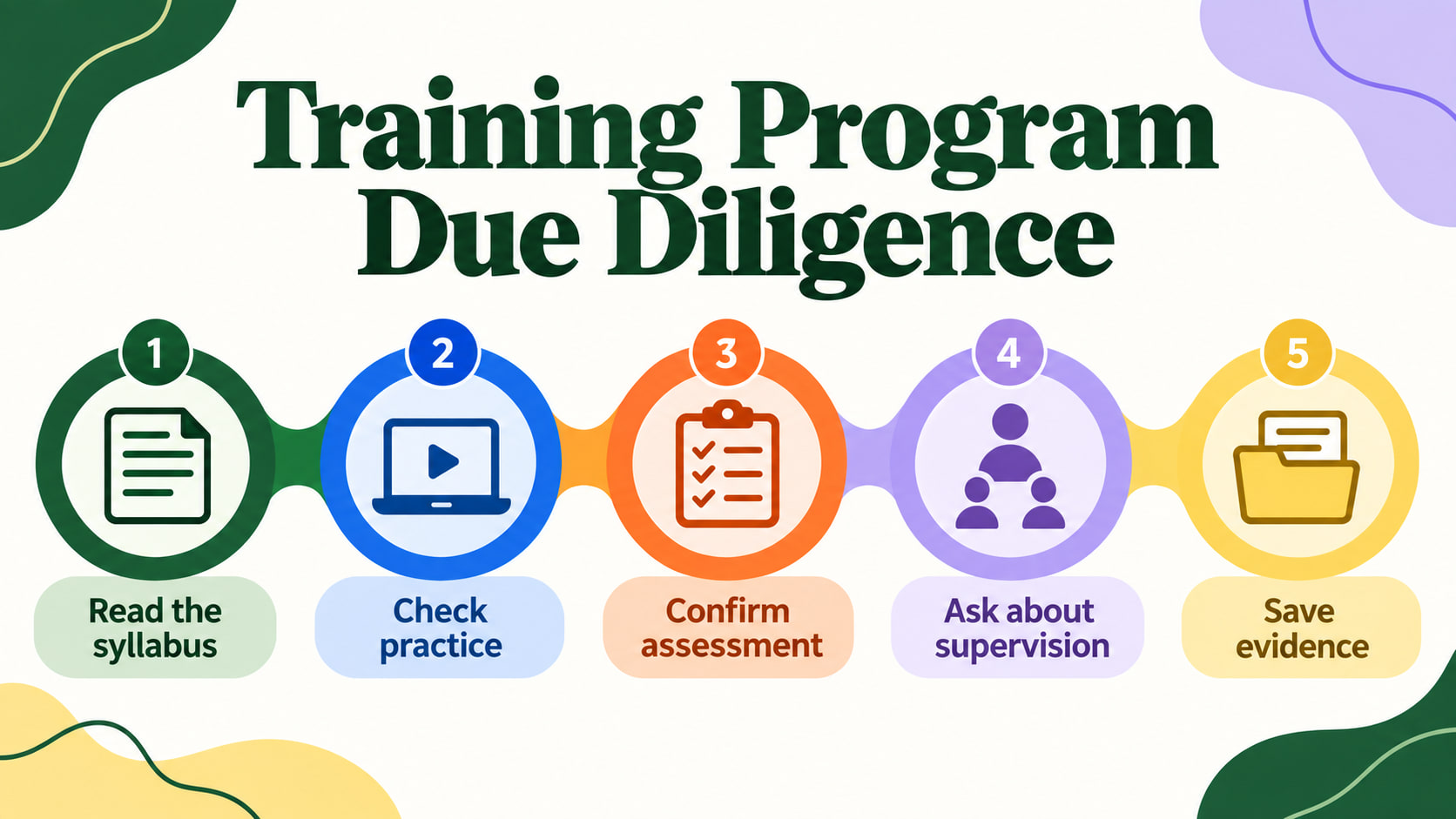
- Which current official requirement or curriculum does the program address?
- What exact lessons, practice, records, and assessments are included?
- Who teaches the material and who performs any competency assessment?
- Is supervision included, referred, or not provided?
- How long is access available, and what happens when the access period ends?
- What support, accessibility features, and response times are offered?
- What is the complete cost, including assessment, retake, extension, and application-related fees?
- What are the refund, cancellation, privacy, and data-retention policies?
- When was the material last reviewed against current official sources?
Ask for direct answers in writing. If a provider avoids explaining who does what, uses a guarantee instead of a process, or cannot identify its sources, treat that uncertainty as part of your comparison. A lower price is not necessarily a better value if essential stages or support are missing.
RBT boundaries and next steps
After training, continue to use supervision and the current authorized procedures. An RBT may implement assigned services, collect data, report objective observations, and receive feedback. An RBT should not independently alter targets, mastery rules, prompts, reinforcement arrangements, behavior plans, or safety procedures.
Before choosing a program, write a one-page comparison with columns for curriculum, competency, supervision, support, cost, updates, and policies. Attach the source link or saved evidence for each answer. Then verify any credentialing decision against the current BACB Handbook and the requirements that apply to your situation.
Frequently asked questions
Does a training course make someone an RBT?
No. Training is one part of a broader credentialing pathway. Confirm the current official requirements, assessment, supervision, application, and examination steps that apply.
Is a 40-hour course the same as supervision?
No. A required training curriculum and ongoing supervision are separate functions. Ask exactly what the provider includes.
How should I compare online programs?
Compare current sources, curriculum detail, practice, competency assessment, supervision, accessibility, support, total cost, and written policies. Do not rely on star ratings alone.
Can a program guarantee certification or a job?
Be cautious with such claims. A provider can describe its services but cannot control every credentialing decision, examination result, employer decision, or local requirement.
Source note: Review the current BACB Handbook, RBT materials, employer requirements, and supervisor direction for your situation. This article is educational and does not provide individualized legal, clinical, employment, or credentialing advice.
Ready to practice the RBT concepts you just reviewed?
Try an independent, original RBT practice resource with exam-style questions, scoring, and answer explanations.
References
- Behavior Analyst Certification Board. RBT Test Content Outline, 3rd edition.
- Behavior Analyst Certification Board. RBT Handbook.
- Behavior Analyst Certification Board. RBT Ethics Code.