
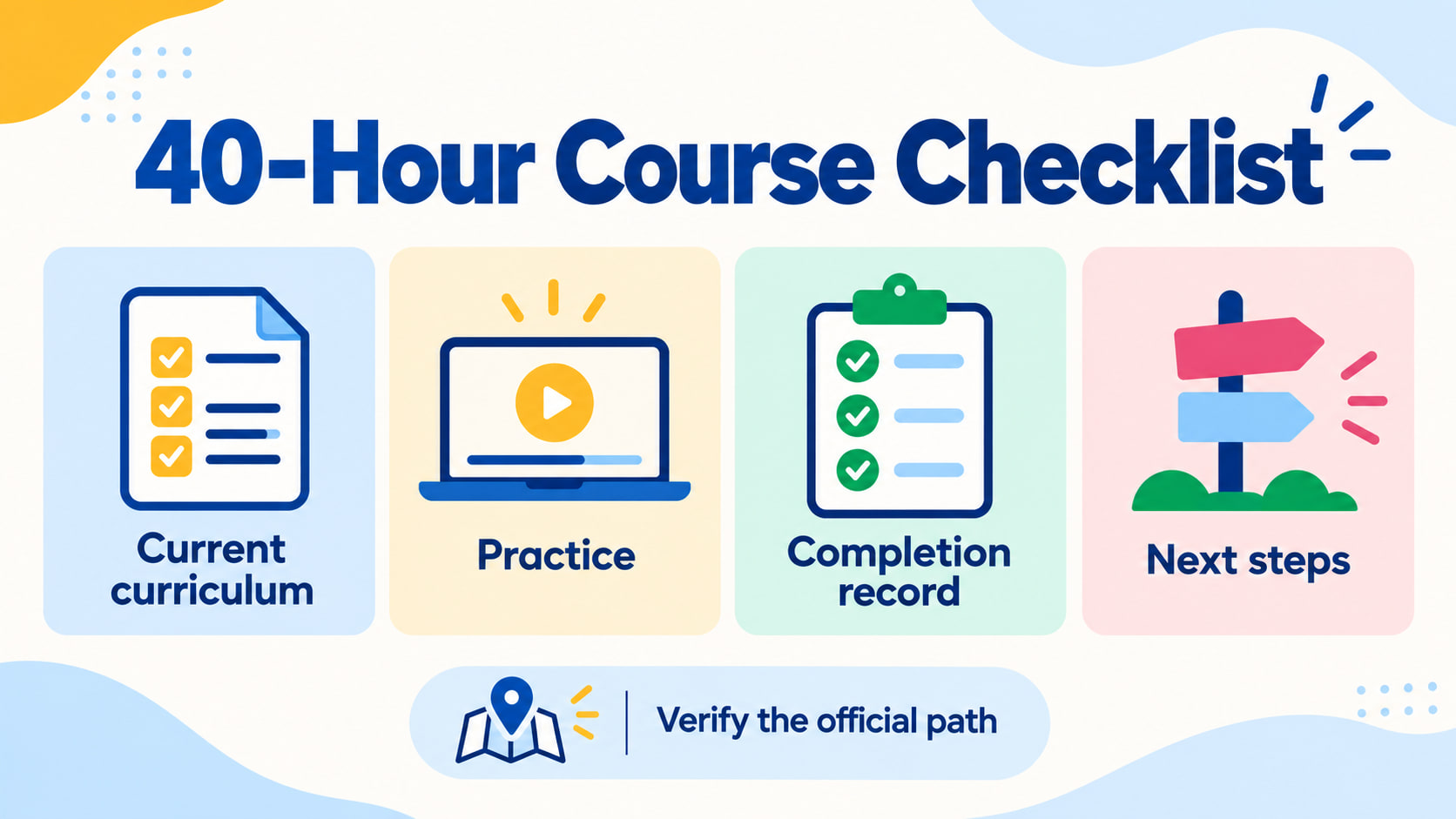
Registered behavior technician 40-hour course usually refers to structured instruction intended to cover an applicable training curriculum.
Table of Contents
- What a registered behavior technician 40-hour course is
- Check the current curriculum
- Verify the provider and source date
- Look for practice and feedback
- Understand the completion record
- Compare support and policies
- Separate training from next steps
- Questions before enrolling
- Frequently asked questions
- References
RBT TRAINING · PROGRAM GUIDE
Registered Behavior Technician 40-Hour Course: What to Check
Compare the curriculum, provider, practice, completion record, support, and next steps before enrolling.
Registered behavior technician 40-hour course usually refers to structured instruction intended to cover an applicable training curriculum. The phrase does not by itself prove that the program is current, that it includes competency assessment or supervision, or that completing it automatically creates a credential. Read the details before enrolling.
Use the current BACB Handbook and official RBT materials for credentialing decisions. A provider may describe its own curriculum and services, but it cannot guarantee certification, examination success, employment, or a particular supervision arrangement. This article is a comparison checklist, not a substitute for official requirements.
What a registered behavior technician 40-hour course is
A 40-hour course is an instructional component, not necessarily the entire credentialing pathway. Depending on the provider, it may include readings, videos, quizzes, examples, practice, instructor feedback, and a completion record. It may not include a competency assessment, supervision, application support, or examination preparation.
Separate the stages: studying content, demonstrating competency, completing an application, receiving supervision, and preparing for an examination if applicable. Ask which stage the course addresses and what you must arrange elsewhere. A short sales page should not be your only evidence.
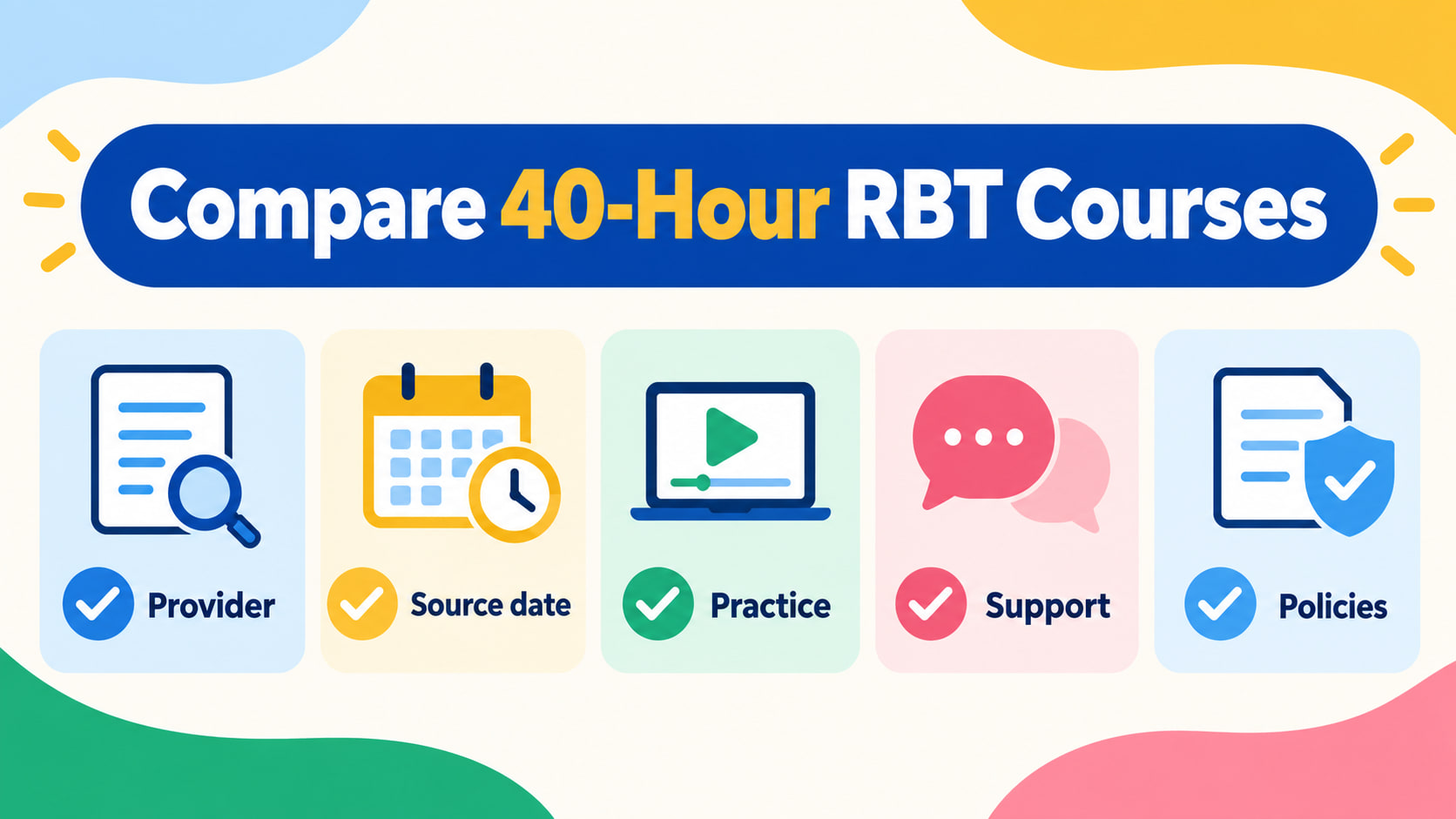
Check the current curriculum
Look for a syllabus with named domains, objectives, activities, source versions, update dates, and completion requirements. Strong instruction connects definitions to observable work such as measurement, skill acquisition, prompting, reinforcement, behavior reduction, documentation, ethics, and supervision.
Check whether the lessons explain what a technician can implement and when to ask for direction. Technical vocabulary without role boundaries can give a learner an inaccurate idea of independent clinical authority. The curriculum should also identify how questions are answered and how missed concepts are reviewed.
Ask whether the materials are original educational content or are presented as official examination content. Be cautious with claims about real, recalled, leaked, or guaranteed questions. Practice should explain reasoning rather than encourage memorization of protected material.
Verify the provider and source date
Find the provider’s legal or business identity, instructor information, contact method, refund policy, accessibility details, and current source version. The person who sells a course, the person who teaches it, the competency assessor, the supervisor, and the credentialing body may be different parties.
Check when the curriculum was last reviewed. A course can remain online while its references, administrative steps, or examples become outdated. Save the syllabus, terms, receipt, completion instructions, and relevant communications as they appeared when you enrolled.
Look for practice and feedback
Quizzes measure recall; practice and feedback help show whether you can apply a concept. Look for scenarios that identify the condition, response, consequence, data rule, and next step. Ask whether explanations are provided, whether you can ask questions, and whether retakes are included.
Passive videos and a completion badge do not automatically demonstrate competency. A useful course shows common errors and gives you a way to practice objective documentation, measurement, prompting, reinforcement, professional communication, and escalation. Use fictional or de-identified scenarios and never place client information in a course forum.
Understand the completion record
Ask what the completion record says, who issues it, when it is issued, whether it expires, and how it can be verified. Confirm that the recorded name and dates will match the information needed for the next step. Keep the record in a secure place and follow the applicable official submission process.
A certificate of completion is evidence that the provider recorded completion of its course. It is not automatically proof of competency, supervision, application approval, examination success, or an RBT credential. Those distinctions should be clear in the provider’s terms.
Compare support and policies
Compare the support window: instructor questions, office hours, technical help, captions, transcripts, accessible documents, updates, and feedback. “Lifetime access” may describe login access but not lifetime instructor responses or curriculum updates.
Read refund, cancellation, transfer, access-expiration, retake, extension, privacy, and data-retention policies before paying. Calculate the total cost, including books, assessment, supervision, technology, and any application-related fees. A low headline price may exclude steps you need.

Separate training from next steps
Training is separate from competency assessment and ongoing supervision. Ask whether the provider offers either service, refers you to another professional, or provides neither. If supervision is offered, request the observation, feedback, communication, cancellation, and privacy arrangements in writing.
Training does not authorize an RBT to independently diagnose, design treatment, change a learner’s plan, choose an unapproved intervention, change mastery criteria, or make a safety decision outside training. Follow the current authorized procedure and use supervision when uncertainty arises.
Pay attention to how the course explains uncertainty. A useful program tells you when to stop, record an objective observation, and ask for supervision. It explains how feedback is handled when an implementation error occurs and how learner dignity and privacy are protected. These details are more useful than a broad claim that the course will make every enrollee “job ready.”
If your goal is employment, compare the course with the actual duties of the positions you are considering. Ask employers which training, credential, background checks, schedule, and supervised experience they require. Keep the course decision separate from the employer decision so that marketing language does not stand in for a written job requirement.
Before enrolling, write down the date you checked the handbook, the provider’s source version, and the questions still unanswered. Recheck those items if enrollment is delayed. A current, documented comparison helps you notice changes in course access, fees, assessment instructions, or official requirements.
Questions before enrolling
- Which current official curriculum or requirement does the course address?
- When was the material last reviewed and updated?
- What lessons, practice, feedback, and completion record are included?
- Who teaches the course and who handles any competency assessment?
- Is supervision included, referred, or not provided?
- How long is access available, and are updates included?
- What is the total cost, including retakes and extensions?
- What are the refund, privacy, and data-retention policies?
- What must I arrange after course completion?
Ask for answers in writing. If a provider avoids naming its sources, blends training with credentialing promises, or replaces process details with a guarantee, treat that uncertainty as important comparison data.
Frequently asked questions
Does a 40-hour course make someone an RBT?
No. It is an instructional component. Confirm the current requirements for assessment, supervision, application, examination, and credential approval.
Does the course include supervision?
Not automatically. Ask whether supervision is included, referred, or not provided, and request the arrangement in writing.
What should a completion record prove?
It should document what the provider says you completed. It does not automatically prove competency, examination success, supervision, or an RBT credential.
Can a course guarantee certification?
Be cautious. A provider can describe its services but cannot control every credentialing decision, examination result, or employer decision.
Source note: Review the current BACB Handbook, RBT materials, employer requirements, and supervisor direction for your situation. This article is educational and does not provide individualized legal, clinical, employment, or credentialing advice.
Ready to practice the RBT concepts you just reviewed?
Try an independent, original RBT practice resource with exam-style questions, scoring, and answer explanations.
References
- Behavior Analyst Certification Board. RBT Test Content Outline, 3rd edition.
- Behavior Analyst Certification Board. RBT Handbook.
- Behavior Analyst Certification Board. RBT Ethics Code.