

Registered behavior technician exam prep works best as a staged system. You verify the current source, learn the concepts, practice applied decisions, review the reason behind each answer, and then test whether you can transfer the rule to fresh wording. A pile of flashcards or a single high score is not the same as a dependable study process.
Table of Contents
- What Registered Behavior Technician exam prep should produce
- Start with the current certification source
- Build a six-domain study map
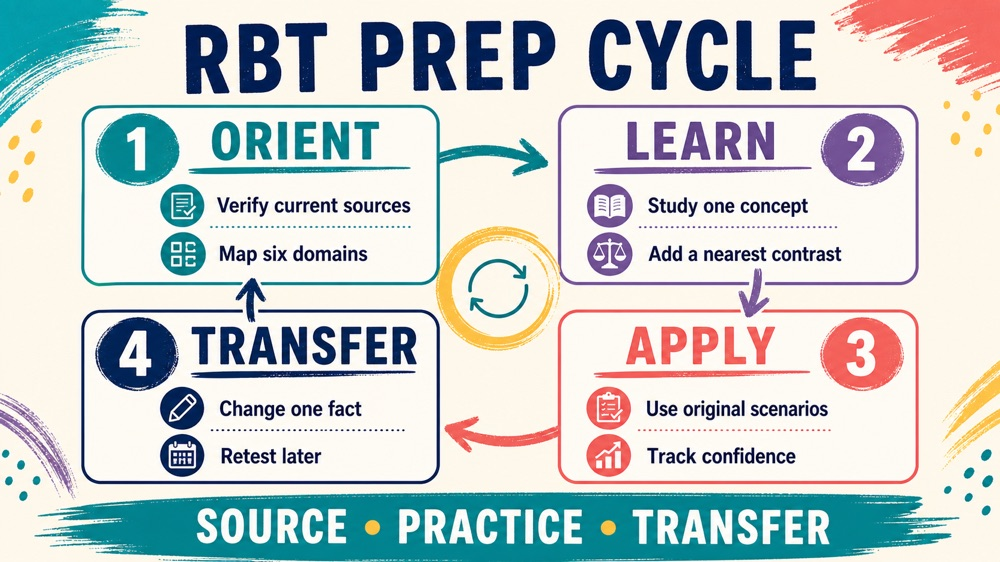
- Use a four-stage prep cycle
- Choose practice resources with audit questions
- Original exam-prep decisions
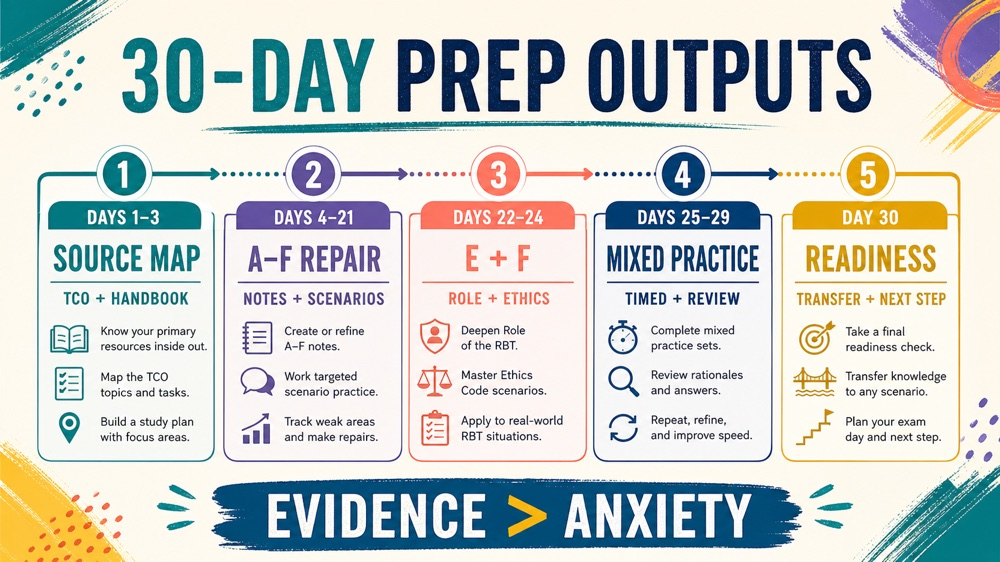
- Follow a 30-day RBT prep plan
- Measure readiness with more than a score
- Avoid common prep failures
- Frequently Asked Questions
- References
The current BACB RBT Test Content Outline, 3rd edition, organizes 43 tasks across six domains. The written examination context includes 75 scored questions and 10 unscored pilot questions, with four answer options and 90 minutes. The BACB RBT Handbook controls eligibility, application, scheduling, examination, and maintenance information; a third-party prep page does not.
RBT Training is not a BACB certification program and is not affiliated with or endorsed by the BACB or Pearson VUE. This guide is independent educational content. Its examples are newly written for study and are not official, recalled, leaked, or BACB-endorsed questions. No study plan, question bank, course, or practice score can guarantee certification or a passing result.
Use the 30-day outline below as a flexible framework. If you have less time, keep the sequence and compress the days; if you have more time, repeat the repair and transfer stages instead of only adding more questions.
What Registered Behavior Technician exam prep should produce
By the end of a useful registered behavior technician exam prep cycle, you should be able to:
- describe the current six-domain and 43-task scope;
- recognize the observable clue that controls a scenario question;
- select a measurement, teaching, reduction, documentation, or ethics response that fits the written plan and RBT role;
- explain why the nearest distractor is not supported;
- work under a time condition without rushing through exception words; and
- identify a next study action from an error pattern rather than from anxiety.
| Prep output | Evidence you created it | Why it matters |
|---|---|---|
| Source map | Current TCO, Handbook, and approved study materials listed with dates. | Prevents outdated or promotional pages from controlling exam facts. |
| Domain map | Questions and errors tagged A–F and, where useful, to a task pattern. | Shows what concept needs repair. |
| Correction log | Clue, rule, role, contrast, and changed-fact answer recorded. | Turns misses into learning. |
| Mixed practice record | Timed condition, confidence, flags, score, and review notes. | Separates retrieval, pacing, and content problems. |
For example: a learner who scores 80% on repeated Domain C flashcards may still need mixed practice if the real problem is switching from acquisition to documentation or ethics. The next action is not automatically “buy a bigger bank”; it may be a changed-fact transfer set and a short timed block.
Start with the current certification source
Do not begin by copying the first “RBT exam prep” outline you find. Start with the BACB materials and separate three questions:
- What is tested? The current TCO defines the 43 tasks and six domains.
- How does the certification process work? The current Handbook controls eligibility, 40-hour training, competency assessment, application, scheduling, examination, and maintenance information.
- How will I learn it? An independent guide, course, flashcard set, or practice test can organize learning but does not become the authority.
Use the current exam frame for study logistics: 75 scored questions, 10 unscored pilot questions, four options, and 90 minutes. Do not assume a provider’s private pass line is a BACB-published raw percentage. Do not treat an “exact,” “real,” or “Pearson-style” label as proof that a page has secure examination content.
The 2026 Handbook also matters outside the test room. RBTs work under direction and close supervision, and the path includes required training and competency steps. Preparation should reinforce role boundaries rather than encourage independent plan changes, diagnosis, or clinical decisions.
Build a six-domain study map
Use the current TCO labels while keeping familiar vocabulary in parentheses only when it helps you recognize older materials:
| Domain | Tasks | High-value prep questions |
|---|---|---|
| A. Data Collection and Graphing | A.1–A.8 | What is observable, which measurement fits, how is it calculated, and what does the graph show? |
| B. Behavior Assessment | B.1–B.3 | What does the RBT implement or record, and which assessment decision belongs to the supervisor? |
| C. Behavior Acquisition | C.1–C.11 | Which teaching, prompting, reinforcement, chaining, shaping, or generalization step follows the plan? |
| D. Behavior Reduction | D.1–D.7 | What antecedent, consequence, differential procedure, safety step, or reporting action is supported? |
| E. Documentation and Reporting | E.1–E.4 | How should the RBT write, communicate, protect privacy, and escalate a concern? |
| F. Ethics | F.1–F.10 | What protects dignity, competence, boundaries, confidentiality, and supervision? |
For each domain, create one page with four boxes: definitions, applied examples, role boundaries, and recurring distractors. When you miss a question, place it in the box that needs repair. This is more useful than making a single “weak domain” label do all the work.
Use a four-stage prep cycle
Organize your registered behavior technician exam prep into four stages:
- Orient: verify the current edition, map six domains, and collect the source materials.
- Learn: study one concept at a time with a short example and a nearest contrast.
- Apply: answer original scenario questions, record confidence, and explain the answer before checking.
- Transfer: change one fact, retest later, and decide whether the error was content, reading, role, data, or pacing.
Do not spend the entire month in stage three. A high volume of questions with no explanation audit can make a repeated mistake feel familiar. Conversely, reading a study guide without retrieval may create recognition without independent responding.
Choose practice resources with audit questions
Before relying on a page, ask:
| Audit question | What a responsible resource should show | What to flag |
|---|---|---|
| Is it current? | Edition, review date, and links to current BACB material. | Unlabeled legacy terminology or old exam facts. |
| Are examples original? | Clear statement that items are independent study content. | Claims of real, recalled, leaked, or exact secure questions. |
| Are explanations useful? | Correct rule, stem evidence, distractor contrast, and role boundary. | Only an answer letter or a generic definition. |
| Does it support review? | Domain tags, flags, confidence, notes, or a correction workflow. | Score shown without a next action. |
| Are commercial claims clear? | Package contents, access, price, and affiliation boundary stated plainly. | Guarantees, fake scarcity, or unexplained credentials. |
Free and paid resources can both be useful. Compare the learning experience, not only the question count. A short set with excellent explanations may expose a reasoning error faster than thousands of repeated items. If a page makes a current claim that affects eligibility, fees, accommodations, or certification status, verify it with the BACB.
Original exam-prep decisions
These examples are newly written for independent study. They are not official, recalled, leaked, or BACB-endorsed questions.
- Source decision: A guide uses a 2nd-edition domain name but says it is a 2026 guide. Use the current 3rd-edition TCO as the anchor and treat the older term as a crosswalk only.
- Practice decision: A learner gets 90% on the same 20 items three times. Switch to fresh wording and record confidence; repeated recognition is not enough evidence of transfer.
- Measurement decision: A stem asks for the delay between an instruction and a response. Look for the latency relationship rather than choosing duration because both use time.
- Role decision: A distractor says the RBT should rewrite the behavior plan after noticing a trend. Choose the role-safe action: record objective data and communicate through supervision unless the authorized plan directs otherwise.
- Timing decision: A learner spends six minutes debating one item in a 90-minute simulation. Flag it, make the best supported choice, continue, and return during review if time allows.
- Ethics decision: A practice provider asks for identifiable session notes to personalize a quiz. Protect confidentiality and use an approved, de-identified route or decline.
Write the controlling clue and the nearest contrast for each example. Then change one fact: replace latency with duration, replace a written plan with an unclear plan, or change a timed set to untimed. Your explanation should change for a reason.
Follow a 30-day RBT prep plan
| Days | Focus | Deliverable |
|---|---|---|
| 1–3 | Source and exam frame | Current TCO/Handbook map, six domains, question-count and time notes, no-guarantee boundary. |
| 4–9 | Domains A and B | Measurement/assessment notes, 30–50 original questions, and a correction log. |
| 10–16 | Domain C | Teaching, prompting, reinforcement, chaining, shaping, and generalization contrasts. |
| 17–21 | Domain D | Reduction, differential procedures, safety, reporting, and changed-fact practice. |
| 22–24 | Domains E and F | Documentation, privacy, supervision, ethics, and role-boundary review. |
| 25 | Mixed diagnostic | Timed or semi-timed set with confidence and flagged-item record. |
| 26–28 | Repair cycle | Target the three most repeated error patterns; retest fresh wording. |
| 29 | Full simulation | All presented items under a 90-minute condition, followed by full review. |
| 30 | Readiness review | Source check, correction log, pacing plan, open questions, and next action. |
Adjust the number of questions to your schedule. Preserve the deliverables. If you have only 10 days, use one day to orient, five days to repair domains, two days for mixed practice, and two days for review. A plan is useful because it creates evidence of learning, not because the number 30 has magic.
Measure readiness with more than a score
After a practice session, record:
- resource and version;
- timed, untimed, open-book, or closed-book condition;
- total correct and domain pattern;
- confidence before seeing the answer;
- number of changed-fact transfers solved;
- reading, content, role, data, ethics, or pacing errors; and
- the next study action.
A strong signal is not “I got a high score once.” It is “I can identify the clue, explain the rule, reject the nearest distractor, and apply it to fresh wording under a realistic condition.” Even that signal cannot predict a secure examination or guarantee certification.
Avoid common prep failures
- Using the first study guide as authority: verify current facts with the BACB.
- Collecting question volume: measure explanation quality and transfer.
- Studying only definitions: add short scenarios and role contrasts.
- Ignoring low-confidence correct answers: review lucky responses.
- Mixing credentials: keep RBT certification, BCBA fieldwork, training, competency assessment, supervision, and professional development distinct.
- Chasing secure content: use original practice and protect exam integrity.
- Claiming a guarantee: no independent resource can guarantee certification or a passing result.
Bottom line: registered behavior technician exam prep should produce a source map, a six-domain plan, original applied practice, an explanation-driven correction log, and a realistic readiness review. Use the BACB materials for authority, use practice resources for rehearsal, and keep the boundary clear: preparation supports the certification process; it does not issue the credential.
Ready to put your prep plan into practice?
Use original RBT practice questions, review every explanation, and map your next study action to the current A–F scope.
Try Free RBT Mock Exams →
Frequently Asked Questions
What is the best registered behavior technician exam prep approach?
Start with the current BACB TCO and Handbook, build a six-domain map, study concepts with examples, use original practice questions, review explanations, and retest changed facts. Choose resources based on explanation quality rather than only question volume.
How long should RBT exam prep take?
A 30-day plan is one workable framework, not a requirement. Compress or extend it while preserving source verification, domain repair, mixed practice, and review.
Should I study all six RBT domains equally?
Cover all six domains, but allocate extra time to the error patterns you can demonstrate. Do not rely only on a provider’s private percentage weights; use the current TCO and your correction evidence.
Are RBT exam prep questions official?
Third-party practice questions should be treated as independent study content. Do not seek or use recalled, leaked, or secure examination items. Verify official facts with the BACB.
Does completing an RBT prep course certify me?
No. A study guide, practice test, or course does not issue BACB certification. Eligibility, application, examination, and maintenance are controlled by the applicable BACB requirements.
Can registered behavior technician exam prep guarantee a passing result?
No. No independent study plan, question bank, course, or practice score can guarantee certification or a passing result.
References
- Behavior Analyst Certification Board. RBT Test Content Outline, 3rd edition.
- Behavior Analyst Certification Board. RBT Test Content Outline, 3rd-edition PDF.
- Behavior Analyst Certification Board. RBT Handbook.
- Behavior Analyst Certification Board. RBT examination resources.
- RBT Exam Practice sampler. Reviewed for competitor research; not an endorsement.
- Practice RBT Exam resource. Reviewed for competitor research; not an endorsement.
- RBT Hub question categories. Reviewed for competitor research; not an endorsement.
- ABA Sprout exam-prep resource. Reviewed for competitor research; not an endorsement.