
An rbt certification study guide should answer two questions at once: what must an applicant understand for the current RBT examination, and how can the applicant build that understanding from reliable source materials? It should not pretend to be the BACB, replace the Handbook, or turn a practice score into a credential promise.
Table of Contents
- RBT certification study guide: what it should do
- Build the official preparation stack
- Use a certification-readiness matrix
- Map the six-domain RBT exam blueprint
- Review Domains A and B through applied decisions
- Review Domains C and D through plan fidelity
- Review Domains E and F through professional judgment
- Choose and audit an RBT certification study guide
- Use original certification-study scenarios
- Follow a 10-day certification study plan
- Frequently Asked Questions
- References
The current BACB preparation recommendation is source-first: review the RBT Test Content Outline, 3rd edition, and the materials gathered from the 40-hour training and competency assessment. This article turns that recommendation into a study system with domain mapping, guide selection, original scenarios, and readiness checks.
This is independent educational content. RBT Training is not the BACB, is not a certification program, and is not affiliated with or endorsed by the BACB. Examples are newly written and are not official, recalled, leaked, or BACB-endorsed questions. No study guide, course, provider, employer, practice score, or mock exam can guarantee certification or a passing result.
RBT certification study guide: what it should do
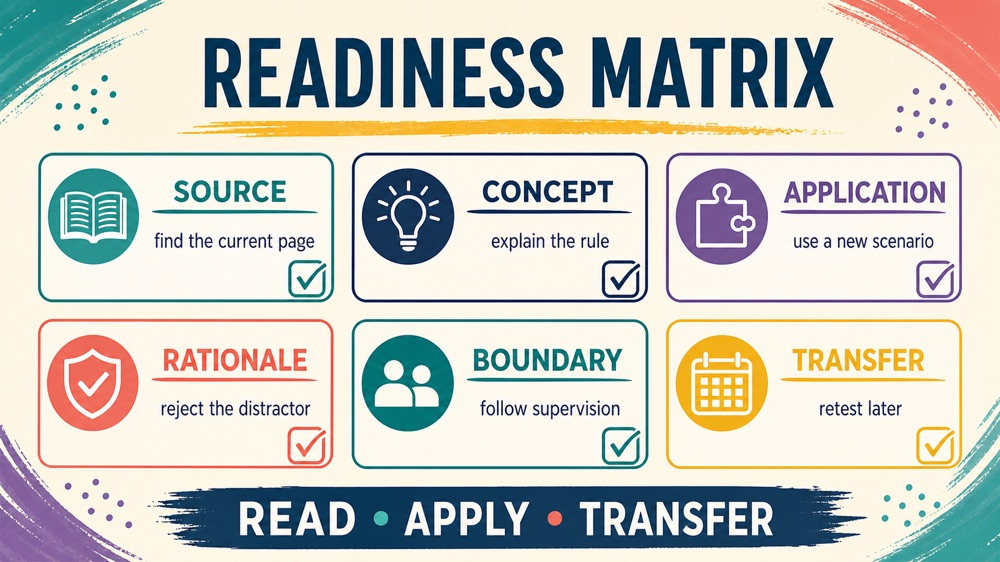
Certification-oriented study is not the same as collecting definitions. A useful guide should help you:
- trace a concept to a current official source;
- connect the concept to an RBT task and entry-level action;
- apply it to a new scenario with observable details;
- explain why the nearest distractor is less appropriate;
- recognize when the written plan or supervision boundary controls; and
- record the error so a later item tests transfer.
It should also keep three statuses separate:
| Status | Meaning | What it does not mean |
|---|---|---|
| Training completed | You finished a qualifying 40-hour program. | You are already an RBT. |
| Competency demonstrated | You demonstrated applicable tasks with an assessor. | You passed the written exam. |
| Exam practice ready | You can apply concepts to original mixed scenarios. | You are guaranteed a passing result. |
| Certification | The BACB application and examination process is complete. | A third-party study provider awarded the credential. |
Build the official preparation stack
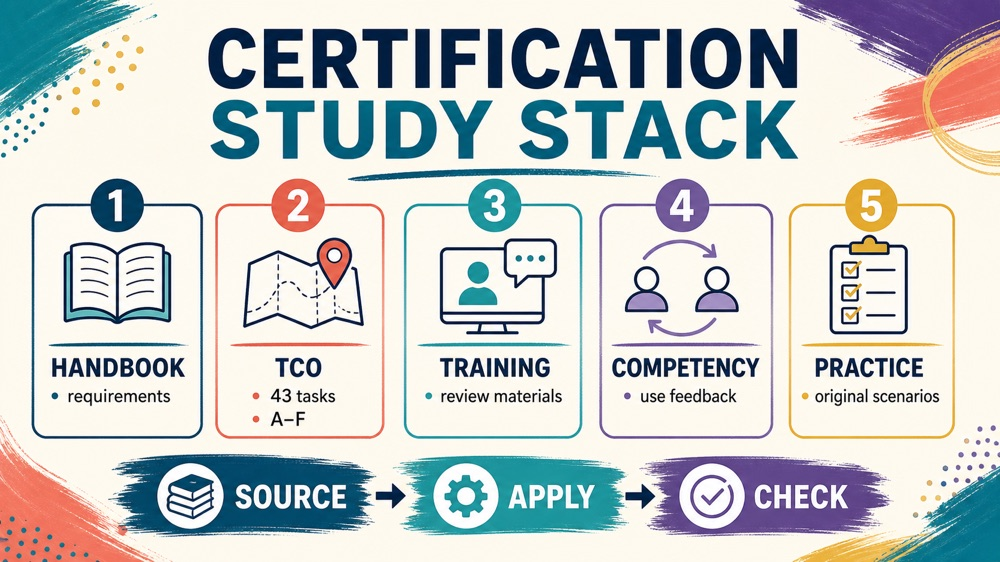
Start with the documents the BACB itself points candidates toward:
- RBT Handbook: use it for eligibility, application, examination, security, and maintenance requirements.
- RBT Test Content Outline, 3rd edition: use it for the 43 tasks and six content areas that define the examination blueprint.
- 40-hour training materials: revisit demonstrations, examples, assigned activities, notes, and quizzes from the qualifying program.
- Competency-assessment materials: review the skills, feedback, and corrections recorded during the initial assessment.
- Current ethics resources: use the RBT Ethics Code (2.0) and other current BACB resources for boundaries and professional conduct.
- Independent practice: add original questions, but label them as independent and never treat them as secure exam content.
Save the publication or update date for each source. Search results may display an old PDF beside a current page. If a study guide uses “3.0,” “professional conduct,” or an approximate task count, verify the term against the current official documents before copying it into your notes.
Use a certification-readiness matrix
| Checkpoint | Ready evidence | Next action if weak |
|---|---|---|
| Source control | You can locate the current Handbook and TCO and explain which one answers which question. | Bookmark official pages and remove outdated copies from the study queue. |
| Concept | You can define the rule in plain language without looking at a flashcard. | Rewrite the definition with one observable example and one nonexample. |
| Application | You can choose a role-appropriate action in a new scenario. | Practice with setting and behavior changes, not another identical item. |
| Rationale | You can explain the best answer and nearest distractor. | Log the missing signal or boundary that caused the error. |
| Competency transfer | You can perform the skill with feedback and follow the written procedure. | Rehearse with the assessor or supervisor; do not self-sign off. |
| Exam readiness | You can complete a mixed timed set while preserving accuracy and ethics boundaries. | Review errors and pacing; do not chase a guaranteed score. |
A matrix prevents one strong area from hiding a weak one. Someone may score well on terminology quizzes but still struggle to document an event objectively or identify when to ask for supervision.
Map the six-domain RBT exam blueprint
The current TCO describes 43 tasks across six domains. The Handbook’s examination outline lists the following content-area distribution. These counts help you allocate review; they do not create separate domain passing scores. The Handbook states that examination questions are equally weighted and that the result is based on overall performance.
| Domain | Questions | Study target |
|---|---|---|
| A. Data Collection and Graphing | 13 (17%) | Measurement, calculations, graphs, observable definitions, reliability, and fidelity. |
| B. Behavior Assessment | 8 (11%) | Preference, skill, and functional-assessment participation under direction. |
| C. Behavior Acquisition | 19 (25%) | Reinforcement, prompting, teaching, chaining, discrimination, shaping, and generalization. |
| D. Behavior Reduction | 14 (19%) | Function, antecedents, differential reinforcement, extinction, punishment effects, and crisis procedures. |
| E. Documentation and Reporting | 10 (13%) | Objective communication, variables affecting progress, and timely supervisor reporting. |
| F. Ethics | 11 (15%) | Competence, supervision, confidentiality, public statements, relationships, gifts, and cultural responsiveness. |
The exam context is 85 multiple-choice questions, 75 scored questions, 10 unscored questions, four possible answers per item, and 90 minutes. Use this context to rehearse pacing and full-domain coverage. Do not attempt to identify the unscored items or infer a passing threshold from a third-party mock test.
Review Domains A and B through applied decisions
Domain A: match the measure to the question. Frequency counts occurrences, rate includes time, duration measures how long, latency measures time from an event to a response, and IRT measures time between responses. Check whether the graph represents the same operational definition across sessions before interpreting a trend.
Domain B: separate data collection from independent clinical interpretation. An RBT may follow a supervisor’s preference, skill, or functional-assessment procedure and record what happened. An RBT should not announce a function or redesign the assessment because one pattern feels obvious.
For example: if a question describes a learner selecting one item from two choices and asks what to record, focus on the selection procedure and data. Do not leap from a choice to the claim that the item will reinforce every response.
Review Domains C and D through plan fidelity
Domain C: trace the teaching sequence: instruction, response, prompt, consequence, prompt fading, and generalization. Reinforcement is defined by its effect on future behavior. Chaining, shaping, discrete-trial teaching, naturalistic teaching, discrimination, and token systems require the plan’s details.
Domain D: identify the function and written intervention before choosing an action. Differential reinforcement, extinction, antecedent interventions, punishment, and crisis procedures are not interchangeable. Questions may test extinction burst, resurgence, response variation, or when the RBT must follow a safety procedure and contact the supervisor.
If a study guide rewards changing the procedure without direction, mark that explanation as unsafe. A certification study resource should strengthen procedural integrity and escalation, not make the RBT an independent treatment designer.
Review Domains E and F through professional judgment
Domain E: document observable events, relevant variables, and communication in a timely way. Include illness, medication, schedule, staffing, caregiver, or data-quality variables when the procedure requires it. Avoid turning an inference into a fact.
Domain F: protect confidentiality, dignity, competence, supervision, and professional boundaries. Check public statements, gifts, multiple relationships, feedback, and cultural responsiveness. The best answer is often the one that pauses, protects information, and follows the correct supervisor or reporting channel.
For example: if a caregiver asks you to omit a difficult event from a note, the certification-ready action is to follow documentation requirements and communicate through the supervisor. A smoother-looking note is not a better note.
Choose and audit an RBT certification study guide
| Selection question | Good evidence | Red flag |
|---|---|---|
| Is it current? | Edition, update date, and official source links are visible. | Old terminology or “2026” with no document trail. |
| Does it cover the blueprint? | All six domains and task-level navigation are clear. | Promises completion but omits documentation or ethics. |
| Does it teach application? | Original scenarios include observable facts and role boundaries. | Only definitions, slogans, or memory tricks. |
| Are answers explained? | Best answer, rule, and nearest distractor are explained. | Letter keys or “BCBA reviewed” without reasoning. |
| Is it independent? | It states that materials are not official or endorsed. | Claims real, recalled, leaked, or guaranteed questions. |
| Are access terms clear? | Price, free limits, trial, privacy, and refund terms are visible. | A sample is called a complete course or the paywall is hidden. |
For a paid guide, ask whether the file is searchable, accessible, printable, and updated when the public blueprint changes. For a free guide, record what is actually included before assuming that a short quiz represents the full content. A useful certification guide can be free or paid; the quality evidence matters more than the label.
Use original certification-study scenarios
These examples are newly written for learning and are not official examination items.
- Data: A graph changes after a staff member stops recording in one setting. Best reasoning: examine measurement and procedural fidelity before claiming behavior change.
- Assessment: A response follows a difficult task once. Best reasoning: record the sequence and seek direction; one observation does not establish function independently.
- Acquisition: A plan specifies least-to-most prompting, but the technician uses a full prompt on every trial. Best reasoning: follow the programmed sequence, collect data, and report prompt dependence.
- Reduction: A target response temporarily increases after extinction begins. Best reasoning: recognize a possible extinction burst, follow the safety and written plan, and contact the supervisor rather than improvising.
- Documentation: A caregiver reports a medication change. Best reasoning: document and communicate the relevant variable according to procedure.
- Ethics: Someone asks whether a child seen in public is a client. Best reasoning: do not confirm or deny client status.
- Study source: A guide sells “real BACB questions.” Best reasoning: avoid protected or recalled content and choose independent original practice.
Follow a 10-day certification study plan
- Day 1: read the current Handbook; write what training, competency, application, and examination each mean.
- Day 2: download the current TCO and make a six-domain task map.
- Day 3: review training notes and identify three concepts that need application practice.
- Day 4: review competency-assessment feedback and rehearse the corresponding skills with supervision.
- Day 5: study Domains A and B with measurement and assessment scenarios.
- Day 6: study Domain C with prompts, reinforcement, chaining, and generalization.
- Day 7: study Domain D with functions, differential reinforcement, extinction, safety, and plan fidelity.
- Day 8: study Domains E and F with documentation, privacy, supervision, and ethics boundaries.
- Day 9: complete a mixed original set and write a rationale for every miss or guess.
- Day 10: complete a timed 85-question practice session, then review the error log instead of chasing a headline score.
For every error, record the domain, task, signal, rule, distractor, and transfer example. If the same concept fails in a new setting, return to your training materials and ask the supervisor or instructor for clarification. Certification readiness includes knowing when you need direction.
Bottom line: the strongest rbt certification study guide uses the current Handbook and TCO as its source layer, your training and competency materials as the applied layer, and original scenarios as the transfer layer. It organizes practice around evidence and boundaries, not a promise that one PDF or mock score can create a credential.
Build a source-first RBT study routine
Review current concepts, practice original scenarios, and use your error log to choose the next study step.
Compare RBT Exam Prep Materials →
Frequently Asked Questions
What should an RBT certification study guide include?
It should connect the current Handbook and 3rd-edition TCO to training and competency materials, cover all six domains, use original scenarios with rationales, and explain supervision, documentation, ethics, and source boundaries.
Does the BACB endorse a study guide?
No. The current Handbook says the BACB cannot endorse specific study guides or preparation materials. Use official BACB documents for requirements and evaluate independent resources for currency, coverage, explanations, and originality.
How many tasks are in the current RBT TCO?
The current RBT Test Content Outline, 3rd edition, describes 43 tasks across six domains. Verify the official document when a third-party guide uses different counts or names.
Are all RBT exam questions equally weighted?
The current Handbook states that all examination questions are equally weighted and that the result is based on overall performance. Domain question counts can guide study coverage, but they are not separate passing thresholds.
Should I study from my 40-hour training?
Yes. The BACB recommends reviewing materials gathered from the 40-hour training and competency assessment along with the current TCO. Use those materials to connect concepts to the procedures you were taught.
Can a study guide guarantee RBT certification?
No. A study guide can organize preparation, but no guide, course, provider, mock score, or practice result can guarantee certification or a passing result.
References
- Behavior Analyst Certification Board. RBT Handbook.
- Behavior Analyst Certification Board. RBT Test Content Outline (3rd ed.).
- Behavior Analyst Certification Board. RBT 3rd-Edition Test Content Outline PDF.
- Behavior Analyst Certification Board. Examination Information.
- Behavior Analyst Certification Board. RBT resources.
- Behavior Analyst Certification Board. RBT Ethics Code (2.0).
- RBT Practice Exam study guide. Reviewed for competitor research; not an endorsement.
- RBT Mock Exam study guide. Reviewed for competitor research; not an endorsement.
- ABA Resource Center RBT study guide. Reviewed for competitor research; not an endorsement.
- My RBT Prep study hub. Reviewed for competitor research; not an endorsement.