

An RBT certification test practice resource should do more than display a percentage. It should rehearse the current written-exam format, show why an answer is best, identify the nearest distractor, and tell you what to review next. It is a simulation for learning—not the secure BACB examination.
Table of Contents
- What an RBT certification test should measure
- Official exam versus practice test versus competency assessment
- Current RBT certification test format and pacing map
- How to judge RBT certification test question quality
- How to take a full practice test
- Turn missed questions into an error log
- Original examples and nearest-distractor reasoning
- Use a seven-day repair cycle
- Map your RBT certification test practice to six domains
- Frequently Asked Questions
- References
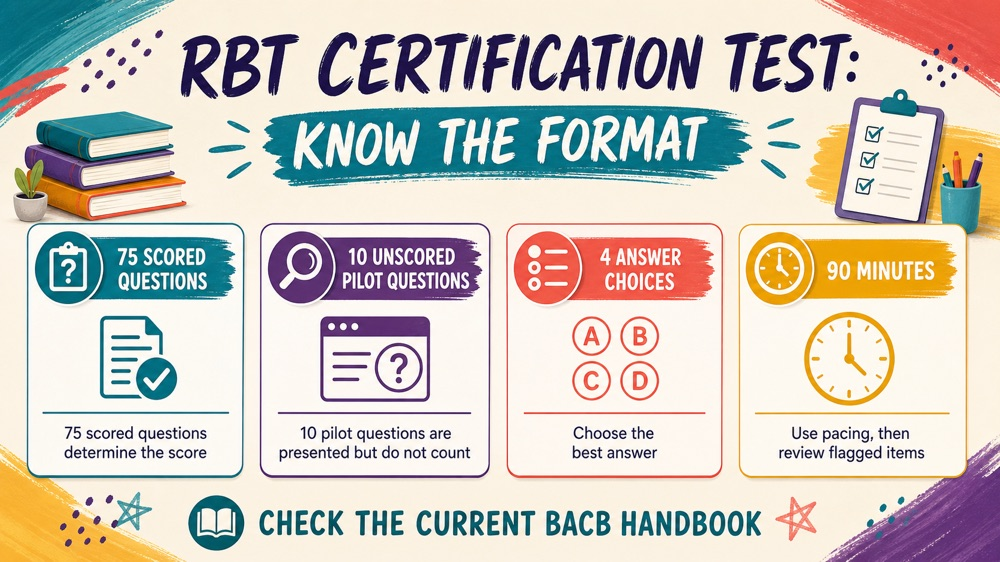
The current official examination information describes an RBT exam with 85 multiple-choice questions, four possible answers per question, and 90 minutes. The exam context includes 75 scored questions and 10 unscored questions. It is delivered in person through authorized Pearson VUE testing sites after the application and eligibility steps are complete.
Do not confuse the written exam with the Initial Competency Assessment. The competency assessment observes practical performance under the current BACB packet; the written exam measures selected answers. A practice test prepares you for the latter and does not replace either official gate.
This is independent educational content. RBT Training is not the BACB, is not a certification program, and is not affiliated with or endorsed by the BACB. All scenarios and questions described here are newly written and are not official, recalled, leaked, or BACB-endorsed questions. No practice score, study guide, or article can guarantee certification or a passing result.
The current RBT Test Content Outline, 3rd edition, describes 43 tasks across six domains. Use that blueprint to diagnose your review rather than assuming that a large question count equals better preparation.
What an RBT certification test should measure
A useful practice test samples decision-making, not only vocabulary. Each item should give you enough observable information to decide among answer choices while preserving the RBT’s role boundary.
| Practice signal | What a strong item asks you to do | Weak version to avoid |
|---|---|---|
| Measurement | Match the behavior and question to frequency, duration, latency, rate, interval, or another stated system. | Choose a definition without a context or operational rule. |
| Assessment | Recognize a preference or ABC procedure and identify what the RBT should record. | Guess function from one topography. |
| Acquisition | Choose the next teaching or prompting step from the written procedure. | Pick a new teaching strategy because it sounds creative. |
| Reduction and safety | Follow the plan and identify when to pause or escalate. | Reward improvisation outside the protocol. |
| Documentation and ethics | Choose objective wording, privacy protection, and supervision-aware communication. | Use a vague “the client was noncompliant” interpretation as the only data. |
The best practice explanation should name the clue, state the rule, and explain why the nearest wrong answer fails. If every explanation says only “B is correct,” the practice score cannot tell you what to repair.
Official exam versus practice test versus competency assessment
| Resource | What it does | What it cannot do |
|---|---|---|
| Initial Competency Assessment | Observes whether an applicant can perform the tasks in the current BACB packet. | It is not a multiple-choice mock exam. |
| RBT certification examination | Measures selected answers on the secure BACB examination delivered through Pearson VUE. | It does not make a third-party practice site official. |
| RBT certification test practice | Rehearses original scenarios, pacing, answer selection, and explanation-based review. | It cannot reveal secure items or guarantee your personal result. |
| Study guide | Explains concepts, terms, procedures, and boundaries before or after practice. | It does not replace the application, assessment, exam, or supervision. |
For example: a practice item may ask what to do when a learner begins a target behavior during a teaching trial. The useful answer depends on the written plan, safety procedure, data rule, and supervisor direction. A correct practice response does not authorize the learner to change that plan in a real session.
Current RBT certification test format and pacing map
Use the official format as a practice boundary:
| Element | Current exam context | How to practice it |
|---|---|---|
| Total questions | 85 multiple-choice questions. | Use a full simulation occasionally to build endurance; use shorter sets for repair. |
| Scored content | 75 scored questions and 10 unscored questions. | Do not try to identify which items are unscored; practice every item seriously. |
| Answer choices | Four possible answers with one correct answer. | Explain why the three nearest distractors fail. |
| Time | 90 minutes. | Start untimed for learning, then add timing checkpoints. |
| Delivery | In person at an authorized Pearson VUE testing site or authorized location. | Practice reading and decision-making without relying on leaked screens or secure-content claims. |
A simple pacing map is 30 minutes for questions 1–28, 60 minutes for 1–57, and a final 30 minutes for 58–85 plus flagged review. The purpose is to avoid spending the whole session on one difficult item, not to create an official rule. Use the plan that preserves accuracy and leaves time to revisit marked questions.
How to judge RBT certification test question quality
- Current blueprint: the resource names the RBT Test Content Outline, 3rd edition, and maps questions to domains.
- Original content: it says questions are newly written practice, not official, real, recalled, or leaked items.
- Observable stems: the scenario gives enough information to use a measurement, procedure, ethical, or supervision rule.
- Nearest distractors: the explanation shows why a tempting answer is wrong, not only why the correct answer is right.
- Transfer: the lesson tells you how the decision would look in a new person, setting, material, or task.
- Privacy: the platform does not ask you to upload identifiable client information.
- Honest results: it does not turn one practice score into a personal pass prediction or guarantee.
Question volume is not a quality metric by itself. Ten carefully explained errors can produce more learning than one hundred repeated definition items. Select a resource that gives you a next action after a miss.
How to take a full practice test
- Prepare the setting: silence notifications, choose a fixed time, and keep the session free of client information.
- Choose the mode: use study mode while learning; use a timed mode only after you understand the concepts.
- Read the stem twice: identify “best,” “first,” “most appropriate,” “not,” and other decision words.
- Answer from the facts: underline mentally the observable behavior, procedure, data, and supervision clue.
- Flag, do not spiral: mark a difficult question and return after protecting the pacing plan.
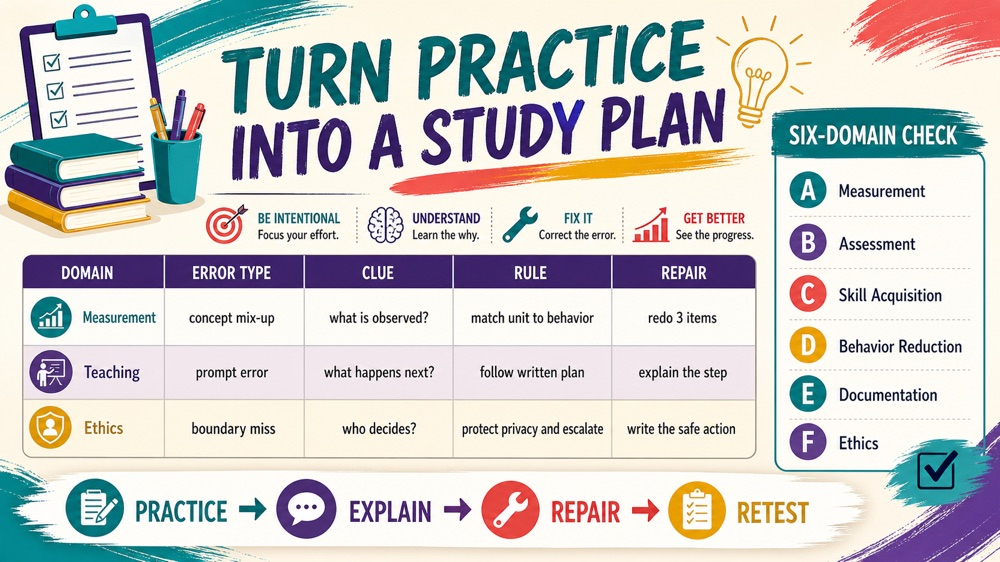
- Review every miss: record the domain, error type, clue missed, rule, and a new example.
- Repeat selectively: take a new set after repairing the error instead of immediately memorizing the same answer order.
Do not use a timed test as your first exposure to a concept. Speed amplifies confusion. Build accuracy, then fluency, then endurance.
Turn missed questions into an error log
| Column | Write this down | Why it matters |
|---|---|---|
| Domain | A, B, C, D, E, or F. | Shows where misses cluster. |
| Decision word | Best, first, except, not, most likely, or next. | Prevents a reading error from masquerading as a concept gap. |
| Observable clue | The behavior, measurement, prompt, consequence, safety fact, or boundary. | Connects the answer to the stem instead of a memorized phrase. |
| Rule | The concise concept or written-plan principle. | Creates a reusable explanation. |
| Nearest distractor | The wrong answer that seemed most plausible. | Targets the exact distinction you need to learn. |
| Repair item | One new original scenario you can solve without seeing the old options. | Tests transfer rather than recognition. |
Useful error labels include knowledge gap, stem-reading error, measure mismatch, procedure sequence, scope boundary, data interpretation, ethics/privacy, and pacing. If a miss has no label, you do not yet know what to study.
Original examples and nearest-distractor reasoning
Measurement example: a stem says the RBT records the time from the instruction “start” until the learner begins the target response. The correct measure is latency. A frequency answer counts occurrences, and a duration answer measures how long the behavior continues. The clue is the time between an event and the response.
Scope example: a learner’s data show little progress under the current teaching procedure. The best next action is to record the data and contact the supervisor according to the plan. Choosing a new prompt hierarchy because it seems faster is a scope error. The clue is that a plan change requires direction.
Ethics example: a caregiver asks the RBT to send a client video from a personal phone to a friend for advice. The RBT should protect privacy, decline the informal transfer, and use the approved channel to consult the supervisor. “The friend is experienced” does not remove the privacy and boundary issue.
These are original study illustrations, not official exam questions. The goal is to notice the decision rule and transfer it to a new stem.
Use a seven-day repair cycle
| Day | Action | Evidence of repair |
|---|---|---|
| 1 | Take a short diagnostic set without looking up answers. | Error log has a domain and error type for each miss. |
| 2 | Review the official TCO, training notes, and one source-grounded explanation. | You can state the rule in plain language. |
| 3 | Write two original scenarios for the same distinction. | You can solve a new context without the old options. |
| 4 | Complete a small mixed set. | The same error does not recur automatically. |
| 5 | Practice the weak domain with timing added. | Accuracy remains stable under a modest time limit. |
| 6 | Take a longer mixed simulation. | Pacing decisions and flagged-question use are visible. |
| 7 | Review the error log and choose the next cycle. | Study time is based on evidence, not anxiety or a headline score. |
A practice score can be a progress signal within the same resource, but it is not a BACB pass-rate conversion or a guarantee. Compare like with like: same mode, similar difficulty, new questions, and the same scoring rule.
Map your RBT certification test practice to six domains
| Domain | Review focus | Question to ask after a miss |
|---|---|---|
| A. Data Collection and Graphing | Measurement fit, data entry, and graph reading. | What event starts, stops, counts, or defines the measure? |
| B. Behavior Assessment | Preference assessment, ABC data, and operational definitions. | What is observed, and what would be an unsupported inference? |
| C. Behavior Acquisition | Teaching, prompts, shaping, chaining, reinforcement, and generalization. | What does the written teaching procedure say happens next? |
| D. Behavior Reduction | Antecedents, differential reinforcement, plan fidelity, and safety. | What is the authorized response, and when should I escalate? |
| E. Documentation and Reporting | Objective notes, communication, and reporting barriers. | Can a reader separate my observation from my interpretation? |
| F. Ethics | Dignity, privacy, competence, boundaries, and supervision. | What protects the client and stays within my role? |
The six-domain map is a study organizer. It does not reproduce secure exam content or imply a fixed question distribution beyond what the official sources publish. Review the current TCO and Handbook before test day.
Bottom line: use an RBT certification test simulation to rehearse the current 85-question, 90-minute format and diagnose the exact rule behind each miss. Then repair the domain, transfer the concept to a new scenario, and keep the practice boundary clear: original learning content is not the BACB examination.
Turn practice results into the next study action.
Use original RBT practice questions and explanations to find the domain and decision rule that need review.
Try Free RBT Practice Questions →
Frequently Asked Questions
What is an RBT certification test?
People often use the phrase for the written RBT certification examination or for a practice simulation. The official examination is a secure multiple-choice test; a practice test is independent learning content and is not official.
How many questions are on the RBT exam?
The current official examination information lists 85 multiple-choice questions: 75 scored questions and 10 unscored questions, with four answer choices and 90 minutes.
Is an RBT practice test the same as the competency assessment?
No. The competency assessment observes practical performance under the current BACB packet. A practice test rehearses written-question reasoning and does not replace the assessment.
How should I use a low practice score?
Record the domain, decision word, observable clue, error type, nearest distractor, and a new repair scenario. A score should guide review, not become a personal pass prediction.
Are RBT practice questions official?
Independent practice questions should be clearly labeled as original and not official, recalled, leaked, or BACB-endorsed. Do not buy or share secure exam content.
Can a practice test guarantee that I will pass?
No. Practice can improve familiarity and reveal review needs, but no test, course, or study guide can guarantee certification or a passing result.
References
- Behavior Analyst Certification Board. Examination Information.
- Behavior Analyst Certification Board. RBT Handbook.
- Behavior Analyst Certification Board. RBT Test Content Outline, 3rd edition.
- Behavior Analyst Certification Board. Pearson VUE BACB examinations.
- RBT Hub practice questions. Reviewed for competitor research; not an official exam source.
- Independent RBT practice exam. Reviewed for competitor research; not an endorsement.
- Independent 85-question practice exam. Reviewed for competitor research; not an official exam source.