

If you search for certified behavior technician, you may be looking at two different things: a job title used by an employer or a recognized credential used in behavior analysis. The distinction matters before you enroll in training, apply for a job, or describe your experience on a résumé.
Table of Contents
- Certified behavior technician: the credential and the job title are not identical
- Compare certified behavior technician, RBT, and BCBA/BCaBA roles
- What an RBT does: implement, measure, teach, document, and communicate
- What an RBT should not decide independently
- How to read a certified behavior technician job listing
- How to study for the RBT credential when your search phrase is certified behavior technician
- Original role-boundary scenarios
- A final verification checklist for candidates and employers
- Frequently Asked Questions
- References
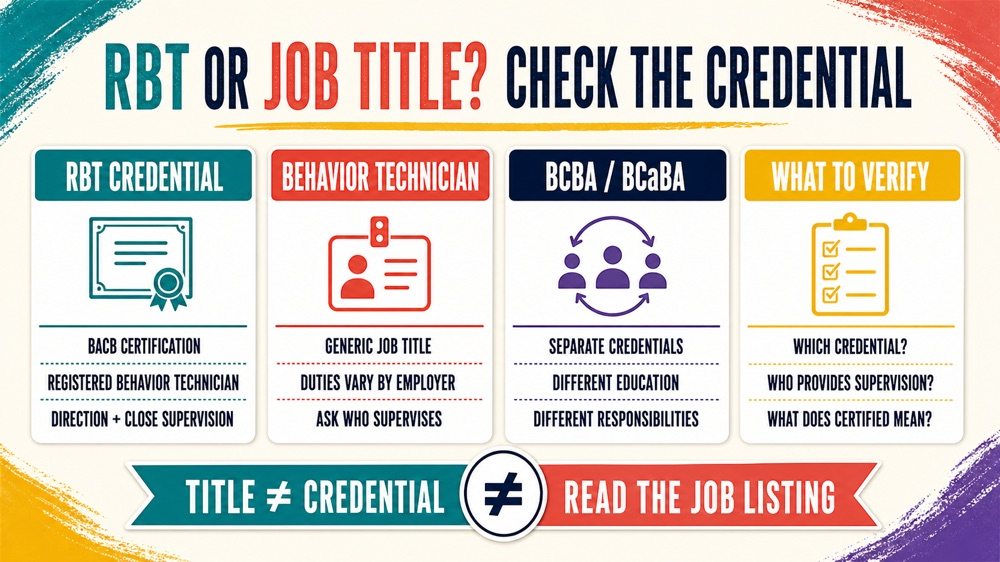
The official BACB credential is the Registered Behavior Technician (RBT) certification. BACB describes an RBT as a paraprofessional who assists with behavior-analytic services under the direction and close supervision of an RBT Supervisor and/or RBT Requirements Coordinator. A clinic may call a direct-care employee a behavior technician, behavioral technician, behavior therapist, or another local title, but the title alone does not prove that the employee holds the RBT credential.
This article uses the current RBT Test Content Outline, 3rd edition, as the study framework. It describes 43 tasks across six domains. The current examination format presents 85 multiple-choice questions: 75 scored questions and 10 unscored pilot questions, with four answer choices and 90 minutes. Those facts help you plan study time; they do not turn a job title into certification.
RBT Training provides independent exam-preparation content. It is not the BACB, does not award the RBT credential, does not decide whether an applicant is eligible, and is not affiliated with or endorsed by the BACB. The explanations and scenarios below are newly written for study, not official, recalled, leaked, or BACB-endorsed questions. No course, employer, or study guide can guarantee certification or a passing result.
Certified behavior technician: the credential and the job title are not identical
The clearest way to interpret certified behavior technician is to ask what the speaker means by “certified.” In an employer’s job listing, the phrase may be shorthand for a technician who has completed an organization’s onboarding or who is expected to obtain RBT certification. In BACB terminology, however, the named credential is Registered Behavior Technician, or RBT.
That distinction is practical:
- RBT: a BACB certification with defined requirements, an examination, ongoing supervision, and maintenance obligations.
- Behavior technician: a broad employment label whose meaning, training, and supervision can vary by employer and jurisdiction.
- Certified behavior technician: a search phrase or local title that should be verified against the actual credential named in the job description.
If a listing says “certified behavior technician” but never names the BACB RBT credential, do not infer that the employer is offering, requiring, or recognizing RBT certification. Ask the recruiter what certification is required, who provides supervision, and whether the role is allowed to use the RBT title only after BACB certification.
Compare certified behavior technician, RBT, and BCBA/BCaBA roles
| Label | What it may mean | What to verify |
|---|---|---|
| Certified behavior technician | A generic search or employer phrase for trained direct-care staff. | Which board, certificate, or internal training does “certified” refer to? |
| Behavior technician | A job title for staff who may deliver direct services or instructional support. | Written duties, required credential, supervisor, setting, and local rules. |
| Registered Behavior Technician (RBT) | The BACB paraprofessional certification for assisting with behavior-analytic services. | Current BACB status, supervising individual, renewal, and supervision requirements. |
| BCaBA | A separate BACB assistant behavior analyst certification with a different education and scope framework. | Do not treat a technician job as an assistant-analyst role. |
| BCBA | A separate BACB behavior analyst certification with responsibility for analysis and supervision under applicable rules. | Do not assign assessment design or treatment-plan authority to an RBT by title alone. |
These labels are not interchangeable. An RBT does not become a BCaBA or BCBA by accumulating technician hours, and a person with a generic behavior-technician title does not automatically hold an RBT certification. The current BACB page and Handbook control certification requirements; the employer and applicable jurisdiction control additional employment conditions.
What an RBT does: implement, measure, teach, document, and communicate
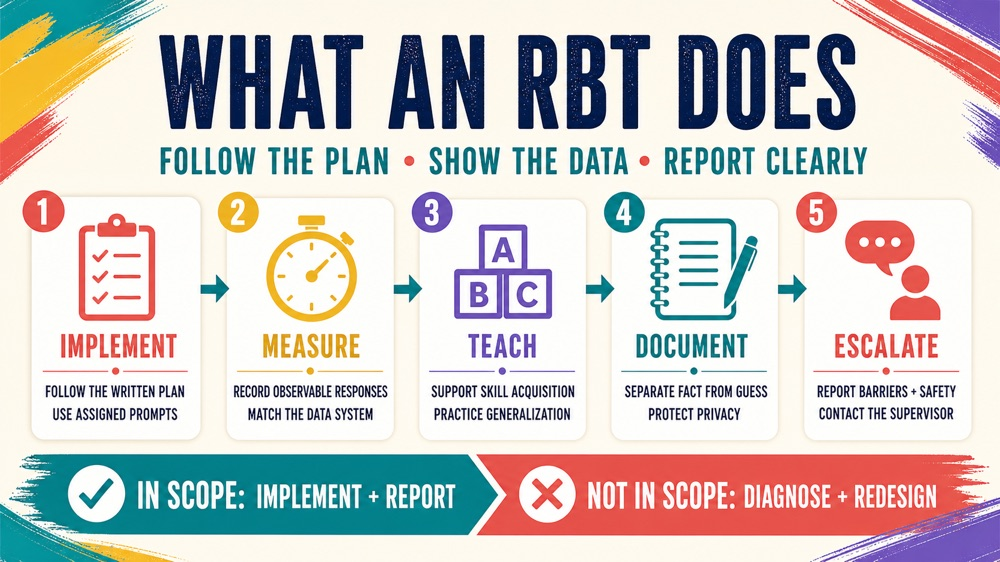
In everyday practice, an RBT’s work is best understood as a supervised implementation loop. The supervisor or clinical team establishes the plan and procedures. The RBT prepares materials, works with the learner or client, follows the written steps, records the defined responses, and reports what happened. The exact tasks depend on the plan, setting, competence, and applicable law.
- Prepare: review the current plan, materials, safety instructions, data definitions, and session priorities.
- Implement: deliver the assigned teaching or behavior-reduction procedure as written, including the specified prompts, reinforcement, and response criteria.
- Measure: record observable behavior with the measurement system selected by the team, such as frequency, duration, latency, or a defined discontinuous system.
- Support generalization: practice the assigned skill across people, materials, or settings only when the plan calls for it.
- Document and report: separate observations from interpretations, protect privacy, report barriers, and contact the supervisor when the plan does not address the situation.
For example: a session plan may tell the technician to deliver a visual instruction, wait three seconds, use a least-to-most prompt sequence, and record independent responses. The technician can implement and measure that sequence. The technician should not rewrite the prompting hierarchy because one session was difficult; that uncertainty belongs in objective notes and supervisor communication.
The same boundary applies to data. “The learner refused because the task was too hard” may be a hypothesis, not a directly observed fact. A stronger note records the instruction, the latency, the response, the prompt, and the consequence, then follows the team’s reporting process.
What an RBT should not decide independently
The word “technician” signals an implementation role, not permission to practice independently. An RBT should not diagnose, select a treatment model, design a functional analysis, change a behavior plan, invent a consequence, or represent a personal interpretation as a clinical conclusion. The RBT should also not perform a task that exceeds current competence simply because a job title says “certified.”
- Assessment: participate only in assigned assessment components under the current plan and supervision; do not independently interpret results or announce a function.
- Behavior acquisition: implement the written teaching procedure; do not replace the target, mastery criterion, prompt plan, or reinforcement arrangement without authorization.
- Behavior reduction: follow the approved safety and reduction procedure; do not improvise an aversive or restrictive response.
- Documentation: write what was seen and done; do not change data to make a graph look better or copy a colleague’s note.
- Ethics: protect confidentiality, dignity, assent-related signals, and professional boundaries; contact the appropriate supervisor when a concern cannot be resolved within the plan.
“Under supervision” is not a decorative phrase. It identifies who is responsible for directing the work and how the technician should respond when conditions change. The current BACB supervision page distinguishes the people who supervise RBTs from the people who assess or train them; read those role descriptions instead of relying on a generic career blog.
How to read a certified behavior technician job listing
Before applying, convert the listing into questions. A job title is an invitation to investigate, not evidence that every requirement is the same across clinics, schools, home programs, and states.
| Listing clue | Question to ask | Why it matters |
|---|---|---|
| “RBT required” | Must the certification be active before the start date, or will the employer support the application? | Training and supervision support differ by employer. |
| “Certification preferred” | Which certification is preferred: BACB RBT, an internal certificate, or another credential? | Generic certification language can hide different standards. |
| “Behavior technician” | Who writes the plan and who provides ongoing supervision? | The title alone does not define scope. |
| “Independent work” | Does this mean working one-to-one between supervisor contacts, or making clinical decisions independently? | RBT work remains within direction, supervision, competence, and the written plan. |
| “Data collection” | Which definitions, systems, devices, and documentation standards are used? | Reliable data require a specified measurement system. |
| “Crisis support” | What training, safety plan, reporting procedure, and local requirements apply? | Safety work should never be inferred from a title. |
Also ask about age range, setting, travel, session length, cancellation policies, pay structure, background checks, and the employer’s plan for supervision. Those are employment conditions, not universal BACB certification facts. Keep the answers in writing before accepting a role.
How to study for the RBT credential when your search phrase is certified behavior technician
Use the official RBT name when you build your study plan. The 3rd-edition TCO lists six domains and 43 tasks. A useful review cycle connects each missed question to the task being tested, the observable clue in the stem, the in-scope RBT action, and the reason the nearest distractor fails.
| Domain | Study question | Workplace transfer |
|---|---|---|
| A. Data Collection and Graphing | What behavior is defined, and what unit matches the system? | Can another team member reproduce the measurement? |
| B. Behavior Assessment | What is being assessed, and what procedure is assigned? | Am I collecting responses or making an unauthorized conclusion? |
| C. Behavior Acquisition | Which prompt, reinforcement, or generalization step is written? | Did I follow the teaching sequence as designed? |
| D. Behavior Reduction | What is the safe, plan-based response to the target behavior? | What should be documented and escalated? |
| E. Documentation and Reporting | Which details are objective and relevant? | Could the supervisor reconstruct the session? |
| F. Ethics | Which option protects privacy, dignity, competence, and role boundaries? | Does the response preserve the client’s rights and the supervisor relationship? |
The current exam presents 85 questions, but only 75 are scored and 10 are unscored pilot questions. Because you cannot identify the pilot items, answer every item. Four answer choices and a 90-minute limit make pacing useful, but pacing should come after concept accuracy. Practice questions should be original and clearly labeled; they should never be presented as official, recalled, leaked, or endorsed exam content.
Original role-boundary scenarios
Scenario 1—job title: a listing says “certified behavior technician” and asks for experience with ABA. It does not name RBT certification or a supervisor. What should a candidate do?
Answer: ask which credential the employer means, who supervises the role, and whether certification is required before hire. Do not assume that “certified” means BACB RBT.
Scenario 2—data: a technician notices that a learner’s behavior looks different from the operational definition in the plan. What is the best first action?
Answer: follow the current definition as written if safe and feasible, record the observable facts, and contact the supervisor about the mismatch. Do not silently invent a new definition.
Scenario 3—assessment: a supervisor assigns a preference assessment and asks the technician to record selections. The technician sees a new pattern and wants to announce that one item is a reinforcer.
Answer: record the assigned responses and report the pattern. Preference indicates selection under the procedure; it does not automatically prove that an item will function as reinforcement in every context.
Scenario 4—plan change: a caregiver asks the technician to add a new consequence that is not in the written plan.
Answer: acknowledge the request, follow the current approved plan, and route the proposed change to the supervisor. A technician should not redesign treatment in the moment.
These scenarios are educational examples, not official exam questions. The common reasoning pattern is to identify the defined task, stay within assigned competence, document objectively, and communicate uncertainty to the responsible supervisor.
A final verification checklist for candidates and employers
- Use “Registered Behavior Technician (RBT)” when referring to the BACB credential.
- Ask what “certified behavior technician” means in the specific listing.
- Confirm who directs and supervises the work and how supervision is documented.
- Separate BACB requirements from state, payer, school, and employer requirements.
- Match study notes to the current TCO, Handbook, and official transition materials.
- Keep implementation, measurement, documentation, safety, and escalation boundaries visible.
- Do not claim certification, clinical authority, or exam access that you do not hold.
Bottom line: a generic certified behavior technician search can lead to an RBT career, but the safe next step is verification. Name the credential, check the supervisor and scope, read the current BACB sources, and use original study materials to practice the six-domain judgment expected of an RBT.
Build your RBT study plan around the official credential.
Use structured practice questions and explanations to review the six current RBT domains without confusing independent study with BACB certification.
Review the RBT study materials →
Frequently Asked Questions
Is certified behavior technician an official BACB credential?
The official BACB technician credential is Registered Behavior Technician, or RBT. Certified behavior technician may be a generic search phrase or employer title, so verify what a particular organization means.
What is the difference between a behavior technician and an RBT?
Behavior technician is a broad job title. RBT is a specific BACB paraprofessional certification with defined application, examination, supervision, ethics, and maintenance requirements.
Does an RBT work independently?
An RBT assists with behavior-analytic services under the direction and close supervision described by the BACB and current Handbook. Independent study or a job title does not authorize independent clinical decision-making.
Can an RBT design a behavior plan?
An RBT should implement assigned procedures and report objective observations. The technician should not independently design, diagnose, or change a behavior plan outside the responsible supervisor’s process.
How many questions are on the RBT exam?
The current format presents 85 multiple-choice questions: 75 scored questions and 10 unscored pilot questions, with four answer choices and 90 minutes.
Are the scenarios in this article official RBT questions?
No. They are newly written educational examples and are not official, recalled, leaked, or BACB-endorsed questions. They are for study reasoning only.
References
- Behavior Analyst Certification Board. Registered Behavior Technician (RBT).
- Behavior Analyst Certification Board. Supervision, Assessment, Training, and Oversight.
- Behavior Analyst Certification Board. Registered Behavior Technician Handbook.
- Behavior Analyst Certification Board. RBT Test Content Outline, 3rd edition.
- Special Learning: BT vs RBT. Reviewed for competitor research; not an official BACB source.
- Indeed: What Does a Behavioral Technician Do?. Reviewed for employment-language research.
- Drexel University: RBT vs. BCBA Career Paths. Reviewed for role-comparison context.