
A behavior technician provides a card written cue when a written or visual prompt is part of the assigned teaching plan and is intended to support an observable response. The cue might be a word, short instruction, checklist, or visual card, but the correct use depends on the learner, the target skill, the prompt hierarchy, and the written program. An RBT does not create a new intervention simply because a card seems helpful. The technician uses the approved cue, records the prompt level or response as required, and communicates barriers to the supervisor. This independent guide explains how to study the phrase a behavior technician provides a card written cue without reducing it to a memorized slogan. It connects prompting, fading, communication, dignity, data integrity, and supervision. Examples are original educational scenarios, not official or recalled examination questions.
Table of Contents
- A behavior technician provides a card written cue: what it means
- A behavior technician provides a card written cue: check the target and format
- Use the prompt hierarchy as written
- Plan for fading and independence
- Respect communication and dignity
- Collect useful prompt data
- Communicate barriers and generalization
- Avoid written-cue mistakes
- A behavior technician provides a card written cue checklist
- Frequently Asked Questions
- References
Continue your RBT study with RBT exam study materials and original practice resources.
Quick answer: Treat a behavior technician provides a card written cue as a current-source RBT study topic. Identify the exact action, source, data rule, and supervision boundary before deciding.
Study boundary: This independent guide is educational content. It is not a BACB policy, certification decision, legal opinion, answer key, or guarantee of examination success. Examples are original and are not official, recalled, leaked, or BACB-endorsed questions.
Current exam context: The current BACB RBT Test Content Outline describes 43 tasks across six domains; the examination includes 75 scored questions and 10 unscored pilot questions in a 90-minute testing period. Verify the current handbook and outline before relying on a time-sensitive detail.
A card can be useful without becoming a substitute for instruction, communication access, or professional judgment. Before presenting it, confirm that the words are readable, the language is appropriate, and the learner has a meaningful way to respond. After presenting it, record the response using the assigned rule and note whether the learner needed a further prompt. This keeps the written cue connected to a measurable teaching plan rather than treating the card as a stand-alone solution.
A behavior technician provides a card written cue: what it means
The phrase describes an observable prompting action: presenting an approved written or visual cue to help evoke a target response. Identify what the card says or shows, when it is presented, what response is expected, and how the plan defines success. A card is a prompt only when the program gives it that role.
A behavior technician provides a card written cue: check the target and format
A written cue may support communication, a task sequence, a transition, self-management, or another assigned skill. Use the response definition and materials specified by the supervisor. Do not replace a learner’s preferred communication mode or add text that changes the task without direction.
Use the prompt hierarchy as written
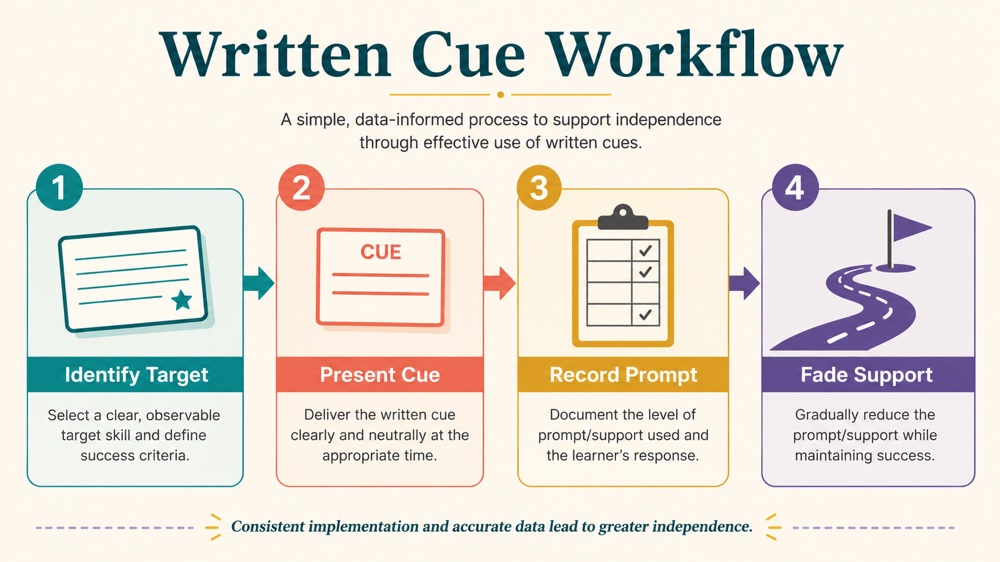
The plan may specify when to present the card, what other prompts are available, and how to respond to an error. Present the least intrusive effective prompt when the program says to do so, and avoid repeating directions in a way that creates prompt dependence. If the hierarchy is unclear, ask before improvising.
Plan for fading and independence
A written cue may be temporary, permanent, or part of a gradual fading plan. Track independent and prompted responses according to the assigned data system. Fading is not simply removing the card on a good day; it is a planned change reviewed by the responsible professional.
Respect communication and dignity
Present the cue discreetly, use neutral language, and allow reasonable processing time. Do not wave a card in front of a learner, use it as a threat, or describe a person by the prompt they need. Support should increase access and independence, not publicize a learner’s needs.
Collect useful prompt data
Depending on the program, record opportunities, prompt level, latency, independent response, errors, or completion. Use the operational definition and timing rule. A note such as needed help is less useful than the approved measure and an objective description of the condition.
Communicate barriers and generalization
Report if the card is missing, unreadable, culturally or linguistically mismatched, ineffective, or difficult to use in another setting. When generalization is programmed, use the approved materials across relevant people and routines. Do not redesign the cue independently.
Avoid written-cue mistakes
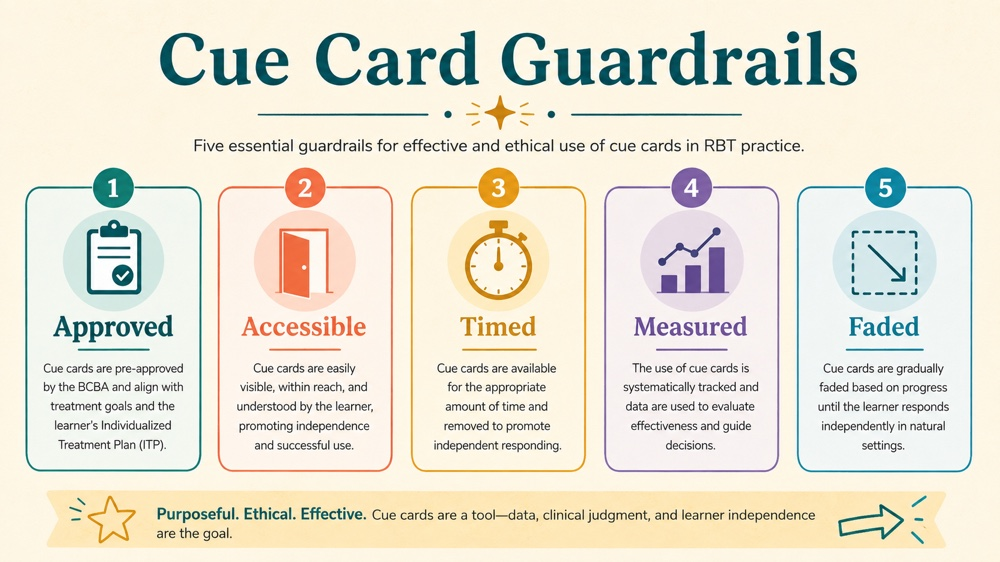
- Creating a new card without approval.
- Counting a prompted response as independent.
- Repeating the cue until the learner responds without recording it.
- Removing the cue without a fading plan.
- Using a card to shame or control a learner.
- Ignoring language, accessibility, or privacy needs.
- Calling original examples official examination questions.
A behavior technician provides a card written cue checklist
- What target response does the card support?
- When and how is the cue presented?
- What prompt and fading rules apply?
- How are prompted and independent responses recorded?
- Is the cue accessible and respectful?
- What happens when the cue is ineffective or missing?
- Which decisions require supervisor direction?
Use a behavior technician provides a card written cue as a prompting and role-boundary study topic. RBT Training is independent educational content and is not affiliated with or endorsed by BACB.
Practice the concept
Review a behavior technician provides a card written cue with original RBT scenarios, current-source reminders, and clear role boundaries.
Review the RBT study resource →
Frequently Asked Questions
When does a behavior technician provide a card written cue?
When an approved written or visual prompt is part of the assigned plan and supports an observable target response.
Can an RBT make a new cue card?
Only within the authorized program and supervision process. A technician should not independently redesign teaching materials or criteria.
How should cue use be measured?
Use the program’s assigned measure, such as prompt level, independent response, latency, or opportunities, with the stated scoring rules.
Are these official exam questions?
No. They are original educational scenarios and are not official, recalled, leaked, or BACB-endorsed.
References
- Behavior Analyst Certification Board: Registered Behavior Technician Handbook, updated June 2026.
- Behavior Analyst Certification Board: RBT Test Content Outline (3rd ed.).
- Behavior Analyst Certification Board: RBT resources.
- Behavior Analyst Certification Board: ethics resources.
- Behavior Analyst Certification Board: RBT Ethics Code (2.0).