
ABA behavior technician is a broad phrase, but the day-to-day role is not vague. In an ABA service setting, a technician may prepare materials, build rapport, implement a written teaching or behavior-reduction procedure, collect data, protect client dignity, communicate observations, and receive supervision. The exact job title and credential depend on the employer and jurisdiction.
Table of Contents
- What an ABA behavior technician does
- BT, RBT, and supervisor roles
- The supervised session cycle
- Map the role to six TCO domains
- Measurement and assessment work
- Teaching and behavior-reduction work
- Documentation, ethics, and communication
- What the RBT does not decide alone
- Original ABA behavior technician scenarios
- Prepare for training and supervision
- Frequently Asked Questions
- References
An RBT is a BACB credentialed behavior technician who works under the direction and close supervision of an RBT Supervisor and/or RBT Requirements Coordinator. “BT” may be an employer’s job title and does not automatically mean the person holds RBT certification. Do not use a general job description as a substitute for the current BACB requirements, employer policy, or supervisor direction.
The current BACB RBT Test Content Outline, 3rd edition, organizes 43 tasks across six domains. The exam context includes 75 scored questions and 10 unscored pilot questions, with four answer options and a 90-minute time condition. Those domains describe competencies that appear in supervised service delivery: measurement, assessment support, acquisition, reduction, documentation, and ethics.
RBT Training is an independent study resource, not an ABA employer, clinical supervisor, BACB certification program, or BACB-endorsed provider. The examples below are newly written and are not official, recalled, leaked, or BACB-endorsed questions. No article, course, practice score, or job description can guarantee certification, employment, or a passing result.
What an ABA behavior technician does
An ABA behavior technician supports behavior-analytic services by carrying out assigned procedures accurately and reporting what happened. The role is both practical and accountable: the technician’s observations and implementation affect client care, data quality, and team decisions.
| Work area | Typical supervised responsibility | Quality question |
|---|---|---|
| Preparation | Review the current plan, gather materials, check data tools, and prepare a safe environment. | Am I using the current authorized procedure? |
| Implementation | Deliver teaching, reinforcement, prompting, or reduction procedures as written. | Did I follow the steps and timing? |
| Measurement | Record defined behavior and skill data using the assigned system. | Is the unit clear and the record observable? |
| Communication | Report data, questions, barriers, and relevant changes to the supervisor. | Did I separate observation from interpretation? |
| Professional conduct | Protect dignity, privacy, boundaries, competence, and client rights. | Did my action stay within role and policy? |
For example: if a learner does not respond to a teaching cue, the technician records the response according to the plan, uses the authorized prompt sequence if applicable, and communicates the pattern. The technician does not quietly rewrite the goal because the response was inconvenient.
BT, RBT, and supervisor roles
These labels overlap in everyday speech, so separate them before studying or accepting a job:
- Behavior technician or BT: a broad role or job title used by employers. Requirements, training, and supervision may vary by organization and jurisdiction.
- Registered Behavior Technician or RBT: a BACB credential for a paraprofessional who provides behavior-analytic services under the required supervision structure. Applicants and certificants must follow current BACB requirements and the RBT Ethics Code (2.0).
- RBT Supervisor or Requirements Coordinator: the BACB-defined oversight role responsible for the RBT’s work within the applicable requirements. The supervisor directs, trains, evaluates, and clarifies procedures; exact organizational structures can differ.
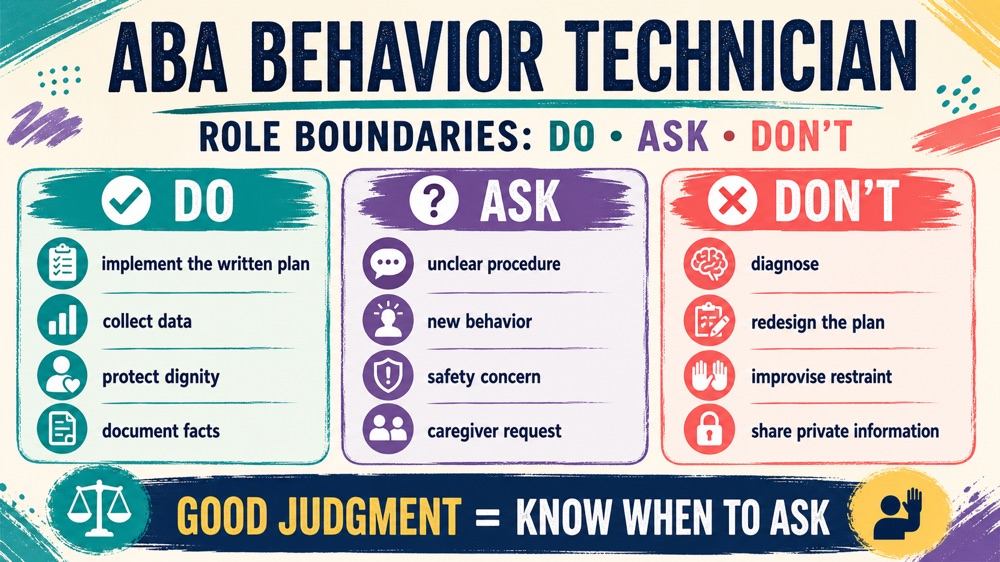
An RBT is not an independent practitioner. The credential does not authorize an RBT to diagnose, independently conduct or interpret a functional assessment, create a behavior-change plan, change a target because a family requests it, or use an unfamiliar or restrictive procedure without the required plan and competence verification.
That boundary is not a statement that technicians lack judgment. Good judgment includes recognizing uncertainty, protecting the client, following the written plan, asking a supervisor, documenting the concern, and escalating through the appropriate channel.
The supervised session cycle
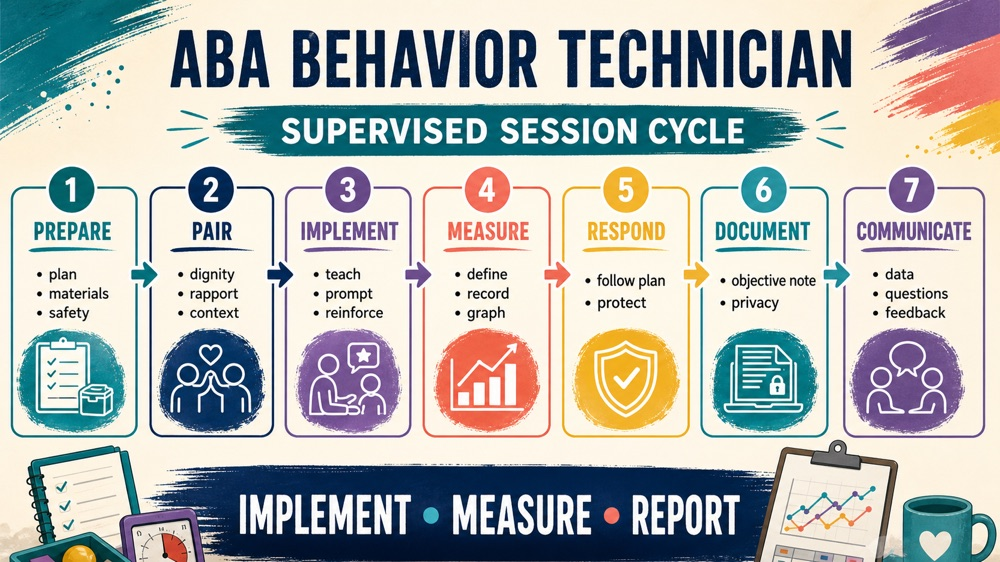
A useful way to understand the ABA behavior technician role is to follow one session from preparation to handoff:
- Prepare: confirm the schedule, client-specific plan, materials, data sheets, safety directions, and communication route.
- Pair and orient: interact respectfully, honor the learner’s dignity, and identify the session context without promising outcomes.
- Implement: run teaching or reduction procedures as written, including prompts, reinforcement, response opportunities, and safety steps.
- Measure: collect the assigned data at the correct time and with the correct operational definition.
- Respond: follow the plan when behavior changes, protect the client, and ask for direction when the plan does not cover the situation.
- Document: write objective notes, record relevant variables, protect private information, and correct errors transparently.
- Communicate and receive feedback: report what was observed, identify barriers, respond professionally to feedback, and complete required supervision records.
The cycle is not a fixed script for every employer. It is a study framework that helps you locate the right domain and ask what evidence controls the decision.
Map the role to six TCO domains
The current TCO connects the technician’s work to six domains:
| Domain | What the technician may practice under direction | Boundary to remember |
|---|---|---|
| A. Data Collection and Graphing | Use operational definitions, collect measurement data, enter data, and read basic patterns. | Do not change the definition or choose a flattering measure independently. |
| B. Behavior Assessment | Assist with preference or skill procedures and record descriptive information as assigned. | Do not independently diagnose function or redesign the assessment. |
| C. Behavior Acquisition | Implement prompting, reinforcement, shaping, chaining, discrimination, generalization, and maintenance procedures. | Follow the current teaching plan and supervisor feedback. |
| D. Behavior Reduction | Implement assigned antecedent, differential-reinforcement, extinction, and safety procedures. | Do not improvise a consequence or use an unauthorized restrictive procedure. |
| E. Documentation and Reporting | Write objective notes, report variables, communicate data, and protect records. | Do not replace observable facts with labels, guesses, or backfilled data. |
| F. Ethics | Practice competence, confidentiality, dignity, boundaries, supervision, and honest communication. | Ask and report when client rights, safety, privacy, or certification status is at risk. |
The six-domain map is useful because a single session can involve all six. A technician may measure a behavior (A), assist with a preference procedure (B), teach a communication response (C), follow a safety plan (D), write a note (E), and protect privacy (F).
Measurement and assessment work
Measurement is the technician’s evidence system. Choose the assigned procedure based on the behavior and question, not on the easiest mark to make. Frequency counts responses; rate adds a time denominator; duration measures how long; latency measures delay to start; IRT measures time between consecutive responses. Partial interval, whole interval, momentary sampling, and permanent product each have different conditions.
Assessment support requires the same discipline. A preference assessment identifies choices that may be useful; it does not automatically prove reinforcer value. ABC information describes events around behavior; it does not by itself authorize the technician to announce a function. Skill assessment data show performance and may guide a supervisor’s teaching decisions.
Imagine a supervisor gives an RBT a multiple-stimulus-without-replacement procedure. The technician presents and records the items as written, protects the learner’s choice, and reports problems. If the learner refuses or the materials are unavailable, the technician follows the plan’s direction for that situation or contacts the supervisor rather than inventing a new assessment.
Teaching and behavior-reduction work
Teaching work may include discrete-trial teaching, naturalistic teaching, prompting and fading, reinforcement, shaping, chaining, stimulus discrimination, generalization, and maintenance. The technician’s skill is accurate implementation: arranging the opportunity, delivering the authorized prompt, reinforcing the specified response, recording data, and responding to feedback.
Behavior-reduction work requires an even clearer boundary. The technician may implement an assigned antecedent strategy, differential-reinforcement procedure, extinction procedure, or safety plan after the required training and competence verification. If the plan is unclear, a new behavior appears, or safety is at risk, pause as appropriate and follow the escalation process.
| Situation | Role-safe response | Unsafe shortcut |
|---|---|---|
| Prompt is not producing a correct response. | Follow the written prompt hierarchy and report the pattern. | Jump to an unapproved prompt or change the goal. |
| Reinforcer loses value. | Use the authorized choice or preference procedure and ask the supervisor. | Promise a larger reward or invent a new contingency. |
| Behavior escalates. | Follow the safety plan, protect the client, and communicate/document. | Use a personal consequence because it worked once. |
| Family requests a new intervention. | Listen respectfully and redirect the clinical change to the supervisor. | Agree to implement it immediately. |
Documentation, ethics, and communication
Documentation is part of service quality, not paperwork after the real work. A useful note identifies what was observed, what procedure was implemented, what data were collected, relevant variables, and who was notified. It avoids labels such as “uncooperative” unless the note defines what that means in observable terms.
Ethics applies in every medium: home, clinic, school, community, video conference, text, email, and social media. Protect identifying information, share only what is necessary for a job-related reason, use secure channels, and follow supervisor direction, law, and employer policy. Avoid multiple relationships and gifts that create conflict. Do not misrepresent credentials, falsify data, cheat, distribute examination materials, or continue representing an inactive or suspended credential as active.
When a concern arises, use a compact communication format:
- Fact: “At 2:10 p.m., the written plan said X and the observed event was Y.”
- Impact or risk: “This may affect safety, privacy, data accuracy, or plan fidelity.”
- Action: “I followed the authorized step and paused the unsupported change.”
- Question: “What direction should I follow next, and where should I document it?”
What the RBT does not decide alone
Many practice questions are really boundary questions. An RBT generally does not independently:
- diagnose a condition or announce a behavior’s function;
- design, discontinue, or materially modify a behavior-change or teaching plan;
- select an assessment procedure outside the supervisor’s direction;
- use an unfamiliar intervention or restrictive procedure without the documented plan and competence verification;
- promise a caregiver a result, make a clinical claim, or speak as the supervising clinician;
- share identifiable client information because a post seems positive; or
- ignore a safety, privacy, integrity, or certification-status concern.
This is not a list of every employer rule or law. When a question depends on a client-specific plan, safety policy, or local requirement, use the supervisor and current authoritative source. Do not turn a study summary into a workplace directive.
Original ABA behavior technician scenarios
The following examples are newly written for this guide. They are not official, recalled, leaked, or BACB-endorsed questions.
- Data: A 30-minute session has 12 responses and a 60-minute session has 15. Best comparison: calculate rate, because count alone is affected by observation time. Nearest distractor: say the second session had more behavior because 15 is larger than 12.
- Assessment: The RBT is asked whether a preference assessment proves an item is a reinforcer. Best answer: no; preference information can guide selection, while reinforcer value is evaluated by its effect on behavior in context.
- Acquisition: The plan says to wait three seconds before the next prompt. Best action: follow the stated delay and record the response. Nearest distractor: prompt immediately to make the trial successful.
- Reduction: A colleague proposes a restraint not named in the plan. Best action: do not improvise; protect the client, follow the safety route, contact the supervisor, and document. The exact emergency action depends on the authorized safety plan and law.
- Documentation: The note reads “client was manipulative.” Best action: replace the label with observable behavior, antecedent, consequence, data, and communication. An adjective is not a measurement.
- Ethics: A parent offers a large gift and asks the RBT to babysit on weekends. Best action: do not accept the arrangement casually; consult the supervisor and follow the code and employer policy about gifts and multiple relationships.
- Scope: A teacher asks the RBT to rewrite a goal. Best action: listen respectfully, document the request if required, and redirect the clinical change to the supervisor.
- Feedback: A supervisor says the RBT’s prompt timing is inconsistent. Best action: respond professionally, practice the corrected sequence, and review new data. Feedback is information for improving performance, not a reason to hide the record.
Prepare for training and supervision
If you are considering an ABA behavior technician role or RBT certification, use a source-first checklist:
- Identify the role: confirm whether the position is a general BT job, an RBT role, or another credential with different requirements.
- Read the current BACB Handbook: verify eligibility, training, competency assessment, application, examination, supervision, ethics, and maintenance requirements.
- Confirm training: ask whether the program is designed for the requirements in effect when you apply, and keep the required documentation.
- Understand supervision: know who is responsible for your work, how questions are escalated, how supervision is documented, and what happens if you change employers.
- Study the TCO: map practice to A–F and use original scenarios, not recalled or leaked exam material.
- Protect the client: treat dignity, privacy, safety, and accurate records as part of competence from the first session.
A study guide can help you recognize concepts, but it cannot determine whether a specific employer, supervisor, state, payer, or client plan authorizes an action. Verify the rule where it matters and ask for clarification before acting outside your role.
Bottom line: an ABA behavior technician is an evidence-and-implementation role. The strongest technicians are precise with data, faithful to the plan, respectful with clients, honest in documentation, responsive to feedback, and willing to ask for supervision before an uncertain decision becomes a client-care problem.
Ready to review the ABA technician role?
Practice original RBT scenarios, map each answer to the six domains, and see what to review next.
Try Free RBT Mock Exams →
Frequently Asked Questions
What does an ABA behavior technician do?
An ABA behavior technician supports supervised behavior-analytic services by implementing assigned procedures, collecting data, assisting with teaching and reduction plans, documenting objectively, protecting client rights and privacy, and communicating observations.
Is every behavior technician an RBT?
No. Behavior technician or BT may be a broad job title. RBT is a BACB credential with specific requirements and a required supervision structure. Confirm the role and current requirements with the employer and BACB.
Can an RBT change a behavior plan?
An RBT should not independently redesign or materially change a client plan. Follow the authorized procedure and bring questions or proposed changes to the responsible supervisor.
What does an RBT study for the exam?
The current TCO has 43 tasks across six domains: Data Collection and Graphing, Behavior Assessment, Behavior Acquisition, Behavior Reduction, Documentation and Reporting, and Ethics.
Are these ABA behavior technician examples official exam questions?
No. They are newly written independent study examples. Do not treat online examples as official, recalled, leaked, or BACB-endorsed content, and verify current exam facts with BACB sources.
Can an ABA behavior technician study guide guarantee certification?
No. A guide can organize concepts and practice, but no independent article, course, job description, or practice score can guarantee employment, certification, or a passing result.
References
- Behavior Analyst Certification Board. RBT certification resources.
- Behavior Analyst Certification Board. RBT Handbook.
- Behavior Analyst Certification Board. RBT Test Content Outline, 3rd edition.
- Behavior Analyst Certification Board. Supervision, assessment, training, and oversight.
- Behavior Analyst Certification Board. RBT Ethics Code (2.0).
- RBTPracticeExam.io assessment guide. Reviewed for competitor research; not an endorsement.
- TheRBT.net study guide. Reviewed for competitor research; not an endorsement.