

An ABA technician job description should clarify implementation duties, data, communication, privacy, training, supervision, and what the role does not authorize.
Table of Contents
- ABA technician job description: how to read the listing
- Core duties to look for
- Data and documentation
- Training and supervision
- Role boundaries
- Questions before accepting
- Common listing phrases
- Frequently asked questions
- References
ABA CAREER · JOB DESCRIPTION
ABA Technician Job Description: What to Look For
Check duties, data, privacy, supervision, training, and the limits of the role.
An ABA technician job description should clarify implementation duties, data, communication, privacy, training, supervision, and what the role does not authorize. Titles vary: an employer may use ABA technician, behavior technician, therapy technician, or another name. Read the actual duties and compare them with the current employer policy and official requirements.
This guide helps job seekers ask better questions. It does not promise employment, pay, certification, competence, or a particular client outcome. A job listing is an invitation to discuss a role, not proof that the role is appropriate or that every advertised benefit is current.
ABA technician job description: how to read the listing
Start with the work itself. Look for the setting, learner population, schedule, travel, physical requirements, documentation, training, supervisor, and escalation route. Notice whether the listing distinguishes direct implementation from clinical decisions.
Be cautious when a description uses broad language such as “manage cases,” “create programs,” or “work independently” without explaining who provides clinical direction. Ask whether those words refer to administrative tasks, assigned implementation, or responsibilities reserved for another qualified professional.
Check the date and employer identity. A copied listing may contain outdated credential language, pay, hours, or requirements. Request the current written offer and policy if the interview conversation differs from the public listing.
Core duties to look for
A clear entry-level technician description often names several observable responsibilities:
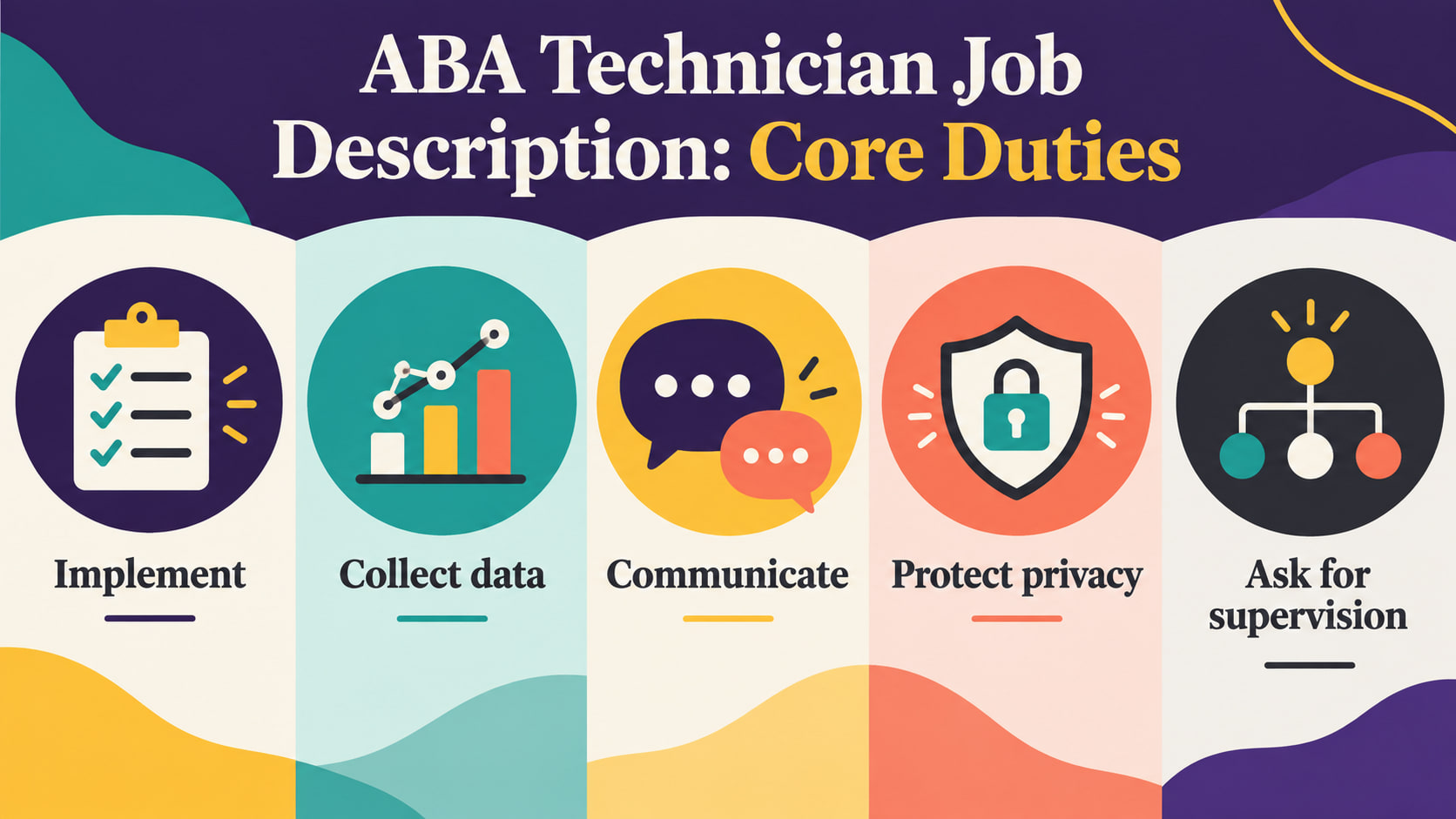
- Implement: Follow assigned teaching, communication, behavior-support, and safety procedures.
- Collect data: Use operational definitions and the approved measurement system.
- Communicate: Share objective observations, questions, and barriers through the correct team channel.
- Protect privacy: Secure records, conversations, screens, and client information.
- Ask for supervision: Pause when the plan, safety, or role is unclear.
Descriptions may also include preparing materials, supporting transitions, attending meetings, writing notes, cleaning materials, communicating with caregivers through an approved process, and completing training. Ask which duties are performed independently and which require direct observation or approval.
Pay attention to how the listing describes the people you will work with. A center, school, home, or community role may require different travel, noise, privacy, transition, and communication routines. Ask whether the job includes one-to-one work, group support, staff collaboration, caregiver contact, or administrative tasks. The same title can describe very different days.
Ask how schedule changes are handled. Cancellations, room changes, staffing gaps, and new safety information can affect implementation. A responsible employer should explain who gives direction when the routine changes and how the technician records time or an interrupted session.
Data and documentation
Data responsibilities should identify what is measured, where it is recorded, and who reviews it. A technician may record frequency, duration, latency, prompt level, accuracy, or another measure specified by the plan. The job should provide training and a way to ask when a definition is unclear.
Objective documentation separates facts from conclusions. “Used the break card after the visual cue” is different from “wanted to escape.” Ask how corrections are made, when notes are due, and how records are protected. Never copy client information into a personal device or public tool.
If the listing expects documentation but gives no time, system, or training, ask how the employer supports accurate completion. Good data should not depend on guessing or filling gaps from memory.
Training and supervision
Ask what training occurs before direct work, who provides it, whether it is paid, and how readiness is checked. Orientation, role-play, observation, competency review, and ongoing supervision may all be relevant, but the exact process varies.
Confirm who answers questions during a session and who can change a plan. A supervisor should be identifiable, reachable through an approved route, and responsible for feedback and escalation. If a listing promises fast independence but cannot describe supervision, ask for clarification before accepting.
Separate employer training from an RBT certification pathway. A job may prepare you for its workflow without satisfying every current official requirement. Use the current BACB handbook and application instructions for credential questions.
Role boundaries
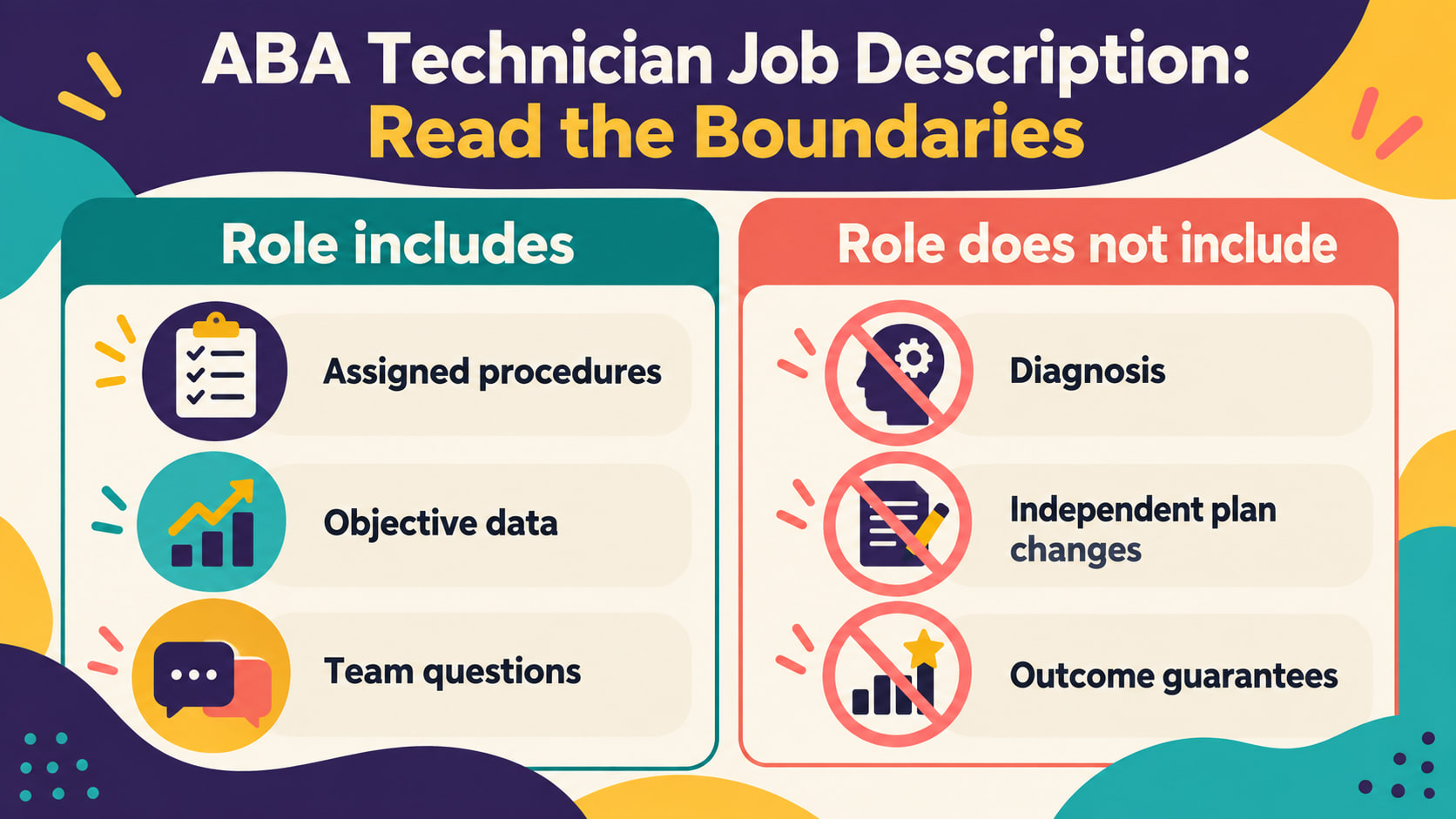
The role commonly includes assigned procedures, objective data, team questions, privacy, and supervision. It does not automatically include diagnosis, independent treatment design, mastery-criterion changes, or outcome guarantees.
Do not accept a listing at face value if it asks an entry-level technician to perform duties that require separate authorization or training. Ask what “independent” means in the employer’s language. It may mean completing a routine without a prompt, or it may be an unsafe instruction to make clinical decisions alone.
Represent your status accurately. Distinguish course completion, supervised experience, internal training, and an active credential. A job title does not prove certification.
Also ask how feedback is delivered. Specific coaching about prompting, data, communication, and documentation is more useful than a general promise that you will “learn on the job.” Find out whether there is a review period, a written competency process, and a safe way to request additional practice.
Before accepting, compare the written description with the interview answers and offer. Save the version you reviewed, note unanswered questions, and ask for corrections in writing. This protects both sides from relying on a broad title when the actual duties, schedule, or supervision are different.
A clear description should also explain how the employer handles privacy concerns, incidents, missed training, and a mismatch between the plan and a real session. Those details show whether support is part of the role or merely an attractive phrase in the advertisement.
Questions before accepting
- Who is my supervisor and how do I contact that person during work?
- What training and competency review happen before direct implementation?
- Which duties are assigned, and which decisions are outside the role?
- How are data, notes, privacy, incidents, and plan questions handled?
- What is paid, what is scheduled, and what changes during cancellations?
- What current official requirements apply if the listing mentions RBT status?
Common listing phrases
- “Implement programs”: Ask whose programs, how current instructions are accessed, and who changes them.
- “Collect data”: Ask which measures, system, training, and review process apply.
- “Work independently”: Ask whether this means routine implementation or independent clinical decisions.
- “Career growth”: Ask what training, supervision, pay, and requirements actually support the promise.
Frequently asked questions
Are all ABA technician job descriptions the same?
No. Duties, settings, training, supervision, pay, and credential expectations vary by employer.
Can an ABA technician change a treatment plan?
Not independently. Implement the current plan, record objective observations, and ask the authorized supervisor or team to review changes.
Does the title prove RBT certification?
No. Verify current credentials through the appropriate official process and represent your status accurately.
What is the biggest red flag?
Unclear duties combined with pressure to work independently, share private information, or make clinical decisions without training and supervision.
Source note: Review the current BACB RBT Handbook, official application instructions, employer policy, ethics code, and supervisor guidance. This article is educational and does not provide individualized legal, clinical, employment, or credentialing advice.
Ready to practice the RBT concepts you just reviewed?
Try an independent, original RBT practice resource with exam-style questions, scoring, and answer explanations.
References
- Behavior Analyst Certification Board. RBT Test Content Outline, 3rd edition.
- Behavior Analyst Certification Board. RBT Handbook.
- Behavior Analyst Certification Board. RBT Ethics Code.