

ABA technician is a broad job-search phrase for a frontline person who supports applied behavior-analytic services. The exact job title, training, supervision, and credential depend on the employer and jurisdiction. When the role is specifically an RBT, the BACB defines a credentialed paraprofessional who assists with behavior-analytic services under the direction and close supervision of an RBT Supervisor and/or RBT Requirements Coordinator.
Table of Contents
- What an ABA technician does in a supervised session
- ABA technician, behavior technician, BT, and RBT
- The supervised ABA technician session cycle
- The six current RBT domains at work
- What an ABA technician or RBT does not decide alone
- Original ABA technician scenarios
- Training and supervision checklist for an ABA technician
- Frequently Asked Questions
- References
That distinction matters. A person may be hired as a behavior technician before becoming an RBT, while another employer may require an active RBT credential. Neither a job advertisement nor a general course description replaces the current BACB Handbook, employer policy, written program, or supervisor direction.
The current RBT Test Content Outline, 3rd edition, organizes 43 tasks across six domains. The exam frame includes 75 scored questions and 10 unscored pilot questions. Those domains mirror the decisions a supervised technician practices: measure, participate in assessment, teach, follow behavior-reduction procedures, document, report, and protect ethics.
This is independent educational content. It is not an employer, clinical service, BACB credentialing program, or BACB-endorsed resource. Examples are newly written and are not official, recalled, leaked, or BACB-endorsed questions. No article, course, practice score, or job description can guarantee certification, employment, or a clinical result.
What an ABA technician does in a supervised session
An ABA technician turns an authorized program into observable session actions. Before teaching begins, the technician reviews the current program, prepares materials, checks safety and communication procedures, and confirms how data will be recorded. During the session, the technician builds a respectful working relationship, presents teaching opportunities, follows prompting and reinforcement steps, responds to behavior according to the plan, and records what occurred. Afterward, the technician completes objective documentation and communicates patterns, barriers, and questions.
| Work area | Typical action | Quality check |
|---|---|---|
| Preparation | Read targets, materials, prompts, consequences, data rules, and safety steps. | Can the next action be traced to the current program? |
| Implementation | Present the assigned cue, prompt, teach, reinforce, and transition as written. | Was the procedure delivered consistently and respectfully? |
| Measurement | Record observable responses using the defined unit and code. | Could another person reproduce the score? |
| Communication | Report objective observations, uncertainty, barriers, and safety concerns. | Are observation and interpretation separated? |
| Supervision | Receive feedback, demonstrate competence, and ask before changing a procedure. | Was the question brought to the responsible supervisor? |
The role is active, skilled work, but active does not mean independent clinical design. A technician can notice that a procedure is difficult or that data changed; the next step is to document and communicate, not silently rewrite the plan.
ABA technician, behavior technician, BT, and RBT
| Label | What it may mean | What to verify |
|---|---|---|
| ABA technician | A broad job-search phrase for someone implementing applied behavior-analytic services. | Employer duties, training, supervision, local rules, and whether a credential is required. |
| Behavior technician or BT | An employer’s title that may cover direct-care or teaching responsibilities. | Whether the role is credentialed, who supervises it, and what procedures are assigned. |
| RBT | A specific BACB paraprofessional certification. | Current BACB eligibility, certification, supervision, and maintenance requirements. |
| Supervisor or clinical lead | The qualified person responsible for oversight, program decisions, and feedback. | Who is listed, available, and authorized to answer the question. |
Do not infer credential status from clothing, a job title, or the fact that someone provides direct services. Ask the employer whether “behavior technician” means training toward RBT, active RBT certification, or a separate internal role. If a job post uses “ABA therapist,” confirm the actual scope rather than assuming it is a BACB credential.
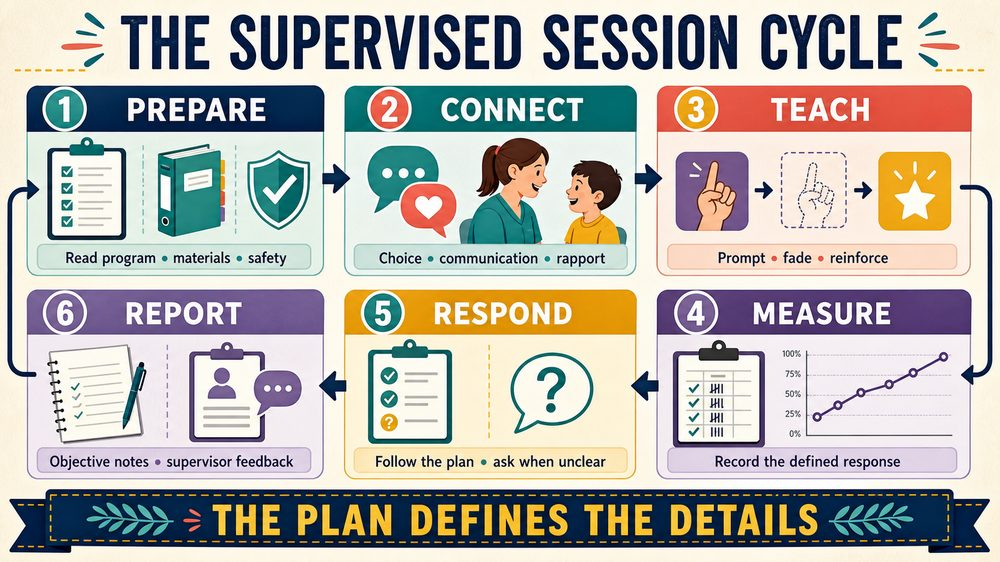
The supervised ABA technician session cycle
- Prepare: review the current program, targets, materials, data sheet, reinforcement arrangement, and safety plan.
- Pair and communicate: follow the relationship-building and learner-choice procedures without making promises or forcing an unplanned interaction.
- Teach: present the cue, use the assigned prompt and fading procedure, and deliver the programmed consequence.
- Measure: score the defined response, prompt level, duration, latency, frequency, or interval outcome close to the event.
- Respond: follow the behavior-reduction or crisis procedure exactly as trained; pause and contact the supervisor when the plan does not cover the event.
- Generalize: practice across people, materials, settings, or routines only when the program calls for it.
- Document and report: complete accurate notes and communicate objective patterns, barriers, and questions.
For example: a learner does not respond to a communication cue. The technician should not automatically repeat the cue ten times, remove the demand, or invent a new reinforcer. Check the written response window and prompt procedure, implement the assigned step, record the outcome, and report a repeated pattern to the supervisor.
The six current RBT domains at work
| Domain | How it appears in technician work | Study question |
|---|---|---|
| A. Data Collection and Graphing | Record behavior and skill data with the defined unit and accuracy. | What is directly observable and what is the measurement system? |
| B. Behavior Assessment | Implement assigned preference, skill, or functional-assessment components. | What procedure is named and what interpretation requires supervision? |
| C. Behavior Acquisition | Use prompting, fading, shaping, chaining, reinforcement, maintenance, and generalization as written. | Which teaching step matches the program? |
| D. Behavior Reduction | Follow the behavior plan, replacement-skill procedure, and safety response. | What does the plan say after the behavior occurs? |
| E. Documentation and Reporting | Write objective notes, report barriers, and protect records. | Could another professional verify the note? |
| F. Ethics | Protect dignity, privacy, assent, competence, boundaries, and data integrity. | Is the action respectful, authorized, and within role? |
The six domains are not six unrelated study chapters. A single session may involve all of them. For instance, a technician may collect data on a replacement skill, implement a prompt-fading step, respond to interfering behavior, write a note, and ask a supervisor about an unexpected pattern. That is why job duties and exam reasoning should be studied together.
What an ABA technician or RBT does not decide alone
| Situation | Role-safe action | Independent shortcut to avoid |
|---|---|---|
| Data are unexpectedly low. | Check the definition and data procedure, document context, and contact the supervisor. | Change the criterion or reinforcement schedule. |
| A learner refuses a task. | Follow the choice, break, communication, and safety procedures in the plan. | Force compliance or create a new consequence. |
| A prompt is not working. | Use the assigned hierarchy and report the pattern. | Switch to a favorite prompt without authorization. |
| A caregiver asks for a new target. | Listen respectfully and route the request through the clinical team. | Promise a treatment change on the spot. |
| A safety event is not covered. | Use emergency and supervisor-contact procedures and document what happened. | Continue improvising to finish the session. |
“Ask the supervisor” is not a weak answer when the issue is outside the technician’s authority or the plan is unclear. It is a precise response to a scope, safety, or fidelity problem. The technician can bring useful observations and possible questions without presenting an independent clinical conclusion.
Original ABA technician scenarios
Scenario 1—measurement: an RBT counts three episodes across a 30-minute session and labels the result “rate.” If the plan asks for frequency, preserve the count; if it asks for rate, divide by the defined time and use the plan’s unit. The key is the measurement definition, not the number alone.
Scenario 2—teaching: a learner completes a target only after a model prompt. Record prompted performance when the plan separates independent and prompted responses. Do not call it independent because the final action looked correct.
Scenario 3—documentation: the note says “the client was manipulative.” Replace that interpretation with observable facts: what instruction was given, what behavior occurred, what consequence followed, and what data were recorded.
Scenario 4—scope: a caregiver asks the technician to stop a program because it seems too difficult. The technician should listen, follow the current authorized plan and safety steps, document the concern, and bring it to the supervisor rather than changing it independently.
These scenarios are newly written for study. They are not official, recalled, leaked, or BACB-endorsed questions.
Training and supervision checklist for an ABA technician
- Confirm whether the job title is BT, ABA technician, RBT, or another local role.
- Read the current employer expectations and identify the responsible supervisor.
- Learn the operational definitions, data units, prompt hierarchy, reinforcement arrangement, and safety plan for each assigned program.
- Practice through instruction, modeling, rehearsal, and feedback rather than reading definitions only.
- Know when to pause and ask: unclear plan, safety concern, repeated data error, client-rights concern, or a requested change.
- Keep documentation objective, timely, secure, and consistent with organization policy.
- Use the current TCO, Handbook, Ethics Code, and official RBT resources for credential claims.
Career pages can help you understand the vocabulary of the job, but primary BACB sources control RBT credential and supervision requirements. A job title can change; the responsibility to work within authorization, supervision, data, dignity, and ethics does not.
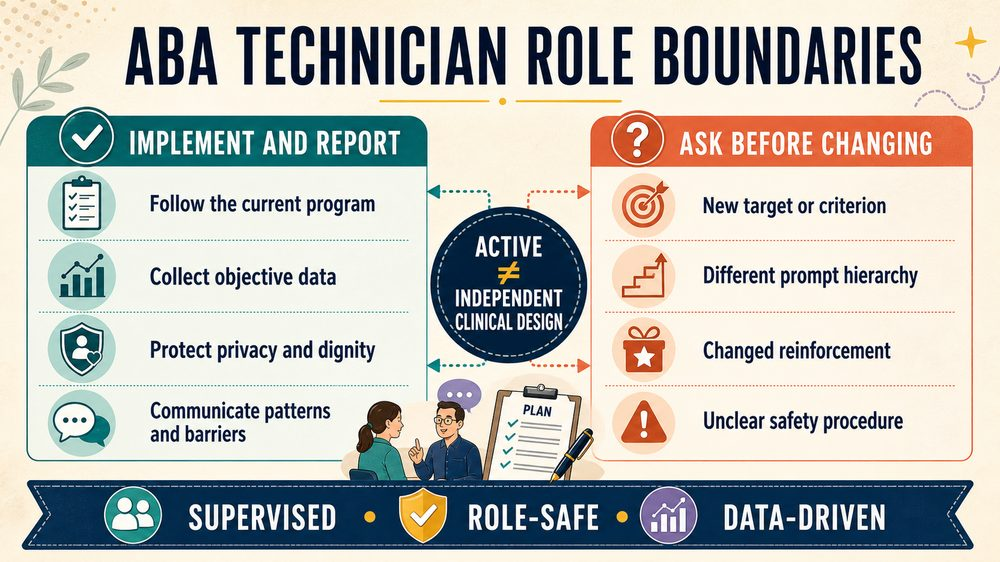
Bottom line: an ABA technician is a supervised implementation role. The strongest technician prepares carefully, follows the current plan, measures objectively, communicates clearly, protects the learner, and asks before changing a procedure. If the role is specifically RBT, verify the current BACB credential and supervision requirements instead of relying on a generic job label.
Build the study habits behind the role.
Use original RBT practice questions to connect data, teaching, behavior reduction, documentation, and ethics.
Try free RBT practice questions →
Frequently Asked Questions
What does an ABA technician do?
An ABA technician commonly implements assigned behavior-analytic procedures, collects data, supports teaching and behavior-reduction programs, documents objectively, communicates observations, and works under the required supervision structure.
Is an ABA technician automatically an RBT?
No. ABA technician or behavior technician may be an employer job title. RBT is a specific BACB credential with current eligibility, certification, supervision, and maintenance requirements.
Can an ABA technician change a behavior plan?
The technician should not independently redesign or materially change an authorized plan. Follow the assigned procedure and bring questions or proposed changes to the responsible supervisor.
What does an RBT study for the exam?
The current TCO contains 43 tasks across six domains: Data Collection and Graphing, Behavior Assessment, Behavior Acquisition, Behavior Reduction, Documentation and Reporting, and Ethics.
Are these ABA technician examples official?
No. They are newly written independent study examples and are not official, recalled, leaked, or BACB-endorsed questions.
References
- Behavior Analyst Certification Board. Registered Behavior Technician resources.
- Behavior Analyst Certification Board. Supervision, Assessment, Training, and Oversight.
- Behavior Analyst Certification Board. RBT Test Content Outline (3rd ed.).
- Behavior Analyst Certification Board. RBT Handbook.
- RBT job description explainer. Reviewed for competitor research; not an endorsement.
- Behavioral technician career explainer. Reviewed for job-title intent; BACB sources control credential facts.