

An advanced behavior technician is not simply a technician who works alone. The phrase is best understood as a description of stronger, more consistent implementation, observation, communication, documentation, and problem-solving within the assigned role. Advanced skills should make a technician more reliable to the team while keeping the plan, scope, supervision, privacy, and safety requirements clear.
Table of Contents
- Advanced behavior technician: the short answer
- Skills that can become more advanced
- Why advanced does not mean independent
- How supervision supports growth
- How to show reliable performance
- A practical growth plan
- Frequently asked questions
Advanced behavior technician skills, scope, supervision, documentation, and professional growth
Advanced Behavior Technician: Skills, Scope, and Growth
Learn what stronger technician performance can look like without confusing experience with independent clinical authority.
An advanced behavior technician is not simply a technician who works alone. The phrase is best understood as a description of stronger, more consistent implementation, observation, communication, documentation, and problem-solving within the assigned role. Advanced skills should make a technician more reliable to the team while keeping the plan, scope, supervision, privacy, and safety requirements clear.
There is no single universal checklist for the word “advanced.” An employer may use it for a senior position, a trainer role, a complex setting, or a technician with more experience. Read the actual job description and supervision arrangement instead of assuming that the label proves certification, authority, or competence in every task.
Advanced behavior technician: the short answer
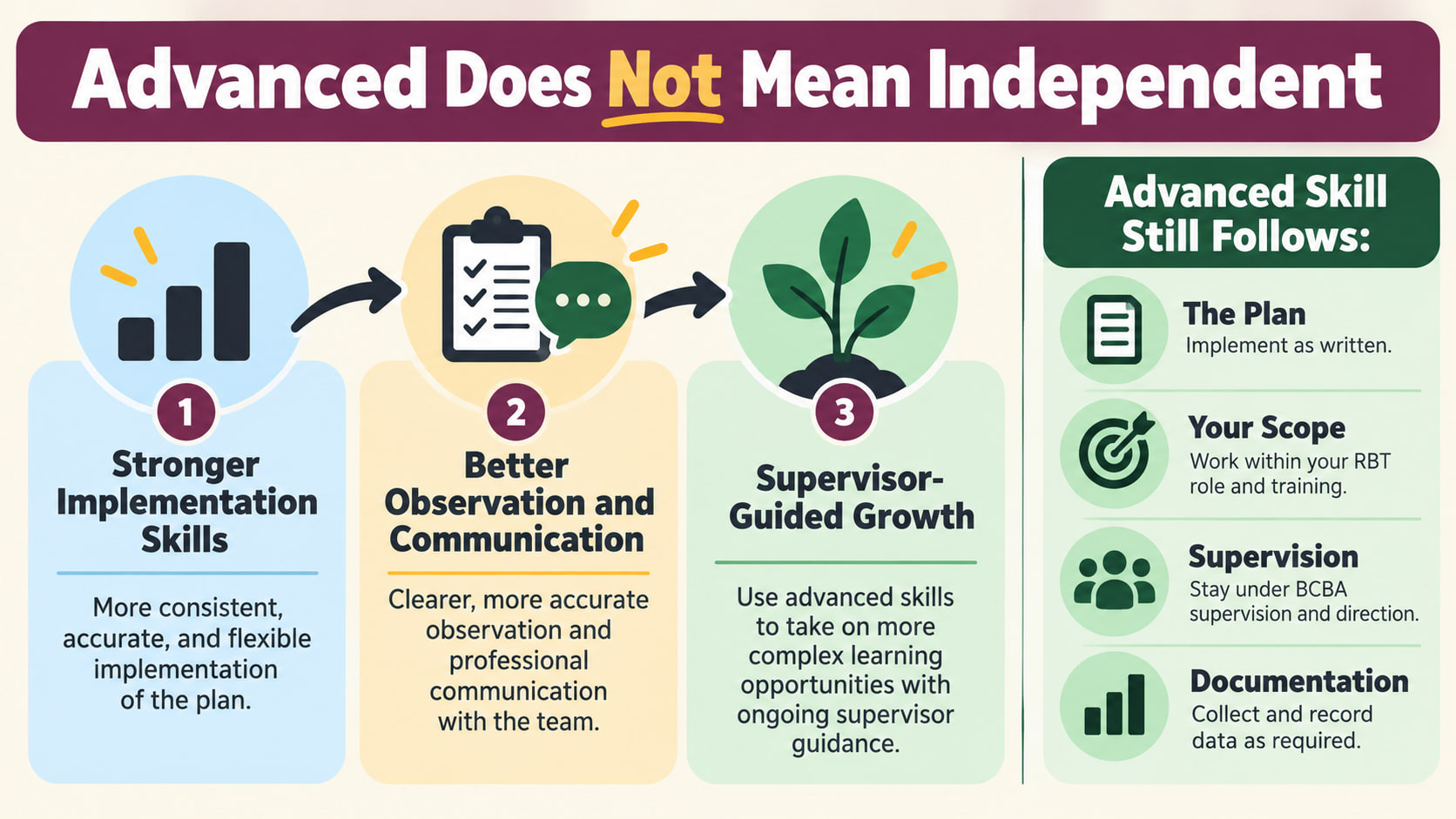
Advanced performance usually means the technician can implement assigned procedures accurately across more situations, notice relevant changes, describe observations clearly, maintain useful records, and use feedback to improve. It does not mean the technician becomes the person who independently diagnoses, designs treatment, changes a plan, interprets every clinical pattern, or supervises others.
A useful test is simple: does the skill improve the quality and reliability of assigned work while preserving the decision-making structure? If yes, it may be a meaningful area of growth. If it requires a new clinical decision or authority, pause and ask the responsible supervisor what is allowed.
Skills that can become more advanced
Implementation fidelity is one foundation. An experienced technician may prepare materials earlier, follow the written sequence more consistently, deliver instructions clearly, use assigned prompts and reinforcement as written, and recognize when a step was missed. Fidelity is not rigidly ignoring the learner; it is accurately implementing the current plan and reporting when the plan does not fit the moment.
Observation and data can also improve. A stronger technician distinguishes what was seen from what was inferred, uses the defined measurement system, records relevant context, and identifies missing or unreliable data. Instead of writing “the learner was noncompliant,” the technician can document the instruction, response, prompt, consequence, duration, or other defined measure that the team actually uses.
Communication is more than giving a long update. It means sending the right facts through the approved channel, protecting privacy, separating observation from opinion, and asking a focused question. A concise handoff can tell the supervisor what changed, what was measured, what support was tried, and what decision or clarification is needed.
Adaptability within the plan matters too. A technician may become better at arranging materials, pacing opportunities, offering assigned choices, and responding calmly when a routine changes. Those are valuable implementation skills. They still do not authorize an unapproved intervention, a new target, or a silent change to the written procedure.
Why advanced does not mean independent
Experience can make a person faster and more observant, but it does not automatically expand scope. A technician who notices a pattern should report it. The person responsible for the plan decides how the observation should be interpreted and whether the plan needs review. This distinction protects the learner, the team, and the technician.
Pause and ask for direction when a request involves diagnosis, assessment beyond the assigned task, treatment design, a plan change, a new safety procedure, clinical advice to a family, supervision of another person, or access to information outside the approved need. Do not use the word “advanced” as a reason to accept responsibility that has not been assigned.
Scope also includes honest representation. A technician can say, “I have practiced this procedure with supervisor feedback,” without saying, “I am qualified to decide the treatment.” Accurate language builds trust and helps the team match tasks to training and competence.
How supervision supports growth
Supervision should turn experience into deliberate practice. Before a new task, confirm the current procedure, materials, data definition, safety steps, and escalation route. During practice, request observation or feedback on one skill at a time. Afterward, record the feedback and the next opportunity to demonstrate the skill.
Useful supervision is specific. It might identify that the technician delivered an instruction consistently but recorded the response too late, or that the technician noticed a barrier but did not use the approved communication route. Specific feedback gives the technician something observable to repeat, adjust, and review.
If the supervisor is unavailable and the situation is outside the written plan, follow the organization’s escalation process. A technician should not improvise a new clinical solution merely to appear capable. Knowing when to pause, protect safety, and ask for help is itself an advanced professional behavior.
How to show reliable performance
Keep evidence tied to behavior rather than labels. Examples may include accurate session records, consistent data collection, completed training checks, supervisor feedback, examples of clear handoffs, and documented follow-through on corrections. The best evidence shows what the technician did, under what conditions, and how the result was reviewed.
- Accuracy: follow definitions and record what occurred without copying, backdating, or hiding errors.
- Consistency: implement the assigned procedure across ordinary variations in materials, setting, and pacing.
- Communication: report relevant facts, barriers, risks, and questions through approved channels.
- Boundaries: protect privacy and refer clinical, legal, or plan questions to the responsible person.
- Coachability: receive feedback, practice the correction, and confirm when the skill is ready for review.
A practical growth plan
Choose one skill that matters to the current role, such as clearer data, smoother transitions, or more concise handoffs. Define what successful performance looks like, identify how it will be observed, practice it with feedback, and review the record. Then decide whether the next step is more practice, a different setting, or a supervisor-approved expansion of duties.
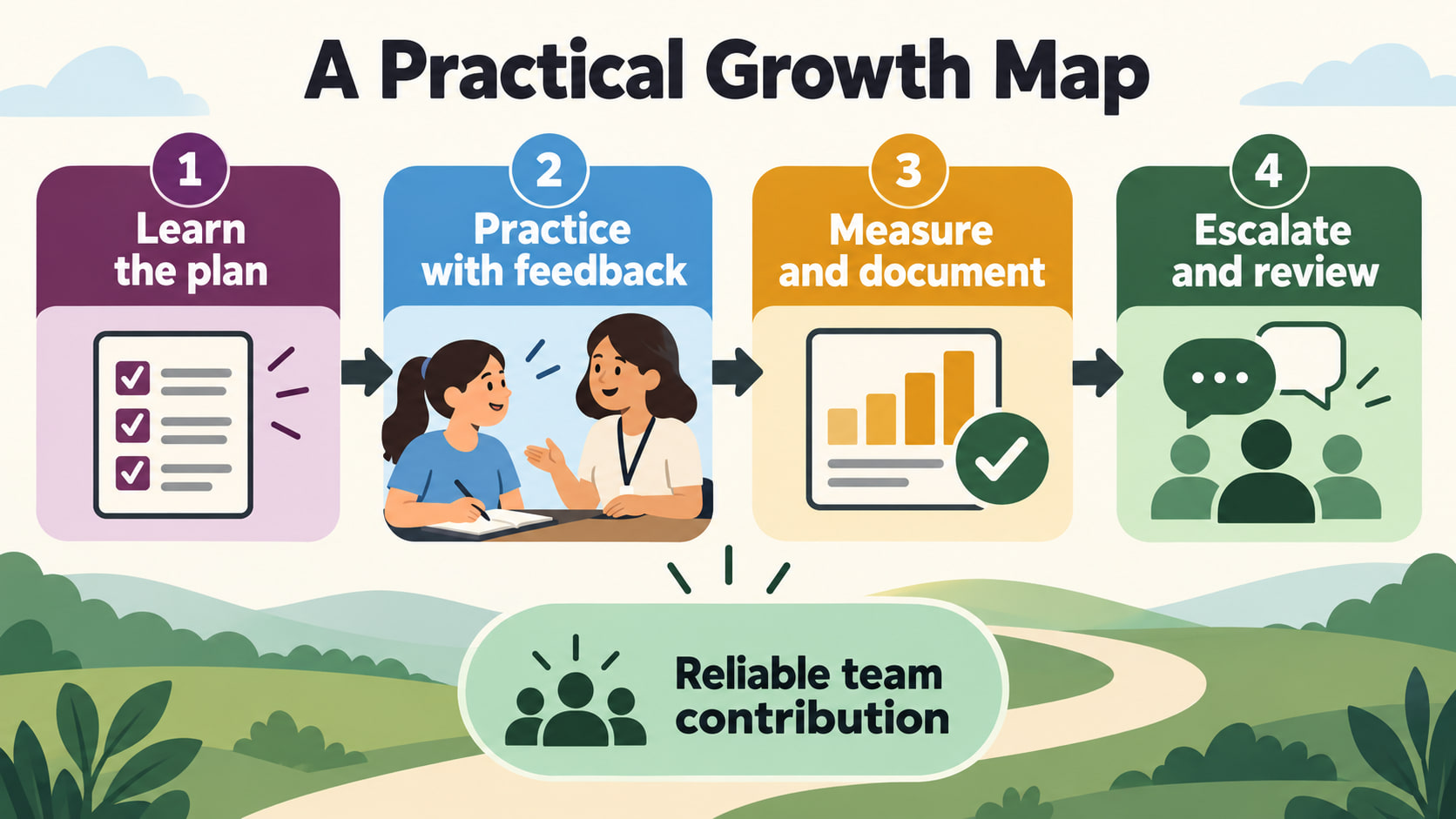
A growth plan should include a stopping point. If the task becomes unclear, the learner’s safety changes, the materials do not match the plan, or the technician is asked to make a decision outside scope, stop and escalate. Reliable professionals are not measured by how often they work without support; they are measured by whether they use support well.
For career conversations, ask the employer or supervisor what “advanced” means in that setting, which competencies are required, how feedback is documented, whether training is paid or supervised, and what decisions remain outside the technician role. Compare the answer with current official credential and supervision materials instead of relying on a job title alone.
Frequently asked questions
Is advanced behavior technician an official credential?
Not necessarily. It may be an employer title or a descriptive phrase. Check the actual credential, job duties, training, supervision, and local requirements rather than treating the phrase as a universal certification.
What skills make a behavior technician more advanced?
More consistent implementation, accurate observation and data, concise communication, reliable documentation, calm problem-solving within the plan, privacy awareness, and effective use of supervision can all be meaningful growth areas.
Can an advanced technician change a behavior plan?
Experience alone does not grant that authority. Report observations and ask the responsible supervisor to review a possible change. Follow the current approved plan until direction is provided, subject to the organization’s safety and escalation procedures.
How should someone build advanced skills?
Choose a specific observable skill, practice it with instruction and feedback, document performance, review the result with the supervisor, and clarify the next step. Avoid treating a label or years of experience as a substitute for competence evidence.
Role reminder: This is educational career and role information, not individualized clinical, credentialing, employment, legal, or treatment advice. Follow the assigned plan and ask the responsible supervisor about a specific situation.
Official starting points: the BACB RBT page, RBT Handbook, RBT Test Content Outline, and supervision and training resources.
Ready to practice the RBT concepts you just reviewed?
Try an independent, original RBT practice resource with exam-style questions, scoring, and answer explanations.
References
- Behavior Analyst Certification Board. RBT Test Content Outline, 3rd edition.
- Behavior Analyst Certification Board. RBT Handbook.
- Behavior Analyst Certification Board. RBT Ethics Code.