

An Amergis behavior technician job search should begin with the exact posting, location, contract, credential language, and current employer information.
Table of Contents
- What an Amergis behavior technician role can involve
- Read the job posting first
- Check RBT and state credentials
- Understand behavior-plan work
- Ask about schedule and employment details
- Interview questions to prepare
- Verify details before accepting
- Frequently asked questions
- References
RBT CAREER · EMPLOYER RESEARCH
Amergis Behavior Technician: How to Evaluate the Role
A practical guide to reading Amergis behavior technician postings, checking credential requirements, and asking about plans, data, schedules, pay, and supervision.
An Amergis behavior technician job search should begin with the exact posting, location, contract, credential language, and current employer information. Job duties and requirements can vary by state, school contract, client setting, and date. A general career article cannot promise a vacancy, pay rate, schedule, or hiring outcome.
Use this guide to evaluate a posting and prepare focused questions. Amergis’ official careers pages and the current job listing control the details. The RBT credential pathway and supervision requirements come from current official sources, not from a recruiter summary or an old screenshot.
What an Amergis behavior technician role can involve
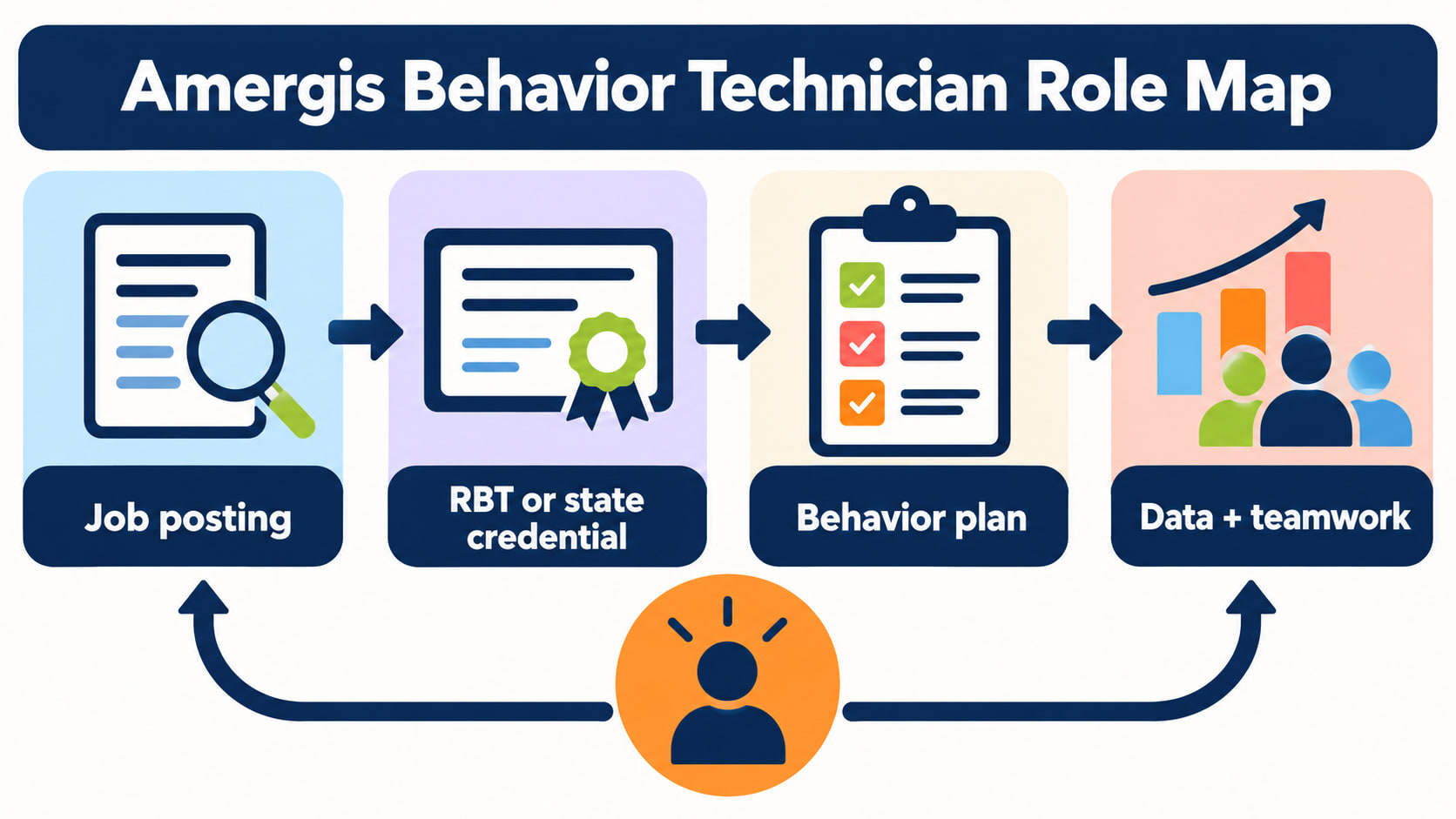
Behavior technician postings may describe one-to-one support, implementation of a behavior plan, data collection, collaboration with educators or behavioral specialists, and work with children or adults who need support. The wording is not identical across postings. Read the actual duties and setting instead of assuming every role is an RBT position.
Some listings may use “behavior technician,” “registered behavior technician,” or “registered/certified behavior technician.” Those labels can carry different credential requirements. A role may require an active BACB RBT certification, a state credential, relevant experience, or a combination that depends on the contract.
Also distinguish a staffing agency relationship from the service setting. You may communicate with a recruiter, work at a school, and receive clinical direction from a behavioral supervisor while the employment paperwork comes from the staffing company. Ask who handles payroll, scheduling, training, performance feedback, and clinical escalation. Knowing who owns each responsibility prevents avoidable confusion after the first day.
Read the job posting first
Before applying, capture the posting title, job ID, location, work setting, employment type, contract duration, estimated pay or weekly rate, hours, start date, and application route. Save the official URL and access date because job pages can change or close.
Separate requirements into three columns:
- Required: credential, background checks, education, experience, licenses, or availability explicitly marked as required.
- Preferred: experience or skills that may strengthen an application but are not stated as mandatory.
- Unclear: items to confirm with the recruiter, such as paid training, travel, supervision, documentation systems, or cancellations.
Do not infer pay or conditions from another city’s posting. A job with the same title can have different school calendars, hours, funding arrangements, or state requirements.
Make a one-page comparison before applying to several listings. Record the job ID, location, setting, credential language, hours, pay basis, travel, supervision contact, and open questions. This prevents details from two contracts from being mixed together and gives you a clear agenda for the recruiter call.
Check RBT and state credentials
If the posting requires RBT certification, compare the requirement with your current status. “RBT certification preferred” is different from “active RBT certification required.” A state may also use a separate behavior-technician credential or license. Ask which credential applies to the contract and whether it must be active before the first day.
Do not represent a 40-hour training certificate, related degree, or prior classroom job as the RBT credential. Confirm the current BACB pathway, competency assessment, supervision, and renewal obligations through official BACB materials. If Amergis says it can support onboarding or training, ask what is included, who supervises it, and what remains your responsibility.
Understand behavior-plan work
A behavior technician may implement a behavior plan maintained by a supervisor and gather quantifiable data for review. That work requires accurate observation, consistent procedures, respectful communication, and timely reporting. It does not authorize the technician to independently design a treatment plan, change a consequence, diagnose a learner, or interpret an ambiguous instruction alone.
Ask what documentation system is used, which measures are recorded, how often feedback occurs, and what happens when the written plan does not match the situation. Clarify how safety concerns, missed data, caregiver questions, and schedule changes are escalated.
Ask about schedule and employment details
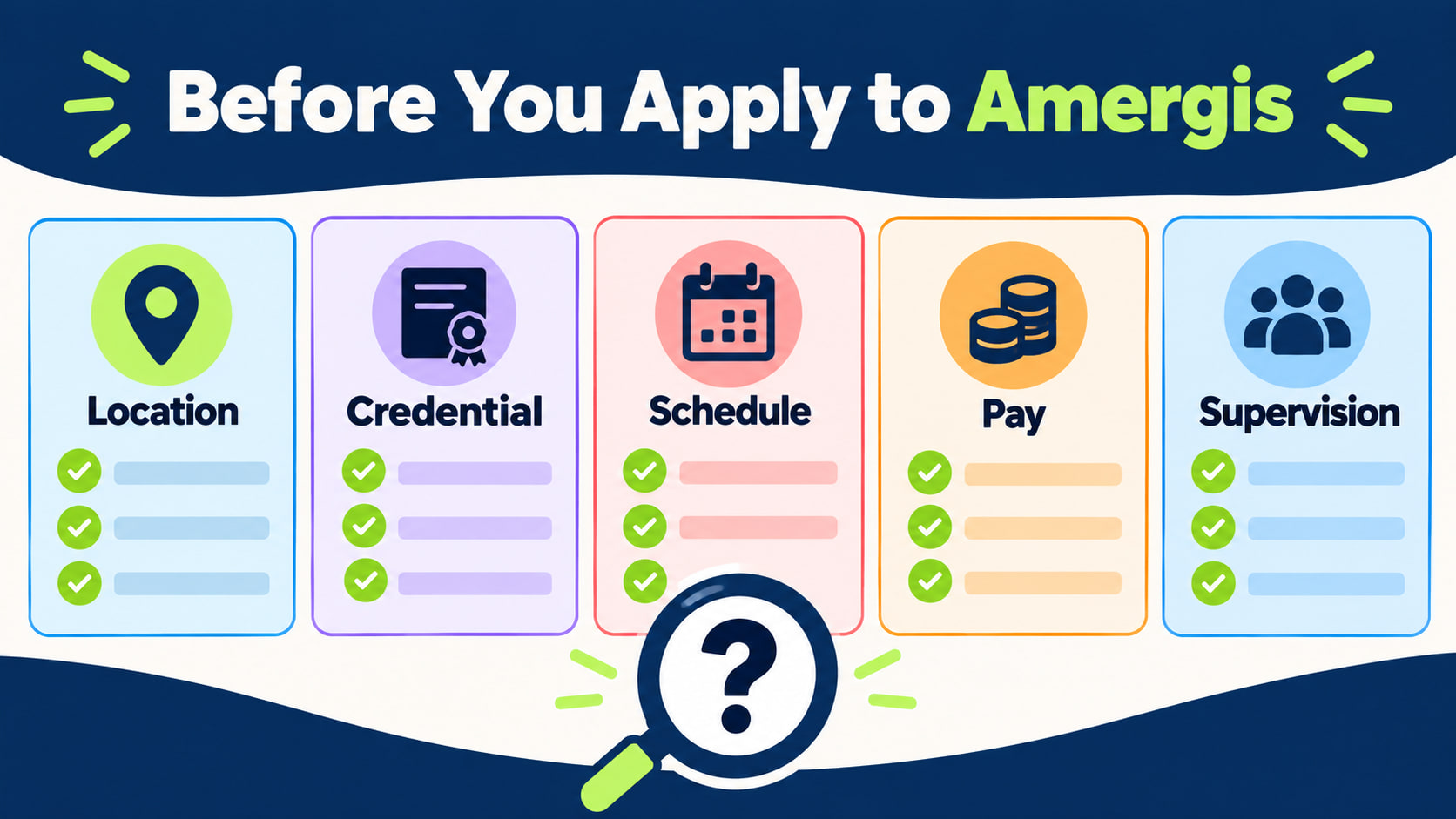
School-based and community roles can differ substantially. Confirm the worksite, travel between clients or schools, school-year calendar, start and end times, cancellations, makeup expectations, minimum hours, overtime rules, break policies, and whether the role is contract, temporary, part-time, or full-time.
Pay shown in a posting may be estimated and may not describe every condition. Ask whether training, meetings, travel, documentation, and cancellations are paid, and request the written offer or policy that controls. Do not rely on a verbal promise when the contract or employer policy is available.
Interview questions to prepare
Prepare questions that show you understand the work while protecting your own decision-making:
- Who is the supervising professional and how is supervision scheduled?
- What behavior-plan and data systems will I use?
- What training and competency checks happen before independent sessions?
- How are cancellations, travel time, and documentation handled?
- What are the escalation steps for safety concerns or a plan conflict?
- Which credential must be active, and who verifies it?
Give honest answers about your experience. Do not claim competence with a procedure you have not been trained to implement. A thoughtful question about supervision is a strength, not a weakness.
Verify details before accepting
Use the official Amergis careers page or the employer’s verified recruiting channel. Check that the job ID, location, recruiter contact, and application link match. Be cautious of requests for money, gift cards, banking information before a legitimate hiring step, or copies of confidential client information.
Before accepting, compare the written offer with the posting and your notes. Confirm the role title, employment relationship, pay basis, hours, location, start date, credential condition, supervision arrangement, and termination or contract terms. If anything is unclear, ask for written clarification before making a decision and accepting the offer.
A company-specific article can help you prepare, but it cannot replace the current job posting or employment agreement. Requirements, openings, and rates change, so verify them at the time you apply.
Frequently asked questions
Does every Amergis behavior technician job require RBT certification?
Not necessarily. Requirements vary by posting, state, setting, and contract. Read the current listing and ask which credential is required for that role.
Will Amergis provide RBT training?
Do not assume. Ask the recruiter what training is provided, whether it is paid, who supervises it, and which BACB requirements remain your responsibility.
Are Amergis behavior technician jobs only in schools?
No universal assumption is safe. The work setting is posting-specific and may include schools or other service environments. Confirm the location and duties in the current listing.
What should I ask about supervision?
Ask who supervises, how often contact occurs, how direct observation and feedback are documented, and what escalation route applies when a procedure or safety situation is unclear.
Source note: Review the current Amergis job posting, Amergis careers information, BACB RBT Handbook, official RBT requirements, employer policies, and supervisor direction for your situation. This article is educational and does not provide individualized legal, clinical, employment, or credentialing advice.
Ready to practice the RBT concepts you just reviewed?
Try an independent, original RBT practice resource with exam-style questions, scoring, and answer explanations.
References
- Behavior Analyst Certification Board. RBT Test Content Outline, 3rd edition.
- Behavior Analyst Certification Board. RBT Handbook.
- Behavior Analyst Certification Board. RBT Ethics Code.