

Apply BACB Ethics Code RBT decisions by moving from facts to the current code, safety and privacy, supervision, role-appropriate action, and documented follow-up.
Table of Contents
- Apply BACB Ethics Code RBT: why a process helps
- Step 1: Notice the facts
- Step 2: Check the code and the plan
- Step 3: Protect safety and privacy
- Step 4: Ask the supervisor or right authority
- Step 5: Act within role and document
- Choose the right reporting route
- Practice the process with examples
- Frequently asked questions
- Sources and scope note
RBT ETHICS GUIDE · DECISION-MAKING AND SUPERVISION
Apply BACB Ethics Code RBT: A Practical Decision Path
Use a five-step process to move from an uncertain situation to safe, supervised, role-appropriate action.
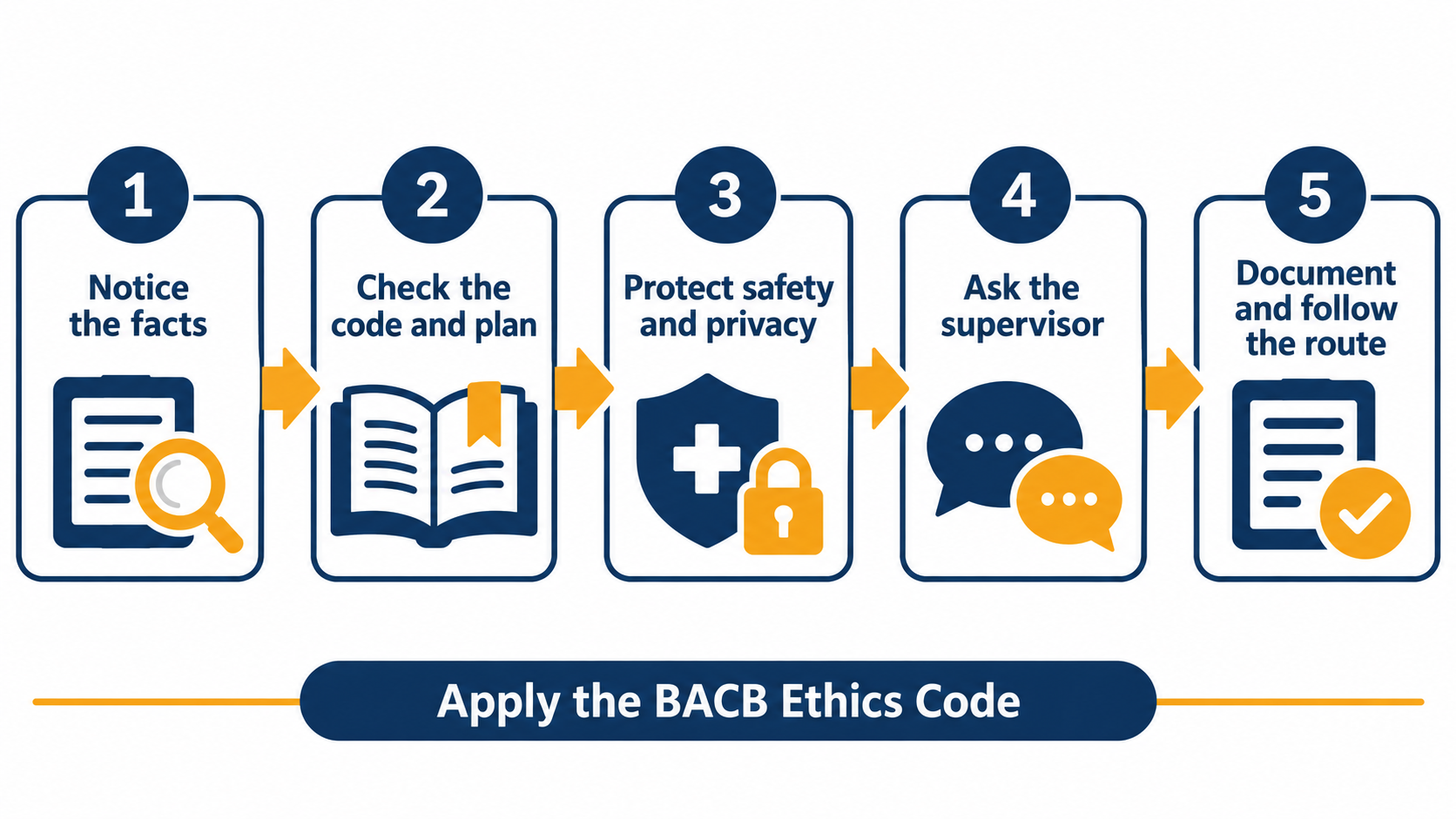
Apply BACB Ethics Code RBT decisions by moving from facts to the current code, safety and privacy, supervision, role-appropriate action, and documented follow-up. This keeps an ethical concern from becoming either a rushed accusation or a problem that everyone quietly ignores.
The RBT Ethics Code (2.0) applies to RBT behavior-technician activities across settings and modalities. It also says that RBTs should seek support from their supervisor and other appropriate workplace individuals when interpreting and applying the code or addressing an ethical dilemma. This guide is educational, not a legal opinion, ethics ruling, or individualized treatment direction.
Apply BACB Ethics Code RBT: why a process helps
An ethics code gives standards, but real situations arrive as incomplete stories: a missing data point, a request to sign a record, a confusing message, a privacy concern, an unfamiliar procedure, or a question about a colleague’s conduct. In the moment, an RBT may feel pressure to act immediately or to decide that nothing can be done.
A repeatable process creates a useful middle path. It slows down unsupported conclusions while still protecting safety and confidentiality. It also respects the RBT role: observe carefully, follow authorized services, ask for direction, communicate relevant facts, and document what was done.
Think of the process as five connected questions:
- What do I actually know?
- Which code standard, written plan, law, or workplace requirement may apply?
- Is there an immediate safety, rights, or privacy issue?
- Who is the appropriate person or authority to consult?
- What can I do within my role, and what follow-up must be recorded?
Step 1: Notice the facts
Start with direct observations and reliable records. Write down what happened, when it happened, who was present, what instruction or request was given, what response occurred, and what action followed. Separate what you saw or heard from what someone inferred.
For example, “the session note lists 90 minutes, but the service ended after 60 minutes” is a fact to verify. “The person is trying to commit fraud” is a conclusion that may not yet be supported. Neutral facts make it easier for a supervisor or authorized reviewer to evaluate the situation.
Preserve the relevant record through the approved system. Do not copy identifiable information into an unapproved group chat, personal notes app, or public post while trying to ask for help.
Step 2: Check the code and the plan
Read the current RBT Ethics Code and the written behavior plan, service instructions, employer policy, or other requirement that governs the work. Look for the standard that connects to the concern. It may involve honesty, accurate documentation, confidentiality, competence, client safety, supervision, multiple relationships, or communication with the BACB.
Checking the plan does not mean treating a document as permission to ignore the code. It means understanding what the RBT was authorized and trained to do. If the plan is unclear, outdated, incomplete, or apparently in conflict with a safety or legal requirement, pause at the boundary and ask for supervision.
Do not use a remembered summary as a substitute for the current source. Requirements can change, and an employer, payer, school, state, or other authority may add a rule that the general code does not describe in detail.
Step 3: Protect safety and privacy
Before debating labels, handle urgent risk. If a client may be in immediate danger, a legal right may be violated, or a serious safety procedure is needed, follow the organization’s emergency and protection process. Contact the supervisor and other appropriate authority as directed. In an emergency, use the applicable emergency route.
At the same time, protect confidentiality. Share only the necessary information with people who have a legitimate role in responding. Do not send a full client history when the supervisor needs one date and one observable event. Do not discuss a concern in a hallway or on social media.
Safety and privacy can pull in different directions. The answer is not to hide the concern or disclose everything to everyone. Ask the supervisor or appropriate authority how to share the minimum necessary information through a secure channel.
Step 4: Ask the supervisor or right authority
RBTs practice under the direction and close supervision of an RBT Supervisor and/or RBT Requirements Coordinator. Bring the factual concern to supervision when it involves an unclear procedure, possible role overreach, a documentation question, a client-rights issue, or a potential code concern.
A useful message can follow this format:
- Observation: “At 2:10 p.m., I observed…”
- Requirement: “The plan or record says…”
- Concern: “I am unsure whether…”
- Immediate action: “I protected safety/privacy by…”
- Question: “What is the approved next step?”
If the concern involves the supervisor, follow the organization’s escalation route, such as a supervisor’s manager, requirements coordinator, human resources, compliance contact, or another designated authority. The RBT should not independently investigate or promise an outcome.
Step 5: Act within role and document
After consultation, take the action you are authorized and competent to take. That may mean implementing the current procedure, pausing an unfamiliar task, correcting a record, providing a factual report, or completing a required form. It does not usually mean rewriting a goal, changing reinforcement, altering a safety procedure, diagnosing a client, or deciding that another professional violated the code.
Document the actions taken, relevant dates, parties involved, and the outcome or pending follow-up through the approved system. The RBT Ethics Code specifically describes documenting actions taken to address a suspected ethics violation and saving relevant documentation.
Follow-up matters because an ethical concern can remain open after the first conversation. Confirm who owns the next step, when it should occur, and what you should do while waiting. If the situation changes, update the supervisor with new facts rather than silently continuing an unsafe or unauthorized practice.
Choose the right reporting route
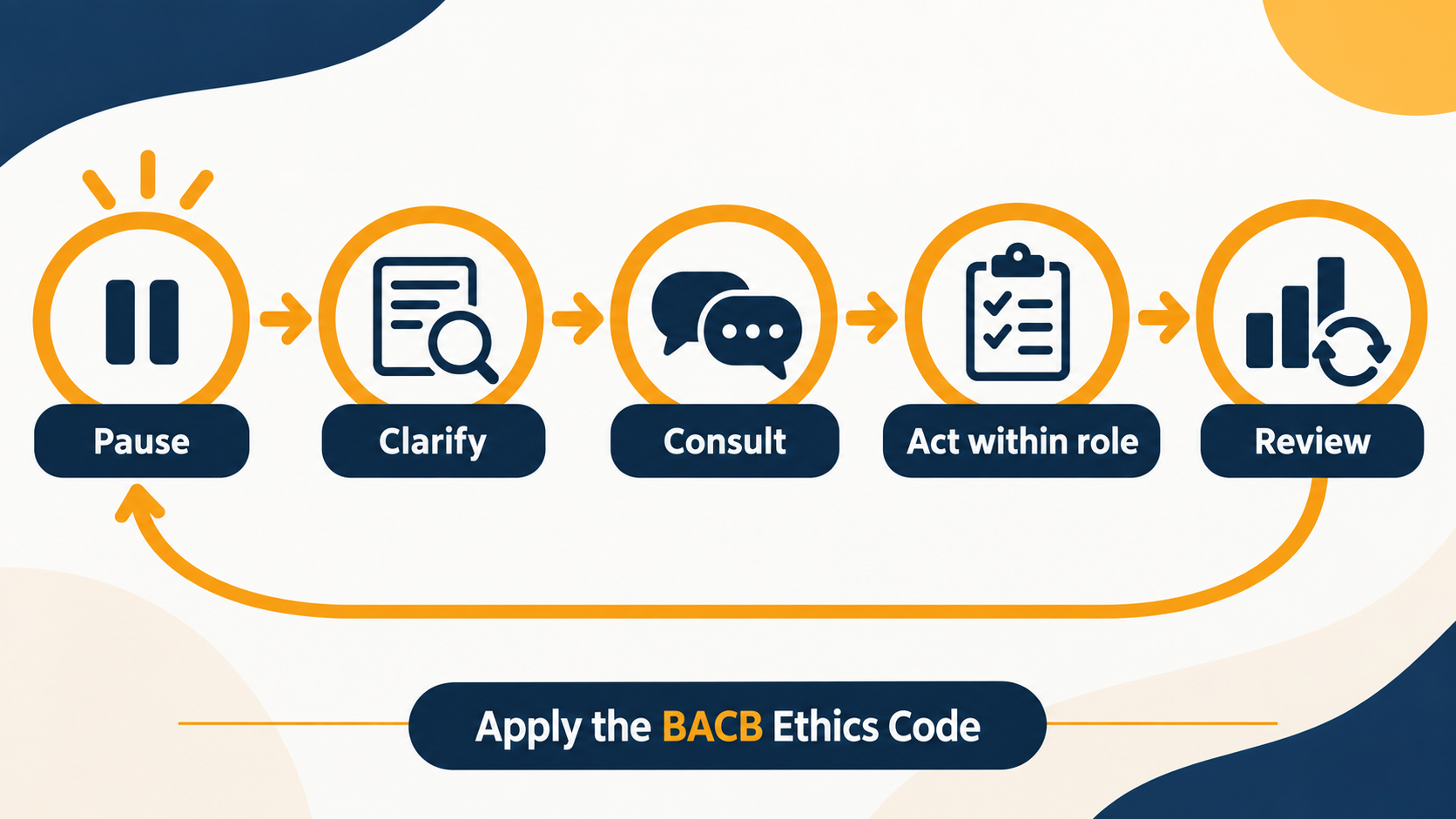
Not every concern belongs in the same inbox. A workplace scheduling or billing question may start with an employer or supervisor. A licensing matter may involve a licensing board. An immediate threat may require emergency or law-enforcement action. A suspected violation of the RBT Ethics Code that is not resolved with supervisor support may require reporting to the BACB.
The RBT Ethics Code says that RBTs attempt to resolve a suspected violation by first bringing it to the supervisor, document the actions taken, and, if the matter cannot be resolved directly, report it to the appropriate authority. The code also lists self-reportable events and states that covered events must be reported to the BACB within 30 days of the event or awareness.
Use the current code and current organizational instructions to determine the route. This article cannot decide whether a particular event is reportable. When uncertain, do not treat uncertainty as permission to delay safety, destroy records, or make a public accusation.
Practice the process with examples
A coworker asks you to record a procedure you did not observe. Notice the request and the missing observation. Check the documentation rule. Decline to sign inaccurately, tell the supervisor, and record the communication through the approved route.
A caregiver asks you to change a program during a difficult session. Notice the request and any immediate safety issue. Follow the current plan within competence, protect the learner, and ask the supervisor how the program should be reviewed. Do not make an independent clinical change.
You receive a client photo in a personal message. Do not forward it or store it in another personal account. Use the approved privacy and reporting route, tell the supervisor what happened, and follow instructions for secure handling and deletion or retention.
You are asked to use an unfamiliar intervention. State that you have not demonstrated competence with it. Ask for training and supervisor confirmation before providing the service, and document the direction according to workplace procedure.
Frequently asked questions
Does applying the code mean reading every standard before acting?
Not necessarily. Protect immediate safety and confidentiality first, then review the relevant current standard, plan, and organizational requirement. Ask the supervisor when the application is unclear.
Can an RBT decide that a coworker committed an ethics violation?
An RBT can observe, document, and report a concern. The RBT should not present an unverified conclusion as a final ruling or investigate beyond the assigned role. The appropriate authority evaluates the matter.
What if my supervisor tells me to do something that seems unethical?
Describe the specific concern, protect immediate safety, and ask for clarification. If the issue is not resolved or involves the supervisor, use the designated escalation route and document your actions. Different concerns may involve an employer, licensing board, BACB, emergency service, or another authority.
Why document an ethics concern?
Documentation preserves the factual timeline, shows what was communicated, supports follow-up, and helps the authorized reviewer understand the response. Use secure, approved records and include only relevant information.
Sources and scope note
This guide is based on the BACB RBT Ethics Code (2.0), the BACB Registered Behavior Technician Handbook, and BACB ethics information. Requirements can change, and employer, payer, school, state, and legal rules may add obligations. Check the current source and ask the appropriate supervisor or authority about your situation.
Ready to practice the RBT concepts you just reviewed?
Try an independent, original RBT practice resource with exam-style questions, scoring, and answer explanations.
References
- Behavior Analyst Certification Board. RBT Test Content Outline, 3rd edition.
- Behavior Analyst Certification Board. RBT Handbook.
- Behavior Analyst Certification Board. RBT Ethics Code.