
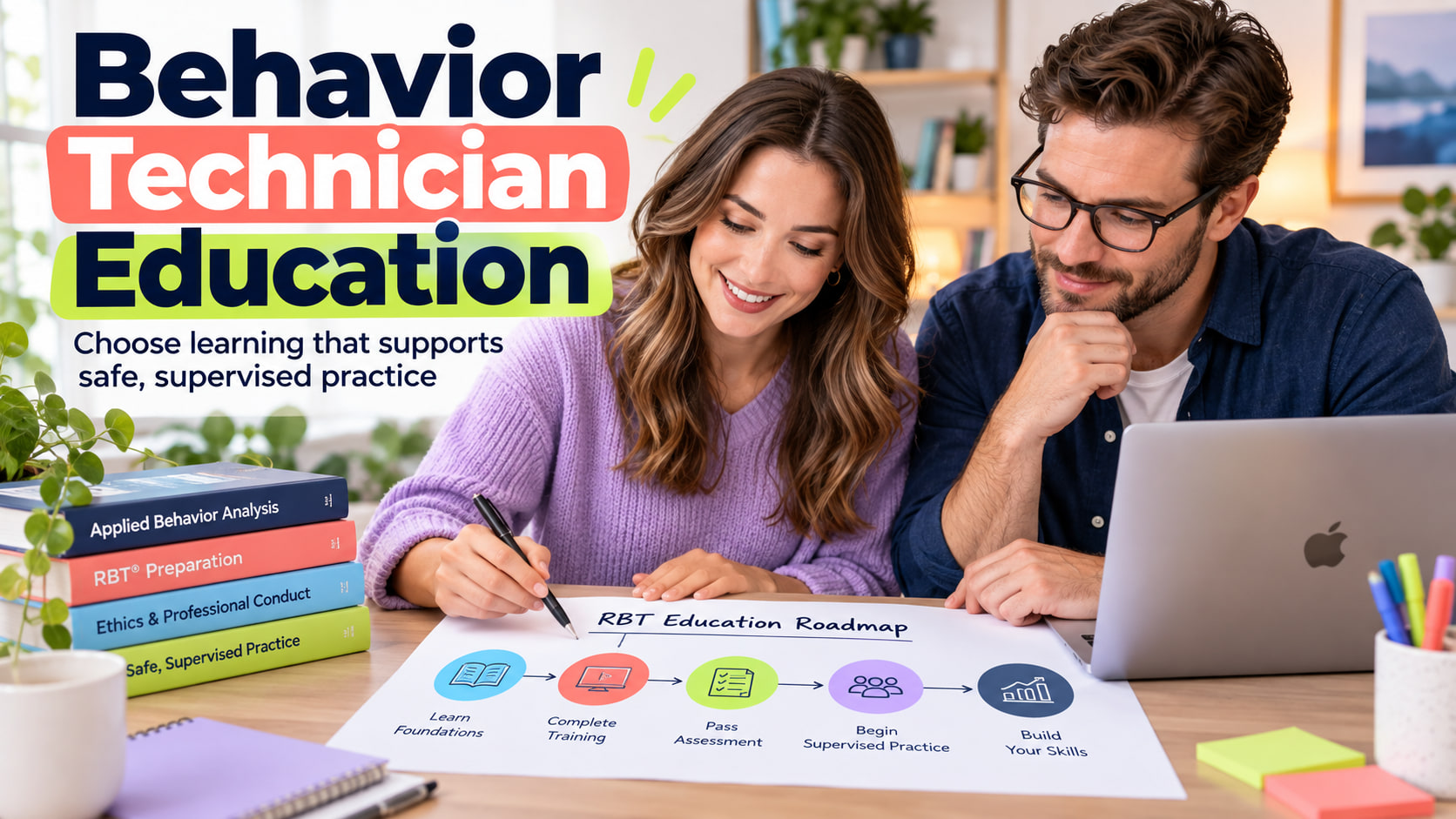
Behavior technician education can include formal coursework, structured training, practice, feedback, supervision, and continuing learning; compare the purpose of each stage.
Table of Contents
- What behavior technician education can include
- Start with foundations and role boundaries
- Compare structured training
- Look for practice and feedback
- Separate competency from learning
- Understand supervision
- Evaluate support and evidence
- Build an education plan
- Frequently asked questions
- References
RBT EDUCATION · LEARNING GUIDE
Behavior Technician Education: Choose Learning for Supervised Practice
Separate foundations, training, competency, supervision, support, and ongoing development.
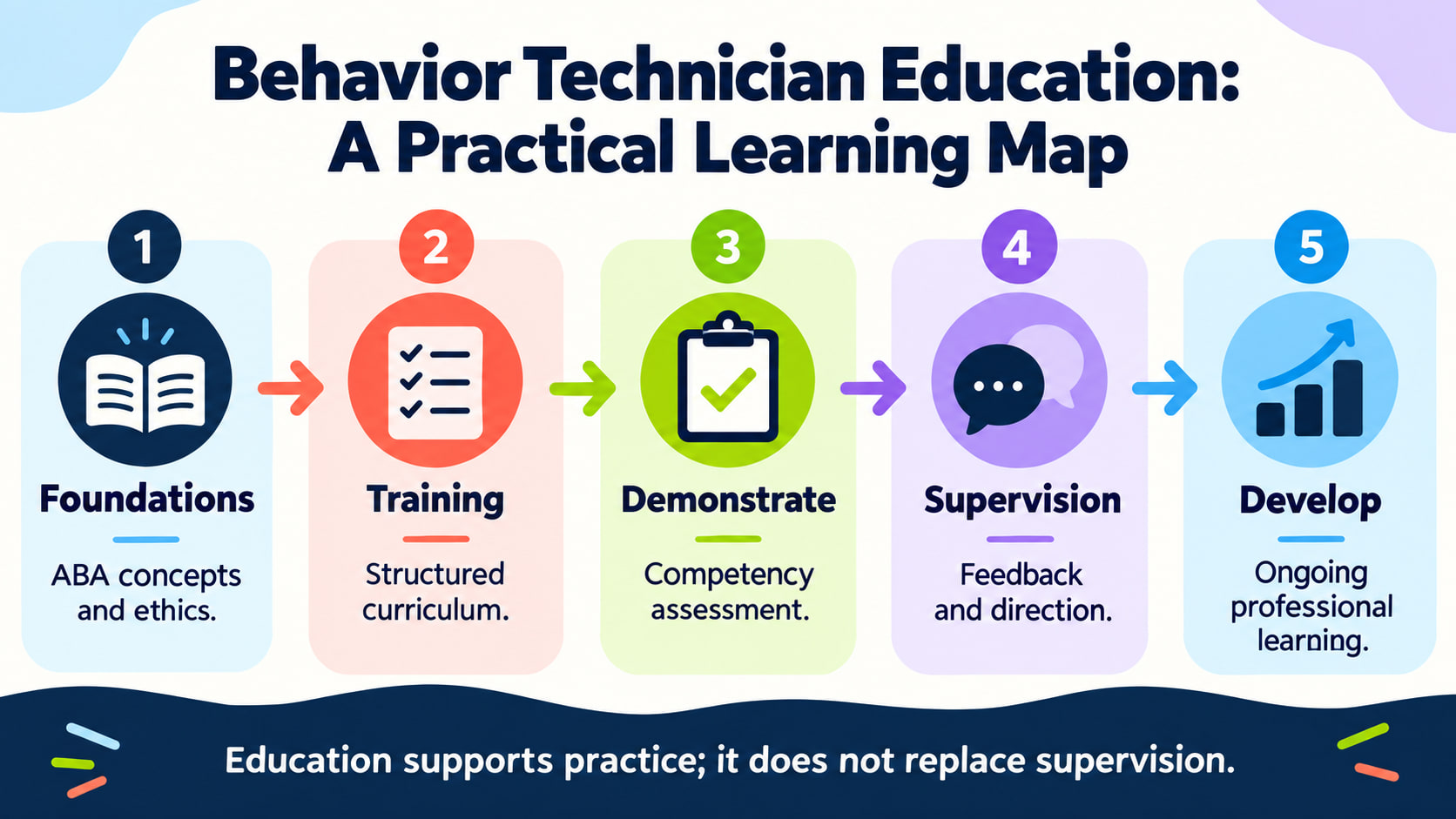
Behavior technician education can include introductory coursework, a structured RBT curriculum, practice activities, competency assessment, supervision, employer onboarding, and ongoing professional learning. These stages are related but not interchangeable. A course title does not tell you which stage a provider actually supplies.
Use current official BACB materials for decisions about the RBT credential. Education can help you understand concepts and prepare questions, but it does not guarantee certification, employment, examination success, or permission to make independent clinical decisions. This guide helps you compare learning pathways responsibly.
What behavior technician education can include
Education may happen through an online course, classroom instruction, employer training, readings, videos, practice scenarios, feedback, or supervised work. Some options focus on general applied behavior analysis concepts; others are designed around a specific credentialing pathway. Ask what the program is intended to accomplish before comparing price or length.
Map the stages you need: foundations, structured training, competency demonstration, supervision, application, examination if applicable, employer requirements, and local requirements. Record who owns each stage. A completion badge is not automatically evidence that every stage has been completed.
Start with foundations and role boundaries
Strong foundations explain observable behavior, measurement, data collection, skill acquisition, prompting, reinforcement, behavior reduction, documentation, ethics, client rights, and professional communication. The goal is not to memorize labels; it is to understand how concepts relate to safe work under direction.
Look for clear role boundaries. A technician may implement an approved plan and report observations, while a supervisor or other qualified professional may direct assessment and treatment decisions. Education should explain when to pause, document, and ask for direction rather than encouraging independent clinical judgment.
Be cautious with examples that use identifiable client information or present an unapproved intervention as a universal solution. Responsible learning uses original, de-identified examples and explains why context and supervision matter.
Compare structured training
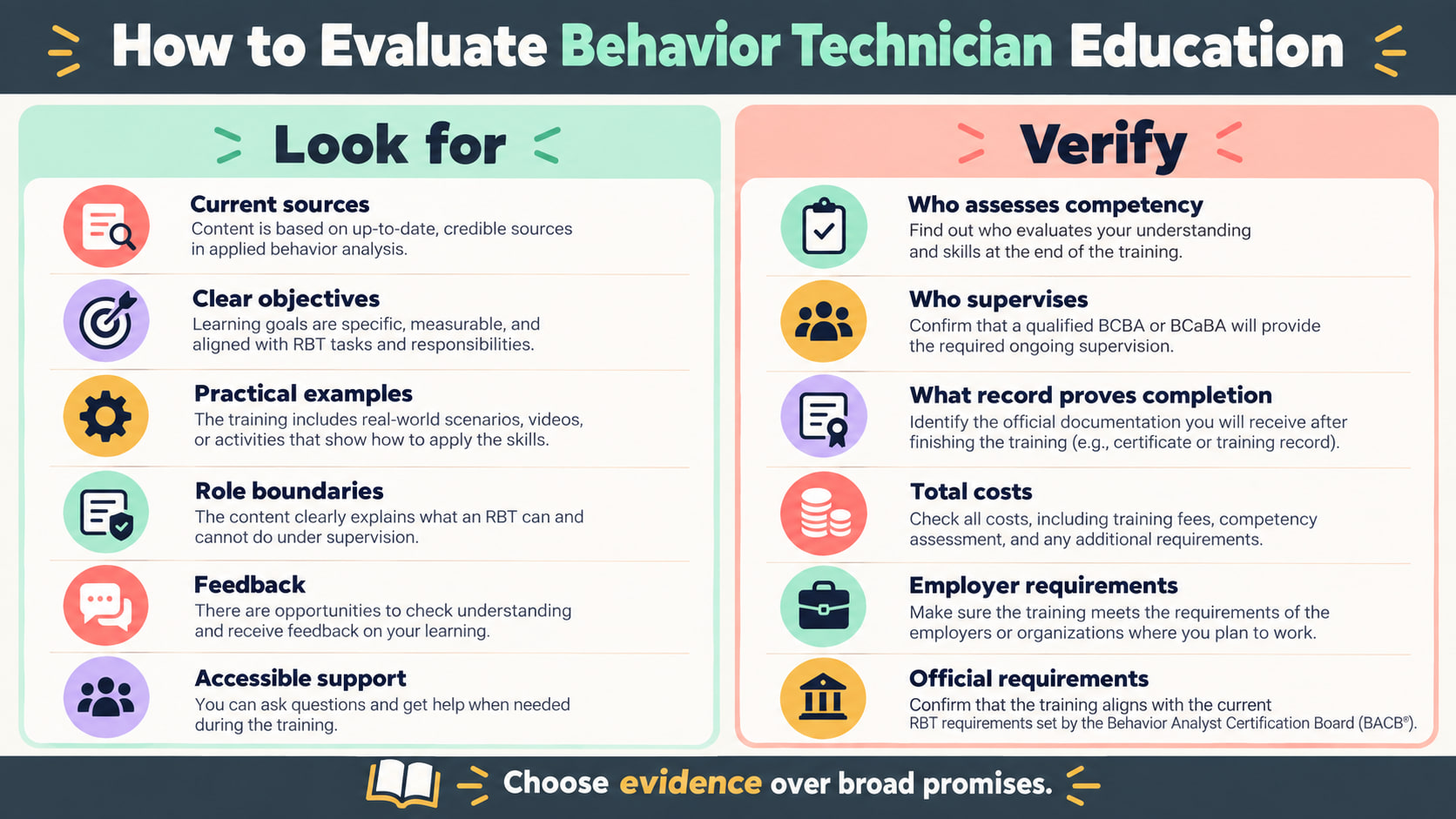
Ask for a syllabus with objectives, topic order, activities, source versions, update dates, instructors, and completion requirements. Check whether the material is aligned with current official sources and how learners are told about updates. A polished platform does not prove that its content is current.
Compare what is included: readings, video, quizzes, scenarios, practice, feedback, study support, accessibility features, and a completion record. Ask whether the program is general education, a specific training requirement, employer onboarding, or a combination. These labels can describe different services.
Do not rely on materials advertised as official, recalled, leaked, or guaranteed examination content. A responsible provider teaches concepts, explains reasoning, and directs administrative questions to current official sources.
Look for practice and feedback
Quizzes measure recall, while practice shows how you apply a concept. Look for activities involving objective descriptions, measurement choices, prompting, reinforcement, documentation, professional communication, and escalation. Ask whether answer explanations are provided and whether you can ask questions.
Find out whether feedback is personal, automated, peer-based, or only a score. Ask how missed concepts are revisited and whether feedback remains available after completion. Course practice should stay educational and de-identified; it cannot substitute for workplace supervision or authorize a change to an approved plan.
Separate competency from learning
Learning introduces information; competency assessment evaluates whether specified tasks can be demonstrated through the applicable process. Ask who conducts an assessment, what tasks are evaluated, how the appointment works, what preparation is provided, and what record you receive.
Do not treat a quiz score, attendance record, or course certificate as an automatic competency assessment. Confirm retake, cancellation, accessibility, expiration, and verification policies. If a provider says “job ready,” ask which observable skills that phrase describes.
Understand supervision
Supervision is an ongoing professional relationship, not simply a course module. Ask whether the provider offers supervision, refers you to a supervisor, or provides no supervision service. If it is offered, request observation, feedback, communication, cancellation, privacy, and payment arrangements in writing.
Do not assume the instructor, assessor, employer, supervisor, and application contact are the same person. Education and supervision do not authorize a technician to independently diagnose, design treatment, change a learner’s plan, select an unapproved intervention, or work outside demonstrated competence.
Evaluate support and evidence
Compare office hours, instructor questions, technical help, captions, transcripts, accessible documents, response windows, update notices, and correction procedures. Test the platform on the device and connection you will use. Ask what happens if technology fails or an accommodation is needed.
Save the syllabus, source date, terms, receipt, written answers, assessment instructions, supervision details, and completion record. Read access-expiration, refund, transfer, privacy, and data-retention policies. “Lifetime access” may describe login access without promising lifetime feedback or updates.
Reviews can reveal questions to investigate, but a rating is not official endorsement. Consider the date, specific claim, source, and relevance. Give greater weight to current written policies and official requirements.
Build an education plan
- Define the destination: Decide whether you need general education, an RBT pathway, employer onboarding, or ongoing development.
- Map the stages: Separate foundations, training, competency, supervision, application, examination, employer, and local requirements.
- Verify sources: Compare provider claims with current official materials and written employer requirements.
- Resolve gaps: Ask who owns each unanswered step before paying or submitting personal information.
- Save evidence: Keep dated documents and the record that proves completion.
Use one row per learning option and columns for source date, objectives, practice, feedback, support, assessment boundary, supervision, record, total cost, and policy. Mark each answer as confirmed, unclear, or not included. This makes a broad education market easier to compare.
Ask how updates are announced and who corrects errors. A program that names its source version, support window, accessibility options, and correction contact gives stronger evidence than a page that only promises career readiness.
Recheck the plan if your employer, location, role, or service setting changes. A learning history may remain useful while a new employer or official process adds another requirement. Pause when an important claim cannot be verified.
Before enrolling, write down the next step, its owner, deadline, and document that proves completion. If education bundles assessment or supervision, read the terms for those services separately.
Keep dated answers with your records. If a provider changes its curriculum, price, or access rules, save the new version and note the effective date. This protects the accuracy of your comparison over time.
Ongoing education should also have a purpose. Choose learning that addresses a real skill, policy update, communication need, or supervisor-directed development goal, and record what you learned and how you will receive feedback.
Frequently asked questions
Is behavior technician education the same as RBT certification?
No. Education may support learning, while certification depends on the current official pathway and its separate requirements.
Does every education program include supervision?
No. Ask whether supervision is included, referred, optional, or not provided, and request the arrangement in writing.
What should I look for in a learning program?
Check current sources, clear objectives, practical examples, feedback, role boundaries, accessible support, assessment boundaries, total cost, and records.
Can education guarantee a behavior technician job?
No. A provider can describe its learning services but cannot control employer decisions or guarantee employment.
Source note: Review the current BACB Handbook, RBT materials, employer requirements, applicable local rules, and supervisor direction for your situation. This article is educational and does not provide individualized legal, clinical, employment, or credentialing advice.
Ready to practice the RBT concepts you just reviewed?
Try an independent, original RBT practice resource with exam-style questions, scoring, and answer explanations.
References
- Behavior Analyst Certification Board. RBT Test Content Outline, 3rd edition.
- Behavior Analyst Certification Board. RBT Handbook.
- Behavior Analyst Certification Board. RBT Ethics Code.