
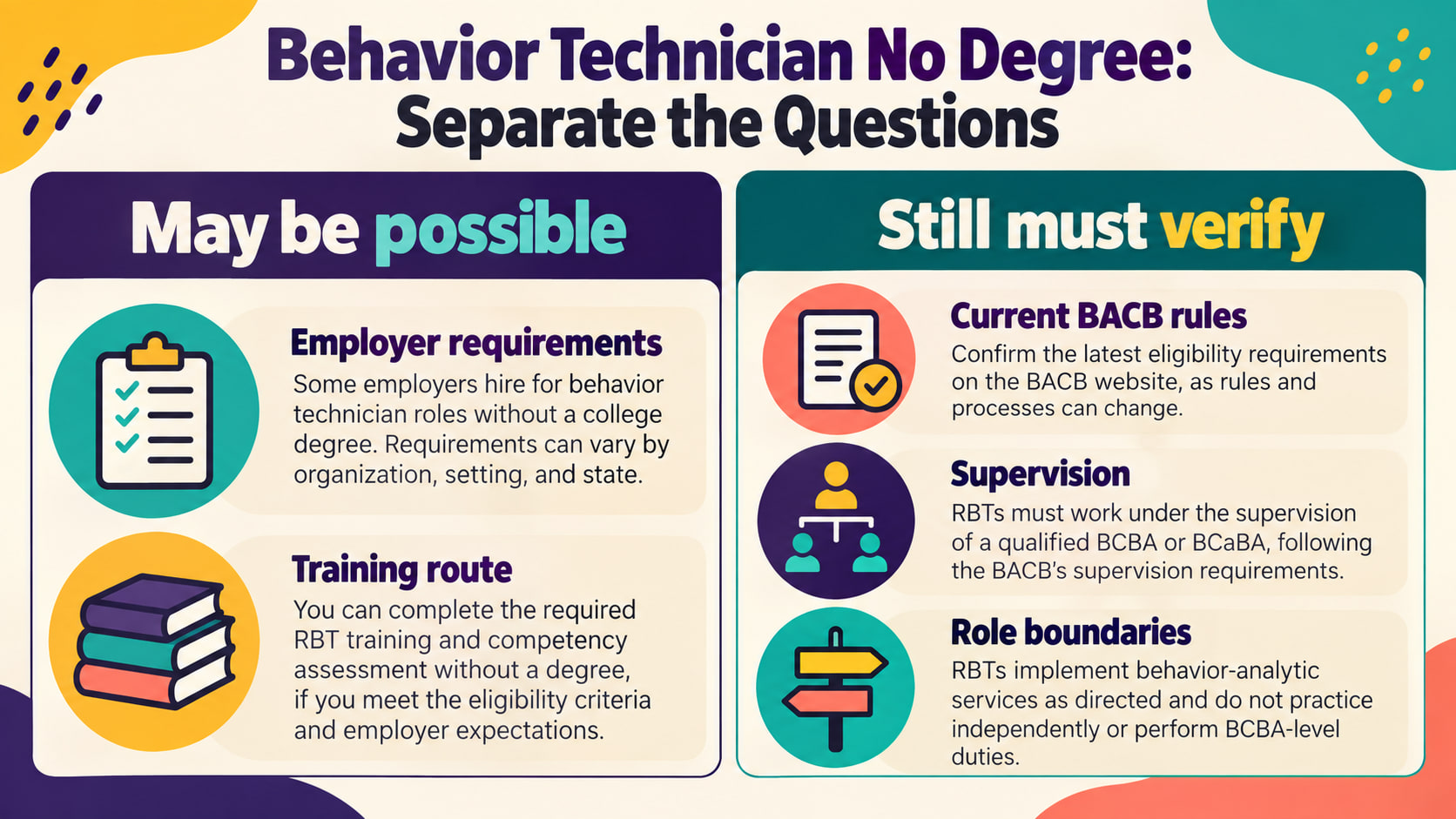
Behavior technician no degree questions should be separated into employer requirements, training routes, current BACB rules, supervision, and the actual role being offered.
Table of Contents
- Behavior technician no degree: what the question really asks
- Check the exact requirements
- Understand the training route
- Ask the employer specific questions
- Verify supervision and role boundaries
- Keep documents and claims accurate
- Common scenarios
- Frequently asked questions
- References
RBT CAREER · ENTRY QUESTIONS
Behavior Technician No Degree: What to Know
Separate employer requirements from current certification, training, supervision, and role boundaries.
Behavior technician no degree questions should be separated into several smaller questions: What does this employer require? What does the current RBT pathway require? Which training and competency steps apply? Who provides supervision? What work is the person actually being hired to perform?
There is no single answer for every employer, state, setting, or credential. A job listing may use “behavior technician,” “ABA technician,” or another title, while an RBT certification has its own current official requirements. Read the exact role description and compare it with current BACB instructions. Do not treat a course advertisement or another person’s pathway as proof of eligibility.
Behavior technician no degree: what the question really asks
Some entry-level roles may focus on employer training, experience, availability, background checks, or supervised implementation rather than a college degree. Other employers may require a degree, specific coursework, a credential, or prior experience. The title alone does not tell you which standard applies.
Also separate “can apply for a job” from “can become certified.” An employer may invite an applicant to begin a training process, but that does not establish that the person meets current BACB eligibility requirements or that a credential will be approved. Use the official handbook and application instructions for credential questions.
Ask whether the position is an RBT role, a non-certified technician role, a trainee role, or another position. Clarify the duties, supervisor, setting, schedule, documentation, and required training before making a decision.
Check the exact requirements
Start with the source that controls the decision. For an employer, that is the current written job posting, offer, and organizational policy. For RBT certification, it is the current BACB handbook, application instructions, task list, and required process. For a state or facility, an additional rule may apply.
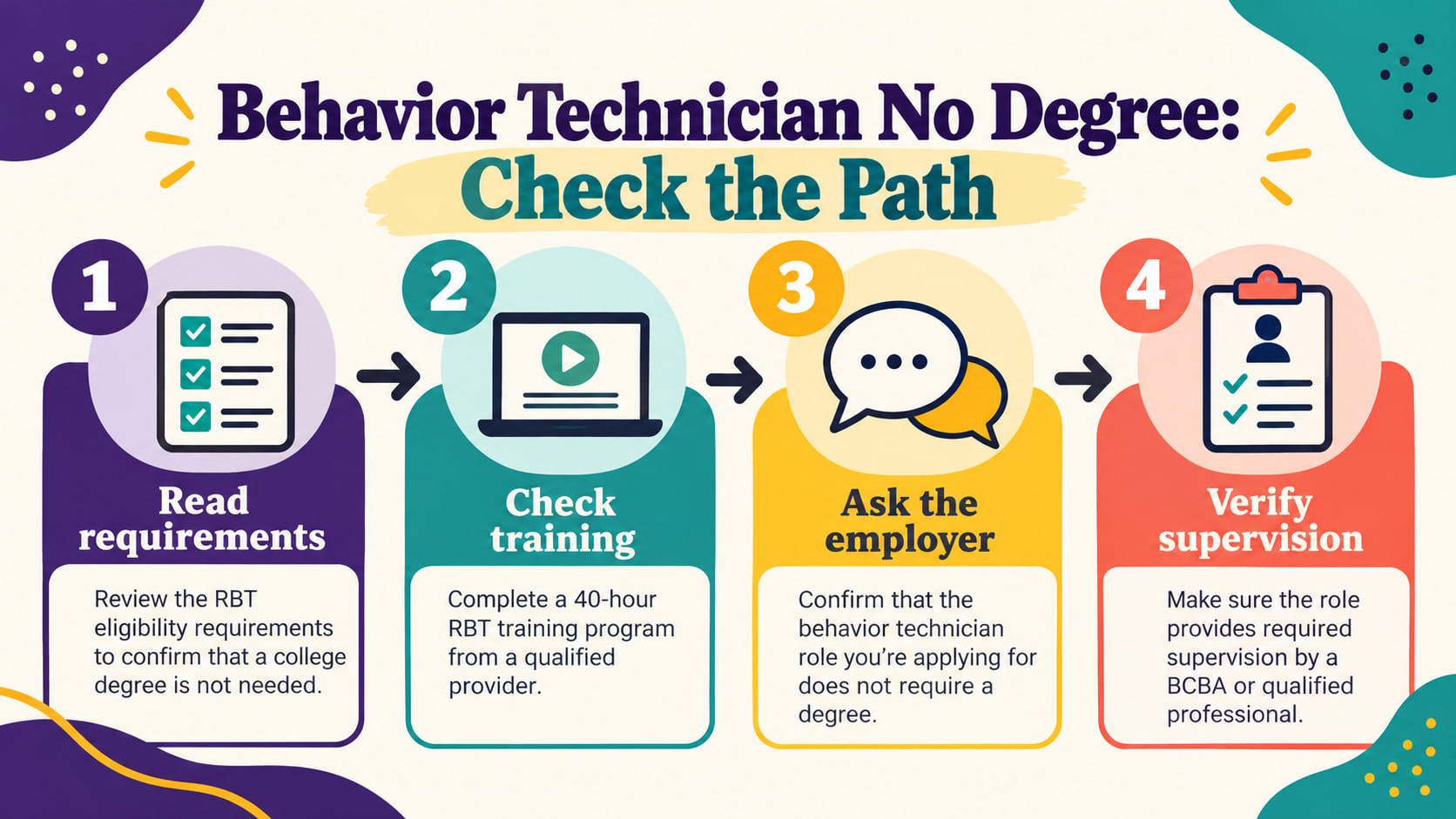
- Read requirements: Save the current posting and identify education, age, screening, schedule, and experience requirements.
- Check training: Ask which training is required, who provides it, and whether it is paid, supervised, or recognized for a particular process.
- Ask the employer: Clarify duties, materials, data systems, safety training, and who answers role questions.
- Verify supervision: Confirm who supervises the work and what happens when the plan or a safety issue is unclear.
Do not assume that “no degree required” means “no requirements.” A role may still require a background check, reliable transportation, physical or schedule commitments, training, competency review, supervision, confidentiality, and accurate documentation.
Understand the training route
Training may include orientation, ethics and privacy, safety, behavior-analytic concepts, skill teaching, data collection, role-play, observation, competency evaluation, and ongoing supervision. The sequence and provider matter. Ask whether the training is for a job, for an RBT pathway, for a specific setting, or for general education.
A certificate of attendance is not automatically a professional credential. A course can teach useful concepts without satisfying every current requirement for a credential or employer role. Check the issuing organization, date, required hours or content, assessment, and what the document is actually intended to prove.
Use training to build observable skills. A learner should be able to explain an approved instruction, practice it safely, collect the specified data, protect privacy, and ask for help when the situation does not match the example. Training should not encourage independent plan changes or claims that exceed the learner’s role.
Ask the employer specific questions
Before accepting an opportunity, ask questions that reveal the real workflow. Examples include: Is a degree required for this exact position? Is the role an RBT position or a trainee position? Who pays for required training or assessment? Who provides supervision? What happens if the assigned plan is unclear? How are privacy, incidents, cancellations, and documentation handled?
Ask how the employer evaluates readiness. A good answer names observation, feedback, competency checks, and supervision rather than promising that a short orientation makes someone independent. Ask what duties are prohibited before training is complete and how a new employee can escalate a concern.
Keep a written record of the answer and check whether it matches the offer and current policy. If a recruiter says one thing and the written role says another, pause and ask for clarification through an official contact.
Verify supervision and role boundaries

Supervision is part of safe implementation, not merely a name on an organizational chart. Confirm how often you can ask questions, how observations and feedback occur, where records are kept, and who is authorized to change a plan. A technician should know what to do when a client’s response, a caregiver request, or a safety event falls outside the written procedure.
Keep the role boundary visible. A technician may implement assigned steps, collect objective data, communicate observations, and protect confidentiality. The technician should not diagnose, select goals, redesign a treatment plan, promise outcomes, or represent an unearned credential as current.
If the position asks you to work without adequate training or direction, ask the employer how the issue will be corrected. Do not accept an unsafe shortcut just because the title sounds entry-level.
Keep documents and claims accurate
Use your legal name and accurate dates on applications, training records, and credential forms. Keep copies in an approved secure location and avoid uploading personal documents to an unverified site. A resume should distinguish education, training, supervised experience, and active credentials.
Do not write “certified” because you completed an orientation, received an offer, created a portal account, or passed an internal check. Use the status shown by the official verification process and follow the current rules for representing credentials.
Common scenarios
- No degree in the posting: Ask whether the role is a technician job, trainee role, or RBT pathway and request the complete written requirements.
- Course advertisement: Check what the course certifies and whether it is recognized for the specific employer or official process.
- Immediate independent work: Ask who provides supervision and what support exists before performing unfamiliar procedures.
- Credential language: Do not claim an RBT credential until the official status is current and verified.
Frequently asked questions
Can someone become a behavior technician without a degree?
Some employers may have roles that do not require a college degree, while others may require one. Verify the exact role and separate employer requirements from current RBT certification requirements.
Does no degree mean no training is needed?
No. Training, safety, privacy, competency, supervision, and employer requirements may still apply.
Does a technician job automatically lead to RBT certification?
No. Employment and certification are separate questions. Follow the current official pathway and verify each requirement.
What should I do if the job expects work I was not trained to perform?
Pause the unfamiliar task when safe to do so, ask the supervisor for direction, and follow the organization’s training and escalation process. Do not claim competence you do not have.
Source note: Review the current BACB RBT Handbook, official application instructions, employer policy, and supervision requirements. This article is educational and does not provide individualized legal, clinical, employment, or credentialing advice.
Ready to practice the RBT concepts you just reviewed?
Try an independent, original RBT practice resource with exam-style questions, scoring, and answer explanations.
References
- Behavior Analyst Certification Board. RBT Test Content Outline, 3rd edition.
- Behavior Analyst Certification Board. RBT Handbook.
- Behavior Analyst Certification Board. RBT Ethics Code.