
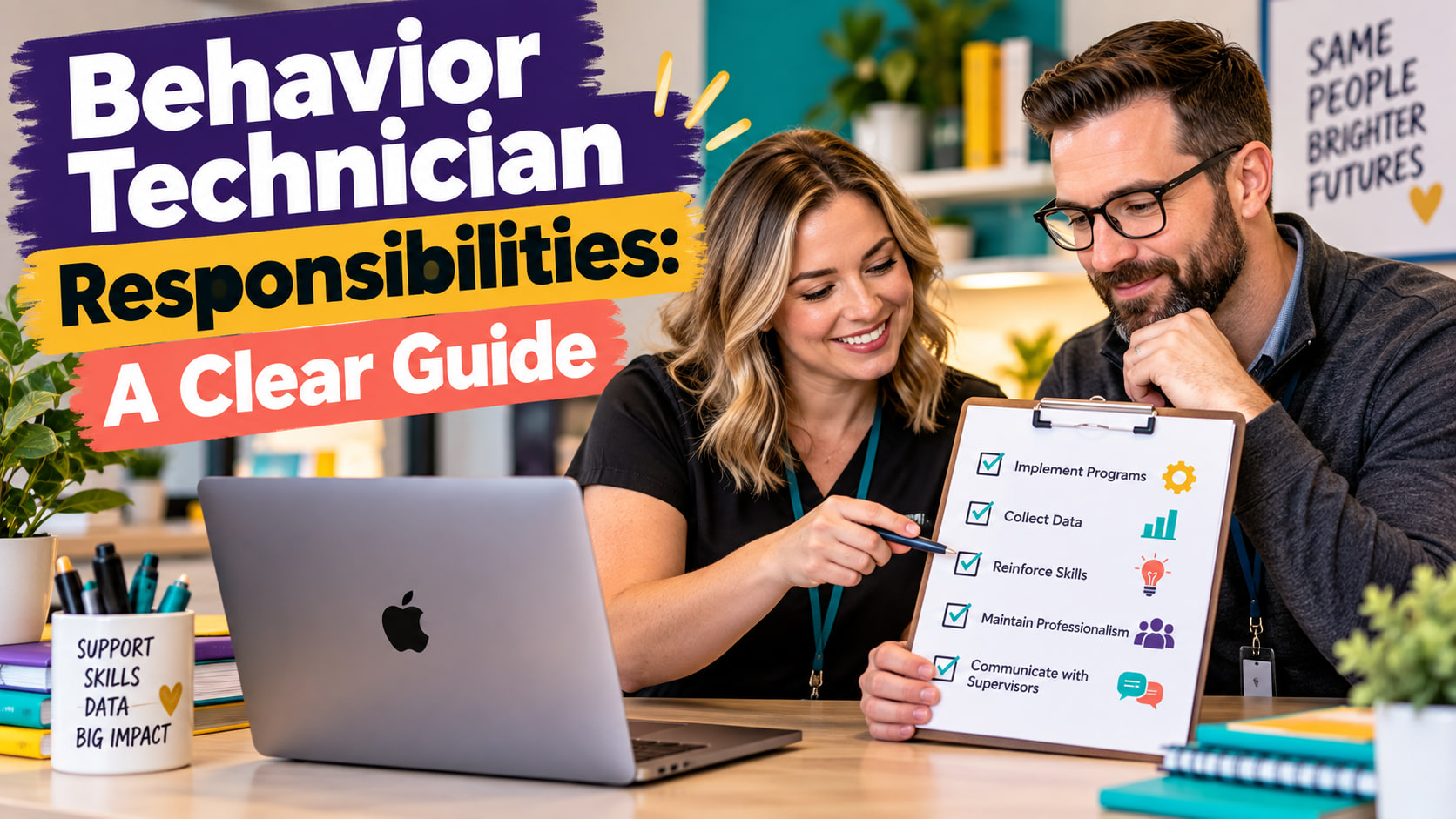
Behavior technician responsibilities include implementing assigned procedures, observing objectively, recording data, communicating with the team, protecting privacy, and asking for supervision.
Table of Contents
- Behavior technician responsibilities: what the role includes
- The daily responsibility cycle
- Implement assigned procedures
- Observe and record objectively
- Communicate and protect privacy
- Keep the role boundary clear
- Common examples
- Frequently asked questions
- References
RBT CAREER · ROLE CLARITY
Behavior Technician Responsibilities: A Clear Guide
Implement, observe, record, communicate, protect privacy, and seek supervision.
Behavior technician responsibilities include implementing assigned procedures, observing objectively, recording data, communicating with the team, protecting privacy, and asking for supervision. The exact duties vary by employer, setting, learner, plan, and credential or job requirements, so a title alone cannot answer every role question.
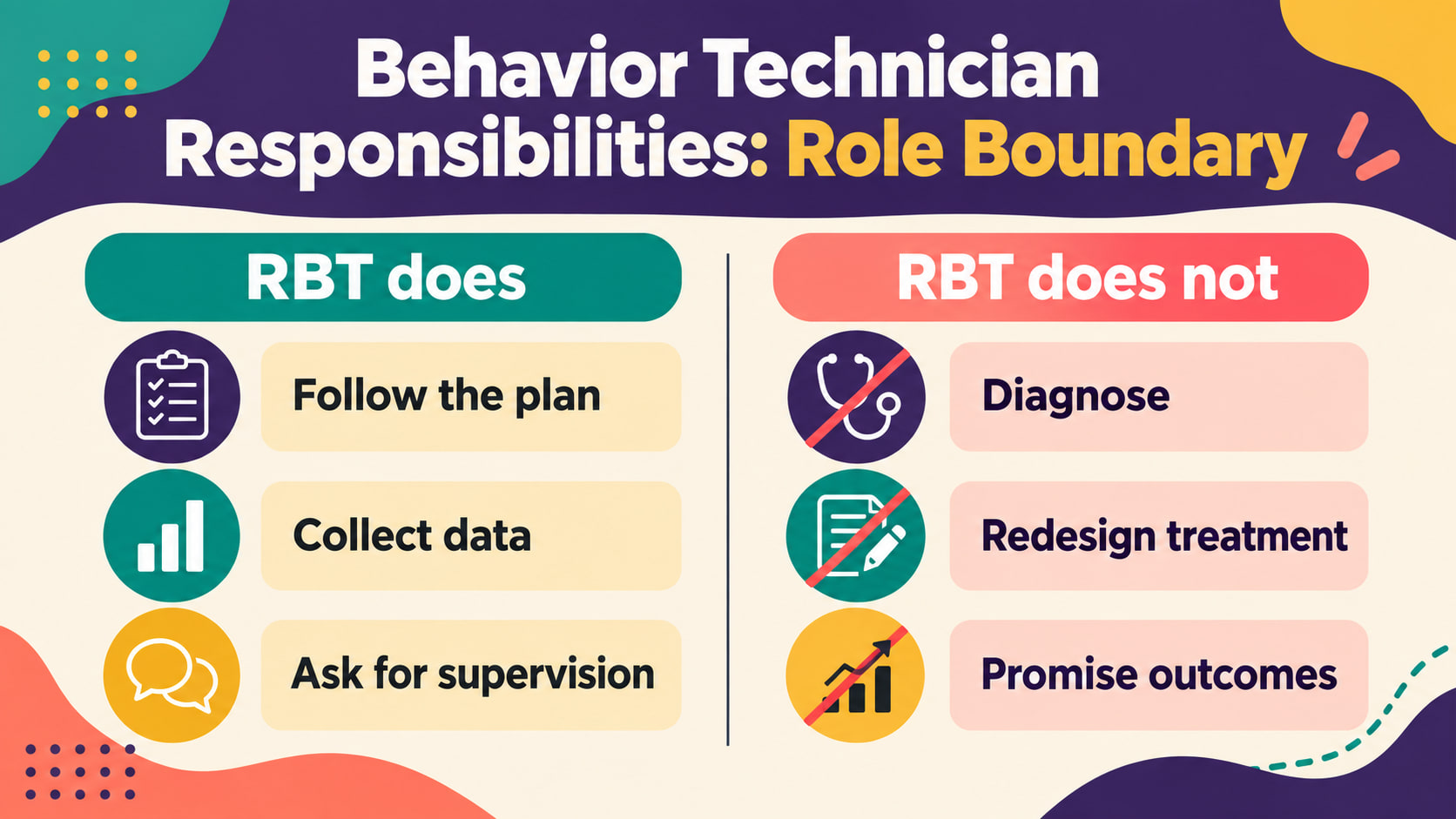
This guide explains common responsibilities without replacing the current BACB handbook, task list, ethics code, employer policy, supervisor direction, or safety process. A technician supports the approved plan; the technician does not independently diagnose, redesign treatment, change goals, or promise outcomes.
Behavior technician responsibilities: what the role includes
A technician’s work connects direct implementation with careful communication. The technician may prepare materials, follow teaching or behavior-support procedures, support communication and participation, collect data, maintain records, and report observations. The work is active, but it is not independent clinical decision-making.
Responsibilities also include knowing when to pause. If the written plan is unclear, a safety event occurs, a caregiver asks for a change, or a learner’s response does not match the procedure, ask the supervisor or designated support contact. Quietly improvising can create inconsistent care and inaccurate data.
Read the current job description and assigned plan. Do not assume that another technician’s duties, a training example, or a social-media post applies to your role.
The daily responsibility cycle
A useful cycle keeps the work visible:
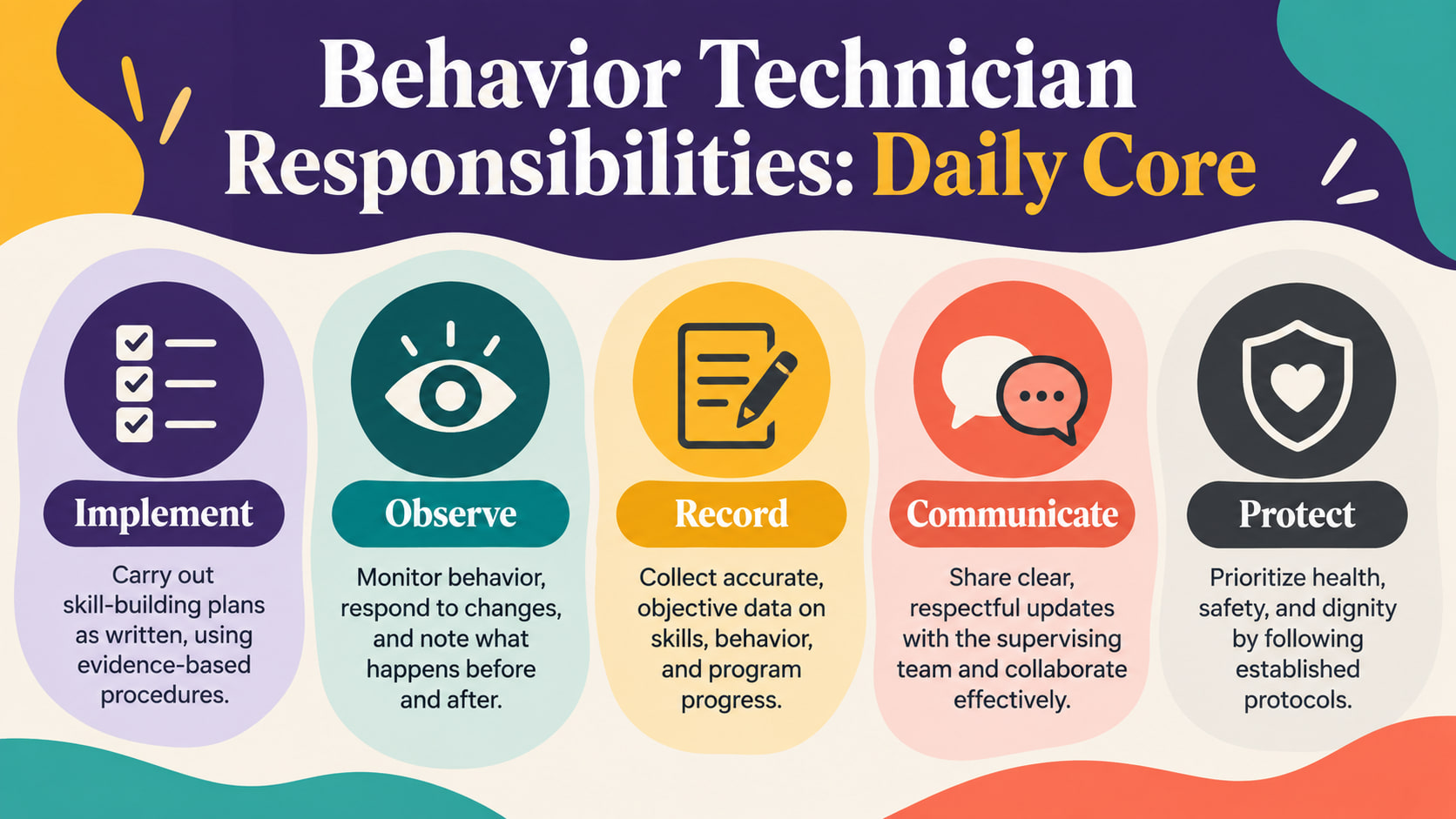
- Implement: Follow current instructions, prompts, reinforcement, communication, and safety procedures.
- Observe: Notice the defined response, context, prompt level, consequence, and relevant changes.
- Record: Complete required data and notes accurately through the approved system.
- Communicate: Share objective facts and questions with authorized team members.
- Protect: Maintain privacy, dignity, safety, boundaries, and secure records.
The cycle repeats across sessions. A technician should be able to explain what the target is, what to do when the response occurs, what to record, and who can answer a question.
Implement assigned procedures
Implementation begins with the current plan. Review target definitions, materials, prompting, reinforcement, data fields, and safety instructions. Use the defined language and timing. If a material is missing or the environment changes, follow the approved contingency and ask before substituting a procedure.
Implementing does not mean following instructions without observation. Watch how the learner responds, protect communication and dignity, and report when the procedure is difficult to apply or appears inconsistent with the situation. Feedback is part of quality implementation.
Do not add a new goal, change a mastery criterion, remove reinforcement, or introduce a consequence because it seems efficient. Bring the observation to supervision and record the direction.
Observe and record objectively
Use the operational definition and approved measurement method. “The learner placed the item in the bin after a model prompt” is an observable note. “The learner was unmotivated” is an interpretation unless the plan defines how that information is measured.
Record independent and prompted responses as the system requires. Include context, response, prompt level, consequence, duration, frequency, or other fields specified by the program. Do not fill gaps from memory or copy one person’s record into another.
One session does not prove mastery, treatment effectiveness, or a function. Share patterns through supervision and let the authorized team interpret trends and decide whether a plan change is needed.
Communicate and protect privacy
Communicate the minimum necessary information through the approved channel. Use neutral language and separate what you saw from what you think it means. “The break card was used after the visual cue” is different from “the learner wanted to escape.”
Protect names, schedules, diagnoses, photographs, data, messages, and conversations. Lock screens, secure paper, use approved systems, and do not place client details in personal chats or public posts. If information is sent to the wrong person or exposed, follow the incident process promptly.
Team communication includes asking focused questions. Identify the exact step that is unclear, the context, what you observed, and what help you need. Do not turn a professional handoff into a casual story about a client.
Keep the role boundary clear
The role can be summarized as “implement and communicate.” A technician may carry out assigned procedures, collect data, protect privacy, and report observations. The technician does not diagnose, independently choose goals, redesign treatment, supervise another person without authorization, or guarantee a client outcome.
Training and a job title do not automatically prove current certification or competence. Represent education, training, experience, and credentials accurately. Follow the current official verification process for credential claims.
When a request crosses the boundary, respond respectfully: “I need to check the current plan and ask my supervisor before I agree.” This protects the learner, the family, the team, and the technician.
Responsibility also includes preparation and follow-through. Arrive with the required materials, review relevant instructions, complete the assigned record, and report barriers that could affect the next session. If a room change, staffing change, technology problem, or schedule disruption affects implementation, describe the change rather than pretending the session happened exactly as planned.
Professional responsibility is not the same as doing everything alone. Asking for help early is a strength because it protects accuracy and safety. A supervisor can clarify a definition, review a pattern, identify an approved alternative, or direct an escalation. The technician’s responsibility is to make the question visible and follow the resulting direction.
Common examples
- Plan question: The instruction is unclear, so the technician pauses, preserves the facts, and asks the supervisor.
- Data question: A response occurs after a prompt, so the technician records the prompt level instead of calling it independent.
- Privacy question: A friend asks about a named client, so the technician does not confirm or deny service and uses the approved route.
- Scope question: A caregiver asks for a new goal, so the technician listens and communicates the request without promising a plan change.
Frequently asked questions
Are behavior technician responsibilities the same at every employer?
No. Duties, setting, supervision, training, and documentation vary. Read the exact role and current policy.
Can a technician change a plan when it is not working?
No. Record objective observations and ask the authorized supervisor or team to review the plan.
Is data collection part of the job?
Often, yes, when the assigned plan and employer process require it. Use the current definitions and approved system.
What is the most important boundary?
Implement the approved role, protect the person’s privacy and dignity, and ask before making a decision outside your authority.
Source note: Review the current BACB RBT Handbook, task list, ethics code, employer policy, and supervisor guidance. This article is educational and does not provide individualized legal, clinical, employment, or credentialing advice.
Ready to practice the RBT concepts you just reviewed?
Try an independent, original RBT practice resource with exam-style questions, scoring, and answer explanations.
References
- Behavior Analyst Certification Board. RBT Test Content Outline, 3rd edition.
- Behavior Analyst Certification Board. RBT Handbook.
- Behavior Analyst Certification Board. RBT Ethics Code.