

Behavior technician skills are observable actions that help an RBT implement services accurately, collect useful data, communicate clearly, and protect the learner’s dignity. A strong study plan turns broad words such as “professional” or “caring” into behaviors that can be practiced and reviewed.
Table of Contents
- How to organize behavior technician skills
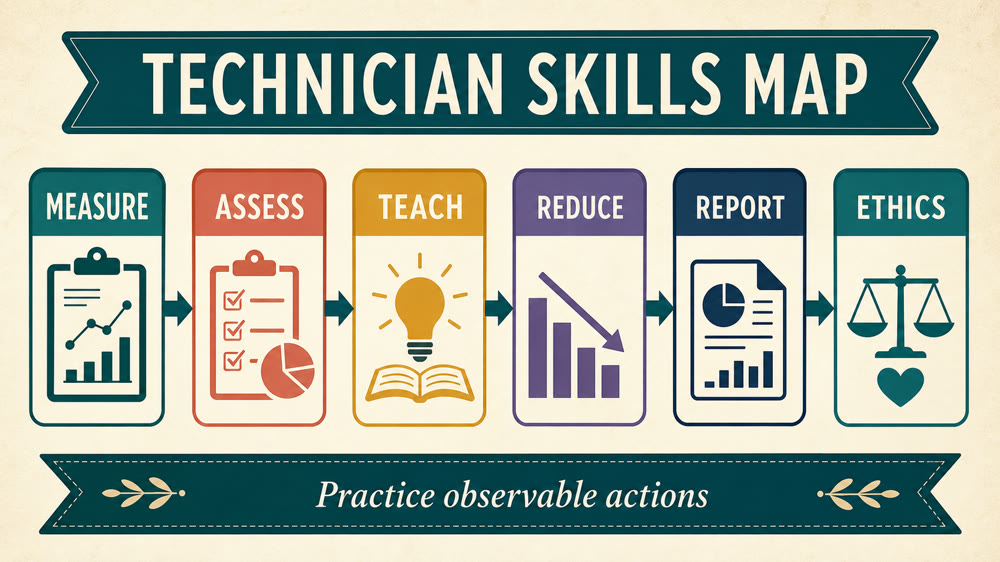
- Measurement and data-collection skills
- Assessment-support skills
- Teaching and skill-acquisition skills
- Behavior-reduction and safety skills
- Documentation and communication skills
- Ethics, privacy, and professional boundaries
- How to practice each skill
- Connection to the current RBT outline
- Rehearse skills under realistic conditions
- Behavior technician skills checklist
- Frequently Asked Questions
- References
Quick answer: Core skills include following written procedures, defining and measuring behavior, supporting assessment and teaching, implementing behavior-reduction plans safely, documenting objectively, communicating concerns, protecting privacy, and working within supervision and competence.
Study boundary: This independent guide uses original examples and does not reproduce official, recalled, leaked, or BACB-endorsed questions. It cannot guarantee certification, a passing result, or permission to work outside the RBT role.
Continue your review with RBT practice questions that reinforce measurement, prompting, supervision, and ethics.
How to organize behavior technician skills
Organize skills by what the technician must do before, during, and after a service interaction. Before the session, review the written plan, materials, target definitions, and safety directions. During the session, deliver the trained antecedent, prompt, reinforcement, or reduction procedure and collect the specified data. Afterward, document what occurred and communicate relevant issues.
This sequence is more useful than memorizing a long list without context. When reviewing behavior technician skills questions, ask which action is observable, which instruction governs it, and which decision belongs to the supervising professional.
Measurement and data-collection skills
An RBT needs to recognize the operational definition and use the measurement system selected in the plan. Depending on the procedure, that may involve frequency, duration, latency, interval recording, permanent product, or another defined system. The important skill is matching the data method to the target and recording it consistently.
- Read the operational definition before scoring.
- Use the stated start and stop rules.
- Distinguish independent, prompted, incorrect, and no-response outcomes when required.
- Record missing information or timing problems honestly.
- Ask for clarification instead of silently changing the scoring rule.
Assessment-support skills
RBTs may support assigned assessment activities by preparing materials, recording observations, implementing directions, or reporting relevant context. The skill is careful observation and faithful documentation. An RBT should not convert a brief observation into a diagnosis or independently decide what a result means for treatment.
For an original example, a technician observes that a learner leaves a work area after a particular instruction. The technician can record the instruction, the observable response, and the setting event as directed. The technician should not announce a function or rewrite the plan without supervision.
Teaching and skill-acquisition skills
Teaching skills include presenting an opportunity, using prompts as written, delivering the programmed consequence, and recording the learner’s response. Practice the timing of each step. If the procedure specifies prompt fading, follow that sequence instead of giving more help than needed or withholding assistance to “test” the learner.
Generalization and maintenance also require fidelity. Use the materials, people, settings, and examples specified in the plan. Report when a skill appears in a new setting, but do not independently change mastery criteria.
Behavior-reduction and safety skills
Behavior-reduction skills begin with knowing the written procedure and safety plan. Implement the trained response calmly, protect the learner and others, and contact the responsible supervisor when a situation exceeds your training. Do not improvise punishment, add restrictions, or treat a safety concern as a test of personal confidence.
Document the observable event and the action taken. A note such as “the learner threw the cup once after the transition instruction; the trained safety response was implemented” is more useful than a label such as “the learner was out of control.”
Documentation and communication skills
Good documentation is timely, objective, and connected to the service. Include the target, procedure, response, relevant variables, and follow-up action required by the workplace process. Communication should use an approved channel and share only the information necessary for the recipient’s role.
If you make an error, report it. Hiding a missed trial or changing a note after the fact undermines data quality and supervision. A technician who communicates clearly gives the team a chance to correct training and protect the learner.
Ethics, privacy, and professional boundaries
Ethical behavior technician skills include respecting dignity, maintaining confidentiality, accepting supervision, avoiding conflicts of interest, and staying within competence. A technician can be warm and supportive while still following the written plan and professional boundary rules. Do not share client stories on personal social media or make promises about progress.
How to practice each skill
- Name the skill in observable terms.
- Write the condition and materials needed.
- Rehearse the response with a qualified trainer or supervisor.
- Use feedback to correct one step at a time.
- Record the data or documentation rule.
- Repeat in a new example only when the procedure allows it.
Connection to the current RBT outline
The current RBT Test Content Outline, 3rd edition, contains 43 tasks across six domains. The current examination includes 75 scored questions and 10 unscored pilot questions. Use the outline to organize the skill map, but remember that an independent article or practice item does not reproduce secure examination content.
Rehearse skills under realistic conditions
A skill becomes easier to use when practice includes the small details that appear in a real service setting. Set up the materials, read the written instruction, define the response before the activity begins, and prepare the data sheet or digital form you would actually use. Then rehearse the interaction at a normal pace. Include a brief pause for the learner to respond, follow the planned prompt procedure, deliver the programmed consequence, and record the result. If you skip setup and documentation during practice, those omissions can remain hidden until the session is busy.
Ask a supervisor or trusted trained colleague to observe one narrow skill at a time. Useful feedback is behavior-specific: the instruction was too vague, the response definition included an inference, the prompt was delivered before the planned delay, or the data entry did not match the event. Write the feedback as an action for the next rehearsal. For example, prepare the definition before presenting the instruction, or use a timer to practice the response interval. Avoid turning a feedback note into a judgment about your personality or general ability.
Track independence across repeated rehearsals. A good practice record can include setup completed, instruction delivered as written, prompt level, response recorded, and question raised for supervision. When a skill is stable in a quiet practice setting, test it with a mild distraction or a new example while keeping the procedure unchanged. Report any uncertainty before changing the plan. This approach develops dependable technician behavior while preserving respect for the learner and the limits of the role.
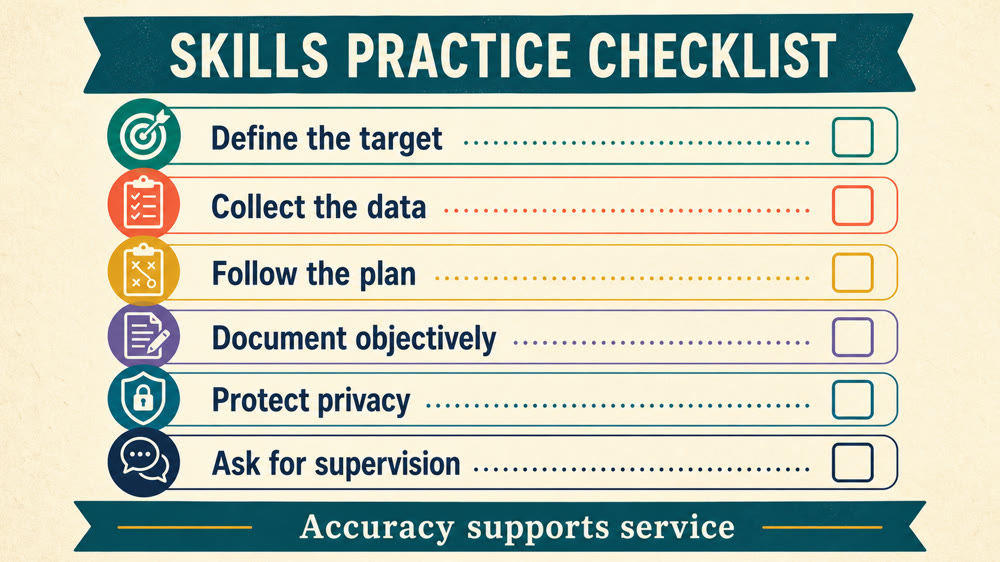
Behavior technician skills checklist
- Define target behavior in observable terms.
- Collect data using the instructed measurement system.
- Implement teaching procedures with accurate timing.
- Follow behavior-reduction and safety procedures as trained.
- Document sessions without unsupported conclusions.
- Communicate errors and concerns through approved channels.
- Protect privacy and maintain professional boundaries.
- Ask for supervision before changing a plan.
Practice observable skills
Use original RBT-style scenarios to connect each skill to a procedure, data rule, and supervision boundary.
Try the RBT practice resource →
Frequently Asked Questions
What are important behavior technician skills?
Important skills include measurement, data collection, assessment support, teaching, behavior reduction, documentation, communication, ethics, privacy, and supervised practice.
How can I practice these skills?
Use observable scenarios, rehearse the written procedure with qualified feedback, record the data rule, and ask for direction when the task exceeds training.
Can an RBT change a procedure after observing a problem?
Document the observation and contact the responsible supervisor. Do not independently change the plan, target, or consequence.
Are these official exam answers?
No. The examples are independent and original, not official, recalled, leaked, or BACB-endorsed questions.
References
- Behavior Analyst Certification Board: Registered Behavior Technician Handbook, updated June 2026.
- Behavior Analyst Certification Board: RBT Test Content Outline (3rd ed.).
- Behavior Analyst Certification Board: RBT resources.
- RBT Training: independent RBT practice questions.