
Behavior technicians are frontline members of a behavior-analytic service team who carry out authorized procedures, observe and measure behavior, communicate with supervisors, and support a learner or client during planned routines. The exact job title, setting, population, and employer duties can vary. A behavior technician may be an RBT, may be working toward RBT certification, or may use a different employer-defined title.
Table of Contents
- Behavior technicians: what the role means in practice
- Behavior technicians versus the RBT credential
- What behavior technicians may do during a supervised session
- Behavior technicians and the six current RBT domains
- Behavior technicians: supervision and role boundaries
- Data, notes, and communication make the work visible
- Skills that help behavior technicians do the job well
- Original behavior-technician scenarios
- Frequently Asked Questions
- References
An RBT is different from a generic job title: it is a BACB credential with specific eligibility, assessment, examination, supervision, and renewal requirements. The BACB describes RBT certification as a paraprofessional certification and says RBTs assist in delivering behavior-analytic services under the direction and close supervision of an RBT Supervisor and/or RBT Requirements Coordinator.
The current RBT Test Content Outline, 3rd edition, describes 43 tasks across six domains. The current exam frame includes 75 scored questions and 10 unscored pilot questions among 85 presented questions. This article is independent study content, not an official BACB job description, recalled exam item, leaked question, endorsed guide, or promise of employment or certification. No article, course, or study guide can guarantee certification or employment.
Behavior technicians: what the role means in practice
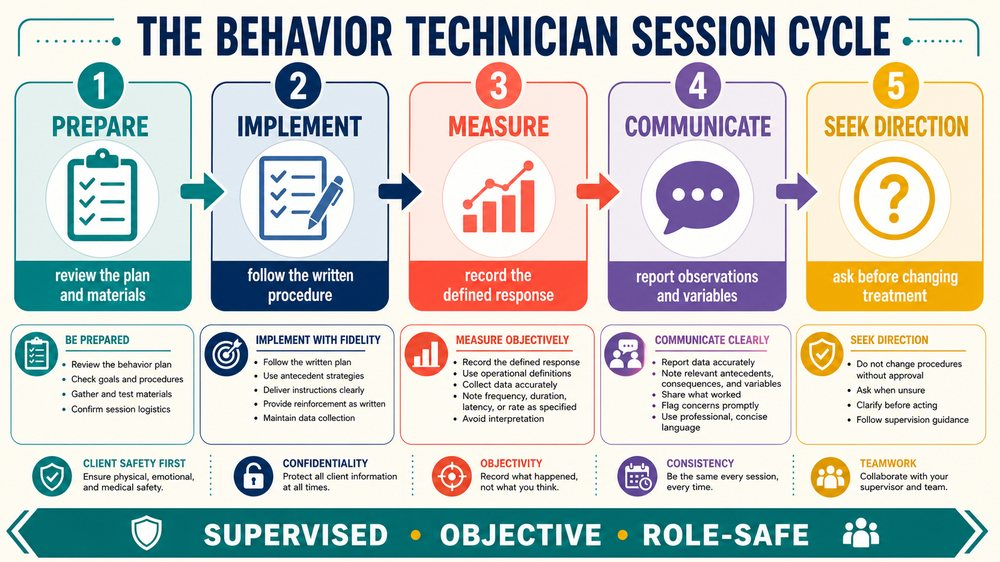
A behavior technician provides direct implementation within an authorized service plan. Typical activities may include preparing materials, arranging teaching opportunities, delivering instructions or cues, using programmed prompts and reinforcement, supporting communication, collecting data, writing objective session information, and reporting questions or changes to a supervisor.
The role is not defined by a single room or diagnosis. Behavior technicians may work in homes, clinics, schools, community settings, or other approved service environments. They may support communication, daily living, learning, safety, social participation, or reduction of a defined behavior. The plan, the supervisor’s direction, client rights, and applicable workplace requirements control what the technician actually does.
| Work element | Observable technician action | Quality check |
|---|---|---|
| Prepare | Review the target, materials, procedure, safety directions, and data fields. | Can the technician state what response counts? |
| Implement | Follow the written sequence, prompts, reinforcement, correction, and transition steps. | Is the procedure delivered consistently? |
| Measure | Record the defined response with the correct unit and scoring rule. | Could another person understand the data? |
| Communicate | Report observations, barriers, concerns, and variables affecting progress. | Is the report objective and timely? |
| Seek direction | Ask the supervisor when a plan is unclear or a decision exceeds the role. | Was uncertainty escalated instead of guessed? |
Behavior technicians versus the RBT credential
The phrase behavior technician is often used as a job title. RBT is a credential issued by the BACB to people who meet the applicable requirements and pass the certification examination. A job posting may use “behavior technician,” “behavior therapist,” “ABA technician,” or another local title; the title alone does not prove that the person holds the RBT credential.
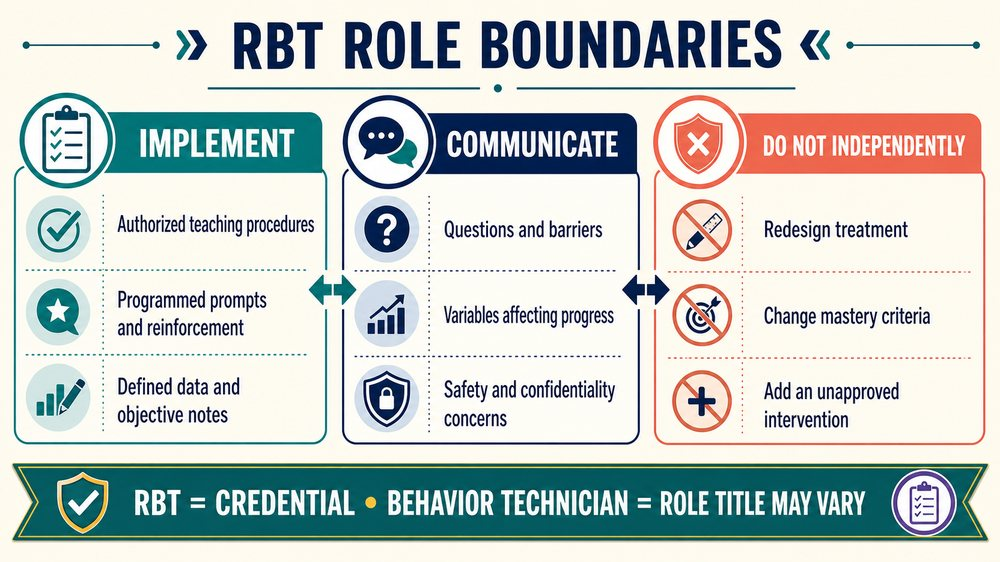
The reverse is also important: an RBT remains a behavior technician in the service-delivery role. The credential does not turn the RBT into a BCBA or authorize independent assessment, treatment design, supervision, or clinical decision-making. Employers, funders, state rules, and service contracts can add requirements, so candidates should verify the role they are applying for rather than infer it from a title.
| Question | Careful answer |
|---|---|
| Is every behavior technician an RBT? | No. The job title may be used for people with different training or credentials. |
| Is every RBT a behavior technician? | RBT certification is built around the supervised behavior-technician role. |
| Does RBT mean independent clinician? | No. RBT services are provided under the required supervision structure. |
| Do duties look identical everywhere? | No. The authorized plan, employer, setting, applicable law, and supervision structure matter. |
What behavior technicians may do during a supervised session
A session is more than presenting worksheets. A technician may begin by checking the current program, confirming materials, reviewing safety and communication procedures, and identifying the data system. During the session, the technician creates the opportunities described in the plan, responds according to the programmed consequence, records the response, and watches for barriers or changes that need to be communicated.
For example: a plan teaches a learner to request help during a classroom routine. The technician prepares the listed materials, arranges the authorized opportunity, follows the prompt and fading sequence, delivers the programmed consequence for the defined request, and records whether the response was independent or prompted. If the request definition is unclear, the technician asks for direction rather than inventing a new response.
- Review the plan and target definition.
- Prepare the environment and materials.
- Deliver the teaching or behavior-reduction procedure as written.
- Collect data with the specified measurement system.
- Document what occurred objectively.
- Communicate questions, barriers, safety concerns, or unusual variables.
Behavior technicians and the six current RBT domains
The current TCO is a useful skill map for studying the role. It does not mean every job uses every task in every session. It shows the broad knowledge and skills an entry-level behavior technician should be able to recognize or perform at the RBT examination level.
| Domain | What to connect to the role | Example study question |
|---|---|---|
| A. Data Collection and Graphing | Measurement, data entry, calculations, graphs, trends, reliability, and procedural fidelity. | What unit and scoring rule does the plan specify? |
| B. Behavior Assessment | Preference assessments, skill-strength/deficit assessment participation, and functional-assessment components. | What assessment activity is authorized? |
| C. Behavior Acquisition | Reinforcement, teaching procedures, prompts/fading, chaining, discrimination, generalization, maintenance, shaping, and token economies. | What step should the technician implement next? |
| D. Behavior Reduction | Functions, antecedent interventions, differential reinforcement, extinction, punishment procedures, secondary effects, and crisis protocols. | What does the written plan say to do safely? |
| E. Documentation and Reporting | Timely communication, clinical direction, variables affecting progress, and objective session communication. | What needs to be reported and to whom? |
| F. Ethics | Competence, supervision, confidentiality, public statements, relationships, gifts, interpersonal skills, and cultural humility. | Which action protects rights and professional integrity? |
Use the six domains to turn a generic job description into observable study behaviors. “Good with children” is not a task. “Records duration according to the written definition and reports an interruption” is observable and tied to data collection.
Behavior technicians: supervision and role boundaries
A behavior technician can notice patterns, share observations, and ask thoughtful questions. That does not mean the technician independently changes the treatment plan. The responsible supervisor or clinical team determines assessment decisions, goals, procedures, mastery criteria, risk procedures, and program changes according to the service system.
| Situation | Role-safe response | Unsafe shortcut |
|---|---|---|
| The target definition is unclear. | Pause at the decision point, request an example/nonexample, and document the clarification. | Choose a definition that makes the data easier. |
| The learner does not respond. | Follow the programmed prompt/correction and seek direction if the plan does not cover the situation. | Add a new procedure from a different program. |
| A caregiver suggests a new goal. | Listen respectfully, record the request, and route it to the supervisor. | Promise that the goal will be added. |
| A safety concern appears. | Follow the authorized safety or crisis procedure and communicate promptly. | Improvise a restrictive response. |
Supervision is not a formality. It is the structure through which training, observation, feedback, clinical direction, and accountability occur. If a technician is asked to work outside competence or without required supervision, the appropriate response is to raise the concern through the established chain of command.
Data, notes, and communication make the work visible
Because much of the service happens in a direct session, accurate documentation helps the team understand what actually occurred. A useful note separates observation from interpretation. It can state the activity, defined response, measurement, prompts, consequences, relevant variables, and communication made to the supervisor without claiming a cause that was not established.
A stronger statement is: “During six opportunities, the learner independently requested help twice and used the written prompt on four opportunities. The classroom schedule changed before the final two opportunities; this variable was reported to the supervisor.” A weaker statement is: “The learner was unmotivated because the schedule changed.” The first preserves observable information; the second presents an interpretation as fact.
- Use the operational definition and correct measurement unit.
- Record prompted, independent, incorrect, absent, or interrupted responses as the plan requires.
- Report illness, medication changes, schedule changes, unavailable materials, or unusual events that may affect progress.
- Protect confidential information in storage, communication, and public statements.
- Accept feedback and ask for training when competence is not yet demonstrated.
Skills that help behavior technicians do the job well
Useful skills are observable and trainable. Attention to detail supports reliable data. Clear communication supports timely clinical direction. Flexibility means adapting within the written plan when the setting changes, not inventing a new intervention. Patience means maintaining respectful implementation and recognizing communication or assent-related signals. Cultural humility means noticing personal assumptions and responding respectfully to the learner, family, and team.
Strong technicians also know what they do not know. They can say, “I need clarification before I continue,” describe what happened without exaggeration, and use feedback to improve fidelity. Those behaviors support both quality of care and exam readiness.
Original behavior-technician scenarios
Scenario 1—title versus credential: a job posting says “behavior technician” but does not mention RBT certification. Treat the title as an employer-defined role and verify the training, supervision, credential, and duties directly.
Scenario 2—data: a technician remembers that a response happened but did not record it using the current measurement system. The correct next step is to report the missing or uncertain data honestly and seek direction, not reconstruct a precise number from memory.
Scenario 3—independent change: a caregiver asks the technician to remove a difficult step from the plan. The technician should listen, document the concern, and route it to the supervisor rather than promise a change.
Scenario 4—confidentiality: a team member asks for a client video to be sent through a personal messaging account. The technician should follow approved privacy and communication procedures and seek direction if the request is not authorized.
These are newly written independent study examples, not official, recalled, leaked, or BACB-endorsed questions.
Bottom line: behavior technicians provide direct, measurable, supervised implementation. RBT is a specific BACB credential, not a synonym for every job title. Study the current six-domain map, practice objective data and communication, respect supervision, and ask for direction before making a clinical change.
Practice the technician decisions.
Review original RBT scenarios on data, teaching, behavior reduction, documentation, ethics, and role boundaries.
Try free RBT practice questions →
Frequently Asked Questions
What do behavior technicians do?
They implement authorized behavior-analytic procedures, collect data, document sessions, communicate observations, and seek direction under the applicable supervision structure.
Are behavior technicians and RBTs the same?
Not always. Behavior technician is commonly a job title; RBT is a BACB credential with defined requirements. An RBT works in the behavior-technician role.
Do behavior technicians write treatment plans?
Technicians generally implement authorized plans and share observations. Independent assessment and treatment design are outside the role boundary unless the applicable professional structure says otherwise.
What should a behavior technician study?
Use the current RBT Test Content Outline, training materials, competency-assessment feedback, measurement, teaching, behavior reduction, documentation, and ethics practice.
Are these role examples official BACB questions?
No. They are newly written independent study examples and are not official, recalled, leaked, or BACB-endorsed questions.
References
- Behavior Analyst Certification Board. Registered Behavior Technician (RBT).
- Behavior Analyst Certification Board. RBT Handbook.
- Behavior Analyst Certification Board. RBT Test Content Outline (3rd ed.).
- BT vs RBT role comparison. Reviewed for competitor research; not an endorsement.
- Behavioral technician career guide. Reviewed for competitor research; not an endorsement.