

Behavioral technician autism spectrum personality traits job requirements should be discussed through observable skills, role duties, training, supervision, and support—not stereotypes.
Table of Contents
- Behavioral technician autism spectrum personality traits job requirements: reframe the question
- Observable skills to discuss
- Read the actual requirements
- Behavioral technician autism spectrum personality traits job requirements: ask about support and supervision
- Avoid stereotypes about autism
- Questions before applying
- Examples of respectful evaluation
- Frequently asked questions
- References
CAREER GUIDE · RESPECTFUL JOB FIT
Behavior Technician Job Fit: Skills and Requirements
Discuss observable skills, training, supervision, and support—not stereotypes.
Behavioral technician autism spectrum personality traits job requirements should be discussed through observable skills, role duties, training, supervision, and support—not stereotypes. Autistic people are not a single personality type, and no diagnosis or trait list can predict whether someone will perform a technician role successfully.
This guide reframes a sensitive job-fit question. An employer should use the actual duties and fair, relevant requirements. An applicant can ask for clear expectations, training, feedback, communication options, and reasonable workplace support. Current employer policies, applicable law, and official credential requirements control the specific decision.
Behavioral technician autism spectrum personality traits job requirements: reframe the question
Instead of asking whether someone has the “right personality,” ask what the role requires and how readiness will be evaluated. Does the technician need to follow a written plan, record objective data, communicate with a team, protect privacy, manage transitions, and seek supervision? Those are observable work behaviors that can be taught, practiced, and supported.
Some traits that people describe as strengths—attention to detail, consistency, or strong interest in systems—may help in particular tasks. They do not guarantee performance, and other people may show the same skills in different ways. A respectful process evaluates the individual’s communication, training, experience, and support needs rather than a stereotype.
Do not use a diagnosis as a shortcut for job screening. Discuss the essential duties and the process for training and accommodation. Keep health information private and request only what the applicable process permits.
Observable skills to discuss
A technician role may involve five practical skill areas:
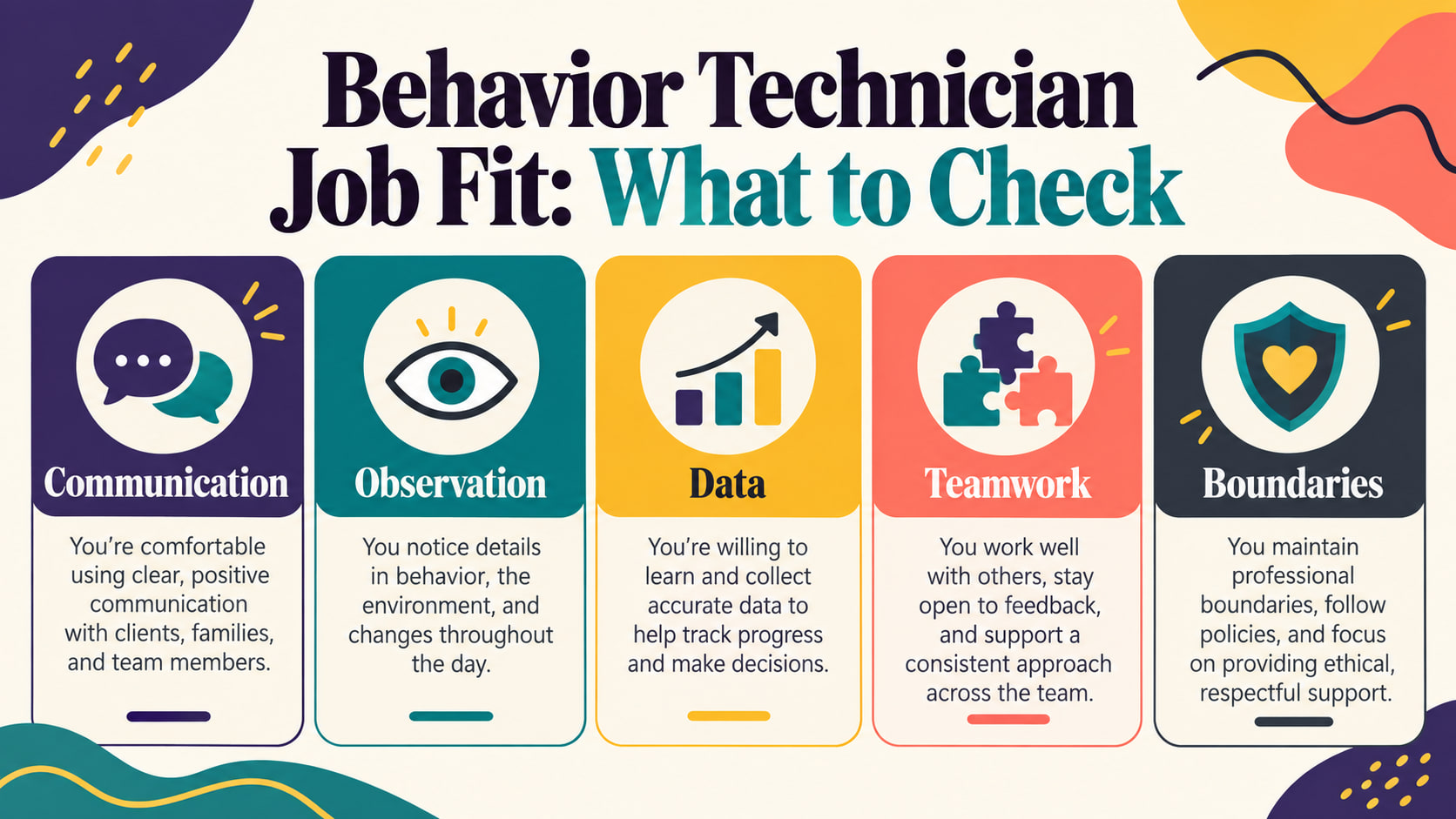
- Communication: Ask questions, share observations, use the approved communication route, and clarify uncertainty.
- Observation: Notice defined responses and context without adding guesses or labels.
- Data: Follow the measurement system, complete records, and correct errors properly.
- Teamwork: Receive feedback, coordinate handoffs, and respect the roles of supervisors and families.
- Boundaries: Protect privacy, follow the plan, and pause before acting outside the assigned role.
These skills are not personality tests. They are work expectations that should be explained, trained, observed, and reviewed. Ask how the employer teaches each skill and what support is available while learning.
Read the actual requirements
Job requirements may include education, experience, background checks, schedule, travel, physical tasks, communication, documentation, training, and supervision. Identify which requirements are essential, which can be learned, and which are preferred. Do not assume that a vague phrase such as “must be a people person” has a clear or fair meaning.
Ask for examples. What does “manage behavior” mean in this role? Who selects programs? What data are recorded? How does the technician respond when a plan is unclear? Clear answers reveal whether the job is implementation, administration, direct care, training, or a mixture.
If an RBT credential is mentioned, separate the employer’s job requirements from current BACB requirements. A job listing or training course does not establish certification, eligibility, or supervision by itself.
Behavioral technician autism spectrum personality traits job requirements: ask about support and supervision
Support can include written instructions, predictable scheduling, a quiet place for documentation, clear feedback, communication preferences, job coaching, visual organization, or another reasonable process. The right support depends on the person and workplace. Ask how requests are made and who responds.
Supervision should identify who directs the plan, who observes performance, and who handles safety or clinical questions. A technician should not be expected to diagnose, redesign treatment, or solve an unclear procedure alone. Good support protects both the learner receiving services and the employee learning the role.
Ask how the employer handles mistakes. A useful process encourages accurate reporting, correction, practice, and feedback. It should not require an employee to hide uncertainty or pretend to understand a procedure.
A strong onboarding process makes the evaluation concrete. The supervisor can demonstrate a procedure, provide written criteria, let the technician practice with feedback, and then observe performance in the real setting. This approach helps distinguish a training gap from a mismatch with an essential duty. It also gives applicants a fairer chance to show what they can do, including when their communication or sensory needs differ from a typical workplace pattern.
Applicants can also compare the job advertisement with the interview conversation. If the listing emphasizes data collection but the interview focuses mainly on personal charm, ask for a written description of the daily tasks and success measures. If the role involves home, school, or center sessions, ask how the setting changes the schedule, travel, documentation, and supervision. Specific answers make it easier to decide whether the position is a good match before accepting an offer.
Avoid stereotypes about autism
Autism does not determine empathy, reliability, flexibility, communication style, sensory needs, or ability to learn. Some autistic applicants may use direct communication, need predictable information, or request an accommodation; others may not. Evaluate the person in front of you and the actual job requirements.
Do not assume that a person who receives autism services cannot work in a behavior-support setting, and do not assume that an autistic person will automatically understand every client’s experience. Professional preparation, supervision, consent, privacy, and role training remain necessary for everyone.
Use respectful language and protect confidentiality. An applicant does not owe a public explanation of a diagnosis. An employer should not ask for personal information unrelated to the job’s lawful and relevant process.
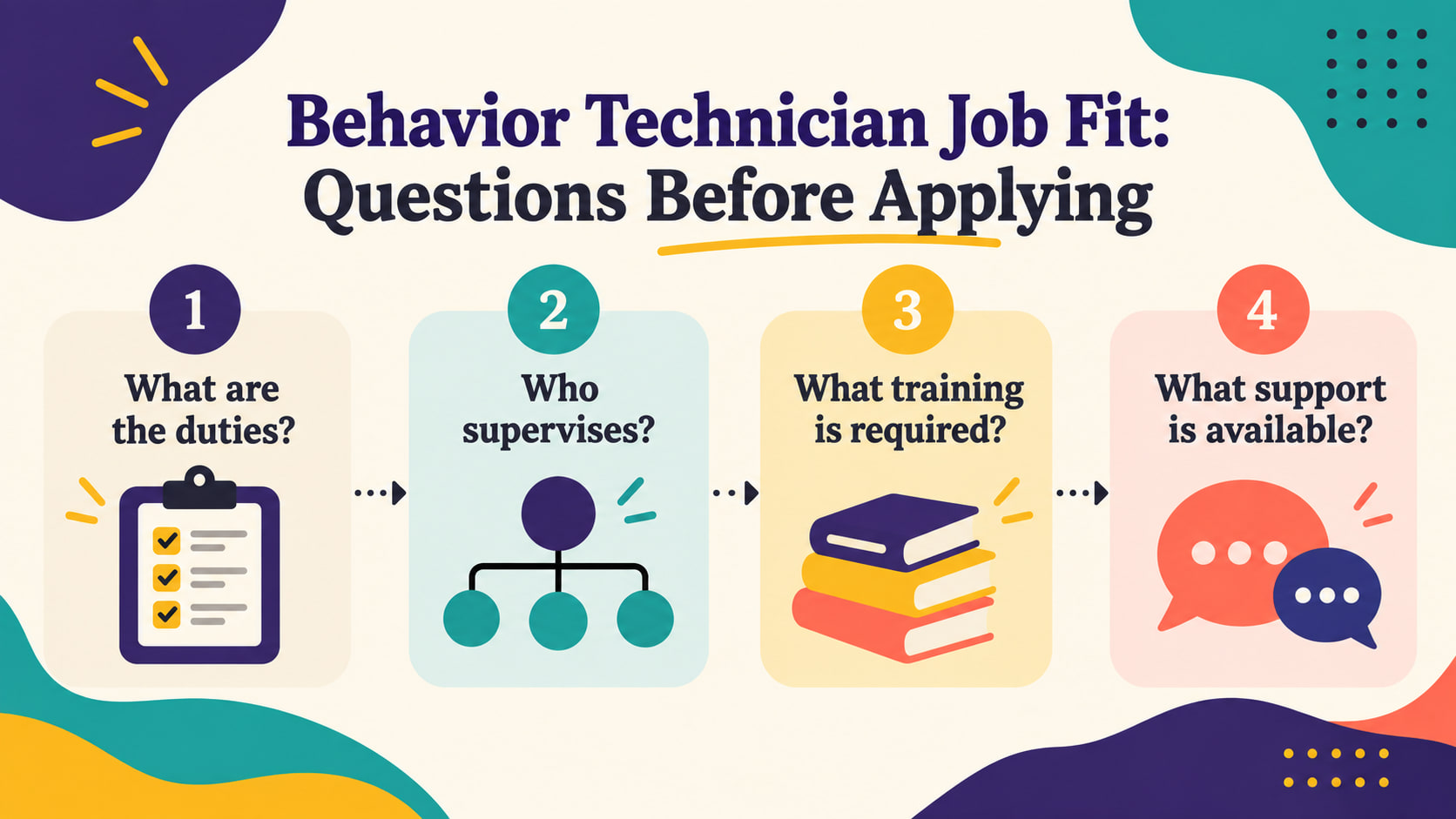
Questions before applying
- What are the essential duties and what does a typical session involve?
- Who trains and supervises the technician?
- How are data, privacy, safety, and plan questions handled?
- What skills are assessed during onboarding or competency review?
- How can an employee request a communication or workplace support?
- Which requirements apply to the exact role and which are preferred?
Examples of respectful evaluation
- Communication: Evaluate whether the applicant can use the approved handoff method, not whether they perform a particular social style.
- Flexibility: Explain how schedule changes occur and ask what supports help the employee respond safely.
- Attention to detail: Use a data-practice task with clear instructions and feedback rather than assuming a trait from a diagnosis.
- Support request: Discuss the workplace process and keep the person’s private information limited to what is necessary.
Frequently asked questions
Do autistic people have a particular personality for this job?
No. Autism is not a single personality profile. Evaluate observable job skills, training, support, and the actual role.
Behavioral technician autism spectrum personality traits job requirements: can an employer require a specific personality?
Job expectations should be relevant, clear, and connected to essential duties. Ask what the phrase means in observable terms.
Does an autism diagnosis prove or disprove job readiness?
No. Readiness depends on relevant skills, training, supervision, support, and the requirements of the specific role.
Can an autistic employee request support?
Discuss the applicable workplace process and the support needed to perform essential duties. Keep personal information private and share it only through the proper route.
Source note: Review the current BACB RBT Handbook, official application instructions, employer policy, applicable law, ethics code, and supervisor guidance. This article is educational and does not provide individualized legal, clinical, employment, or credentialing advice.
Ready to practice the RBT concepts you just reviewed?
Try an independent, original RBT practice resource with exam-style questions, scoring, and answer explanations.
References
- Behavior Analyst Certification Board. RBT Test Content Outline, 3rd edition.
- Behavior Analyst Certification Board. RBT Handbook.
- Behavior Analyst Certification Board. RBT Ethics Code.