

Good behaviour technician training should give you more than a completion badge. Before enrolling, check whether the course is built for the current RBT requirements, fits the required timing, provides usable documentation, and connects correctly to the Initial Competency Assessment.
Table of Contents
- What behaviour technician training should answer
- The current RBT training pathway
- How to check the curriculum
- How to verify the timing
- What documentation to request
- How training connects to the competency assessment
- How to compare providers responsibly
- Common course-selection mistakes
- Frequently asked questions
- References
RBT TRAINING GUIDE · COURSE SELECTION
Behaviour Technician Training: How to Check an RBT Course Before Enrolling
Use a requirement-first checklist to compare course timing, curriculum, documentation, provider independence, and the next competency step.
Good behaviour technician training should give you more than a completion badge. Before enrolling, check whether the course is built for the current RBT requirements, fits the required timing, provides usable documentation, and connects correctly to the Initial Competency Assessment. A polished sales page cannot replace that verification.
This guide is about evaluating a course before you pay. It does not recommend a provider, confirm your eligibility, or promise certification. The BACB handbook and your application instructions control the requirements that apply to your situation.
What behaviour technician training should answer
Before you compare prices or delivery formats, ask a course provider five basic questions:
- Is the course designed for the current RBT requirements and curriculum outline?
- How long does the course take, and does the schedule fit the permitted training window?
- What certificate will I receive, and what information will it contain?
- Who is responsible for the training, and does the provider meet the independence requirements?
- What must I do next to complete the Initial Competency Assessment and apply?
If a provider answers only with “you get certified after this course,” treat that as a warning sign. Training is a step in a pathway. It is not the same as an application decision, competency assessment, examination result, or active certification status.
The current RBT training pathway
The current RBT Handbook describes a sequence that includes required training, an Initial Competency Assessment, an application, and the examination. The 40-hour training must meet the BACB’s 2026 requirements and curriculum outline. After completing it, the applicant must demonstrate competency using the Initial Competency Assessment effective January 1, 2026, within the time window described in the handbook.
The handbook also explains that training may be offered by an employer, university, or online training program. The BACB does not provide 40-hour training, certificates of completion, or individual training-program recommendations. That means your responsibility is not to find a provider that claims to be “official”; it is to verify that the course evidence matches the current requirements.
The pathway can be summarized as:
- Choose a course that is designed for the current requirements.
- Complete the training within the permitted time window.
- Receive and preserve the training certificate.
- Complete the Initial Competency Assessment with an eligible assessor.
- Submit the application and supporting documents for BACB review.
- Follow the official instructions for the examination and later supervision.

How to check the curriculum
Ask for the course outline before enrolling. It should identify the current RBT content rather than relying on a generic “ABA basics” description. Look for coverage that is clearly connected to the applicable task list and ethics requirements, including measurement and data, assessment concepts, skill acquisition, behavior reduction, documentation and reporting, and professional conduct.
Check whether the course explains how learners will practice the material. Reading slides can introduce vocabulary, but a technician also needs to understand how to record behavior, follow written procedures, communicate observations, protect confidentiality, and recognize when supervisor direction is needed. The course should not encourage an RBT to diagnose, redesign treatment, or practice independently.
Ask how updates are handled. A course created for an older edition may still contain useful concepts, but the provider should explain whether the curriculum was reviewed against the requirements effective in 2026. If the outline does not show an edition, date, or responsible trainer, request clarification in writing.
How to verify the timing
The current handbook states that the required training must be completed in no less than 5 days and no more than 180 days. Use the provider’s start date, final completion date, and course schedule to check the window before you begin. A course that is advertised as “finish in one weekend” may not fit the current requirement even if the total hours add up.
Do not confuse access time with training completion. A platform might give you six months of access, while your actual training dates are recorded differently. Ask how the provider defines the start and completion dates and how those dates will appear on the certificate.
Keep evidence of the schedule, completion status, and any approved corrections. If you pause or transfer a course, ask the provider how the record will be handled. The goal is a clean application record, not just a progress bar that reached 100 percent.
What documentation to request
Before enrolling, ask to see a sample certificate with personal information removed. Confirm that the provider can issue a certificate after completion and that it identifies the course, learner, training dates, total hours, trainer or provider information, and any other fields required by the current packet. The exact document requirements can change, so compare the sample with the current BACB instructions.
Save more than the certificate. Keep the course outline, completion email, invoice or enrollment record, training dates, and any messages that explain a transfer or correction. Store them securely and use the privacy practices required by your employer or training provider.
A certificate is evidence that the training provider says you completed the course. It is not an independent BACB approval. If the application team requests clarification, follow the official process rather than assuming the provider’s marketing statement settles the question.
How training connects to the competency assessment
Training and the Initial Competency Assessment are related but separate. Training introduces the required knowledge and procedures. The assessment evaluates whether you can competently perform the tasks identified by the current assessment packet. Ask the provider which person is responsible for assessment and whether that person is eligible under the current handbook.
The assessment should not be treated as a formality that a course automatically guarantees. You may need additional practice, instruction, modeling, rehearsal, or feedback before you are ready. A responsible course can explain the next step without promising that every learner will pass on the first attempt.
Also check the timing: after training, the Initial Competency Assessment must be completed within the period allowed before you submit the application. Use the current handbook for the exact date window and coordinate it with the eligible assessor.
How to compare providers responsibly
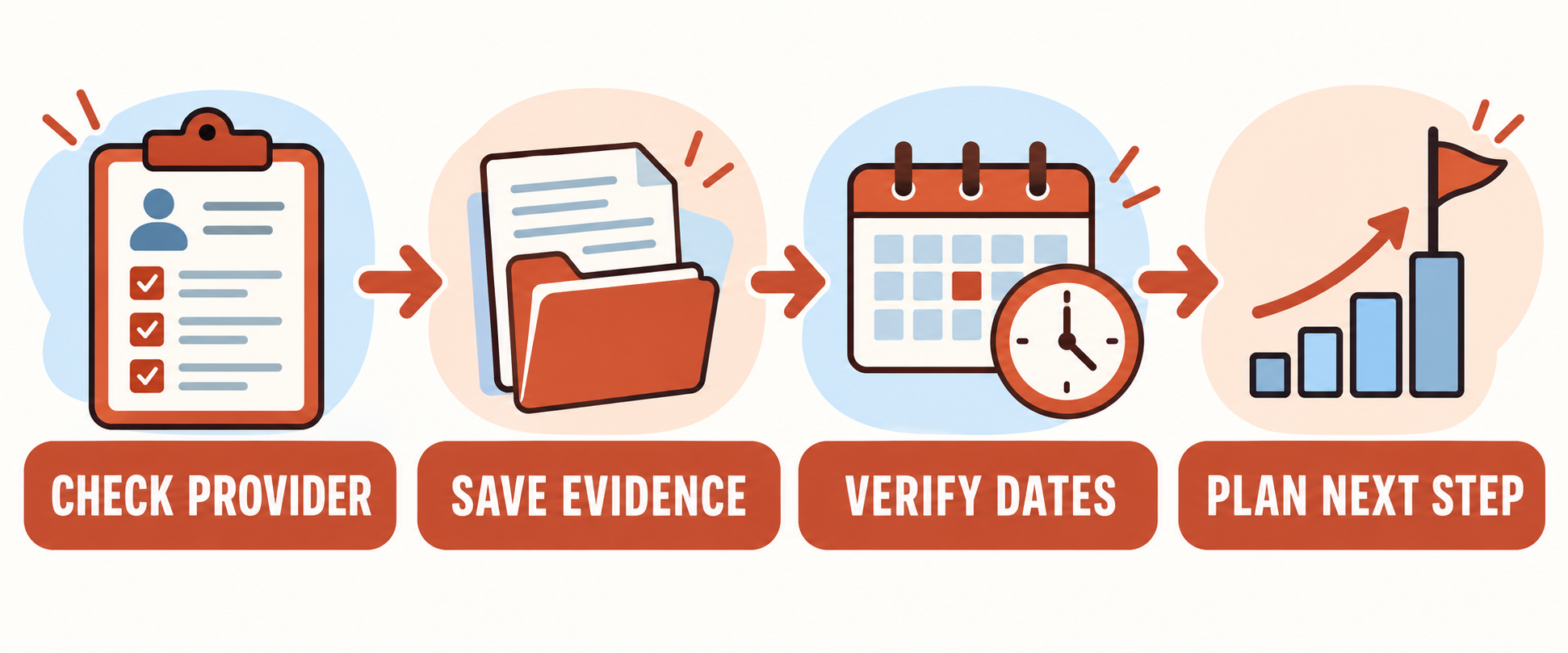
Build a simple comparison table instead of choosing by advertising language. Record:
- Format: employer, university, live online, self-paced, or another structure.
- Curriculum date: which requirements and outline the course says it follows.
- Training window: start and completion rules, including the no-less-than-5-days and no-more-than-180-days limits.
- Evidence: certificate details, course outline, and record-retention support.
- Trainer information: who teaches, how questions are answered, and whether independence restrictions are addressed.
- Next step: how the provider explains the Initial Competency Assessment without claiming to guarantee the outcome.
- Total cost: tuition plus any separate assessment, application, examination, materials, or rescheduling expenses.
Look for clear policies on refunds, identity verification, accessibility, missed sessions, technical problems, and support. These policies do not decide BACB eligibility, but they affect whether you can complete and document the course reliably.
Common course-selection mistakes
- Choosing by the word “official”: A marketing label is not a BACB recommendation.
- Ignoring the edition: Generic ABA content may not show that the course follows the current RBT requirements.
- Counting hours without checking dates: Total hours do not answer the permitted completion window.
- Assuming the certificate is enough: The pathway also includes the competency assessment, application, examination, and supervision.
- Skipping provider independence: Ask whether the trainer and assessor meet current relationship and employment restrictions.
- Believing a pass-rate promise: A course can support preparation but cannot guarantee an exam or application outcome.
Frequently asked questions
Does the BACB recommend a behaviour technician training provider?
No. The BACB states that it does not provide 40-hour training, certificates of completion, or training-program recommendations. Evaluate the course against the current requirements and keep the official handbook available.
Can I complete the training online?
The current handbook says training may be offered by an employer, university, or online training program. The delivery format does not remove the curriculum, timing, documentation, or competency requirements.
Does a training certificate make me an RBT?
No. The certificate documents training completion. You still need to follow the application, Initial Competency Assessment, examination, and supervision steps described in the current BACB process.
How long should the required training take?
The current handbook states that the 40-hour training must be completed in no less than 5 days and no more than 180 days. Confirm the dates and documentation rules before enrolling.
Bottom line: Choose behaviour technician training by evidence, not by a badge or a promise. Verify the current curriculum, permitted dates, certificate, provider independence, and Initial Competency Assessment path before you pay. Training can prepare you for the RBT pathway, but it does not replace official review or guarantee certification.
Ready to practice the RBT concepts you just reviewed?
Try an independent, original RBT practice resource with exam-style questions, scoring, and answer explanations.
References
- Behavior Analyst Certification Board. RBT Test Content Outline, 3rd edition.
- Behavior Analyst Certification Board. RBT Handbook.
- Behavior Analyst Certification Board. RBT Ethics Code.