
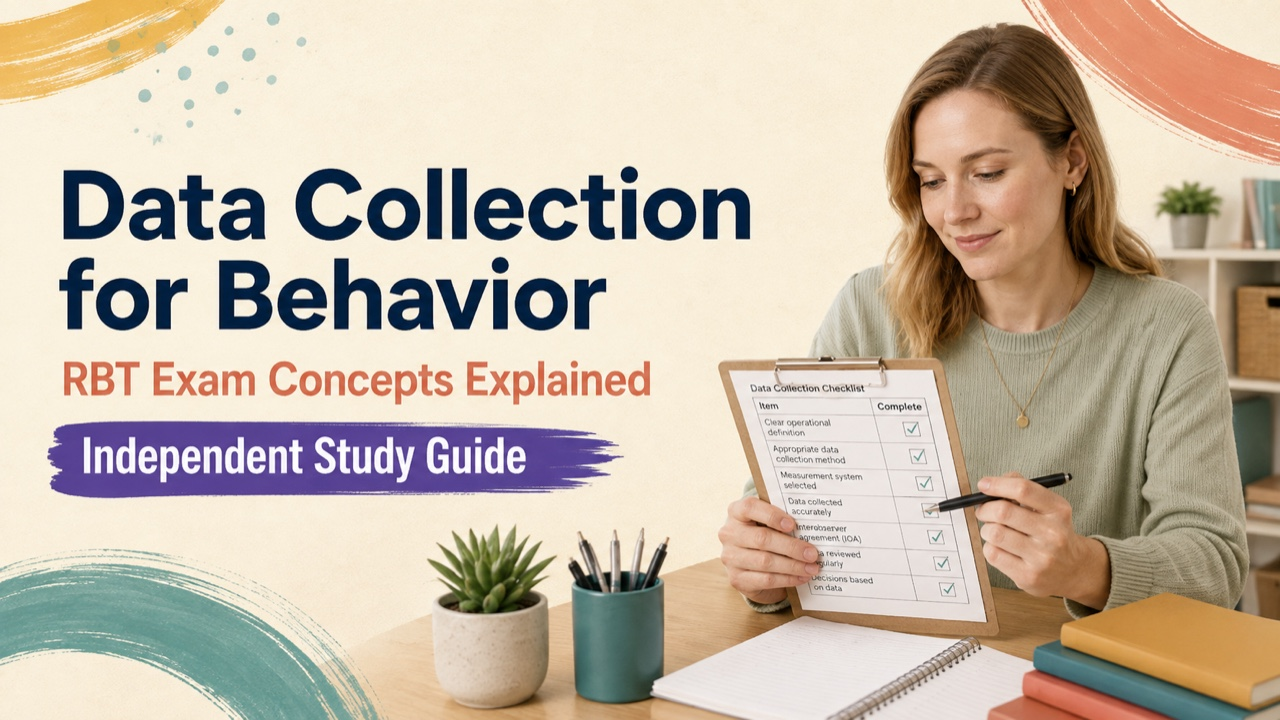
data collection for behavior is most useful to study as an observable RBT task rather than as a phrase to memorize. Start by identifying the setting, the written procedure, the learner response, the measurement rule, and the point at which an RBT should communicate with the responsible supervisor.
Table of Contents
- How to study data collection for behavior
- Core concept and observable action
- Original study scenario for data collection for behavior
- Implementation, timing, and fidelity
- Measurement and documentation
- Supervision and role boundaries
- Ethics, privacy, and respectful service
- Connection to the current RBT examination
- Common mistakes to avoid
- Study checklist for data collection for behavior
- Frequently Asked Questions
- References
Quick answer: Build a current-source study plan, connect the topic to the applicable RBT domain, practice an original scenario, and review the role boundary. Use the current BACB Handbook for credential, eligibility, application, supervision, and examination decisions.
Study boundary: This independent guide explains concepts and uses original examples. It is not official policy, an answer key, or a substitute for authorized training. The examples are not official, recalled, leaked, or BACB-endorsed questions. This guide is not a promise of certification or a credential.
How to study data collection for behavior
Begin with a plain-language definition and then translate it into an action that could be observed. A useful study note says what happens, under what condition, and how the result is recorded. Avoid definitions that depend on guessing a person’s intention or that imply an RBT may make an independent clinical decision.
The topic belongs to the measurement-assessment cluster and connects with operational definitions, measurement systems, observation, data quality, and assessment support. That connection is a study map, not permission to change a plan. If the written procedure, safety direction, or data rule is unclear, pause and ask the responsible supervisor or authorized instructor.
Core concept and observable action
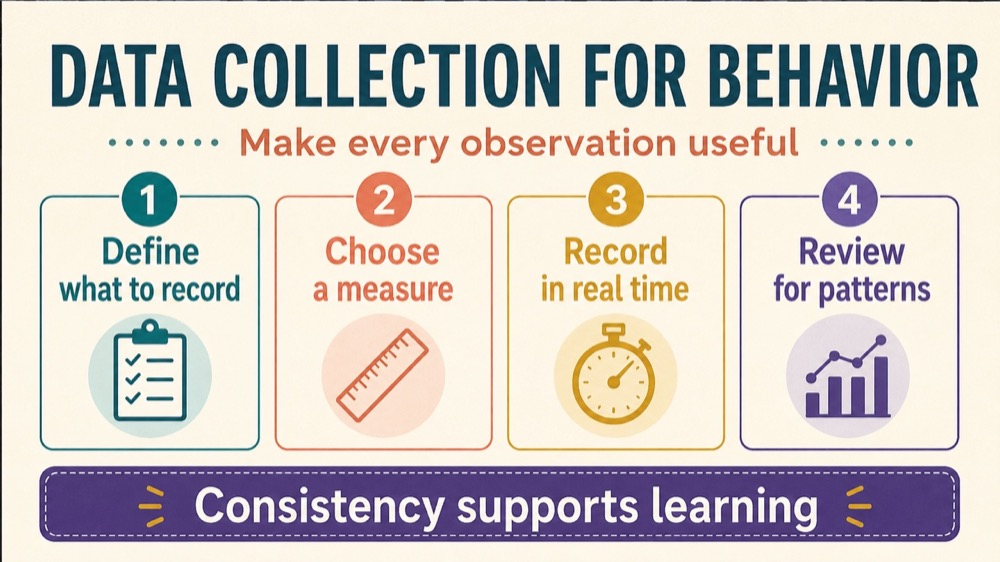
For any RBT concept, separate the label from the action. Ask: What would the technician see? What would the technician do? What would the technician record? What would the technician report? These four questions make a broad topic concrete and reduce the risk of selecting an answer because it merely sounds professional.
- Identify the target: Find the operational definition, goal, or assigned task.
- Check the condition: Note the materials, instruction, context, timing, and safety directions.
- Implement as trained: Follow the written procedure without adding an unapproved step.
- Measure and document: Use the specified data system and describe observable events.
- Communicate: Report uncertainty, errors, or safety concerns through the appropriate channel.
Original study scenario for data collection for behavior
Imagine that an RBT receives a written procedure related to data collection for behavior. The procedure names a target response, identifies the materials, and gives a rule for recording the outcome. During a session, the learner’s response does not fit the technician’s expectation. The technician should not fill in the gap with a personal interpretation or invent a new procedure because the session is moving quickly.
A careful response is to follow the applicable step, record what actually occurred, and communicate the uncertainty. For example, “the learner did not respond during the stated interval; the technician recorded no response and asked for clarification about the next trial” is more useful than “the learner was not cooperative.” The first statement preserves an observable record and a clear supervision question.
When reviewing data collection for behavior, ask which part of the scenario is directly supported by the written plan and which part requires direction. This reasoning transfers across measurement, teaching, behavior reduction, documentation, ethics, and examination questions.
Implementation, timing, and fidelity
Implementation fidelity means carrying out the assigned procedure in the order and manner in which it was trained. Timing can matter: an instruction may be followed by a defined response window; a prompt may be delivered only after that window; reinforcement or correction may depend on the response category. Small changes can alter both learning opportunities and data.
Prepare materials before the interaction, reduce avoidable distractions, and keep your attention on the written steps. If a device fails, materials are missing, or a safety condition changes, document the problem and use the workplace process for direction. Do not hide an implementation problem just to make a data sheet look complete.
Measurement and documentation
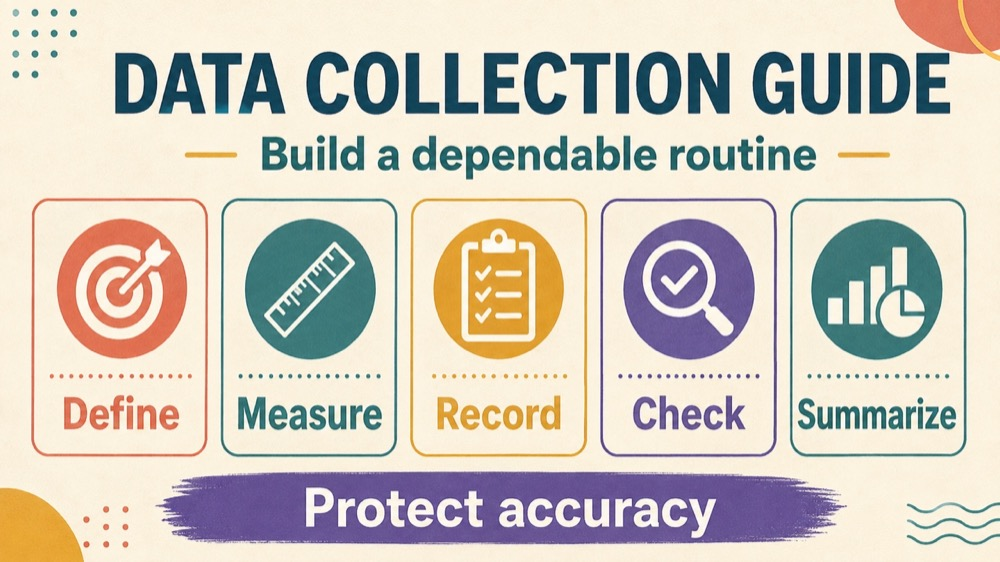
Measurement should match the operational definition and the system selected in the plan. Depending on the task, the system may involve frequency, duration, latency, interval recording, permanent product, or a response category such as independent or prompted. The technician should use the stated start and stop rules rather than substituting a more convenient measure.
Documentation should be timely, objective, and relevant. Describe what happened, what procedure was implemented, what was measured, and what follow-up was communicated. Avoid converting a hypothesis into a fact. If a data rule was misunderstood, report the issue promptly so the supervising team can decide what correction is appropriate.
Supervision and role boundaries
An RBT works within supervision and demonstrated competence. The RBT may implement assigned services, collect data, report observations, and receive feedback. The RBT should not independently diagnose, rewrite a treatment plan, select a new intervention, change mastery criteria, or promise a result. When the task exceeds training, asking for direction is the correct professional action.
Supervision also includes feedback and practice. A supervisor may observe a procedure, model a step, review a note, or ask the RBT to demonstrate the skill again. Treat feedback as information for improving accuracy, not as a reason to conceal the original error.
Ethics, privacy, and respectful service
Ethical study connects technical decisions to the learner’s dignity and privacy. Use approved systems for records, share only necessary information, and avoid discussing identifiable client details in public or personal social media. Use neutral, observable language and follow safety directions without humiliating the learner.
- Protect confidential information and verify recipients.
- Work only within training and current supervision.
- Report errors, risks, and relevant changes honestly.
- Maintain professional boundaries with learners, families, and colleagues.
- Ask for clarification rather than improvising a clinical decision.
Connection to the current RBT examination
The current RBT Test Content Outline, 3rd edition, contains 43 tasks across six domains. Use the outline to map data collection for behavior to its related study area, then practice the observable reasoning rather than searching for protected material. The current examination includes 75 scored questions and 10 unscored pilot questions.
Those examination facts provide context, not a promise. Independent practice questions should be clearly labeled as original and should explain why an answer fits the scenario. Check the current BACB Handbook for administrative details that may change over time.
Common mistakes to avoid
- Memorizing a label without practicing the action: Rewrite the concept as a condition, response, and data rule.
- Scoring by intuition: Return to the operational definition and stated measurement system.
- Changing the plan independently: Document the observation and ask the responsible supervisor.
- Writing interpretations as facts: Separate observable events from hypotheses.
- Using outdated or protected materials: Verify the source and use original practice.
- Ignoring privacy and competence: Ethical boundaries apply during study and service delivery.
Study checklist for data collection for behavior
- Can I define the topic in observable language?
- Can I identify the condition, materials, and written procedure?
- Can I explain the RBT action and the measurement or documentation rule?
- Can I give an original example without private client details?
- Can I identify what belongs to supervision or plan design?
- Can I explain the related current-outline task?
- Can I state the 43-task, 75-scored, and 10-unscored-pilot context accurately?
- Can I identify when to ask for direction?
Practice the concept
Use independent RBT practice to review data collection for behavior with original scenarios and clear role boundaries.
Try the RBT practice resource →
Frequently Asked Questions
What should I know about data collection for behavior?
Know the plain-language definition, the observable RBT action, the data or documentation rule, and the supervision boundary. Confirm current requirements in official BACB materials.
How should I practice this topic?
Write an original scenario, identify the written procedure, choose the observable response, and explain when you would communicate with the responsible supervisor.
Can an RBT change the procedure if the result looks unusual?
Document the observation and ask for direction. Do not independently change targets, prompts, consequences, measurement rules, or mastery criteria.
Are these official examination questions?
No. This guide uses independent explanations and original scenarios, not official, recalled, leaked, or BACB-endorsed questions.
References
- Behavior Analyst Certification Board: Registered Behavior Technician Handbook, updated June 2026.
- Behavior Analyst Certification Board: RBT Test Content Outline (3rd ed.).
- Behavior Analyst Certification Board: RBT resources.
- RBT Training: independent RBT practice questions.