

RBT behavior can mean the behavior of a Registered Behavior Technician, the behavior of a learner receiving services, or the behavior concepts an RBT must study. This guide keeps those meanings separate. An RBT observes and records defined behavior, implements assigned teaching or reduction procedures, communicates objectively, and works under the direction and close supervision of the responsible professional.
Table of Contents
- What RBT behavior means in a study question
- Observable behavior and operational definitions
- RBT behavior and data collection
- Behavior acquisition and the RBT role
- Behavior reduction and safe implementation
- A scenario: describing RBT behavior accurately
- Documentation, communication, and professional behavior
- Current examination map for RBT behavior
- Mistakes to avoid when studying RBT behavior
- RBT behavior review checklist
- Frequently Asked Questions
- References
Quick answer: Treat rbt behavior as a current-source RBT study topic. Identify the actor and decision owner, follow the written procedure, record observable facts, and keep the supervision boundary visible.
Study boundary: This independent guide is educational content. It is not a BACB policy, certification decision, legal opinion, answer key, or guarantee of examination success. Examples are original and are not official, recalled, leaked, or BACB-endorsed questions.
Current exam context: The current BACB RBT Test Content Outline describes 43 tasks across six domains; the examination includes 75 scored questions and 10 unscored pilot questions in a 90-minute testing period. Verify the current handbook and outline before relying on a time-sensitive detail.
What RBT behavior means in a study question
A good RBT study question gives enough information to identify whose behavior is being discussed and what the technician is expected to do. A learner’s behavior may be the target of measurement or intervention. An RBT’s behavior may be the professional action being evaluated, such as recording data, delivering reinforcement, protecting privacy, or asking for direction.
Start by naming the actor and the observable event. Avoid using a diagnosis, personality label, or guessed motive as though it were a measurement. If a prompt says that a learner ‘refused,’ look for the operational definition or describe what the learner did after the instruction. If it asks about an RBT, identify the role boundary before choosing the action.
Observable behavior and operational definitions
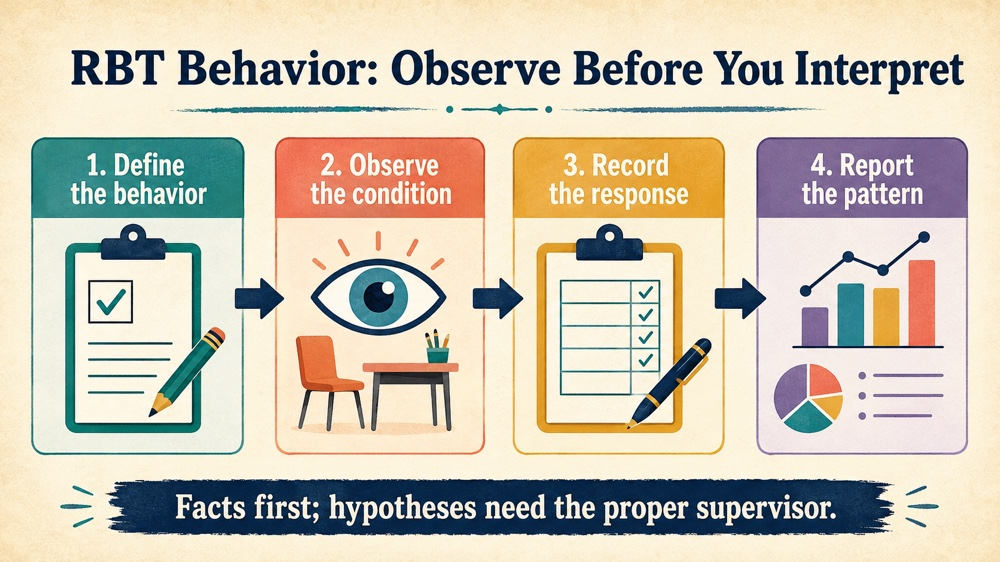
Behavior is most useful for assessment and teaching when it is described in observable, measurable terms. An operational definition states what counts, what does not count, and when an episode starts or ends. The RBT follows the definition provided by the supervising team and records the behavior using the assigned measurement system. The technician should not rewrite a definition during a session because an example feels ambiguous.
For practice, turn vague language into an observable description. ‘The learner was upset’ might become ‘the learner cried, pushed the materials away, and did not contact the instruction for 20 seconds,’ if those are the actual observed events and the plan defines them as relevant. The exact definition still belongs to the program; the study skill is separating observation from interpretation.
RBT behavior and data collection
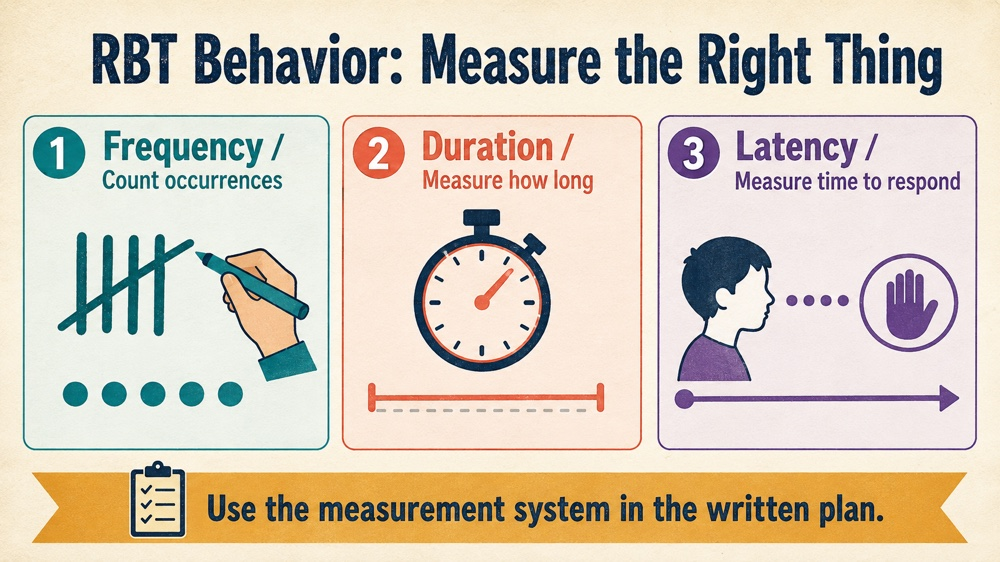
Data turns an observation into information that the clinical team can review. The RBT may record frequency, rate, duration, latency, interval data, permanent product, or another system specified in the plan. Each system has different rules. A technician who records every occurrence when the program calls for duration is not demonstrating extra effort; the technician is collecting the wrong measure.
Read the measurement rule before the session and ask about unclear start, stop, or scoring criteria. Record what occurred at the time it occurred when possible. If a material, definition, or timer is missing, communicate the problem and preserve the available facts. Do not fill a blank later from memory or change the system to make the graph look better.
Behavior acquisition and the RBT role
Behavior acquisition teaches a new skill or increases a useful response. An RBT may implement reinforcement, prompting, shaping, chaining, discrimination training, generalization, and maintenance procedures when trained and assigned. The program determines the target, prompt, consequence, and data rule. The RBT’s work is accurate implementation and communication, not independent design of goals or mastery criteria.
A learner’s correct response may be independent, prompted, or approximated. The RBT records the category defined by the plan and delivers the programmed consequence. If the learner improves or struggles, report the pattern with examples. Do not raise the reward, skip the prompt, or change the task sequence simply because the technician prefers a different teaching style.
Behavior reduction and safe implementation
Behavior reduction procedures address behavior that interferes with learning, safety, or participation. An RBT may implement antecedent strategies, differential reinforcement, extinction, or a safety procedure when those actions are written, trained, and authorized. The RBT should understand the function described by the plan but should not announce a new functional hypothesis or choose a new consequence independently.
If a safety situation occurs, follow the trained crisis or emergency procedure, protect the learner and others, and report the event promptly. Record observable antecedents, responses, consequences, and relevant variables. Avoid punitive language, public discussion, or an informal restraint technique. A professional response is calm, specific, and connected to the written plan and supervision pathway.
A scenario: describing RBT behavior accurately
During a session, a learner leaves the table after an instruction. A coworker says the learner ‘wanted attention.’ The RBT should first check the operational definition and record the observable sequence: instruction, movement away, staff response, and return or other consequence. If the plan calls for an antecedent adjustment or communication response, implement it as written and report the observation to the supervisor.
The tempting error is to treat the coworker’s interpretation as data or to change the consequence in order to test a theory. The RBT may notice patterns, but a clinical analysis and procedure change require the appropriate professional process. Observation, documentation, and consultation are more defensible than improvisation.
Documentation, communication, and professional behavior
Documentation should make it possible for another qualified team member to understand what happened without guessing. Write objective session notes, record required data, identify relevant changes, and report injuries, barriers, caregiver concerns, or deviations through the approved channel. Never copy a previous note and change only the date if it does not accurately describe the session.
Professional RBT behavior also includes confidentiality, punctual communication, accepting feedback, and recognizing limits of competence. An RBT may say, ‘I am not sure how this plan applies to this situation; I will check with the supervisor,’ without appearing unhelpful. Asking for direction protects the learner and improves the quality of the record.
Current examination map for RBT behavior
The current RBT Test Content Outline organizes examination content into six domains: Data Collection and Graphing, Behavior Assessment, Behavior Acquisition, Behavior Reduction, Documentation and Reporting, and Ethics. Its tasks connect the observable work of an RBT to data accuracy, assessment participation, teaching, reduction, communication, and professional conduct. Study the behavior of the technician as carefully as the behavior of the learner.
Use original scenarios that change one feature at a time. Change the measurement system, prompt level, schedule, setting, or supervisor instruction, then explain why the correct RBT action changes. The current examination includes 75 scored questions and 10 unscored pilot questions in a 90-minute period, but knowing the numbers does not replace understanding the decision in the scenario.
Mistakes to avoid when studying RBT behavior
- Using mental-state labels as though they were operational definitions.
- Collecting a familiar measure instead of the measure written in the program.
- Treating an RBT observation as authorization to change a clinical procedure.
- Recording prompted or approximated responses as independent without checking the criterion.
- Backfilling notes, altering data, or hiding a deviation from the supervisor.
- Discussing learner information in an unapproved channel or public setting.
- Assuming that a high-level concept replaces the exact instruction and safety plan.
RBT behavior review checklist
- Can I identify the actor, observable response, condition, and consequence in a scenario?
- Can I follow an operational definition without rewriting it during the session?
- Can I match frequency, duration, latency, rate, interval, and product measures to their rules?
- Can I implement acquisition or reduction procedures only when trained and assigned?
- Can I document facts and report uncertainty without making an unsupported diagnosis?
- Can I explain how supervision protects the learner and the technician?
- Can I distinguish a useful observation from an independent clinical decision?
A reliable RBT answer is observable, procedural, and appropriately modest. State what was seen, follow the written plan, record the required information, and ask the responsible supervisor when a change, risk, or ambiguity exceeds the technician’s authority.
Practice the concept
Review rbt behavior with original RBT scenarios, current-source reminders, and clear role boundaries.
Try the RBT practice resource →
Frequently Asked Questions
What does RBT behavior refer to?
It may refer to an RBT’s professional actions, a learner’s observable behavior, or the behavior concepts RBT candidates study. The actor and context should be identified before choosing an answer.
Can an RBT change an operational definition?
An RBT should use the definition and measurement rules in the assigned plan and report ambiguity. Definition changes require the appropriate supervising process.
What should an RBT do when behavior is unsafe?
Follow the trained safety or emergency procedure, protect people, document observable facts, and report promptly through the approved supervision and workplace channels.
Are the scenarios official questions?
No. They are original study scenarios and are not official, recalled, leaked, or BACB-endorsed questions.
References
- Behavior Analyst Certification Board: Registered Behavior Technician Handbook, updated June 2026.
- Behavior Analyst Certification Board: RBT Test Content Outline (3rd ed.).
- Behavior Analyst Certification Board: RBT resources.
- Behavior Analyst Certification Board: ethics resources.
- Behavior Analyst Certification Board: RBT Ethics Code (2.0).