

How to be a behavioral technician is a question many people ask when they want practical experience in applied behavior analysis (ABA). The path involves more than memorizing terminology. A strong entry-level technician learns to follow written procedures, collect reliable data, protect client dignity, communicate with a supervisor, and recognize the limits of the role.
Table of Contents
- What does a behavioral technician do?
- How to be a behavioral technician: the basic pathway
- How to be a behavioral technician: what to learn during training
- Why competency matters
- How to prepare for the current RBT examination
- Supervision and scope of practice
- Common mistakes new behavioral technicians make
- Behavioral technician study checklist
- Frequently Asked Questions
- References
Quick answer: To become a behavioral technician through the RBT pathway, review the current BACB requirements, complete the required training, demonstrate competency, submit the appropriate application, prepare for the current examination, and work under ongoing supervision after certification. If you are learning how to be a behavioral technician, use the current BACB Handbook for application decisions because requirements can change.
Study boundary: This is an independent RBT study guide. It is not an official BACB handbook, certification decision, treatment plan, or source of secure examination material. The examples are newly written for study and are not official, recalled, leaked, or BACB-endorsed questions.
Continue your review with RBT practice questions that reinforce measurement, prompting, supervision, and ethics.
What does a behavioral technician do?
A behavioral technician provides direct services by implementing behavior-analytic procedures that have been selected and trained by the responsible clinical team. Depending on the setting, daily work may include teaching communication or daily-living skills, using reinforcement, collecting session data, supporting behavior-reduction procedures, and documenting what occurred.
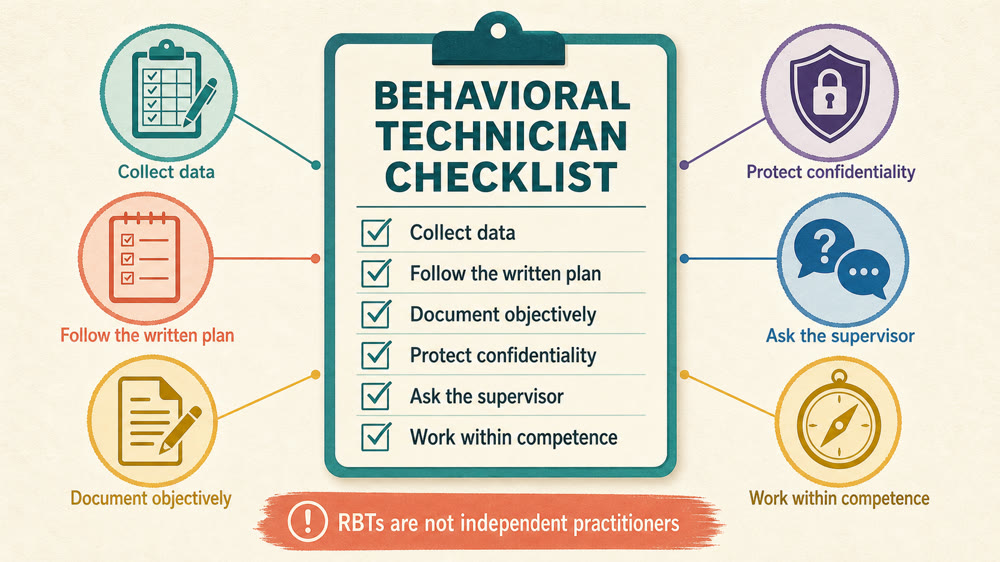
The technician’s job is not to improvise a new treatment plan whenever a session becomes difficult. The technician follows the written program, asks for direction when a step is unclear, and reports observations objectively. The BACB describes RBTs as nonindependent practitioners who provide services under ongoing supervision. That boundary protects the learner, the family, the technician, and the quality of the data.
How to be a behavioral technician: the basic pathway
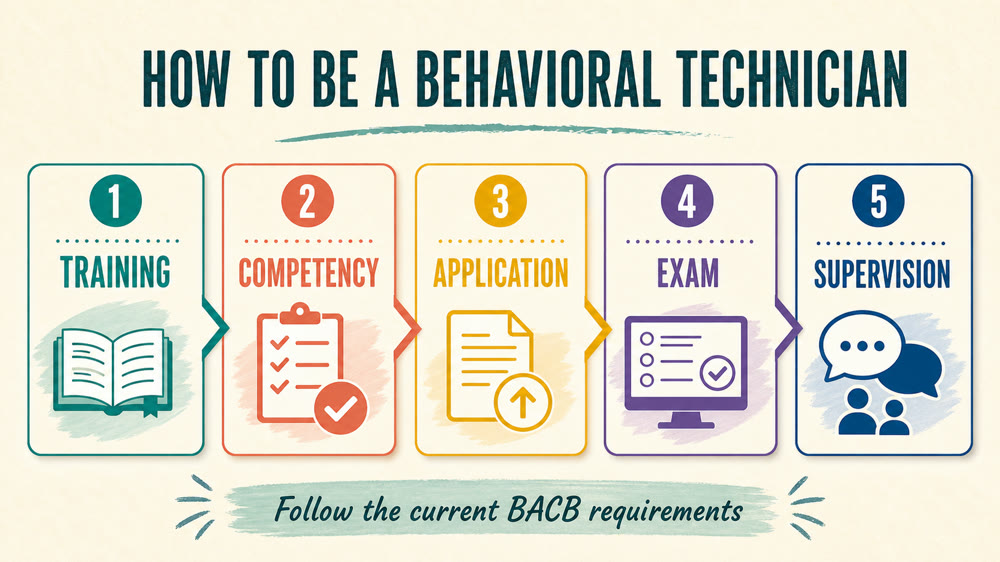
The exact administrative process depends on the current BACB rules and the applicant’s situation, but a practical study map looks like this:
- Understand the role: Decide whether you are prepared for direct service, careful documentation, feedback, and supervised practice.
- Complete the required training: Build a foundation in measurement, assessment, skill acquisition, behavior reduction, documentation, and ethics.
- Demonstrate competency: Show that you can perform the relevant technician tasks accurately, not merely define them.
- Submit the application: Follow the current BACB instructions and provide the required documentation through the appropriate process.
- Prepare for the examination: Study the current RBT Test Content Outline and practice applying concepts to original scenarios.
- Maintain supervised practice: Continue receiving direction and feedback while working within your demonstrated competence.
How to be a behavioral technician: what to learn during training
Training should help you connect technical terms to observable events. For example, frequency describes how many times a behavior occurs, duration describes how long it lasts, latency describes the time before a response begins, and rate describes occurrences relative to a unit of time. The correct measure depends on the behavior definition and the written data-collection procedure.
You should also learn how to implement behavior-acquisition procedures such as reinforcement, prompting, prompt fading, discrete-trial teaching, naturalistic teaching, chaining, discrimination training, shaping, and token economies. The current TCO lists these skills under behavior acquisition, which is one of six examination domains.
Behavior reduction study should include identifying common functions of behavior, implementing authorized antecedent interventions, using differential reinforcement when directed, and recognizing possible secondary effects of extinction. These concepts do not give an RBT permission to select a new intervention independently. They help the technician implement and describe an existing plan accurately.
Why competency matters
Competency means that you can perform a task safely and accurately under the conditions required by the procedure. A person may be able to define reinforcement but still need practice delivering it immediately and contingently. A person may know what duration means but still need coaching to start and stop a timer consistently.
Original study scenario: A learner is practicing handing over a break card. The written plan defines an independent response as handing over the card within five seconds of the opportunity without a prompt. If the learner does not respond, the plan directs the technician to use a specific prompt and record the outcome as prompted. The technician should not change the wording, shorten the response window, or score the prompted response as independent just because the final action was correct.
This kind of scenario tests whether you can identify the target response, the opportunity, the prompt, the timing rule, and the recording rule. It also tests whether you understand your role boundary.
How to prepare for the current RBT examination
The current RBT examination is based on the RBT Test Content Outline, 3rd edition. The BACB Handbook states that the examination includes 75 scored questions and 10 unscored pilot questions, with 90 minutes to complete the test. The TCO describes 43 tasks organized into six domains: Data Collection and Graphing, Behavior Assessment, Behavior Acquisition, Behavior Reduction, Documentation and Reporting, and Ethics.
Study by rotating between definition review and scenario practice. When reviewing a question, underline the observable behavior, the measurement method, the intervention step, the data rule, and the person responsible for clinical direction. Be cautious when an answer choice asks the RBT to diagnose, redesign a plan, or act without supervision.
Use independent practice questions to develop reasoning. Do not describe practice questions as real, official, recalled, or leaked examination items. The BACB does not endorse specific study guides, and purchasing a study product does not guarantee an examination result.
Supervision and scope of practice
Supervision is part of safe practice, not a sign that a technician has failed. A supervisor may provide instruction, modeling, rehearsal, feedback, observation, and clinical direction. The technician should communicate concerns promptly when data are unusual, a procedure is unclear, a safety issue occurs, or a relevant variable may affect progress.
- Implement procedures only after you have been trained and shown competence.
- Ask before changing a prompt, reinforcement schedule, target, or behavior-reduction step.
- Document illness, medication changes, schedule disruptions, or other relevant session variables according to workplace rules.
- Describe what you observed instead of guessing why a person behaved a certain way.
- Protect confidentiality and do not confirm or deny someone’s client status to a friend or stranger.
Common mistakes new behavioral technicians make
- Using vague notes: Replace “the client was upset” with observable actions, timing, and context.
- Repeating instructions without recording prompts: Additional spoken help may change how the response should be scored.
- Changing a plan during a hard session: Follow the authorized procedure and seek clinical direction.
- Ignoring data quality: Inconsistent timing, unclear definitions, or missing trials can make patterns difficult to interpret.
- Working beyond competence: Pause and ask for training instead of guessing.
- Overpromising results: Skill development is individual, and no study guide can guarantee certification or client outcomes.
Behavioral technician study checklist
Before applying or beginning supervised work, review whether you can:
- Define and distinguish frequency, rate, duration, latency, percentage, and interval recording.
- Describe behavior and environment in observable, measurable language.
- Explain reinforcement, prompting, fading, shaping, chaining, and generalization.
- Identify common behavior functions and follow an authorized intervention.
- Record session events objectively and report relevant variables.
- Recognize when to seek supervisor direction.
- Apply confidentiality, dignity, integrity, and professional-boundary expectations.
- Explain why an RBT is not an independent clinical practitioner.
Practice behavioral technician decisions
Review independent RBT-style scenarios about measurement, prompting, supervision, documentation, and ethics.
Try the RBT practice resource →
Frequently Asked Questions
How long does it take to become a behavioral technician?
The timeline depends on how quickly you complete the current training, competency, application, and examination steps. Check the latest BACB Handbook for requirements and deadlines.
Can a behavioral technician work independently?
RBTs are not independent practitioners. They provide services under ongoing supervision and within their demonstrated competence.
What should I do if a procedure is unclear?
Pause when appropriate and seek direction from your supervisor. Do not guess or make an unauthorized clinical change.
Is this article an official BACB study guide?
No. This is independent educational content. Its scenarios are original and are not official, recalled, leaked, or BACB-endorsed examination questions.
References
- Behavior Analyst Certification Board: Registered Behavior Technician Handbook, updated June 2026.
- Behavior Analyst Certification Board: RBT Test Content Outline (3rd ed.).
- Behavior Analyst Certification Board: RBT resources.
- RBT Training: independent RBT practice questions.