

If you are searching how to become a behavior technician, start by separating a job title from a credential. A behavior technician may be an entry-level employee who implements behavior-support procedures under workplace direction. A Registered Behavior Technician (RBT) is a specific paraprofessional certification issued by the Behavior Analyst Certification Board and practiced under the direction and close supervision of an RBT Supervisor and/or RBT Requirements Coordinator.
Table of Contents
- How to become a behavior technician: job title versus RBT
- How to become a behavior technician: check basic eligibility
- Complete the current 40-hour training
- Pass the initial competency assessment
- Submit the certification application
- Prepare for the RBT examination
- Start supervised practice and maintain status
- Map the behavior-technician role to six TCO domains
- Original how-to-become scenarios
- How to become a behavior technician: use a document checklist
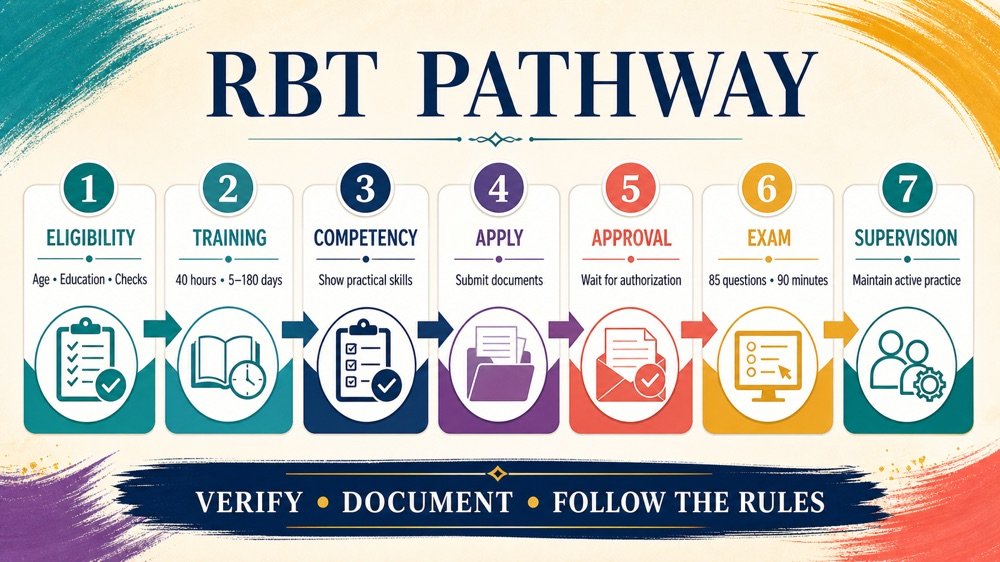
- A practical seven-step timeline
- Frequently Asked Questions
- References
The current RBT pathway includes eligibility checks, current 40-hour training, an initial competency assessment, a certification application, an approved determination, the RBT examination, and ongoing requirements after certification. Training can be online and/or in person when it meets the current BACB requirements; finishing a course does not itself award the RBT credential.
The current RBT Test Content Outline, 3rd edition, describes 43 tasks across six domains. The examination includes 75 scored questions and 10 unscored questions, presented as 85 multiple-choice questions with four options and 90 minutes. This article uses original examples and does not reproduce or imply access to secure examination content.
RBT Training is an independent study resource, not the BACB, an application processor, a certification issuer, a clinical supervisor, or an employer. The examples are newly written and are not official, recalled, leaked, or BACB-endorsed questions. No course, employer, practice score, or article can guarantee certification or a passing result.
How to become a behavior technician: job title versus RBT
The phrase “behavior technician” is broad. Employers may use BT, behavior technician, ABA technician, direct-care staff, or another title for a person who implements a written program. The BACB RBT credential is narrower: it has defined eligibility, training, competency, examination, ethics, and supervision requirements.
| Question | General behavior-technician job | RBT credential |
|---|---|---|
| Who defines it? | An employer, service organization, or jurisdiction. | The BACB certification program and current requirements. |
| What work may involve? | Implementing assigned support procedures and recording information. | Delivering behavior-analytic services under the required direction and close supervision. |
| What proves readiness? | Employer onboarding, training, and role-specific competency. | Current eligibility, training, initial competency assessment, application approval, examination, and active status. |
| Can the title be used automatically? | Only according to the employer and applicable rules. | No. Do not represent yourself as an RBT until the credential and status support that representation. |
For example: a clinic may hire a new behavior technician before that person completes the RBT pathway. The employee may receive orientation or supervised training, but that employment status does not prove that the person has BACB certification. Ask the employer exactly which duties are allowed before certification and who is responsible for supervision.
How to become a behavior technician: check basic eligibility
Current BACB guidance states that an RBT applicant must be at least 18 years old, have a high-school-level education or equivalent, and pass the required criminal background and abuse-registry checks reviewed by an attestor. These are starting requirements, not the entire pathway.
- Age: confirm that you meet the minimum age when you submit the application.
- Education: locate your diploma or equivalent documentation before an application deadline.
- Background and abuse-registry checks: confirm the timing, reviewer, and acceptable documentation in the current Handbook.
- Jurisdiction: check whether the BACB can accept an application from your location and whether state or employer rules add conditions.
- Identity and account: create or verify the BACB account so names and documents match exactly.
Do not rely on a social-media checklist if your history may affect eligibility. The BACB provides a prior-history review route for people who are unsure about a criminal or disciplinary history; use the current official instruction rather than guessing.
Complete the current 40-hour training
For applications on or after January 1, 2026, the training must meet the current RBT 2026 40-Hour Training Requirements and Curriculum Outline. It may be structured online, in person, or as a combination, but delivery format alone does not make a course eligible.
| Training check | What to verify |
|---|---|
| Duration | At least 40 hours, completed in no fewer than 5 days and no more than 180 days. |
| Content | The current curriculum covers behavior-technician service delivery, data, assessment, behavior change, documentation, and ethics. |
| Behavioral skills training | The course includes an eligible combination of didactic instruction, modeling with exemplars and nonexemplars, role-play with feedback, quizzes, interactive activities, or instructor-led discussion. |
| Responsible trainer | The training is designed and overseen by an active BCaBA, BCBA, or BCBA-D who has completed the 8-hour supervision training. |
| Assistant trainer | Any assistant trainer meets the current RBT certification-or-higher requirement and is overseen by the responsible trainer. |
| Certificate | The certificate includes trainee information, dates, time, trainer information, and the required 2026 independent-of-BACB statement. |
| Records | The responsible trainer maintains the required records; keep your own certificate and completion evidence too. |
A generic course badge, a playlist, or a “pass guaranteed” landing page is not enough evidence. For each provider you consider, save the current outline, trainer information, course dates, interactive components, certificate sample, refund terms, and contact route.
Pass the initial competency assessment
After the required training, complete the current RBT Initial Competency Assessment with a qualified responsible assessor under the applicable BACB rules. The assessment is different from a multiple-choice practice quiz: it evaluates performance of behavior-technician skills.
Before scheduling, verify:
- the assessor’s current credential and supervision-training status;
- whether an assistant assessor is involved and meets the current requirement;
- the assessment version and effective date;
- the skills, role-plays, observations, or documentation required;
- how unsuccessful items are remediated and documented; and
- the timing relationship between training, assessment, and application.
Do not treat a practice score, course final, or employer orientation as a substitute. If a provider says “the final quiz is your competency assessment,” ask for the official requirement and assessor documentation before proceeding.
Submit the certification application
Once eligibility, training, and competency evidence are ready, submit the RBT certification application through the BACB process. The application is the point where documents and attestations are reviewed; an employer or training provider may help you prepare, but it does not control the BACB determination.
- Confirm the name on your BACB account matches your identification and certificates.
- Upload the current training certificate and required supporting records.
- Complete the attestation and background or abuse-registry documentation as directed.
- Review every date and certification number before submitting.
- Save the submission confirmation and watch the portal for action items.
- Respond through the official route if BACB requests clarification.
Application approval is not the same as certification. It authorizes the next step under the applicable rules. Wait for the approved determination and scheduling instructions before treating the examination as available.
Prepare for the RBT examination
The current RBT exam assesses entry-level knowledge consistent with the RBT Test Content Outline, 3rd edition. It includes 85 multiple-choice questions, 75 scored and 10 unscored, with four answer choices and 90 minutes. The examination is delivered through authorized testing arrangements, including Pearson VUE locations described by the BACB.
Use the official TCO as the study map:
- practice choosing and calculating measurement systems;
- distinguish assessment participation from independent clinical decision-making;
- apply reinforcement, prompting, teaching, chaining, maintenance, and generalization;
- match behavior-reduction procedures and safety steps to the written plan;
- write objective documentation and communicate variables or concerns; and
- apply competence, supervision, confidentiality, boundaries, and cultural-responsiveness principles.
Keep third-party practice questions separate from secure exam content. Original questions are useful when they explain the decision rule and nearest distractor; no study provider should claim to sell real, recalled, leaked, or BACB-endorsed questions.
Start supervised practice and maintain status
After certification, RBT practice remains supervised. Current BACB materials describe RBTs as working under the direction and close supervision of an RBT Supervisor and/or RBT Requirements Coordinator. Certification status can also be affected by whether the required supervisor is on record, so do not assume that passing the exam alone permits unrestricted practice.
Ask an employer or supervisor:
- Who is the responsible RBT Supervisor or Requirements Coordinator?
- How are supervision contacts, observations, feedback, and records documented?
- What happens if the supervisor is unavailable or employment ends?
- How are ethics concerns, safety events, data irregularities, and client complaints escalated?
- Which current recertification, professional-development, self-reporting, and record-retention requirements apply to your status?
Read the current Handbook for the requirements in effect when you apply, certify, and recertify. Rules can change by effective date, and state or employer obligations may be stricter than the general BACB pathway.
Map the behavior-technician role to six TCO domains
The current TCO gives you a useful study and job-readiness map:
| Domain | Behavior-technician application | Boundary question |
|---|---|---|
| A. Data Collection and Graphing | Record observable behavior, use the assigned measurement, enter data, update graphs, and report trends. | Am I following the definition and measurement system? |
| B. Behavior Assessment | Assist with preference, skill, and functional-assessment components as directed. | Am I collecting information without claiming independent diagnosis? |
| C. Behavior Acquisition | Implement reinforcement, teaching, prompting, shaping, chaining, generalization, and maintenance procedures. | Am I following the teaching plan and fading direction? |
| D. Behavior Reduction | Implement antecedent, differential-reinforcement, extinction, punishment, and crisis procedures as written. | Am I changing a procedure or responding safely under the plan? |
| E. Documentation and Reporting | Communicate session events, client variables, concerns, suggestions, and data issues. | Is my note objective, timely, complete, and private? |
| F. Ethics | Work within competence, supervision, confidentiality, public-statement, gift, relationship, and cultural-responsiveness requirements. | Would I pause and ask before this action exceeds my role? |
Training that only lists job duties is incomplete. A competent behavior technician must connect a procedure to data, client dignity, the written plan, supervision, and the reason for escalation.
Original how-to-become scenarios
These examples are newly written for study and career planning. They are not official, recalled, leaked, or BACB-endorsed questions.
- Job title: A clinic hires a person as a behavior technician before the person applies for RBT certification. Best interpretation: the employee may perform only duties allowed by the employer, supervisor, and applicable rules; the job title does not prove RBT status.
- Training timing: A provider says its 40-hour course can be completed in three days. Best review: compare the schedule with the current requirement of no fewer than 5 days and no more than 180 days before relying on the certificate.
- Online course: A course has 40 hours of video but no modeling, practice, feedback, quizzes, interactive activity, or instructor discussion. Best action: ask how it meets current behavioral-skills-training components; video hours alone are not the whole audit.
- Competency: A learner passes a multiple-choice final and is told the initial competency assessment is complete. Best action: verify the qualified assessor and current performance-assessment documentation.
- Application: A training company submits an application and tells the learner they are certified. Best interpretation: application submission is not BACB approval or certification status.
- Exam preparation: A practice website advertises recalled BACB questions. Best action: do not use or share protected content; choose original, source-backed practice instead.
- Supervision: A newly certified RBT has no supervisor listed after moving jobs. Best action: stop assuming active practice is allowed, review current status rules, and contact the appropriate supervisor or BACB route.
- State rule: A state employer requires an additional registry or training step. Best action: follow the stricter applicable rule and do not present the BACB pathway as a complete statement of state law.
How to become a behavior technician: use a document checklist
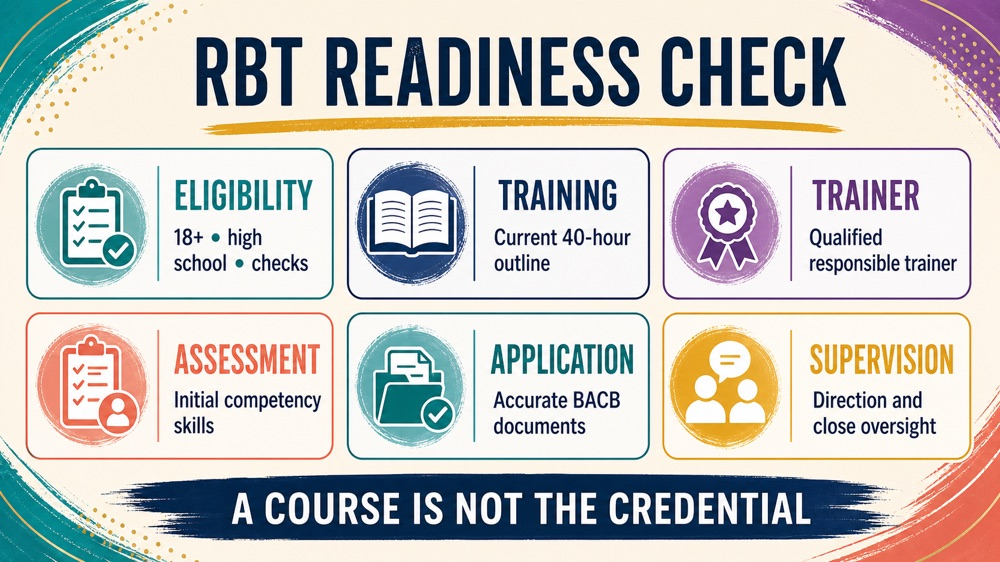
If your question is how to become a behavior technician, treat this folder as a readiness record rather than a pile of marketing emails. Keep a secure folder with:
- high-school-level education or equivalent record;
- background and abuse-registry check documentation;
- 40-hour training certificate with dates, hours, trainer details, and current statement;
- training provider and responsible-trainer contact information;
- initial competency assessment documentation and assessor details;
- BACB account, application, action-item, and approval records;
- examination scheduling confirmation and score communication;
- supervisor or Requirements Coordinator information; and
- ongoing supervision, ethics, professional-development, self-reporting, and recertification records as applicable.
Do not send sensitive records to random study groups or store client information in a public folder. Protect both your certification documents and the confidentiality of people receiving services.
A practical seven-step timeline
- Explore: compare the job title, settings, duties, schedule, pay, and supervision offer.
- Verify: read the current BACB Handbook, RBT page, training outline, and applicable state or employer rules.
- Train: complete an eligible current 40-hour program and retain the certificate.
- Demonstrate: complete the current initial competency assessment with a qualified assessor.
- Apply: submit accurate documents and resolve any action items.
- Test: schedule after approval and prepare with the current TCO and original practice.
- Practice: work under the required supervision and maintain status and ethical responsibilities.
Bottom line: to become a behavior technician, you can often begin by applying for supervised entry-level work, but to become an RBT you must follow the current BACB pathway. If you are deciding how to become a behavior technician, confirm eligibility, audit training, complete competency, apply, wait for approval, pass the authorized examination, and maintain supervised practice.
Ready to review the RBT exam path?
Practice original scenarios across the current six domains and see which concepts to review next.
Try Free RBT Practice Questions →
Frequently Asked Questions
What is the fastest way to become a behavior technician?
Start by checking the job’s entry requirements and supervision offer, then verify the current BACB pathway if you want the RBT credential. Speed should not mean skipping the required training, competency assessment, application approval, exam, or supervision.
Do I need a college degree to become an RBT?
Current BACB eligibility guidance requires a high-school-level education or equivalent, not a college degree. Employers and jurisdictions may add their own requirements, so verify the specific role before applying.
Can I complete the RBT training online?
The current 40-hour training may use an online and/or in-person format when it meets the BACB curriculum, delivery, timing, trainer, behavioral-skills-training, documentation, and other requirements.
Is a behavior technician the same as an RBT?
No. Behavior technician is a broad job title; RBT is a specific BACB certification. A person can work in a supervised technician role without automatically holding the RBT credential.
How long does it take to become an RBT?
The answer depends on training dates, assessment availability, application review, exam scheduling, and any action items. Current training must be completed over no fewer than 5 days and no more than 180 days; verify the full timeline from the current BACB resources.
Can a course or employer guarantee RBT certification?
No. A course, employer, practice score, or article can support preparation but cannot guarantee BACB approval, examination results, or certification.
References
- Behavior Analyst Certification Board. Registered Behavior Technician (RBT) resources.
- Behavior Analyst Certification Board. RBT Handbook.
- Behavior Analyst Certification Board. Guidance for Meeting RBT Requirements During the 2026 Transition.
- Behavior Analyst Certification Board. RBT 2026 40-Hour Training Requirements and Curriculum Outline.
- Behavior Analyst Certification Board. RBT Test Content Outline (3rd ed.).
- Behavior Analyst Certification Board. Examination Information.
- edX behavioral technician career guide. Reviewed for competitor research; not an endorsement.
- WGU behavior technician career guide. Reviewed for competitor research; not an endorsement.