

People ask, “Is the registered behavior technician exam hard?” The most honest answer is that difficulty depends on what you have practiced. The test is not only a vocabulary check: it asks you to recognize an observable clue, choose the measurement or procedure that fits, and stay inside the RBT’s supervised role. Candidates who memorize definitions but do not practice decisions can find the scenarios harder than expected.
Table of Contents
- Is the registered behavior technician exam hard? What drives difficulty?
- Start with the current exam structure
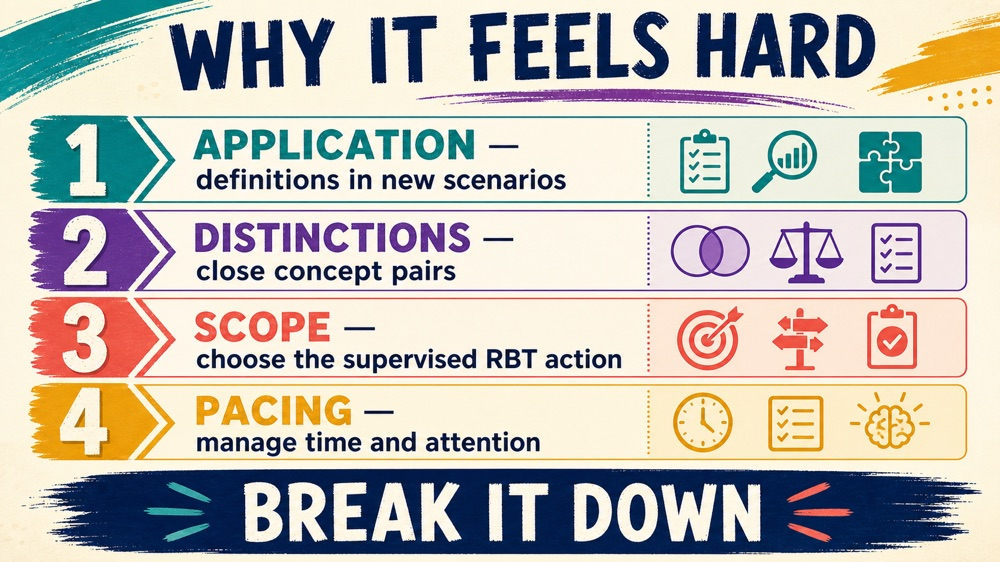
- Difficulty one: applied scenarios
- Difficulty two: close concept pairs
- Difficulty three: professional boundaries
- Difficulty four: time and attention
- How to study if the exam feels hard
- Common difficulty myths
- Frequently Asked Questions
- References
This guide breaks difficulty into parts you can actually prepare for: current content breadth, applied scenarios, close distinctions, professional judgment, and time management. It also gives you a way to diagnose whether a weak practice score reflects a knowledge gap, a reading error, or test pressure.
RBT Training is an independent educational resource. It is not affiliated with, operated by, or endorsed by the Behavior Analyst Certification Board (BACB). The examples and practice prompts below are newly written for independent study; they are not official, recalled, leaked, or BACB-endorsed questions. No article, practice score, or study schedule can guarantee a passing result.
Is the registered behavior technician exam hard? What drives difficulty?
“Hard” is not one fixed property of the exam. It can mean a large amount of content, unfamiliar terms, ambiguous-looking options, a fast clock, or anxiety about choosing the safest professional action. Separate those sources before changing your study plan.
| Difficulty source | What it looks like | What helps |
|---|---|---|
| Content breadth | You know one domain well but miss questions in another. | Map study across all six current domains and track task-level errors. |
| Application | You can define a term but miss it in a new scenario. | Underline the observable clue and explain why each option fits or fails. |
| Close distinctions | Two options sound plausible. | Write the nearest contrast and the condition that separates them. |
| Role judgment | An option asks you to change a plan or make an unsupported clinical decision. | Return to the written plan, documentation, and supervision route. |
| Timing | You spend too long on early items or rush the last ones. | Practice a calm pacing routine and review time-consuming item types. |
A candidate with strong ABA experience may still need to learn the RBT-specific scope and exam language. A candidate new to ABA may need more time for vocabulary and applied examples. Neither background makes success automatic or impossible.
Start with the current exam structure
Use the current RBT Test Content Outline, 3rd edition as the academic anchor. It describes 43 tasks across six domains. The exam context used in this workflow includes 75 scored questions and 10 unscored pilot questions. The presented question count and the scored count are not the same, so a practice resource should explain which structure it is simulating.
| Current domain | Study question |
|---|---|
| A — Data Collection and Graphing | Can you choose and apply the measurement named by the observable rule? |
| B — Behavior Assessment | Can you support assessment procedures and report what was observed without guessing? |
| C — Behavior Acquisition | Can you implement teaching, prompting, reinforcement, and generalization steps as written? |
| D — Behavior Reduction | Can you follow the plan safely and avoid designing an intervention independently? |
| E — Documentation and Reporting | Can you write objective records and communicate relevant information? |
| F — Ethics | Can you protect dignity, boundaries, confidentiality, competence, and supervision? |
The outline controls exam scope. The handbook and ethics resources control process and professional expectations. Independent study sites may explain the concepts, but they should not be treated as the authority for current requirements or as a source of official exam questions.
Difficulty one: applied scenarios
Many learners experience a gap between “I know the definition” and “I can select the best action.” Scenario items hide the definition inside a sequence of events. Read for the behavior, the measurement rule, the plan instruction, and the role boundary.
- Identify the observable event: replace a label such as “noncompliant” with what the person did or did not do.
- Find the condition: note whether the stem says “for the entire interval,” “at the end,” “after the instruction,” or another controlling feature.
- Match the procedure: choose the method that fits the rule, not the term you remember most strongly.
- Check the role: eliminate options that diagnose, change treatment, or act outside the written plan without direction.
For example, if a question asks for the time between an instruction and the start of a response, latency is the relevant measure. If it asks how long the response continues, duration is relevant. A correct answer requires the clue, not simply familiarity with both words.
Difficulty two: close concept pairs
Close pairs make the exam feel harder because both options may be legitimate ABA terms. Build contrast cards instead of isolated definitions.
| Contrast | Question to ask | Typical controlling clue |
|---|---|---|
| Frequency vs. rate | Is the count being related to a unit of time? | Rate includes a time unit; frequency is a count of occurrences. |
| Duration vs. latency | Are you measuring how long the response lasts or the delay before it starts? | Response length versus response onset. |
| Partial vs. whole interval | Does any occurrence count, or must the behavior continue throughout? | Any moment versus the complete interval. |
| Preference vs. reinforcer | Has the stimulus been selected, or has its consequence effect been demonstrated? | Choice does not by itself prove reinforcement. |
| Objective note vs. interpretation | Could another observer verify the statement? | Observable action and measure versus a subjective label. |
The goal is not to memorize every pair as a trick. It is to practice the decision rule until the scenario’s controlling feature stands out.
Difficulty three: professional boundaries
Some questions are difficult because two responses sound helpful, but only one stays within the RBT role. When a written plan is unclear, a safety concern appears, or a requested change exceeds your training, the best response usually includes accurate documentation and the correct supervision route.
- Implement: follow the written procedure you are trained and authorized to use.
- Observe: collect the requested data and describe what occurred objectively.
- Communicate: report relevant changes, barriers, or uncertainty to the supervisor.
- Protect: maintain client dignity and confidentiality.
- Do not improvise: do not diagnose, determine function independently, or redesign treatment because an item is inconvenient.
Practice reading the verbs in the answer options. “Implement,” “record,” “report,” and “ask” may fit the technician role. “Diagnose,” “authorize,” “change the plan,” and “guarantee” should prompt a scope check.
Difficulty four: time and attention
A ninety-minute exam window can make a familiar concept feel difficult if you spend too long on an early item. Time practice should build a calm routine rather than a race.
| Practice stage | Purpose | Record |
|---|---|---|
| Untimed concept set | Learn the distinction and read explanations carefully. | Accuracy, confidence, and the controlling clue. |
| Timed domain set | Practice attention while the content is still focused. | Time per item and item types that cause rereading. |
| Timed mixed set | Switch between domains and maintain concentration. | Domain accuracy, pacing, and fatigue pattern. |
| Full practice session | Rehearse the complete routine with independent items. | Corrections, not only the total score. |
If you finish with unanswered items, examine why. Was the stem unclear, did you overanalyze two options, or did you lose track of time? Each cause needs a different repair.
How to study if the exam feels hard
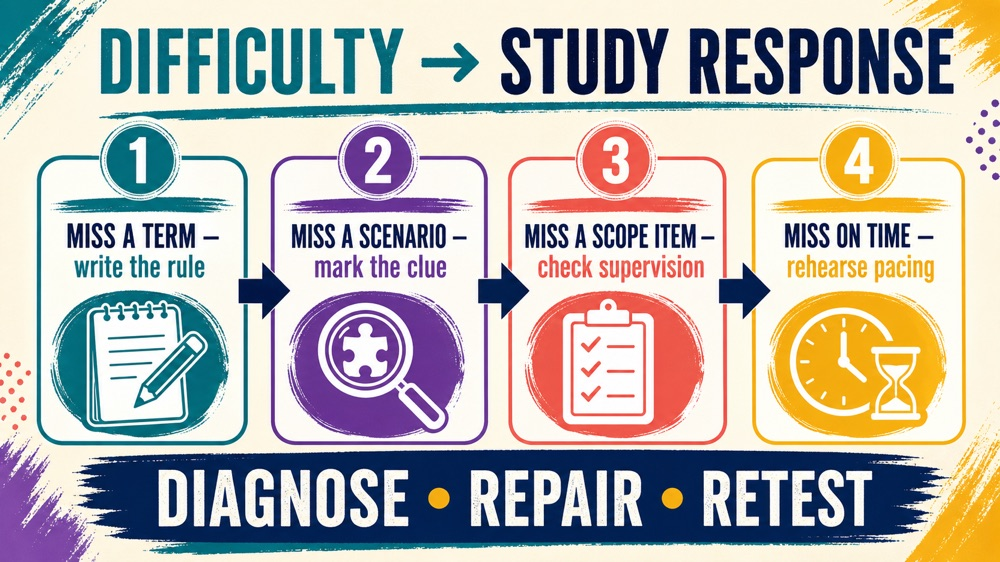
Use a four-step diagnostic plan:
- Baseline: take a mixed practice set and mark confidence before checking answers.
- Classify errors: label each miss as definition, application, distinction, scope, reading, or timing.
- Repair one category: study the source concept and write a fresh example that changes the decisive feature.
- Retest after a delay: use new items and compare transfer, not just a repeated score.
For a definition problem, create a plain-language rule. For an application problem, solve a new scenario. For a scope problem, compare the RBT action with the supervisor action. For a timing problem, rehearse a decision routine and move on when the clue is sufficient.
Common difficulty myths
- “It is only memorization.” Definitions matter, but the decisive work is applying them to a changed situation.
- “A week is always enough.” Preparation time depends on prior knowledge, training quality, practice accuracy, and available study time.
- “A high practice score guarantees the result.” Independent practice is a diagnostic signal, not an official pass decision.
- “The hardest material is always the most advanced.” A simple measurement distinction can be harder than a complex term if the clue is missed.
- “Clinical experience makes the test automatic.” Experience helps, but the current blueprint, wording, and scope boundaries still need deliberate study.
- “Two plausible answers mean the item is unfair.” Often the difference is the measurable clue, plan instruction, or technician boundary.
Bottom line: the registered behavior technician exam feels hard when study stays at the level of terms instead of decisions. Use the current TCO, practice all six domains, build contrast cards, protect role boundaries, and diagnose timing separately from content. That makes difficulty specific enough to work on.
Want to see which difficulty is slowing you down?
Use independent RBT practice questions, then classify each miss by concept, application, scope, or timing.
Try Free RBT Practice Questions →
Frequently Asked Questions
Is the registered behavior technician exam hard?
It can feel challenging when questions require applied decisions, close concept distinctions, professional judgment, and steady pacing. Difficulty varies with training and practice, so diagnose the specific gap rather than relying on a universal label.
Is the registered behavior technician exam hard for someone new to ABA?
New learners may need extra time for vocabulary, examples, and supervised-role boundaries. Use short concept sets, contrast cards, and fresh scenarios instead of trying to memorize the entire glossary at once.
Is the registered behavior technician exam hard because questions use scenarios?
Scenario wording can feel difficult when a learner knows a definition but misses the controlling clue. Underline what is observable, identify the instruction or measurement rule, and compare each option to that clue.
Is the registered behavior technician exam hard under a time limit?
It can be if you reread every option or spend too long on one item. Practice untimed explanations first, then add timed domain sets and record which item types consume attention.
Can practice scores predict whether I will pass?
Practice scores can show patterns in your preparation, but an independent score is not an official pass decision and cannot guarantee an outcome.
References
- Behavior Analyst Certification Board. RBT Test Content Outline, 3rd edition.
- Behavior Analyst Certification Board. RBT Handbook, updated June 2026.
- Behavior Analyst Certification Board. RBT Ethics Code.
- RBT exam preparation resource. Reviewed for competitor research; not an endorsement.
- RBT exam difficulty resource. Reviewed for competitor research; not an endorsement.
- RBT exam questions and difficulty resource. Reviewed for competitor research; not an endorsement.