

The phrase RBT 2027 recertification requirements can describe two related questions: what changes after the 2026 transition, and when a particular RBT’s two-year cycle actually ends. The current BACB Handbook says RBTs recertifying after January 1, 2027 must earn 12 professional development units during each two-year cycle and submit a recertification application on or before the recertification date. This guide separates the transition from the individual deadline so you can build the right plan.
Table of Contents
- RBT 2027 recertification: the short answer
- What changes after the 2026 transition
- The 12-PDU requirement
- How the two-year recertification cycle works
- What to document in your BACB account
- Common 2027 transition mistakes
- Frequently asked questions
- Official sources and scope
RBT certification maintenance, PDUs, and the 2026 transition
RBT 2027 Recertification Requirements: PDUs, Timing, and the Transition
Understand the new two-year cycle without assuming every RBT has the same 2027 deadline.
If you are searching for RBT 2027 recertification, the first thing to know is that “2027” does not automatically mean every RBT submits an application during the 2027 calendar year. The current BACB transition guidance and Handbook connect recertification to an individual’s two-year cycle. After January 1, 2027, the maintenance model centers on 12 professional development units, a recertification application, and an on-time submission.
The 2026 transition is the source of much of the confusion. Some RBTs use a 2026 recertification competency assessment, while the later cycle uses PDUs instead. This article separates the transition path, the ongoing requirement, and the account-specific date you need to verify.
RBT 2027 recertification: the short answer
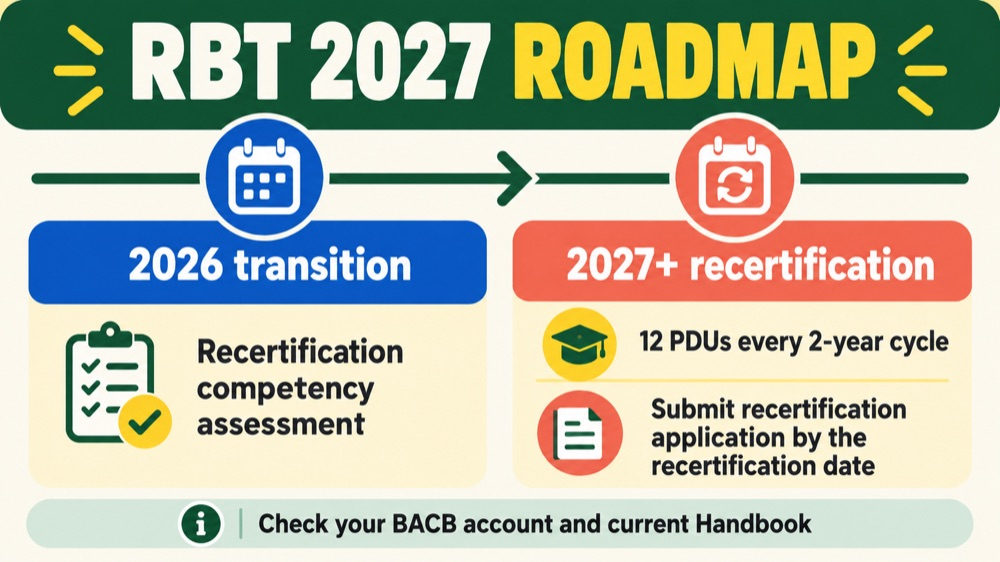
- After January 1, 2027, the current Handbook says RBTs need 12 PDUs during each two-year recertification cycle.
- The Handbook says RBTs submit a recertification application, including payment, every two years as of 2027.
- You must complete the application on or before your recertification date to avoid a lapse and late fees under the current guidance.
- Current RBTs do not all recertify in calendar year 2027; use the recertification date shown in your BACB account.
- The competency assessment used during the 2026 transition should not be assumed to apply to later PDU-based cycles.
This is a maintenance plan, not a promise that any particular PDU will be accepted. Save the correct documentation, enter it in the BACB account as instructed, and check the current Handbook when you are ready to submit.
What changes after the 2026 transition
The BACB transition guidance describes different paths across 2026, 2027, and 2028:
| Transition point | General guidance | What to verify |
|---|---|---|
| 2026 recertification | Current RBTs recertifying in 2026 use the recertification competency assessment under the transition guidance. | Your 2026 recertification date and current assessment packet. |
| 2027 calendar year | Current RBTs do not automatically need a new recertification application in 2027 solely because the calendar changed. | Your account’s cycle and recertification date. |
| 2027 and later cycles | The new maintenance model uses 12 PDUs during each two-year cycle and an on-time recertification application. | PDU entries, documents, fees, and application availability. |
| 2028 example | RBTs who became certified or recertified in 2026 generally prepare for the next cycle with 12 PDUs and no competency assessment. | The current transition guidance and your account-specific instructions. |
“Generally” matters here. An RBT who becomes certified at a different point in 2026 may see a different date from someone who recertified earlier. Treat the transition graphic as a map, then follow the account and current Handbook.
The 12-PDU requirement
The current Handbook says an RBT must earn 12 professional development units in the BACB account during each two-year recertification cycle. PDUs are intended to support continued growth, not merely repeat the same orientation or client-specific instruction.
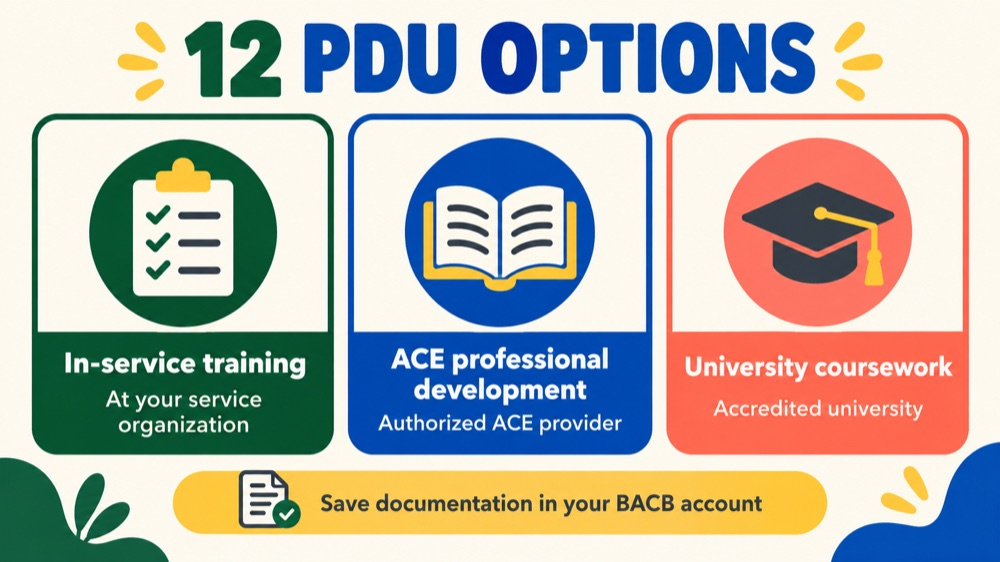
The Handbook identifies three broad PDU paths:
- In-service training: behavior-analytic service-delivery training provided through the RBT’s service organization by an eligible BCaBA, BCBA, or BCBA-D.
- Professional development events: eligible events provided by an Authorized Continuing Education provider.
- University coursework: eligible didactic behavior-analytic courses at an accredited university with the required passing grade or pass result.
Not every learning activity fits these categories. The transition materials state that ongoing RBT supervision, client-specific training, and supervised fieldwork toward BCaBA or BCBA certification do not count toward this PDU requirement. Repeating the same activity also does not provide new or expanded knowledge or skills for the purpose of the requirement.
How the two-year recertification cycle works
The cycle is anchored to your certification or recertification date, not simply January 1 through December 31. As of 2027, the current Handbook says recertification applications are available within 45 days of the recertification date and as soon as the required PDUs have been entered.
Use a rolling checklist:
- Find the date. Open your BACB account and record the recertification date.
- Divide the work. Twelve PDUs over two years is easier to manage when you schedule checkpoints instead of waiting for the final month.
- Confirm eligibility. Before attending an event or course, check the current provider and activity requirements.
- Save documentation immediately. Keep forms, certificates, syllabi, transcripts, dates, and provider information in a secure folder.
- Enter the PDUs. Upload or record them in the BACB account using the current instructions.
- Submit on time. Complete the recertification application and payment on or before the recertification date.
Do not wait until the application window appears to begin learning what counts. The application may be available only near the date, but PDU planning happens across the entire cycle.
What to document in your BACB account
Documentation depends on the PDU path. A service organization may use an RBT Professional Development form. An ACE event may use a form from the ACE provider. University coursework may require a syllabus and transcript. Save enough detail to connect the document to the activity, provider, date, and PDU entry.
| PDU path | Useful documentation to retain | Boundary to remember |
|---|---|---|
| In-service training | Organization form, provider identity, event date, topic, and PDU information. | It must relate to behavior-analytic service delivery, not only one client’s program. |
| ACE event | Provider form or certificate, event details, date, and PDU information. | Confirm the provider and event are eligible under current ACE/PDU guidance. |
| University course | Syllabus, transcript, course title, grade or pass result, and institution details. | The course must meet the current didactic behavior-analytic coursework rules. |
Keep the original documents even after entering the PDU. If an action item or audit question occurs, a clear record of what you completed is more useful than a calendar note that only says “training done.”
Common 2027 transition mistakes
- Assuming every RBT recertifies in 2027. The cycle follows your account-specific date.
- Using the 2026 assessment forever. The transition guidance separates 2026 competency assessment work from later PDU-based cycles.
- Counting supervision as a PDU automatically. Ongoing RBT supervision is not listed as a qualifying PDU path in the transition guidance.
- Repeating the same presentation. Repeated activities do not provide new or expanded knowledge or skills for this requirement.
- Waiting to enter all PDUs. Record them as you complete them and fix documentation gaps early.
- Missing the application date. The current Handbook says to submit on or before the recertification date to avoid lapses and late fees.
- Relying on an old transition graphic. Use the current Handbook, transition page, portal, and processing updates.
Frequently asked questions
Does every RBT need to recertify in 2027?
No. The current transition guidance says current RBTs do not need to recertify in 2027 solely because it is 2027. Check the recertification date in your BACB account.
How many PDUs are required after the 2026 transition?
The current Handbook says 12 PDUs during each two-year recertification cycle for RBTs recertifying after January 1, 2027.
Is a recertification competency assessment required in 2027 and later?
Do not assume it is required for later cycles. The transition guidance describes the 2026 competency assessment and the later PDU-based model. Follow the current instructions for your cycle.
When should I submit the recertification application?
The current Handbook says to complete the recertification application, including payment, on or before your recertification date. The application becomes available within 45 days of that date and after the required PDUs have been entered, according to the current guidance.
Can client-specific training count toward the 12 PDUs?
The transition guidance says client-specific training does not count toward this PDU requirement. Check the current PDU guidance before counting an activity.
Official sources and scope
This guide summarizes public BACB recertification and transition guidance for educational planning. Review the current RBT Handbook, Guidance for Meeting RBT Requirements During the 2026 Transition, RBT professional-development guidance, and application-processing updates before acting. Requirements, forms, dates, and account instructions can change. This article is not individualized certification, legal, immigration, employment, or financial advice.
Next step: Check your BACB recertification date, create a two-year PDU tracker, and save the documentation for every eligible activity as you complete it.
Ready to practice the RBT concepts you just reviewed?
Try an independent, original RBT practice resource with exam-style questions, scoring, and answer explanations.
References
- Behavior Analyst Certification Board. RBT Test Content Outline, 3rd edition.
- Behavior Analyst Certification Board. RBT Handbook.
- Behavior Analyst Certification Board. RBT Ethics Code.