
An RBT certification practice test can help you study for the Registered Behavior Technician examination, but it does not make you certified. A practice page is an independent learning resource. The BACB controls the eligibility requirements, application process, examination, and certification decisions.
Table of Contents
- What an RBT certification practice test can do
- Verify the current certification scope
- Choose an RBT certification practice test format
- Judge the explanation, not the branding
- Map certification practice to six domains
- Original certification-practice decisions
- Connect practice with training and assessment
- Use a readiness checklist without a guarantee
- Avoid certification-practice mistakes
- Frequently Asked Questions
- References
The current BACB RBT Test Content Outline, 3rd edition, describes 43 tasks across six domains. The current written-exam context includes 75 scored questions and 10 unscored pilot questions; the Handbook describes four answer options and 90 minutes. A third-party resource may use 50, 75, or 85 questions, but its count and score do not create an RBT credential.
RBT Training is not a BACB certification program and is not affiliated with or endorsed by the BACB, Pearson VUE, or the practice providers reviewed here. The examples in this guide are newly written for independent study. They are not official, recalled, leaked, or BACB-endorsed questions. No practice result, course, or study guide can guarantee certification or a passing result.
What an RBT certification practice test can do
A useful RBT certification practice test can help you:
- recognize the current six-domain vocabulary;
- apply a concept to a short scenario instead of repeating a definition;
- practice selecting the best-supported action within the RBT role;
- identify weak task patterns and pacing problems; and
- review why a distractor is wrong and transfer the rule to new wording.
It cannot approve an application, replace the required training or competency process, reveal secure examination content, or award the RBT credential. A practice score is a study signal that depends on the question quality, edition, test conditions, item freshness, and explanation accuracy.
| Practice feature | Useful question | Boundary |
|---|---|---|
| Current-edition label | Does the content map to the 3rd-edition TCO? | A label is not proof; check the source and task wording. |
| Question count | Is this a short diagnostic, scored-length set, or full simulation? | 50, 75, or 85 does not make a set official. |
| Answer explanation | Does it use the stem evidence and nearest contrast? | Confident copy is not the same as academic review. |
| Score report | Which domain or error type should I repair? | It is not an official scaled score or pass prediction. |
For example: a site can call itself a certification practice test because it offers multiple-choice questions, but the page still needs a clear disclaimer and current source trail. The word “certification” describes the learner’s goal, not the authority of the practice provider.
Verify the current certification scope
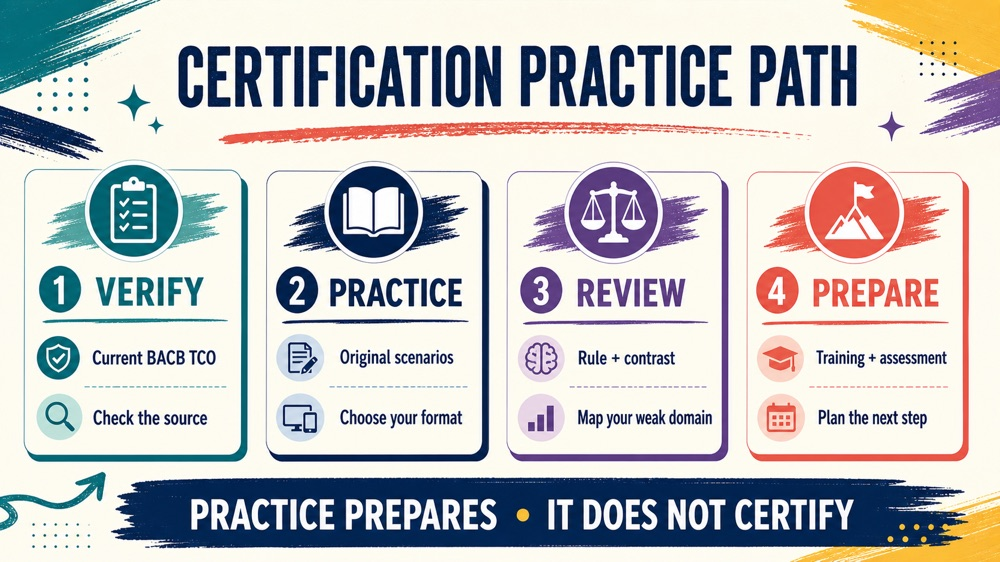
Before studying from any RBT certification practice test, verify four things against the current BACB materials:
- Edition: current examination content uses the RBT Test Content Outline, 3rd edition.
- Scope: the outline contains 43 tasks organized into six domains.
- Exam context: the current written examination includes 75 scored and 10 unscored pilot questions, four answer options, and 90 minutes.
- Process: certification depends on meeting applicable requirements, submitting an application, receiving an approved determination, and taking and passing the BACB examination.
Do not let a practice page silently turn its own course completion, badge, membership, or score into “RBT certification.” If the page uses older domain names, use them only as a crosswalk. The current TCO controls current study vocabulary.
Use the official RBT Handbook and BACB RBT examination resources for process changes. A blog or practice site may be helpful for examples, but it should not be the only authority for eligibility, application, scheduling, fees, accommodations, or certification maintenance.
Choose an RBT certification practice test format
Search results combine several formats under the same phrase. Choose based on your stage:
| Format | Best time to use it | Evidence to record |
|---|---|---|
| 10–25 question diagnostic | Early baseline or a short study window. | Domain, confidence, and first error pattern. |
| 50-question mixed test | Concept practice before full endurance work. | Decision rule and time per item. |
| 75-question scored-length set | Review the scored-item context or run a mid-preparation check. | Six-domain coverage, explanations, and transfer errors. |
| 85-question timed simulation | Later preparation and test-condition rehearsal. | Pacing, flags, fatigue, raw score, and correction quality. |
Do not take the largest set by default. A short set with a precise explanation can reveal a concept gap faster than an 85-question bank with repeated or poorly justified items. Conversely, a learner who has only studied by topic may need a full mixed simulation to discover that switching domains is the real problem.
Judge the explanation, not the branding
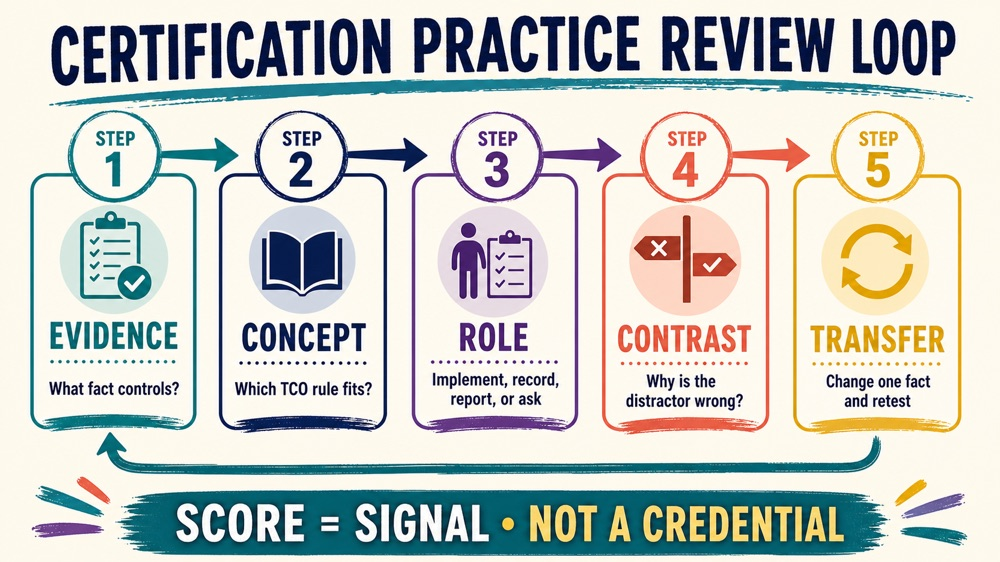
When reviewing a practice question, use a five-part explanation standard:
- Evidence: What observable fact, timeline, or instruction controls the decision?
- Concept: Which current task or technical rule fits?
- Role: What should the RBT implement, record, report, ask, or stop safely?
- Contrast: Why does the nearest distractor fail?
- Transfer: What changed fact would make a different answer correct?
Be cautious with pages that promise “real questions,” “correct final answers,” “exact Pearson questions,” or a guaranteed score. A responsible independent resource should state that its questions are original and should point readers to the current BACB sources. A practice provider’s professional design or claimed reviewer does not remove the need to check the reasoning.
Keep a correction log with the question ID, domain, task pattern, your answer, the correct rule, the nearest contrast, and a changed-fact version. Review low-confidence correct answers as well as misses. That is how a certification practice test becomes a learning tool rather than an answer-key ritual.
Map certification practice to six domains
Use the current TCO to check coverage:
| Domain | Tasks | What to look for in practice |
|---|---|---|
| A. Data Collection and Graphing | A.1–A.8 | Measurement units, data entry, graphs, observable definitions, calculations, trends, and fidelity risks. |
| B. Behavior Assessment | B.1–B.3 | Preference, skill assessment, functional assessment components, and role boundaries. |
| C. Behavior Acquisition | C.1–C.11 | Reinforcement, teaching, chaining, prompts, discrimination, generalization, maintenance, shaping, and token economies. |
| D. Behavior Reduction | D.1–D.7 | Assigned reduction procedures, antecedents, consequences, safety, and reporting when the plan is unclear. |
| E. Documentation and Reporting | E.1–E.4 | Objective notes, accurate communication, privacy, and timely escalation. |
| F. Ethics | F.1–F.10 | Competence, dignity, boundaries, supervision, cultural humility, and confidentiality. |
A good study plan does not have to spend equal time in every domain. It should, however, show whether a wrong answer came from a missing concept, a changed edition, a reading error, a role error, or a procedure-fidelity problem. The largest domain is not automatically the only domain worth reviewing.
Original certification-practice decisions
These examples are newly written for independent study. They are not official, recalled, leaked, or BACB-endorsed questions.
- Source check: A practice page calls its 75 questions “the actual certification exam.” What should you do? Treat the claim as a warning, use current official sources for exam facts, and choose original independent practice instead of secure or recalled content.
- Measurement: A question asks how long a learner stays engaged after starting a task. Which clue matters? The interval starts at engagement onset and ends when engagement stops, so duration is the relevant measurement family.
- Assessment: An answer choice asks the RBT to independently determine the function of behavior and rewrite the plan. What is the role problem? It assigns an independent clinical decision beyond the RBT’s described implementation and reporting role.
- Acquisition: The plan specifies least-to-most prompting after a defined wait. An option says to prompt immediately to save time. What is wrong? It changes the assigned prompt procedure and may change the opportunity being measured.
- Reduction: A behavior escalates and the practice stem says the safety plan has a specific response. Which answer is strongest? Follow the written safety procedure, protect the client, document observable facts, and report through supervision.
- Documentation: A note says, “The client was defiant.” What should be selected? Replace the label with observable behavior, context, program steps, data, and relevant communication.
- Ethics: A practice provider asks learners to upload identifiable session notes for “personalized scoring.” What should you consider? Protect confidentiality and use only approved, de-identified materials through the proper route.
For each item, write one changed fact and solve it again. If your answer changes, identify the rule that controlled the change. That transfer step is more informative than memorizing the first answer.
Connect practice with training and assessment
The BACB Handbook recommends preparing with the current TCO and materials gathered from 40-hour training and the Competency Assessment. A certification practice test should reinforce those foundations, not replace them.
| Resource | What it contributes | How practice should support it |
|---|---|---|
| Current TCO | Tasks and domain scope for the examination. | Tag each question to a current task or domain. |
| 40-hour training materials | Core concepts, examples, and learning activities. | Use practice errors to return to the relevant lesson. |
| Competency Assessment materials | Performance and feedback expectations for assigned procedures. | Review implementation, communication, and supervision boundaries. |
| Independent practice test | Retrieval, applied scenarios, pacing, and diagnostics. | Use explanations and changed facts; do not treat the score as certification. |
If a practice answer conflicts with the written plan or supervisor direction, do not use a generic online answer to override the client-specific procedure. Record the question, identify the conflict, and ask the responsible professional. Exam preparation and clinical authorization are related but not interchangeable.
Use a readiness checklist without a guarantee
Use this private checklist after a fresh, unassisted practice session:
- I can explain the current six-domain and 43-task scope.
- I can distinguish 75 scored, 10 unscored pilot, and third-party practice counts.
- I can explain the nearest contrast for my repeated errors.
- I can identify when an RBT should implement, record, report, ask, or stop.
- I can finish a mixed set with a pacing plan and review strategy.
- I can use official BACB materials for current application, examination, and certification information.
- I understand that RBT Training does not award the RBT certification.
Keep the date, resource, condition, score, confidence, and error map. If the score is strong only on repeated items or with open-book help, label it accurately. A readiness checklist helps choose the next study action; it does not forecast the secure examination.
Avoid certification-practice mistakes
- Confusing preparation with certification: only the BACB process determines the credential.
- Trusting “real questions” language: use original, clearly labeled study content.
- Mixing editions: use the current 3rd-edition TCO and label older terms as a crosswalk.
- Treating 75 or 85 as a magic number: understand scored, pilot, and provider-selected formats.
- Using a provider pass mark as official: treat it as a private benchmark only.
- Ignoring role boundaries: do not choose independent diagnosis, treatment selection, or plan changes when the stem calls for supervision.
- Uploading identifiable data: protect client privacy in every study system.
- Reviewing only the total score: map errors to domains, tasks, and decision rules.
Bottom line: use an RBT certification practice test to rehearse concepts, applied decisions, pacing, and correction. Verify the current BACB scope, choose original ethical material, connect errors to training and competency feedback, and keep the boundary clear: practice prepares you for the certification process; it does not issue the certification.
Ready to practice for the certification exam?
Use original RBT practice questions, review the decision rule behind every miss, and verify current certification information with the BACB.
See the Three RBT Mock Exams →
Frequently Asked Questions
What is an RBT certification practice test?
It is an independent study resource that uses practice questions to help candidates review concepts, applied scenarios, pacing, and explanations for the BACB RBT examination. It does not issue the RBT credential.
Does passing an RBT certification practice test certify me?
No. RBT Training and other independent practice providers do not award BACB certification. Certification depends on meeting the applicable BACB requirements, application process, and examination requirements.
Should an RBT certification practice test have 75 or 85 questions?
Both can be useful independent formats. The current written-exam context includes 75 scored questions and 10 unscored pilot questions, while a provider may use 75 scored-length items or 85 presented items.
Are online certification practice questions official?
No. Third-party questions are not official because they use “certification,” “Pearson,” “real,” or “3rd edition” language. Use original study content and verify current facts with the BACB TCO and Handbook.
Can a practice score guarantee that I will pass?
No. A practice score, course, study guide, or question bank cannot guarantee eligibility, certification, a passing result, or the content of a secure examination.
References
- Behavior Analyst Certification Board. RBT examination resources.
- Behavior Analyst Certification Board. RBT Test Content Outline, 3rd edition.
- Behavior Analyst Certification Board. RBT Test Content Outline, 3rd-edition PDF.
- Behavior Analyst Certification Board. RBT Handbook.
- Independent RBT certification practice resource. Reviewed for competitor research; not an endorsement.
- Independent RBT practice-exam resource. Reviewed for competitor research; not an endorsement.
- Independent 75-question practice resource. Reviewed for competitor research; not an endorsement.