
The phrase RBT recertification competency assessment after 2027 comes from the BACB’s 2026 transition. The current guidance separates the last competency-assessment-based recertification step in 2026 from later cycles built around 12 professional development units and a recertification application. This guide explains what changes, what does not change, and why your BACB account date still controls.
Table of Contents
- RBT recertification competency assessment after 2027: the short answer
- What the 2026 transition actually changed
- What replaces the later assessment step
- How to follow your individual recertification date
- What documents to keep
- Common transition mistakes
- Frequently asked questions
- Official sources and scope
RBT recertification transition, competency assessment, and PDUs
RBT Recertification Competency Assessment After 2027: What Changes
Separate the 2026 assessment path from the later two-year PDU cycle.
The phrase RBT recertification competency assessment after 2027 usually means one practical question: will an RBT still need to complete the competency assessment used during the 2026 transition? The current BACB guidance separates the paths. The 2026 recertification step uses the recertification competency assessment, while later cycles move to 12 professional development units and an on-time recertification application.
This is a transition topic, so the calendar year alone is not enough. Your BACB account shows the individual recertification date and cycle. Use the current Handbook and transition guidance to understand the structure, then use your account for the action that applies to you.
RBT recertification competency assessment after 2027: the short answer
- The competency assessment remains part of the 2026 transition path for RBTs who recertify in 2026.
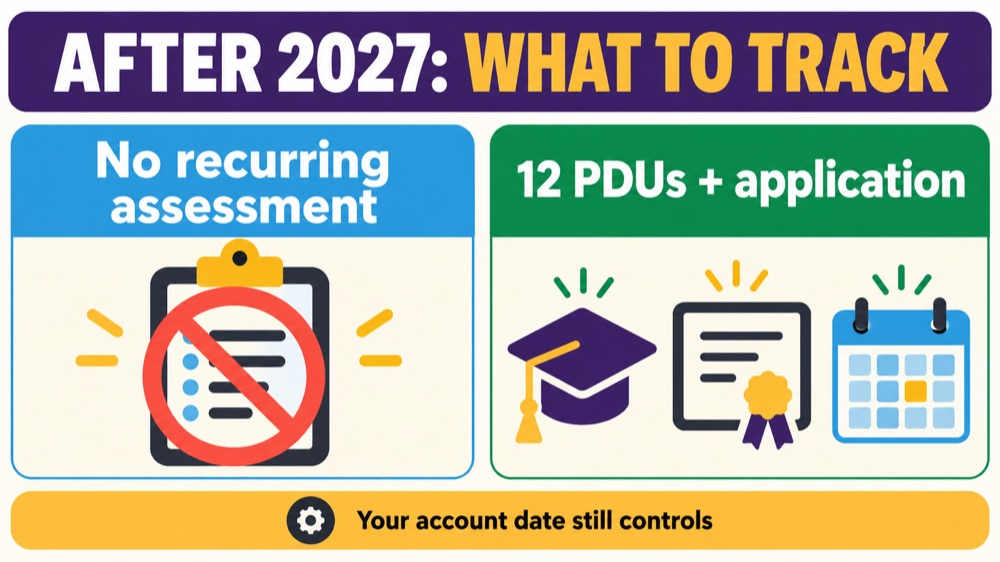
- For later cycles after January 1, 2027, the current Handbook centers on 12 PDUs during each two-year cycle and a recertification application.
- The transition guidance says no competency assessment is required for the later cycle described for RBTs who became certified or recertified in 2026.
- “After 2027” does not mean that every RBT has the same deadline; your account date controls.
- Keep the PDU documentation and complete the application, including payment, on or before the recertification date.
Do not delete old records just because the assessment is not part of the later cycle. Keep the documents that support your 2026 recertification and separately build the PDU record for the next cycle.
What the 2026 transition actually changed
Before the new two-year maintenance model, the recertification competency assessment was a recurring maintenance step. The 2026 transition is the bridge: current RBTs complete the assessment-based recertification step one last time under the transition, then begin a two-year cycle with professional development requirements.
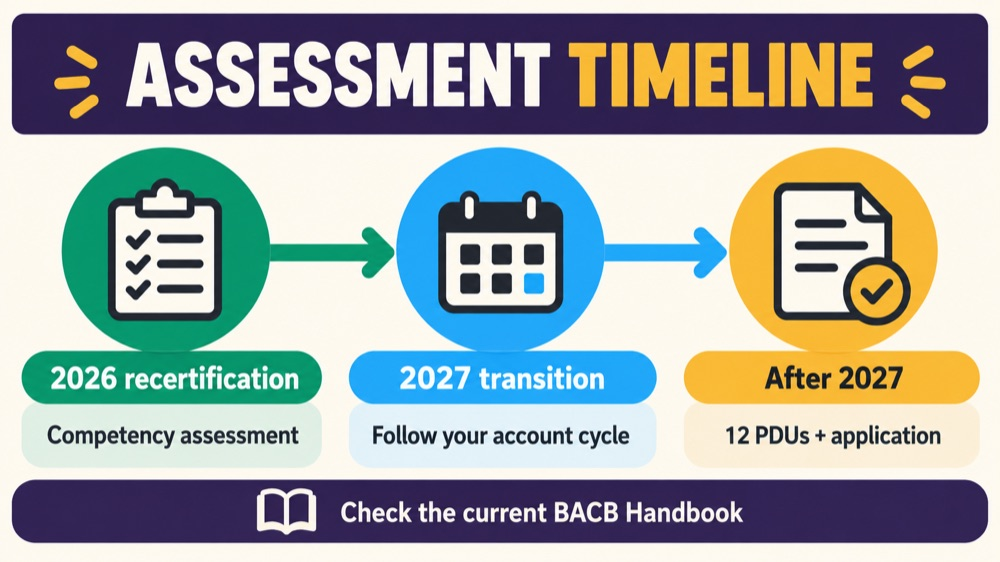
| Period | Main maintenance path | What to verify |
|---|---|---|
| 2026 recertification | Complete the current recertification competency assessment and application requirements. | Current packet, assessor, timing, signatures, and account instructions. |
| 2027 transition year | Do not assume a new application is due solely because the calendar changed. | Your individual cycle and account date. |
| Later cycles | Earn 12 PDUs during the two-year cycle and submit the recertification application. | PDU entries, documentation, payment, and deadline. |
The word “last” should be used carefully. It means the assessment-based step in the transition path described by the current BACB guidance, not a promise that no other assessment could ever apply to an unusual status or a future rule change. Always read the current Handbook if the BACB updates the policy.
What replaces the later assessment step
The later cycle is not “nothing is required.” The assessment step is replaced by a maintenance package:
- Earn 12 PDUs. The current Handbook places them in the BACB account during each two-year recertification cycle.
- Use eligible learning paths. Current guidance identifies organization in-service training, ACE professional-development events, and eligible didactic behavior-analytic university coursework.
- Save matching records. Forms, certificates, syllabi, transcripts, dates, and provider information should support the PDU entry.
- Submit the application. The recertification application includes payment and must be completed by the individual recertification date.
Not every hour of learning is automatically a PDU. The current transition guidance says ongoing RBT supervision, client-specific training, and supervised fieldwork toward BCaBA or BCBA certification do not count toward this PDU requirement. Repeating the same activity also does not provide new or expanded knowledge or skills for the requirement.
How to follow your individual recertification date
Use your BACB account as the source for your date. Then create four reminders:
- Cycle start: record the date your two-year cycle begins.
- PDU checkpoints: review your balance throughout the cycle instead of waiting for the final month.
- Application window: check when the recertification application becomes available and whether the required PDUs have been entered.
- Due date: complete the application and payment on or before the recertification date.
The current Handbook says recertification applications are available within 45 days of the recertification date and as soon as required PDUs have been entered. Availability is not the same as completion; leave time to correct a missing document or portal action item.
What documents to keep
| Record | Why keep it | Example evidence |
|---|---|---|
| 2026 assessment | Supports the transition-year recertification step. | Completed current packet, assessor information, dates, signatures. |
| In-service PDU | Shows the organization activity and provider. | Organization form, topic, date, and PDU amount. |
| ACE PDU | Connects the event to an eligible ACE provider. | Provider form or certificate with event details. |
| University PDU | Shows the eligible course and passing result. | Syllabus, transcript, institution, and course title. |
Store records securely and use consistent file names. Keeping the assessment and PDU documents in separate folders can prevent you from uploading the wrong document to a later application.
Common transition mistakes
- Using the 2026 packet after the transition. A later cycle is not automatically an assessment submission.
- Assuming “no assessment” means “no maintenance.” The 12 PDUs and application still matter.
- Calling every 2027 calendar date a deadline. Follow the certification cycle shown in your account.
- Counting supervision or client training automatically. The current transition guidance excludes those categories from the PDU requirement.
- Repeating one activity. Repetition without new or expanded knowledge does not satisfy the stated professional-development intent.
- Waiting to upload documentation. Enter PDUs and fix missing records throughout the cycle.
- Forgetting the application payment. Completing PDUs alone does not complete recertification.
Frequently asked questions
Is the RBT recertification competency assessment required after 2027?
The current transition guidance says the later cycle described for RBTs certified or recertified in 2026 does not require a competency assessment. Instead, it uses 12 PDUs and a recertification application. Check your account and the current Handbook for your path.
Does every RBT complete the assessment in 2026?
Do not generalize beyond the current transition instructions and your account. Current RBTs recertifying in 2026 are directed to the assessment-based transition path, but individual status and dates still matter.
What replaces the assessment?
The later maintenance model uses 12 PDUs during a two-year cycle, supporting documentation, and a recertification application with payment.
Can I use my initial competency assessment for recertification?
Do not substitute an initial assessment for a recertification requirement. Initial and recertification assessments serve different purposes, and later cycles may not require either one. Follow the current document instructions.
Where can I find the exact deadline?
Check the recertification date in your BACB account and the current Handbook. A calendar-year label such as 2027 or 2028 is not enough to determine the exact date.
Official sources and scope
This guide summarizes public BACB transition and recertification guidance for educational planning. Review the current RBT Handbook, Guidance for Meeting RBT Requirements During the 2026 Transition, RBT professional-development guidance, and application-processing updates before acting. Requirements, forms, dates, and account instructions can change. This article is not individualized certification, legal, immigration, employment, or financial advice.
Next step: Check your BACB recertification date, keep your 2026 assessment record separate, and start a PDU tracker for the later cycle.
Ready to practice the RBT concepts you just reviewed?
Try an independent, original RBT practice resource with exam-style questions, scoring, and answer explanations.
References
- Behavior Analyst Certification Board. RBT Test Content Outline, 3rd edition.
- Behavior Analyst Certification Board. RBT Handbook.
- Behavior Analyst Certification Board. RBT Ethics Code.