
Registered behavior technician certification online usually means an online training route, not a button that instantly awards an RBT credential. Under current BACB requirements, the 40-hour training may use an online and/or in-person format when the program meets the required curriculum, timing, trainer, and behavioral-skills-training conditions. Completing that course is only one part of the certification pathway.
Table of Contents
- The short answer
- Online training versus online certification
- Registered behavior technician certification online: the current chain
- Audit an online 40-hour program
- Compare online delivery formats
- Connect training to the six TCO domains
- What to check before paying
- Original online-certification scenarios
- What happens after the online course
- Use a source-first study plan
- Frequently Asked Questions
- References
The RBT credential is issued by the Behavior Analyst Certification Board. An independent school, employer, university, or online provider does not issue the BACB credential simply because a learner finishes its course. The remaining steps include the initial competency assessment, application and approval, the certification examination, and ongoing supervision requirements.
The current RBT Test Content Outline, 3rd edition, organizes 43 tasks across six domains. The examination context includes 75 scored questions and 10 unscored pilot questions, with four answer options and 90 minutes. A good online course should prepare you to understand the content; it should not promise a particular score or certification outcome.
RBT Training is an independent study resource, not the BACB, a certification issuer, a training provider of record, or a clinical supervisor. The examples below are newly written and are not official, recalled, leaked, or BACB-endorsed questions. No online course, certificate, practice score, or article can guarantee certification or a passing result.
The short answer
Yes, an online format can be part of the current RBT 40-hour training route. No, finishing an online course alone does not make someone a certified Registered Behavior Technician. The useful question is not “Is the course online?” but “Does the training meet the requirements that apply when I apply, and do I understand what remains afterward?”
| What online training may provide | What it does not automatically provide |
|---|---|
| Instruction, modeling, role-play or interactive activities, quizzes, feedback, and a completion record when requirements are met. | The BACB credential, an approved certification application, a completed competency assessment, or a passing examination result. |
| Exposure to the current curriculum and practice with data, teaching, reduction, documentation, and ethics concepts. | Permission to practice independently or replace a BACB-required supervisor. |
| A certificate that can support an application when it contains the required information and the training is eligible. | A guarantee that BACB will accept a particular provider or that the learner will pass. |
For example: a webpage may say “become certified online in 40 hours.” Read that as a marketing claim until the provider clearly separates course completion from BACB certification and shows how its program meets the current requirements. A certificate is evidence of training; it is not the credential itself.
Online training versus online certification
Use precise language when comparing programs:
- Online 40-hour training: a delivery format for the required training curriculum. The current BACB outline permits an in-person and/or online structure and describes required content and behavioral-skills-training components.
- Online course certificate: a provider’s record that the learner completed its training under its stated conditions. It should identify the responsible trainer and required training information.
- RBT certification: the BACB credential obtained only after the applicable eligibility, training, competency assessment, application, approval, examination, and other requirements are satisfied.
- Active RBT status: certification maintenance also depends on ongoing requirements, including the required supervision structure. A person cannot assume that a course certificate permits unsupervised practice.
The examination is another separate step. The BACB examination information describes the RBT exam as a 90-minute, 85-question computer-based examination with 75 scored and 10 unscored questions, delivered through authorized testing arrangements. An online training portal is not the same thing as the secure certification examination.
Registered behavior technician certification online: the current chain
For a reader researching registered behavior technician certification online, this sequence prevents the most expensive misunderstanding:
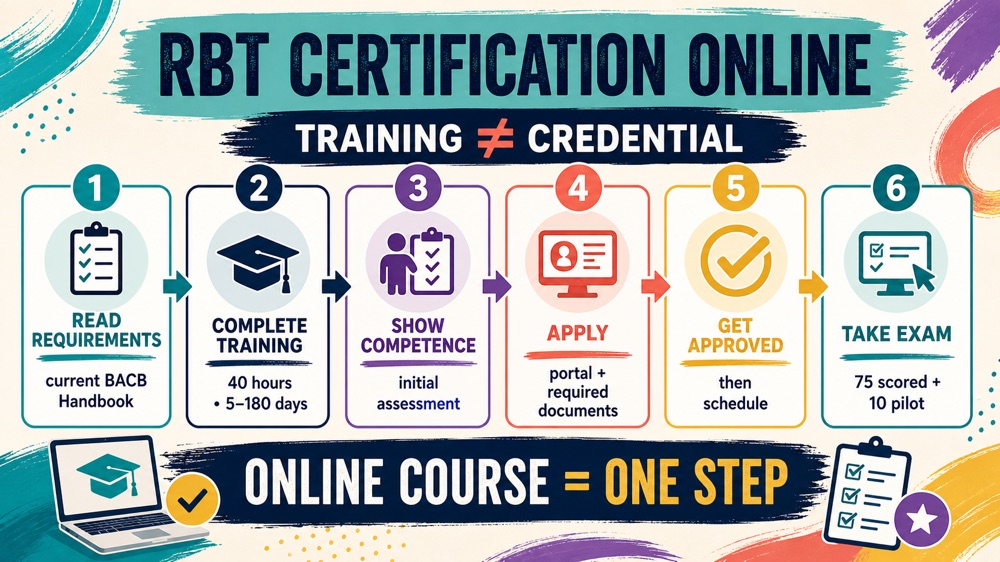
- Read current requirements: start with the RBT Handbook and current BACB RBT resources, because future application dates can use revised requirements.
- Complete eligible training: finish at least 40 hours of current curriculum training within the required calendar-day window and keep the completion documentation.
- Demonstrate initial competency: complete the current RBT Initial Competency Assessment after the required training and within the applicable application window.
- Submit the application: use the BACB portal and required attestation or supporting documents. Training providers may assist, but the BACB controls the application decision.
- Wait for approval and schedule: after an approved determination, follow BACB and Pearson VUE directions for the examination appointment and payment.
- Take the examination: prepare for the current TCO and follow testing-center rules. Practice questions are independent study material, not secure exam content.
- Maintain the credential: follow ongoing supervision, ethics, recertification, self-reporting, and status requirements that apply after certification.
Each step has its own evidence. A course completion email does not prove that the competency assessment is complete. A passed practice test does not prove that an application is approved. An application submission does not prove that the person may represent themselves as an active RBT.
Audit an online 40-hour program
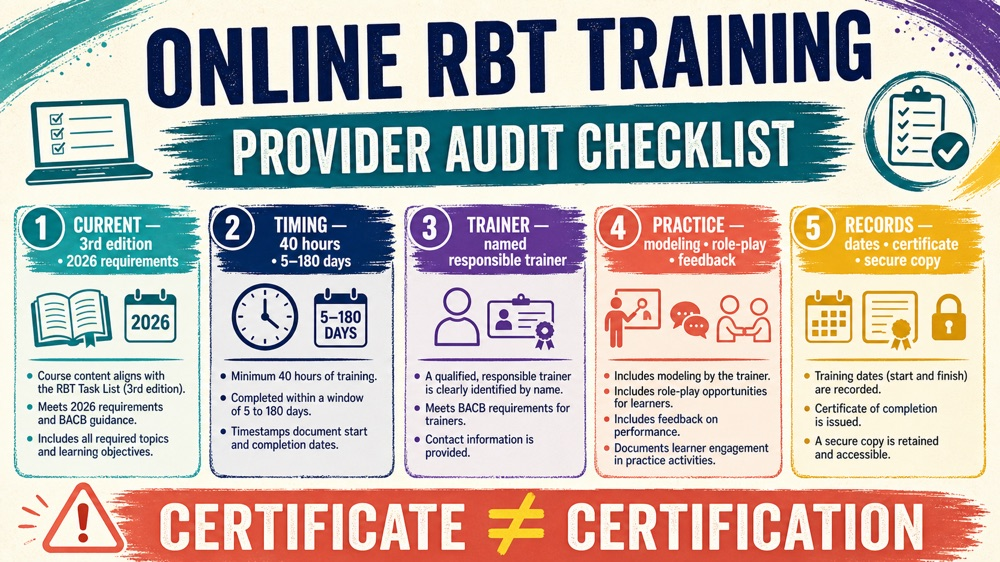
Before paying, check the program against the current BACB 2026 training outline:
| Check | Evidence to request | Red flag |
|---|---|---|
| Current version | Clear statement that the curriculum is designed for requirements in effect when you apply. | Only says “Task List 2nd edition” or “Task List 3.0” without a current source. |
| Duration | At least 40 hours, completed in no fewer than 5 days and no more than 180 days, with dates recorded. | Promises a weekend shortcut or lets reading time silently count as training. |
| Curriculum | Content covers the required behavior-technician service-delivery curriculum, not just exam vocabulary. | Only flashcards and a final quiz. |
| Behavioral skills training | Modeling, exemplars and nonexamples, role-play with feedback, interactive activities, or other qualifying components. | Video playback with no practice or feedback. |
| Responsible trainer | Named responsible trainer and evidence of the required qualification and supervision training. | Anonymous instructor or a promise that a certificate will be “automatically approved.” |
| Records | Completion certificate and provider record contain required details and can be retrieved later. | Only a payment receipt or a generic “course completed” badge. |
| Independence | Provider discloses its relationship to the BACB and any limits of its service. | Uses BACB branding or implies BACB endorsement without evidence. |
The BACB does not provide 40-hour training, completion certificates, or provider recommendations. An independent program may be excellent, but it should be evaluated against the official requirements and not selected because a page uses the word “certification” more often.
Compare online delivery formats
| Format | May fit when you need | Question to ask |
|---|---|---|
| Self-paced online | Flexible schedule and time to replay demonstrations. | How are role-play, feedback, attendance, dates, and questions documented? |
| Live online cohort | Real-time instructor discussion, modeling, and peer practice. | Are the sessions interactive and are absences made up within the allowed window? |
| Hybrid | Online instruction plus in-person role-play or assessment support. | Which parts are included in the 40 hours and who documents them? |
| Employer training | Direct connection to a workplace, materials, and a potential supervisor. | Is the trainer independent as required, and what happens if employment changes? |
| University or continuing education | Structured calendar, student support, and formal records. | Does the course explicitly meet the current BACB training requirements? |
Convenience is not the same as quality. A self-paced course may be the best option for one learner and a poor option for another if the learner needs immediate feedback on prompting, data collection, or professional communication. Choose the delivery structure that produces evidence of understanding and safe performance.
Connect training to the six TCO domains
The course should not treat online RBT certification as an abstract multiple-choice project. The current TCO connects training to six domains:
| Domain | What to see in a strong online course | Transfer question |
|---|---|---|
| A. Data Collection and Graphing | Operational definitions, measurement systems, data entry, graphs, and trend interpretation. | Can I choose a unit from a real stem? |
| B. Behavior Assessment | Preference and skill assessment support, descriptive information, and role limits. | Can I assist without claiming independent clinical authority? |
| C. Behavior Acquisition | Prompts, reinforcement, shaping, chaining, discrimination, generalization, and maintenance. | Can I follow the plan when a learner responds differently? |
| D. Behavior Reduction | Antecedents, differential reinforcement, extinction, safety, and reporting. | Can I protect the client without improvising? |
| E. Documentation and Reporting | Objective notes, data communication, privacy, and escalation. | Can another trained reader understand what happened? |
| F. Ethics | Competence, scope, supervision, dignity, boundaries, confidentiality, and integrity. | Do I know when to ask, pause, document, or report? |
A course that promises certification while teaching only definitions is incomplete as a preparation experience. The initial competency assessment and supervised service role require applied performance, not just recognition of vocabulary.
What to check before paying
Make a one-page provider comparison before enrolling:
- Copy the program’s exact current-edition statement and source link.
- Write down start and end-date rules and how the provider records the 40 hours.
- Record the responsible trainer’s name, credential, and role.
- List the behavioral-skills-training activities: modeling, practice, feedback, quizzes, and discussion.
- Ask what the certificate contains and how corrections are handled.
- Separate included services from add-ons: competency assessment, application help, exam prep, supervision, background check, or job placement.
- Read the refund, privacy, accessibility, and technical-support policies.
- Save the official BACB links and compare every major claim.
Be especially careful with phrases such as “BACB approved,” “guaranteed certification,” “guaranteed pass,” “become an RBT instantly,” or “the exam is included.” Those phrases may describe a package, not the official credentialing decision. Ask for precise evidence before paying.
Original online-certification scenarios
The following examples are newly written for this guide. They are not official, recalled, leaked, or BACB-endorsed questions.
- Course completion: A learner finishes 40 hours in three calendar days. Best review: check the current timing requirement before assuming the certificate is usable; current training must be completed over no fewer than 5 days and no more than 180 days. Nearest distractor: treat the total number of video hours as the only requirement.
- Online format: A provider says online training cannot count because it is not in person. Best review: compare the claim with the current BACB delivery rule, which allows an online and/or in-person structure when the other requirements are met.
- Training versus credential: A course email says “Congratulations, you are now an RBT.” Best action: verify whether this is only a course message, correct your understanding, and use BACB status as the credential authority. Do not represent yourself as certified based only on the email.
- Trainer evidence: A program does not name the responsible trainer. Best action: request the information before enrolling or relying on the certificate. A generic platform login is not evidence of qualified oversight.
- Assessment: A course offers a multiple-choice final but no behavioral practice or feedback. Best review: compare its components with current behavioral-skills-training requirements; a quiz alone may not demonstrate applied training quality.
- Application: A learner passes a mock exam before submitting the application. Best interpretation: use the result to guide study only. It does not establish eligibility, BACB approval, or a passing official exam.
- Active practice: A newly trained person has no qualified supervisor on record. Best action: verify current status and supervision requirements before providing or representing behavior-analytic services as an active RBT.
- Version control: A course uses a 2nd-edition outline but advertises 2026 certification. Best action: ask how the provider meets the current requirements and do not assume old materials satisfy a future application.
What happens after the online course
After training, keep the evidence and move deliberately:
- confirm the initial competency assessment requirements, responsible assessor, timing, and documentation;
- prepare the certification application and attestation in the BACB portal;
- wait for an approved determination before scheduling the certification examination;
- use the current TCO and Handbook to study, while treating third-party questions as independent and original;
- schedule and take the examination through the authorized testing route; and
- after certification, maintain supervision, ethics, records, self-reporting, and recertification requirements.
Do not throw away course records after receiving a certificate. Keep the certificate, trainer details, dates, payment records, assessment documents, and BACB correspondence in a secure location. If a provider changes its website, your own records are still important evidence.
Use a source-first study plan
- Day 1: read the current RBT Handbook and write the full certification chain in your own words.
- Day 2: audit the online training provider using the 40-hour, 5–180 day, trainer, curriculum, and interactive-component checklist.
- Day 3: study Domains A and B with measurement and assessment scenarios.
- Day 4: study Domains C and D with plan-fidelity and safety contrasts.
- Day 5: study Domains E and F with objective documentation, privacy, supervision, and ethics scenarios.
- Day 6: complete original mixed practice and log why each nearest distractor fails.
- Day 7: review the application, assessment, exam, and active-status steps; verify every changing fact from the BACB.
Bottom line: the safest answer to “Can I get registered behavior technician certification online?” is precise: you may be able to complete the required training online, but the BACB certification pathway continues beyond the course. Verify the current requirements, audit the provider, keep your records, complete the assessment and application, take the authorized examination, and maintain supervision after certification.
Ready to prepare for the RBT pathway?
Review original RBT scenarios, map your gaps to the current TCO, and choose the next study step.
Review RBT Study Materials →
Frequently Asked Questions
Can I complete registered behavior technician certification online?
You may be able to complete the required 40-hour training in an online and/or in-person format when the program meets current BACB requirements. Completing the course alone does not award the RBT credential; you still need the remaining assessment, application, approval, examination, and maintenance steps.
Does the BACB provide online RBT training?
The BACB sets requirements and issues the credential; it does not provide 40-hour training or endorse a specific provider. Evaluate independent programs against the current BACB training outline and Handbook.
How long must online RBT training take?
Current training requirements specify at least 40 hours completed in no fewer than 5 days and no more than 180 days. Confirm the rules that apply when you apply.
Is an online RBT course the same as RBT certification?
No. A course may provide eligible training and a completion record. BACB certification requires the complete pathway, including an initial competency assessment, application approval, examination, and applicable ongoing requirements.
Can online training guarantee that I will pass the RBT exam?
No. Training and practice can support preparation, but no independent provider, certificate, mock score, or online course can guarantee certification or a passing result.
What should I check before buying an online RBT course?
Check the current edition, 40-hour duration, 5–180 day window, curriculum, behavioral-skills-training components, responsible trainer, certificate details, records, fees, and the exact services included after training.
References
- Behavior Analyst Certification Board. RBT 2026 40-Hour Training Requirements and Curriculum Outline.
- Behavior Analyst Certification Board. RBT Handbook.
- Behavior Analyst Certification Board. RBT application resources.
- Behavior Analyst Certification Board. Examination Information.
- Behavior Analyst Certification Board. RBT Test Content Outline, 3rd edition.
- UTSA online RBT training information. Reviewed for competitor research; not an endorsement.
- The New ABA 40-hour training guide. Reviewed for competitor research; not an endorsement.
- RBT Hub 40-hour training explainer. Reviewed for competitor research; not an endorsement.