
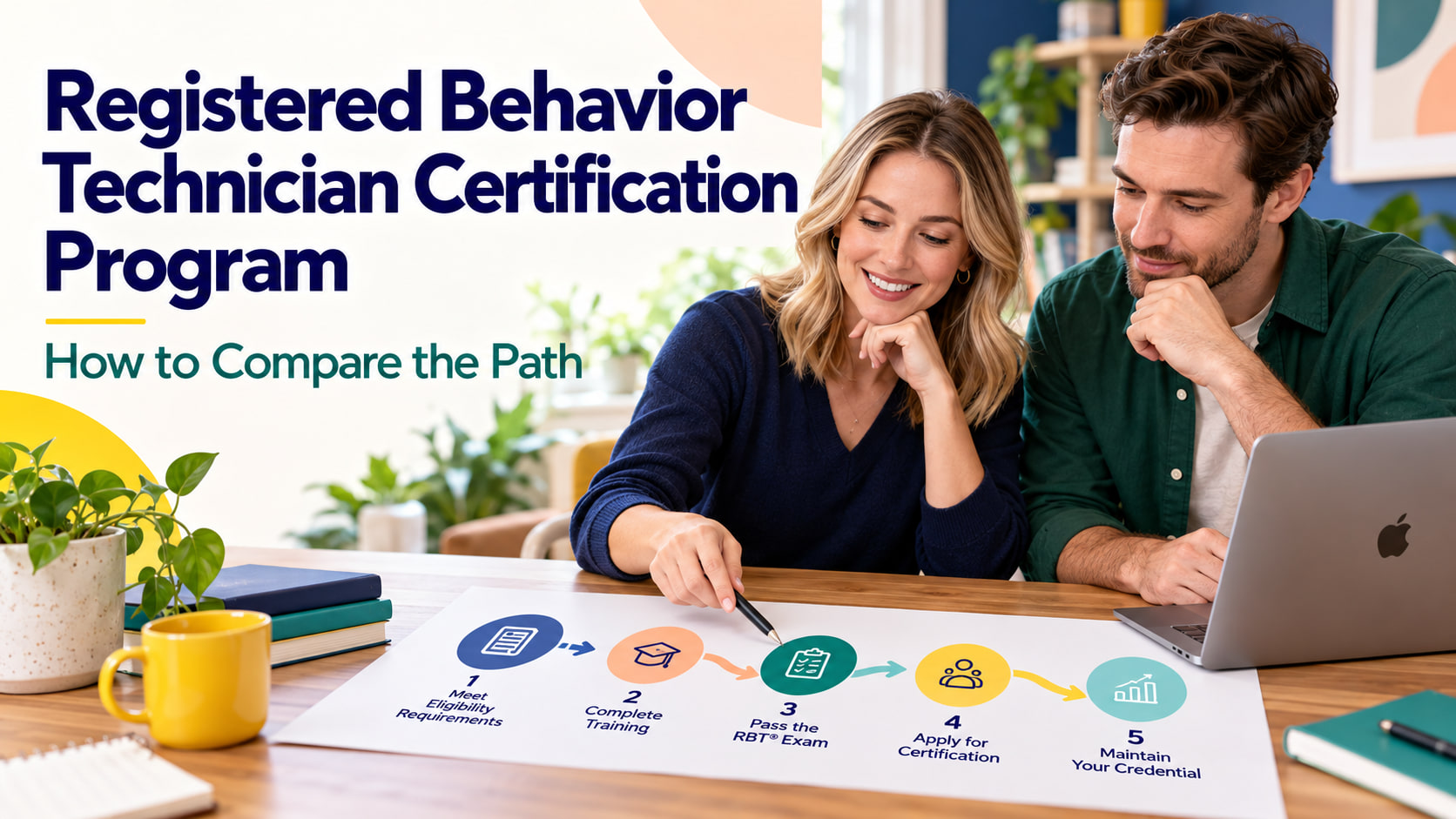
Registered behavior technician certification program can refer to a course provider, employer pathway, or bundle of services covering several credentialing steps.
Table of Contents
- What a registered behavior technician certification program may include
- Start with official requirements
- Compare training
- Check competency assessment
- Ask about supervision
- Review application and status steps
- Save evidence and compare cost
- Make a documented decision
- Frequently asked questions
- References
RBT CREDENTIALING · PROGRAM GUIDE
Registered Behavior Technician Certification Program: How to Compare the Path
Separate training, competency, supervision, application, and status verification before choosing a program.
Registered behavior technician certification program can refer to a course provider, an employer pathway, or a bundle of services that includes several credentialing steps. The label alone does not prove that training is current, that competency assessment or supervision is included, or that a credential will be approved. Compare the actual process and responsibilities.
Use the current BACB Handbook and official RBT materials for decisions about eligibility, application, supervision, examination, and status. A provider can explain its own services, but it cannot guarantee certification, examination success, employment, or a specific outcome. This article is a research guide, not individualized credentialing advice.
What a registered behavior technician certification program may include
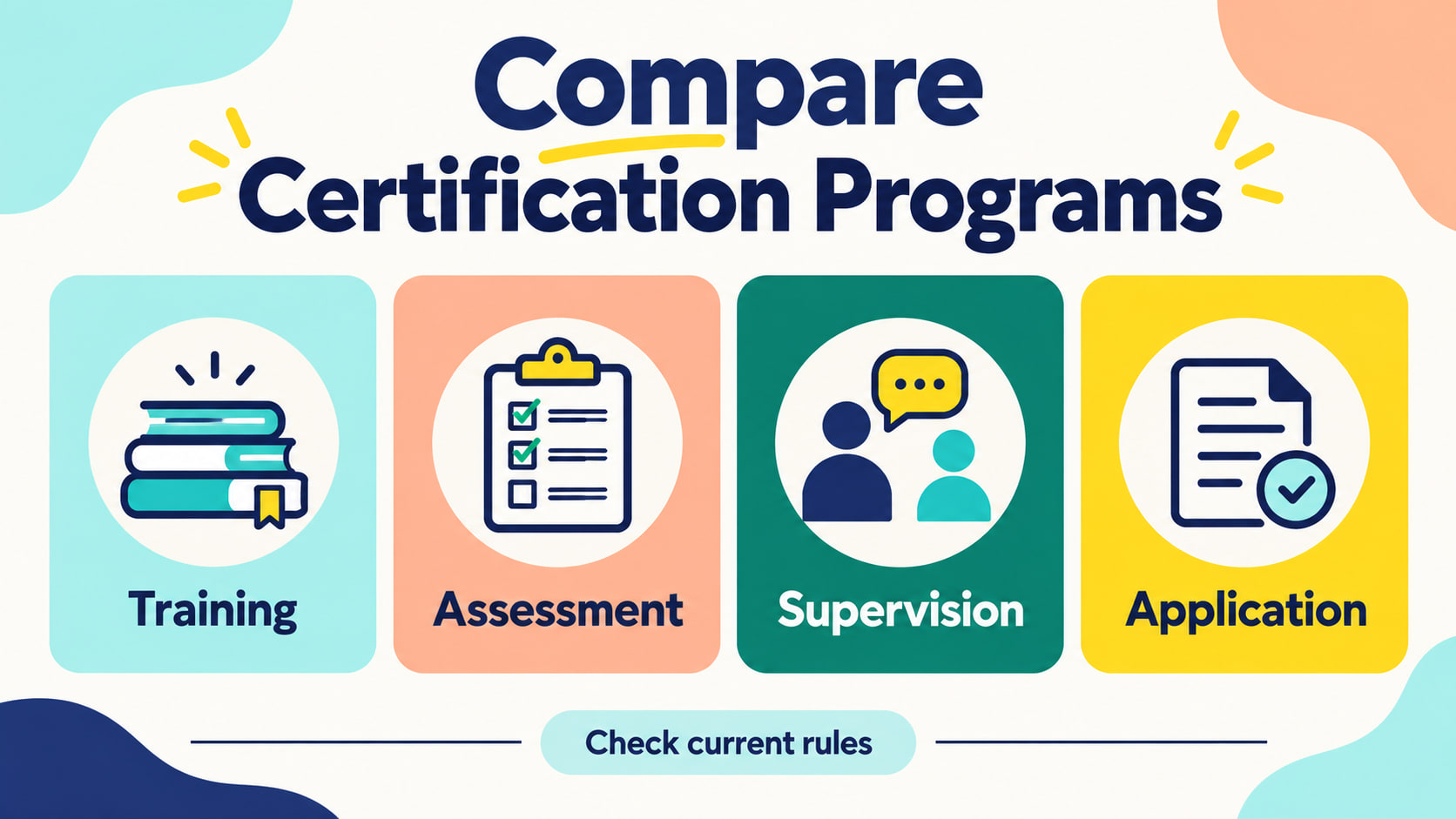
A program may provide structured instruction, practice, a completion record, competency assessment coordination, application guidance, supervision, or examination preparation. Those functions are distinct. One provider may offer only instruction while another bundles several services with different fees and policies.
List the stages you need: learning content, demonstrating competency, completing an application, receiving supervision, preparing for an examination if applicable, and verifying status. Mark who owns each stage. A certificate or sales page should not be treated as proof that every stage is complete.
Start with official requirements
Begin with current official sources rather than a provider’s summary. Check the source date, version, definitions, application instructions, supervision information, and examination details. Requirements and administrative processes can change, so an old blog post or saved checklist may no longer be sufficient.
When a provider’s claim differs from the official material, pause and record the conflict. Ask the provider to identify its source and verify the answer with the responsible official authority. Do not submit personal information or pay a fee while a material requirement remains unclear.
Compare training
Review the syllabus, objectives, topics, activities, practice, access period, instructor support, accessibility, update date, and completion record. Useful instruction connects concepts to observable work such as measurement, skill acquisition, prompting, reinforcement, behavior reduction, documentation, ethics, and professional boundaries.
Ask whether examples are original educational scenarios. Be cautious with material presented as official, recalled, leaked, or guaranteed examination content. A responsible program explains reasoning and directs administrative questions to current official sources.
Check competency assessment
Instruction and competency assessment answer different questions. Instruction covers content; assessment evaluates whether specified tasks can be demonstrated under the applicable process. Confirm who performs the assessment, what tasks are evaluated, what preparation is offered, how appointments work, and what documentation you receive.
A quiz score or course badge is not automatically a competency assessment. Ask about retakes, expiration, cancellations, accessibility, fees, and verification. If a provider says a learner is “ready,” ask which observable skills that statement describes.
Ask about supervision
Supervision is an ongoing professional relationship, not simply a video module. Ask whether the program offers supervision, refers you to a supervisor, or provides no supervision. If it is offered, request the observation, feedback, communication, cancellation, privacy, and payment arrangements in writing.
Do not assume the course instructor, employer, competency assessor, and supervisor are the same person. Training and supervision do not authorize an RBT to independently diagnose, design treatment, change a learner’s plan, or select an unapproved intervention.
Review application and status steps
Application tasks may involve forms, signatures, identity details, fees, deadlines, verification, and communications. Confirm which step the provider supports and which step remains yours. Use the current official instructions and protect identity information in approved systems.
Status verification is separate from course completion. If a program claims to help verify a credential, ask what record is checked, who can access it, and how corrections are handled. Do not treat a provider’s internal database or completion email as proof of official status.
Save evidence and compare cost
Save the current handbook link, syllabus, source date, terms, receipt, completion record, assessment instructions, supervision details, application communications, and employer requirements. Record what is included, excluded, optional, and paid separately.
Calculate total cost, including tuition, assessment, retakes, extensions, supervision, technology, books, travel, and application-related fees. Read refund, cancellation, transfer, access-expiration, privacy, and data-retention policies before paying. A high review rating is not official endorsement.
Make a documented decision
- Define the goal: Identify whether you need a course, a full credentialing pathway, employer onboarding, or status support.
- List the stages: Separate training, competency, supervision, application, examination, and verification.
- Verify sources: Compare provider claims with current official materials.
- Resolve gaps: Ask who owns each unanswered next step.
- Save evidence: Keep dated documents and written answers before paying or submitting personal information.
If your goal is employment, ask the employer which requirements it actually enforces and whether training, assessment, meetings, travel, or supervision are paid. Keep employer decisions separate from program marketing.
Ask how the provider handles uncertainty. A responsible program explains when a learner should pause, record an objective observation, and ask a supervisor or official authority. It also explains accessibility, privacy, technical problems, errors, and correction procedures. These details often reveal more than a broad “career ready” promise.
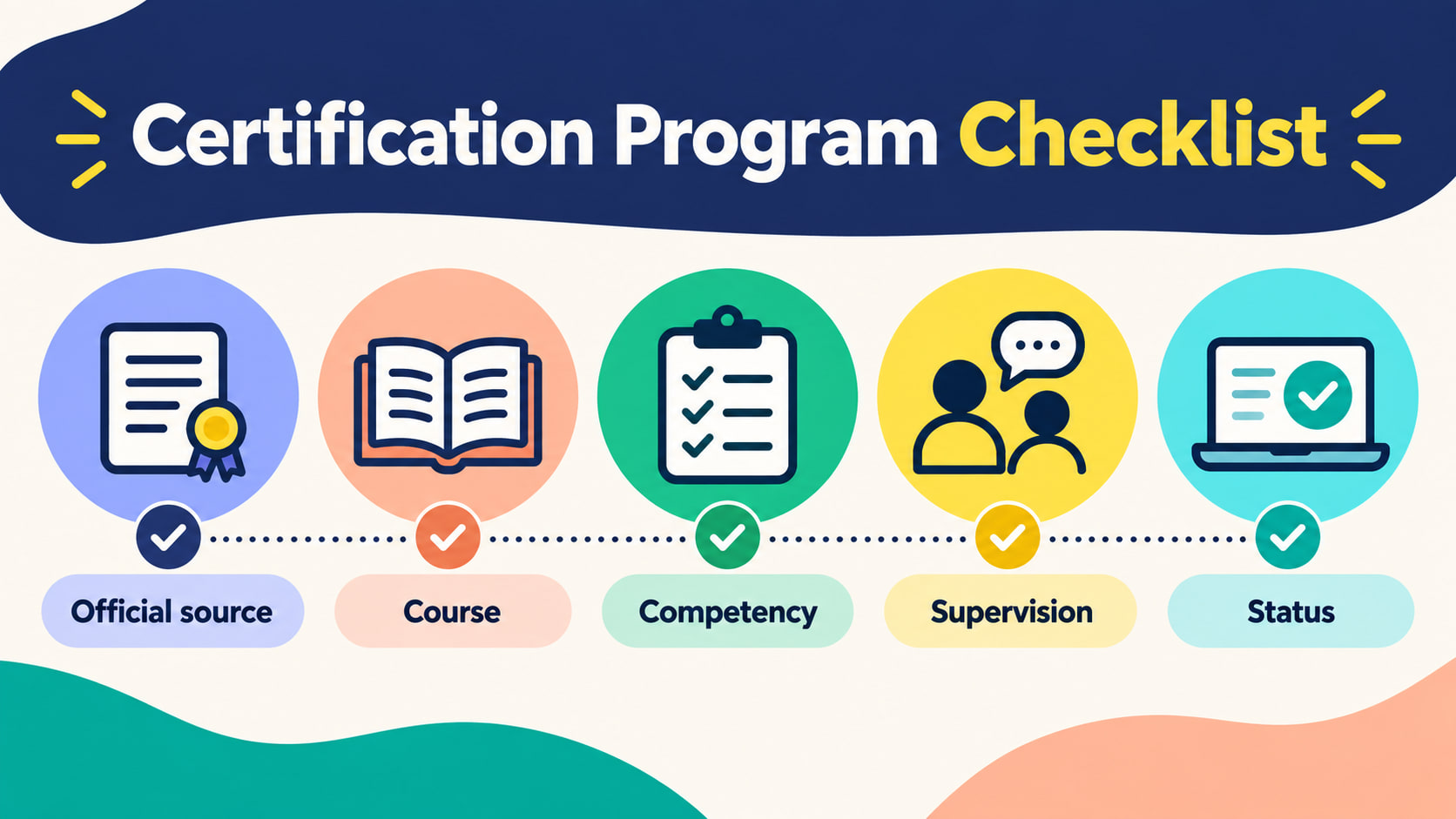
Keep a comparison sheet with one row per program and columns for source date, training, practice, assessment, supervision, status support, total cost, and policy. Mark each answer as confirmed, unclear, or not included. Save written answers and revisit them before payment or submission of identity information.
Recheck the path if your role, location, service setting, or employer changes. The same training history may be relevant but not sufficient for every situation. Record the date and source for each answer so changes are visible.
Also separate a provider’s internal progress marker from official status. A dashboard may show that lessons were completed, while an official registry or approval process answers a different question. Ask which record is authoritative before describing yourself as credentialed.
If a program includes several services, read the contract for cancellation, transfer, and access-expiration rules. Know whether assessment or supervision fees continue when a course is paused. Written details make it easier to compare programs fairly.
Before enrolling, write down the exact next step, its owner, its deadline, and the document that proves completion. This four-part check prevents an attractive bundle from hiding a missing requirement today.
Frequently asked questions
Does every certification program include supervision?
No. Ask whether supervision is included, referred, or not provided, and request the arrangement in writing.
Does completing a program create an RBT credential?
Not automatically. Training, competency assessment, supervision, application, examination, and approval can be separate steps.
How do I compare programs?
Compare current sources, curriculum, practice, assessment, supervision, status steps, accessibility, total cost, and policies. Do not rely on a guarantee or rating alone.
Can a provider guarantee certification?
Be cautious. A provider can describe its services but cannot control every official decision, examination result, or employer decision.
Source note: Review the current BACB Handbook, RBT materials, employer requirements, applicable local rules, and supervisor direction for your situation. This article is educational and does not provide individualized legal, clinical, employment, or credentialing advice.
Ready to practice the RBT concepts you just reviewed?
Try an independent, original RBT practice resource with exam-style questions, scoring, and answer explanations.
References
- Behavior Analyst Certification Board. RBT Test Content Outline, 3rd edition.
- Behavior Analyst Certification Board. RBT Handbook.
- Behavior Analyst Certification Board. RBT Ethics Code.