

A registered behavior technician exam study guide should do more than collect definitions. It should tell you which source controls the current exam, how the six domains fit together, which close concepts need deliberate comparison, and what to do after a practice error. A long PDF can still be a weak guide if it uses an old edition, hides its source, or asks you to memorize labels without applying them to a scenario.
Table of Contents
- What a current study guide should do
- Start with the official source hierarchy
- Map the six current RBT exam domains
- Build your registered behavior technician exam study guide routine
- Domain A: data collection and graphing
- Domain B: behavior assessment
- Domain C: behavior acquisition
- Domain D: behavior reduction
- Domain E: documentation and reporting
- Domain F: ethics
- Repair the confusions that cost points
- Use a four-stage study plan
- Move from study guide to practice test
- Audit a guide before you trust it
- Common study-guide mistakes
- Frequently Asked Questions
- References
This guide starts with the current RBT Test Content Outline, 3rd edition. The official outline describes 43 tasks organized into six domains. It also states the examination context of 75 scored questions and 10 unscored pilot questions. The article uses those facts as the scope anchor, then adds an independent study sequence, concept checks, and original examples.
RBT Training is an independent educational resource. It is not affiliated with, operated by, or endorsed by the Behavior Analyst Certification Board (BACB). Use the current BACB Handbook, RBT examination hub, TCO, and Ethics Code for official requirements and process details. No study guide, practice score, or calendar can guarantee a passing result.
What a current study guide should do
A useful registered behavior technician exam study guide answers five questions before it asks you to take a quiz:
| Question | What a strong guide provides | Warning sign |
|---|---|---|
| What source is current? | Edition, date, official link, and a clear separation between BACB requirements and independent teaching. | “Updated” appears without an edition or source note. |
| What is in scope? | The current six-domain map, 43-task boundary, and official question-context facts. | Old labels or weights are presented as current without a crosswalk. |
| How is a concept applied? | Observable clues, short scenarios, contrasts, and role-safe actions. | Definitions are listed but never used in a decision. |
| How do I repair an error? | A correction method that names the rule, distractor, confidence, and next retest. | The only feedback is a score or answer letter. |
| When am I ready for longer practice? | Evidence from source coverage, domain performance, transfer, and pacing. | A fixed score or number of weeks is presented as a guarantee. |
Use the guide as a map, not as a substitute for training, the initial competency assessment, supervision, or current certification instructions. The exam tests knowledge and application; a study guide cannot certify practical competence or complete an administrative requirement.
Start with the official source hierarchy
When pages disagree, do not average the claims. Put them in a source hierarchy:
- Current BACB TCO: use the RBT Test Content Outline, 3rd edition, for examinable scope, task names, domains, and the 75-scored/10-unscored pilot-question context.
- Current BACB Handbook and RBT hub: use them for eligibility, application, examination navigation, accommodation, supervision, and maintenance instructions.
- Current RBT Ethics Code: use it for professional conduct, client dignity, confidentiality, competence, supervision, and boundary decisions.
- Independent study material: use it to explain concepts, provide original scenarios, and structure review. Treat its claims about timing, readiness, or “real” questions as provider claims unless the official source supports them.
This order matters because search results often blend old and current information. A study page may still use Measurement, Skill Acquisition, or Professional Conduct and Scope of Practice. Those labels can help you find older notes, but the current TCO controls the current edition. A competitor’s “32% Skill Acquisition” table, for example, should not override the current TCO’s domain distribution.
Map the six current RBT exam domains
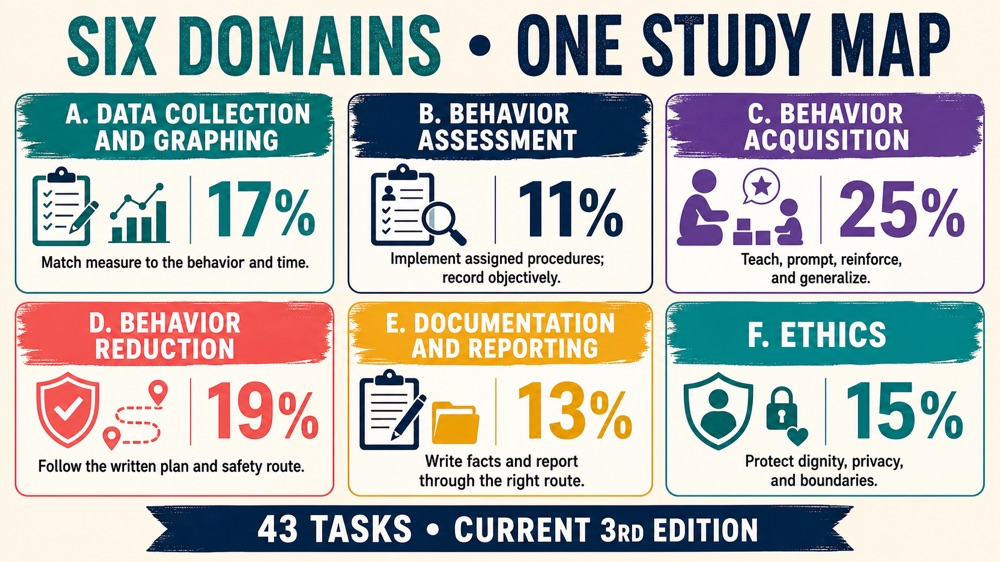
The current outline describes six domains and 43 tasks. Use the table as a prioritization map, not as a prediction of the exact order or wording of individual items:
| Domain | Questions / share | Core study decision |
|---|---|---|
| A. Data Collection and Graphing | 13 / 17% | Match the behavior and time condition to a measurement, data entry, calculation, or graphing procedure. |
| B. Behavior Assessment | 8 / 11% | Implement an assigned assessment accurately and distinguish observation from independent interpretation. |
| C. Behavior Acquisition | 19 / 25% | Follow teaching, prompting, reinforcement, chaining, shaping, maintenance, and generalization procedures in the plan. |
| D. Behavior Reduction | 14 / 19% | Apply authorized antecedent, differential-reinforcement, extinction, safety, and reporting procedures. |
| E. Documentation and Reporting | 10 / 13% | Write objective records, protect information, preserve data integrity, and communicate through the right route. |
| F. Ethics | 11 / 15% | Choose actions that protect dignity, privacy, competence, supervision, boundaries, and integrity. |
The distribution helps you avoid a common study error: spending all your time on favorite acquisition terms while never practicing data integrity, documentation, or ethics scenarios. It also prevents the opposite error of treating the smallest domain as a memorized glossary. Every domain requires a decision rule and a role-safe application.
Build your registered behavior technician exam study guide routine
Use a repeatable routine for each domain. The order below keeps learning, application, and correction separate:
- Preview: read the current domain name and task range, then list the terms you already confuse.
- Define: write each term in plain language and add the observable feature that separates it from its nearest neighbor.
- Apply: solve two or three original scenarios without looking at the explanation.
- Correct: record the controlling clue, your answer, nearest distractor, confidence, and source.
- Transfer: solve a new scenario with the setting, time unit, behavior, prompt condition, or professional relationship changed.
- Mix: return to a mixed-domain set so you practice switching decisions rather than staying inside one vocabulary category.
Do not make the calendar the evidence. A four-week or eight-week plan may be a helpful container, but the next study action should come from your errors and coverage. If you have not completed required training or competency steps, use the current BACB requirements rather than assuming a study calendar replaces them.
Domain A: data collection and graphing
Domain A asks you to connect the target and time condition to a data procedure. Make a contrast sheet for continuous measures such as frequency, rate, duration, latency, and interresponse time, and for discontinuous procedures such as partial-interval, whole-interval, and momentary time sampling. Add permanent-product recording, data entry, graph updates, and observable descriptions.
Example: If a supervisor asks for responses per minute, the time unit controls the answer: calculate rate, not just count. If the stem asks how long the response lasted, you need duration information. If it asks how long after the instruction the response began, you need latency. The same target behavior can be described with different measures, so do not select a measure from the behavior name alone.
Study check: Can you explain what each measure counts, what information it needs, and what it cannot tell you? Can you describe a behavior without “angry,” “lazy,” or “noncompliant” unless those terms have been operationally defined? Can you identify an entry or graphing error without changing the underlying observation?
Domain B: behavior assessment
Domain B requires a clear distinction between implementing an assigned procedure and independently interpreting or redesigning it. Review single-stimulus, paired-stimulus, multiple-stimulus, and free-operant preference-assessment formats as applicable to your training materials. Also review objective ABC recording, skill-assessment support, and the RBT’s supervised role in assessment activities.
Example: If a plan says to present a paired array and record the selected item, the RBT should follow that procedure and report the result. A selected item may be a preference indicator in that assessment; it is not automatically a reinforcer for every response and it does not, by itself, establish a behavioral function. A study guide should make that boundary visible instead of using “preferred” and “reinforcing” as interchangeable words.
Study check: For each assessment format, write the presentation rule, the response to record, and the conclusion you are not authorized to draw from the result alone.
Domain C: behavior acquisition
Domain C is the largest current domain by the official planning share. Build a concept map rather than a list: instruction and motivation, prompting and fading, reinforcement, discrete-trial and naturalistic teaching, task analysis and chaining, shaping, discrimination, generalization, maintenance, and token economies. Keep the learner response, teaching condition, programmed consequence, and data point visible in every example.
Example: If the written plan specifies least-to-most prompting and the learner responds independently within the wait time, the RBT should follow the programmed consequence and record the independent response. Adding a prompt “to be safe” can obscure the learner’s actual level of independence. Rewriting the hierarchy during the session is a supervision and plan-fidelity question, not a shortcut.
Study check: Can you distinguish acquisition from maintenance, a prompt from a consequence, shaping from changing the task goal, and generalization from simply repeating the same trial? Write one changed scenario for each distinction.
Domain D: behavior reduction
Domain D is easiest to study when you keep plan fidelity and safety at the center. Review antecedent strategies, differential reinforcement, extinction as written, crisis and emergency procedures, and communication after an incident. Do not turn a concept review into permission to design a treatment plan from a single scenario.
Example: If an RBT sees a target behavior and the written plan includes an antecedent strategy, response procedure, and safety step, the correct study action is to follow the plan, document what occurred, and use the approved reporting route. If the RBT is unsure whether a new consequence is allowed, seek supervisor direction. A procedure that worked for another learner is not automatically authorized here.
Study check: For each intervention term, identify the antecedent or consequence relation, the data you would record, the safety limit, and the question that must go to the supervisor.
Domain E: documentation and reporting
Domain E turns clinical accuracy into a record another person can use. Practice objective session notes, data integrity, incident and injury communication, confidentiality, and chain-of-command decisions. Write what happened, when, where, how often, for how long, and what procedure was implemented when those details are available. Do not invent missing details to make a note sound professional.
Example: Replace “the client was defiant during homework” with a description such as, “After the instruction to begin math, the client pushed the worksheet to the floor twice and did not begin within 30 seconds.” The revision makes the response, count, antecedent, and time condition observable. It does not claim to know the client’s motive.
Study check: Rewrite three subjective notes without adding facts. Then identify which information belongs in a routine note, which requires an incident report, and which should be escalated under the current workplace and supervision process.
Domain F: ethics
Domain F is not a final list to memorize after the “technical” material. Ethics choices appear inside measurement, teaching, documentation, and communication scenarios. Review dignity, privacy, competence, supervision, boundaries, conflicts of interest, gifts, social media, cultural humility, and integrity through the current RBT Ethics Code and official requirements.
Example: If a family member asks an RBT to post an identifiable session photo on a personal social-media account, the safe first move is not to post it or ask another RBT to post it. Protect confidentiality and follow the organization’s privacy and supervision route. A friendly request does not remove a professional boundary.
Study check: For every ethics scenario, ask: whose information is involved, what relationship exists, what competence or supervision issue is present, and which policy or supervisor should be consulted?
Repair the confusions that cost points
Most unproductive review repeats a term after an error without identifying the confusion. Build a “nearest neighbor” table:
| Confusion | Question to ask | Repair task |
|---|---|---|
| Frequency vs. rate | Does the answer need a time unit? | Rewrite one count as a rate and explain the difference. |
| Preference vs. reinforcement | What did the assessment show, and what did it not establish? | Separate selection data from future response-consequence effects. |
| Prompt vs. consequence | Did the event occur before the response or after it? | Annotate the sequence in a teaching trial. |
| Acquisition vs. maintenance | Is the skill being established or checked after learning? | Describe the change in teaching support and data decision. |
| Objective note vs. interpretation | Could another observer verify the sentence? | Replace labels with observable action, time, count, or duration. |
| Implementing vs. redesigning | Does the written plan authorize this change? | Mark the point where the RBT should seek direction. |
| Confidentiality vs. convenience | Who can see the information and why? | Choose the privacy-safe reporting or storage route. |
Use a confidence mark before feedback. A correct answer selected as a guess is not stable evidence. A wrong answer chosen with high confidence may show that two concepts have been inverted. Both deserve a changed scenario on the next retest.
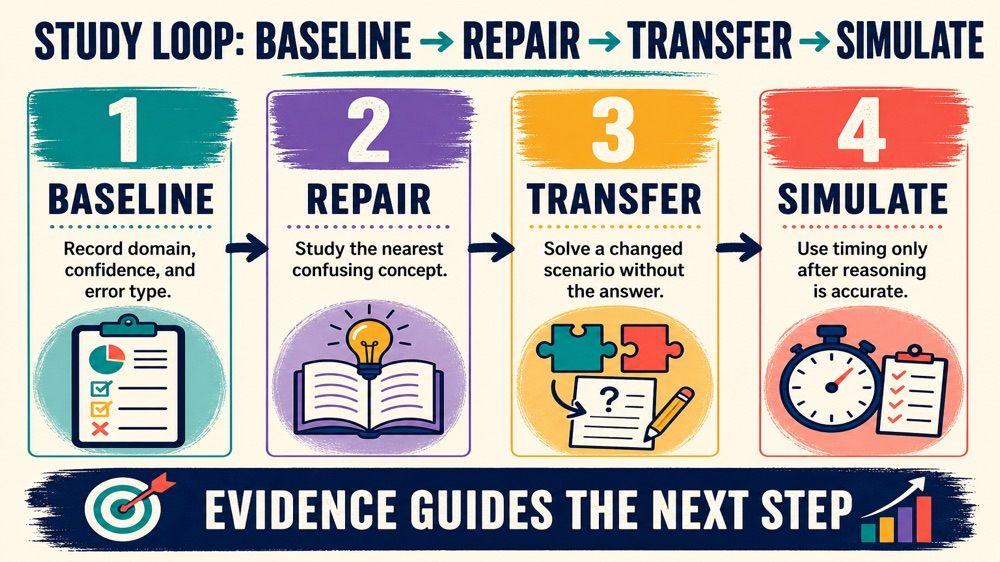
Use a four-stage study plan
A flexible plan is more honest than promising that every candidate needs the same number of days. Move through four evidence-based stages:
- Baseline: take a short mixed set or diagnostic under a stated condition. Record domain, confidence, and error type; do not treat the score as a forecast.
- Foundation: work through the official TCO map and one domain at a time. Define terms, compare close concepts, and write original examples.
- Repair and transfer: target the weakest distinctions, then solve new scenarios with changed settings, time units, prompts, or relationships. Mix domains after focused repair.
- Simulation: use a longer, timed practice format only after your untimed explanations are accurate. Review the correction log rather than repeating the same form until the score rises from memory.
If you have four weeks, you can distribute these stages across four weekly blocks. If you have eight weeks, add more transfer and retest cycles. The calendar should bend to your evidence. The BACB Handbook and current requirements determine eligibility and process; the study plan does not.
Move from study guide to practice test
A study guide teaches the “what” and “why.” Practice questions test whether you can apply that knowledge when the clue is short and the alternatives are plausible. Move formats deliberately:
| Format | Use it when | Review output |
|---|---|---|
| Concept notes | You cannot define or contrast the terms without help. | Plain-language definition plus nearest-neighbor contrast. |
| Domain quiz | You need to repair one current task group. | Clue, rule, distractor, confidence, next action. |
| Mixed practice | You can explain focused items and need to switch domains. | Domain distribution, error type, and transfer success. |
| Timed simulation | Your untimed answers are accurate and you need pacing evidence. | Timing cause, late-session accuracy, and correction quality. |
| Printable PDF | You learn by annotating or want an offline review record. | Edition, readability, answer-key, and source audit. |
Third-party pages may describe an 85-question, 90-minute simulation or publish a personal 80% benchmark. Label those as provider study conditions. The official TCO controls the 75 scored and 10 unscored pilot-question context and current domain map; a practice provider cannot convert its own timer or threshold into a guarantee.
Audit a guide before you trust it
Before you build a month of study around a guide, check:
- Edition and date: Does it name the RBT Test Content Outline, 3rd edition and indicate when it was reviewed?
- Official links: Can you reach the BACB TCO, Handbook, examination hub, and Ethics Code from the guide?
- Current map: Does it use A–F current domain names and the 43-task boundary, while labeling old names as legacy?
- Academic boundary: Does it distinguish independent examples from official, recalled, leaked, or endorsed examination content?
- Explanation quality: Does feedback identify the clue and why the nearest distractor fails?
- Data and privacy: Does the PDF or site explain access, storage, account, or personal information practices clearly?
This audit is especially important because “complete” can mean six menus rather than complete current coverage. A guide can be visually polished and still mix editions, repeat old percentages, or make a study threshold sound like a pass standard. Check the map before trusting the marketing.
Common study-guide mistakes
- Using an old map as the only map: crosswalk 2nd-edition notes to the current 3rd-edition TCO.
- Memorizing terms without conditions: write what changes the answer.
- Studying only the largest domain: use the current distribution but keep all six domains active.
- Confusing the exam with certification steps: keep training, competency assessment, application, examination, and maintenance separate.
- Repeating one practice form: use a new scenario and record transfer, not just recognition.
- Treating a third-party timer as official: verify format and process with BACB.
- Ignoring role boundaries: choose plan-based, objective, supervision-safe actions.
- Trusting “guaranteed” language: no study guide or score can guarantee the certification outcome.
Bottom line: Build your registered behavior technician exam study guide around the current BACB source hierarchy, not around the loudest search result. Map the 43 tasks and six domains, learn the high-confusion distinctions, practice original scenarios, correct errors by evidence, and use longer simulations only when they answer a pacing question. That approach is more durable than memorizing an old table or chasing a guaranteed score.
Ready to organize your review?
Compare current RBT exam-prep materials, then use your domain errors and correction log to choose the next study action.
Compare RBT Exam Prep Materials →
Frequently Asked Questions
What should a registered behavior technician exam study guide include?
It should identify the current BACB source, map the six domains and 43 tasks, explain close concepts with observable examples, and provide a correction loop for practice errors.
What is the current RBT exam outline?
The current RBT Test Content Outline, 3rd edition, describes 43 tasks organized into six domains: Data Collection and Graphing, Behavior Assessment, Behavior Acquisition, Behavior Reduction, Documentation and Reporting, and Ethics.
How many questions are on the RBT exam?
The current BACB TCO states that the examination includes 75 scored questions and 10 unscored pilot questions. Consult the current BACB examination hub and Handbook for process details.
Should I use a 2nd-edition study guide?
Use older material only as a labeled cross-reference. Compare its labels, task map, weights, and process details with the current 3rd-edition TCO before relying on it.
How long should I study?
Study time depends on your training, prior knowledge, confidence, and error pattern. Use a baseline, domain repair, transfer, and simulation cycle rather than treating a fixed number of weeks as universal.
Can a study guide guarantee a passing result?
No. A guide can organize evidence and practice, but it cannot guarantee a passing result, certification, or performance on the official examination.
References
- Behavior Analyst Certification Board. RBT Test Content Outline, 3rd edition.
- Behavior Analyst Certification Board. RBT Test Content Outline, 3rd-edition PDF.
- Behavior Analyst Certification Board. RBT Handbook.
- Behavior Analyst Certification Board. RBT examination resource hub.
- Behavior Analyst Certification Board. RBT Ethics Code (2.0).
- Independent RBT study-guide resource. Reviewed for competitor research; not an endorsement.
- Independent RBT study-plan resource. Reviewed for competitor research; not an endorsement.